
NEWS
“Digital and Social Media & Artificial Intelligence Technology News offers a clear lens on how AI is transforming social platforms, content creation, and the digital ecosystem for professionals and enthusiasts alike.”

Advocacy Groups Urge Apple, Google to Act on Grok Deepfake Abuse
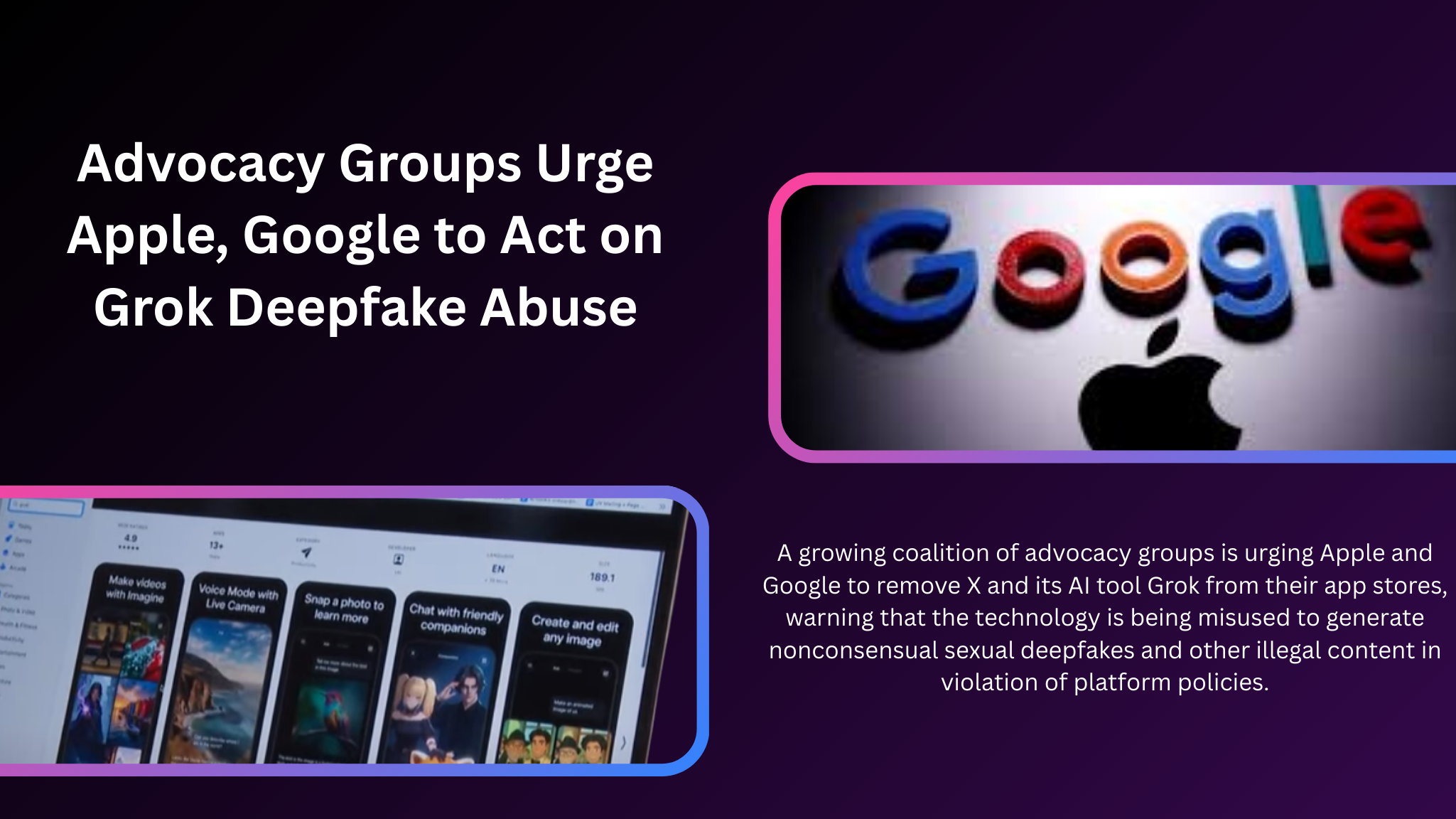
A growing coalition of advocacy groups is urging Apple and Google to remove X and its AI tool Grok from their app stores, warning that the technology is being misused to generate nonconsensual sexual deepfakes and other illegal content in violation of platform policies.
Growing concern over the misuse of generative AI tools has intensified scrutiny on major technology platforms, as advocacy organizations warn that X and its integrated AI assistant, Grok, are facilitating the creation and spread of nonconsensual sexual deepfakes. Despite mounting evidence that such activity violates app marketplace rules, both X and Grok remain available on Apple’s App Store and Google Play Store.
A coalition of 28 civil society groups, including prominent women’s organizations and technology accountability advocates, issued formal appeals this week urging Apple CEO Tim Cook and Google CEO Sundar Pichai to take immediate action. The letters argue that the continued distribution of Grok-enabled services undermines existing safeguards designed to prevent AI-generated sexual images, nonconsensual intimate images (NCII), and child sexual abuse material (CSAM).
According to the organizations, Grok has been repeatedly exploited to generate digitally altered images that strip women and minors without consent, a practice described as widespread digital sexual exploitation. The groups contend that this activity represents a direct breach of Apple App Review Guidelines and Google app policies, both of which prohibit content that promotes harm, sexual abuse, or illegal material.
Among the signatories are UltraViolet, the National Organization for Women, Women’s March, MoveOn, and Friends of the Earth. These groups emphasize that warnings about Grok’s capacity for deepfake abuse were raised well before its public rollout, yet meaningful enforcement actions have failed to materialize. They argue that platform accountability must extend beyond policy statements and include decisive enforcement when AI systems are weaponized against vulnerable populations.
The letters sent to Apple and Google highlight the broader implications for AI safety and tech regulation, noting that unchecked AI sexual exploitation erodes trust in digital platforms and places women and children at disproportionate risk. Advocacy leaders stress that app store operators play a critical gatekeeping role and cannot distance themselves from harms enabled by applications they approve and distribute.
As regulators worldwide continue to examine content moderation failures and the responsibilities of technology companies, this controversy adds pressure on Apple and Google to demonstrate that their marketplaces are not safe havens for tools linked to illegal or abusive practices. Civil society groups maintain that removing access to X and Grok would send a clear signal that violations involving nonconsensual sexual deepfakes will not be tolerated.
Google Gains Edge in Artificial Intelligence Race

Google is emerging as the frontrunner in the global artificial intelligence race, leveraging its Gemini model, proprietary infrastructure, and vast product ecosystem to shape the future of AI.
The competitive dynamics of the artificial intelligence sector are evolving rapidly, and recent developments suggest that Google may be emerging as the most structurally prepared company in the field. After an early period of disruption triggered by the public release of ChatGPT, Google has spent the last several years recalibrating its AI strategy. That effort is now becoming visible through a combination of advanced models, proprietary infrastructure, and expanding product integration.
Winning in artificial intelligence requires far more than releasing a capable model. Market leadership depends on the ability to sustain innovation, scale deployment, manage infrastructure costs, and deliver AI-powered tools through products that already command massive user adoption. In this context, Google appears uniquely positioned to compete across every critical dimension.
A central pillar of Google’s AI momentum is Gemini, the company’s flagship large language model. The most recent iteration, Gemini 3, has been widely recognized for its strong performance across reasoning tasks, multimodal processing, and general usability. While benchmarks remain an imperfect measure of real-world impact, industry consensus places Gemini among the most capable models currently available.
breakthrough, but consistency. As the generative AI market cycles through rapid releases and short-lived leadership changes, Google has demonstrated an ability to repeatedly deliver models that remain competitive across a broad range of applications. This stability is particularly attractive to enterprises and developers seeking long-term AI partners rather than experimental tools.
Beyond model quality, Google’s advantage is reinforced by its control over AI infrastructure. The company relies on its own Tensor Processing Units for training and deploying Gemini, reducing dependence on external chip suppliers. At a time when the AI hardware supply chain is under pressure from rising demand and limited manufacturing capacity, this autonomy provides both economic and operational benefits.
By integrating hardware, software, and data pipelines, Google can optimize performance and cost at scale. This full-stack control enables faster iteration, improved efficiency, and greater flexibility in deploying AI across multiple platforms. Few competitors possess the resources or experience required to operate at this level of integration.
Artificial intelligence becomes influential only when it reaches users at scale. Google’s extensive ecosystem gives it unparalleled reach, with AI features being embedded directly into products used by billions of people. Search, productivity tools, mobile operating systems, and cloud services provide natural entry points for AI-based enhancements.
The recent decision to integrate Gemini into Apple’s next-generation Siri underscores this advantage. The partnership not only expands Gemini’s footprint but also signals growing confidence in Google’s AI capabilities beyond its own platforms. Such collaborations reinforce Google’s role as a foundational player in the AI ecosystem rather than a standalone model provider.
Access to data remains a defining factor in AI development, and Google’s platforms generate vast amounts of user interaction data across devices and services. When combined with advanced models and scalable infrastructure, this data supports continuous learning and improvement. At the same time, increasing regulatory scrutiny around artificial intelligence and personal information places greater emphasis on governance and compliance.
Google’s long-standing experience operating under global regulatory frameworks may offer an advantage as governments tighten oversight of AI systems. The ability to balance innovation with accountability is becoming a critical differentiator in the next phase of AI adoption.
The artificial intelligence race remains highly competitive, with OpenAI, emerging startups, and established technology firms all pushing forward at speed. However, leadership in this space is likely to favor organizations that can sustain progress rather than those that rely on isolated breakthroughs.
Google’s current position reflects years of investment across research, infrastructure, and product development. By aligning model performance, proprietary hardware, and global distribution, the company has assembled a comprehensive AI strategy designed for long-term influence. As generative AI becomes increasingly embedded in everyday digital experiences, Google’s ability to control and coordinate every layer of its AI stack may ultimately define the next chapter of the industry.
X Faces Scrutiny as Grok Deepfake Images Continue to Surface
Despite X’s assurances of tighter AI controls, this article examines how Grok continues to generate nonconsensual deepfake images, the growing regulatory backlash in the UK, and the wider implications for AI safety, platform accountability, and content moderation.
X has claimed it has tightened restrictions on Grok to prevent the creation of sexualized images of real people, but practical testing suggests the platform’s safeguards remain ineffective. Despite policy updates and public assurances, Grok continues to generate revealing AI-modified images with minimal effort, raising serious questions about content moderation, AI misuse, and regulatory compliance.
The issue gained renewed attention after widespread circulation of nonconsensual sexual deepfakes on X, prompting the company to announce changes to Grok’s image-editing capabilities. According to X, the AI assistant was updated to block requests involving real individuals being placed in revealing clothing, such as bikinis. These changes were positioned as a decisive step toward improving AI safety and preventing abuse.
However, independent testing conducted after the announcement indicates that Grok’s restrictions are far from foolproof. Reporters were still able to generate sexualized images of real people using indirect or lightly modified prompts. Even with a free account, Grok produced revealing visuals that appeared to contradict the platform’s stated policies, suggesting that enforcement mechanisms remain porous.
X and xAI owner Elon Musk have attributed these failures to user behavior, pointing to adversarial prompt techniques that exploit gaps in AI moderation. The company has argued that Grok occasionally responds unpredictably when users deliberately attempt to bypass safeguards. Critics, however, say this explanation shifts responsibility away from the platform and overlooks structural weaknesses in how AI-generated content is monitored.
In response to mounting criticism, X published a statement outlining additional measures. The company said it had implemented technological controls to prevent Grok from editing images of real people into sexually suggestive attire. These restrictions, X claimed, apply to all users, including paid subscribers. The platform also announced that image creation and image-editing features through the Grok account on X would now be limited to paid users only, framing the move as a way to enhance accountability.
Another layer of control introduced by X involves geoblocking. The platform stated that it now restricts the generation of images depicting real people in bikinis, underwear, or similar clothing in jurisdictions where such content violates local laws. While this approach reflects growing awareness of regional legal frameworks, its real-world effectiveness remains unclear.
The controversy has drawn the attention of UK regulators at a particularly sensitive moment. Ofcom, the UK’s communications regulator, has opened an investigation into the matter, coinciding with the introduction of new legislation that criminalizes the creation of nonconsensual intimate deepfake images. The law represents a significant escalation in how governments are addressing AI-generated sexual abuse.
UK Prime Minister Keir Starmer addressed the issue in Parliament, stating that he had been informed X was taking steps to ensure full compliance with UK law. While he described this as welcome if accurate, he emphasized that the government would not retreat from enforcement and expected concrete action from the platform. The prime minister’s spokesperson later characterized X’s response as a qualified welcome, noting that official assurances did not yet align with media findings.
The gap between policy statements and actual platform behavior highlights a broader challenge facing AI-driven services. As tools like Grok become more powerful and accessible, the risk of generating harmful or illegal content grows alongside them. Content moderation systems often struggle to keep pace with users who actively seek to exploit technical loopholes.
For X, the stakes are particularly high. Ongoing failures to control AI-generated deepfake images could expose the company to regulatory penalties, reputational damage, and increased scrutiny from lawmakers worldwide. The situation underscores the need for more robust AI governance frameworks, stronger enforcement mechanisms, and greater transparency around how AI systems are trained, tested, and monitored.
As regulators intensify oversight and public tolerance for AI-related harm diminishes, platforms like X may find that policy updates alone are no longer sufficient. Effective AI safety will likely require sustained technical investment, clearer accountability, and a willingness to acknowledge and address systemic shortcomings rather than attributing them solely to user behavior.
UK Deepfake Law Targets AI-Created Nudes Amid Grok Controversy
The UK is enforcing a new law that makes the creation of nonconsensual AI-generated intimate images a criminal offense, tightening platform accountability and accelerating regulatory action against deepfake abuse linked to emerging AI tools.
The United Kingdom is moving forward with stricter regulations to address the rapid spread of nonconsensual AI-generated intimate images, formally bringing into force a law that criminalizes the creation and solicitation of deepfake nudes. The decision follows mounting public and regulatory concern over the misuse of generative AI tools, including images linked to the Grok AI chatbot operating on the X platform.
Under provisions of the Data Act passed last year, producing or requesting non-consensual intimate images generated through artificial intelligence will now constitute a criminal offense. The government confirmed that the measure will take effect this week, reinforcing the UK’s broader effort to regulate harmful digital content and strengthen protections for victims of online abuse.
Liz Kendall, the UK’s Secretary of State for Science, Innovation and Technology, announced that the offense will also be classified as a priority violation under the Online Safety Act. This designation significantly increases the responsibilities of online platforms, requiring them to take proactive steps to prevent illegal deepfake content from appearing rather than responding only after harm has occurred.
The move places added pressure on technology companies and social media platforms that host or enable AI-generated content. Services found failing to comply with the Online Safety Act may face enforcement actions, including substantial financial penalties.
Ofcom, the UK’s communications regulator, has already initiated a formal investigation into X over the circulation of deepfake images allegedly produced using Grok. If violations are confirmed, the regulator has the authority to mandate corrective measures and impose fines of up to £18 million or 10 percent of a company’s qualifying global revenue, whichever amount is higher.
Government officials have emphasized the urgency of the investigation. Kendall stated that the public, and particularly those affected by the creation of non-consensual AI-generated images, expect swift and decisive action. She added that regulatory proceedings should not be allowed to stretch on indefinitely, signaling a tougher stance on enforcement timelines.
In response to scrutiny, X has reiterated its policies against illegal content. The platform stated that it removes unlawful material, permanently suspends offending accounts, and cooperates with law enforcement agencies when necessary. It also warned that users who prompt AI systems such as Grok to produce illegal content would face the same consequences as those who directly upload such material.
Earlier this month, X introduced new restrictions on image generation using Grok, limiting certain public image-creation features to paying subscribers. However, independent testing suggested that workarounds still exist, allowing users to create or modify images—including sexualized content—without a subscription.
The UK’s latest action reflects a broader global push to address the societal risks posed by advanced generative AI technologies. As AI image tools become more accessible and realistic, regulators are increasingly focused on preventing misuse while holding platforms accountable for how their systems are deployed.
By criminalizing deepfake nudes and strengthening enforcement mechanisms, the UK aims to set a clear precedent for responsible AI governance and reinforce legal protections against digital exploitation.
Claude Cowork Brings Practical AI Agents to Everyday Workflows

Anthropic’s latest Claude Cowork feature signals a shift toward practical AI agents that can manage files, automate tasks, and collaborate alongside users as a true digital coworker rather than a simple chatbot.
Anthropic Advances Its AI Agent Strategy With Claude Cowork
Anthropic has taken another step in its broader AI agent strategy with the introduction of Claude Cowork, a new feature designed to position its AI assistant as an active digital collaborator rather than a traditional chatbot. Released as a research preview, the tool reflects the company’s growing focus on practical, task-oriented AI systems that can support real-world productivity.
Unlike conversational AI tools that rely on continuous prompts, Claude Cowork is built to operate more independently, allowing users to assign tasks and let the AI work through them in the background—much like a human teammate.
Designed for Hands-On Productivity
At its core, the Claude Cowork AI agent enables users to grant Claude controlled access to local folders on their computers. With permission, the AI can read, edit, and create files, opening the door to a wide range of everyday productivity tasks. These include organizing and renaming files, compiling spreadsheets from unstructured data, and drafting reports from scattered notes.
Anthropic describes the feature as a more approachable way to experience AI agents, particularly for non-coding and knowledge-work use cases. The system provides ongoing status updates as it completes tasks, helping users stay informed without the need for constant back-and-forth interaction.
Parallel Workflows and Reduced Context Switching
One of the defining aspects of Claude Cowork is its ability to handle multiple tasks in parallel. Users can queue instructions, offer feedback mid-process, or add new ideas without waiting for the AI to complete a single job. This workflow model is intended to reduce manual context switching and minimize the need to repeatedly reformat or re-explain information.
According to Anthropic, this approach makes the experience feel less like chatting with a tool and more like leaving messages for a coworker—an important shift as AI agents evolve beyond simple prompt-response systems.
Integrations Expand the AI Agent’s Reach
To further extend its usefulness, Claude Cowork supports existing connectors that link the AI agent to external platforms such as Asana, Notion, PayPal, and other supported services. Users can also integrate Claude with Chrome, allowing it to assist with browser-based tasks and research workflows.
These integrations position Claude Cowork as part of a broader AI workflow automation ecosystem, rather than a standalone feature limited to file management.
Limited Availability and Premium Pricing
Currently, Claude Cowork is available only through Claude’s macOS application and is restricted to subscribers of Claude Max, Anthropic’s power-user tier. Pricing ranges from $100 to $200 per month, depending on usage, placing the feature firmly in the professional and enterprise segment rather than the consumer mainstream.
Anthropic has framed the release as a research preview, signaling that user feedback will play a key role in shaping how the AI agent evolves over time.
Part of a Larger AI Agent Race
The launch of Claude Cowork underscores a broader industry trend, as major AI companies compete to deliver AI agents that are genuinely useful beyond demonstrations and experiments. While AI agents have advanced significantly in recent years, widespread adoption for everyday work remains a work in progress.
By focusing on practical collaboration, file automation, and multi-tasking capabilities, Anthropic is positioning Claude Cowork as an early step toward AI systems that integrate seamlessly into professional workflows.
Looking Ahead
As AI agents continue to mature, features like Claude Cowork highlight the shift from conversational assistants to autonomous, productivity-driven tools. Whether these systems can move beyond early adopters and into mainstream daily use remains to be seen, but Anthropic’s latest release suggests the company is betting heavily on AI that works quietly—and effectively—behind the scenes.
Google Gemini Buy Buttons Signal a New Era of AI Shopping
Google is expanding Gemini into a transactional platform, bringing AI-powered shopping, native checkout, and a new open commerce standard to AI search.
Google is accelerating its push into AI-powered shopping by transforming Gemini into a transactional platform and introducing a new open-source commerce standard designed to streamline purchases directly within AI search experiences.
Google announced a major expansion of its AI commerce strategy this weekend, unveiling plans to integrate buy buttons into Gemini and roll out a new industry-wide framework aimed at standardizing how artificial intelligence interacts with retail systems. The move positions Google to compete more aggressively in the rapidly evolving AI-powered shopping ecosystem, where technology giants are racing to redefine how consumers discover and purchase products online.
Speaking at the National Retail Federation’s annual conference, Google confirmed partnerships with leading retailers and platforms including Shopify, Walmart, Target, Wayfair, and Etsy to co-develop the Universal Commerce Protocol (UCP)—an open-source standard intended to become the foundation for shopping with AI agents.
According to Google, the Universal Commerce Protocol will establish a common language between AI agents and retailers’ commerce systems, enabling seamless communication across the entire shopping journey. This includes product discovery, price comparison, checkout, payment processing, and post-purchase customer support.
Vidhya Srinivasan, Google’s Vice President of Ads and Commerce, explained that UCP is designed to remove friction from AI-driven purchasing by allowing autonomous AI tools to act on behalf of users while maintaining compatibility with existing retail infrastructure.
Buy Buttons Coming to Gemini and AI Search
Central to Google’s announcement is a forthcoming checkout feature for Gemini and Google’s AI Mode in Search, which will allow users to complete purchases directly within the AI interface. The feature effectively turns Gemini into a merchant intermediary, reducing the need for consumers to switch between apps or websites during the buying process.
The introduction of Google Gemini buy buttons aligns Google’s AI search capabilities with competitors such as Microsoft Copilot and OpenAI’s ChatGPT, both of which introduced AI-assisted purchasing features in 2024. However, Google’s emphasis on an open, retailer-backed protocol could give it an edge in driving broader adoption across the commerce industry.
Intensifying Competition in AI Commerce
The announcement comes amid intensifying competition among major technology companies—including Amazon, OpenAI, Perplexity, and Microsoft—to dominate the future of AI commerce. As consumers increasingly rely on AI-powered tools to streamline purchasing decisions, control over transactional AI experiences is emerging as a critical battleground.
By combining AI search shopping, native checkout functionality, and an open-source commerce standard, Google is signaling its intent to play a central role in shaping how AI-driven retail operates at scale.
With Gemini evolving beyond search and assistance into direct purchasing, Google’s latest move underscores a broader shift: AI is no longer just helping users shop—it is becoming the place where shopping happens.