

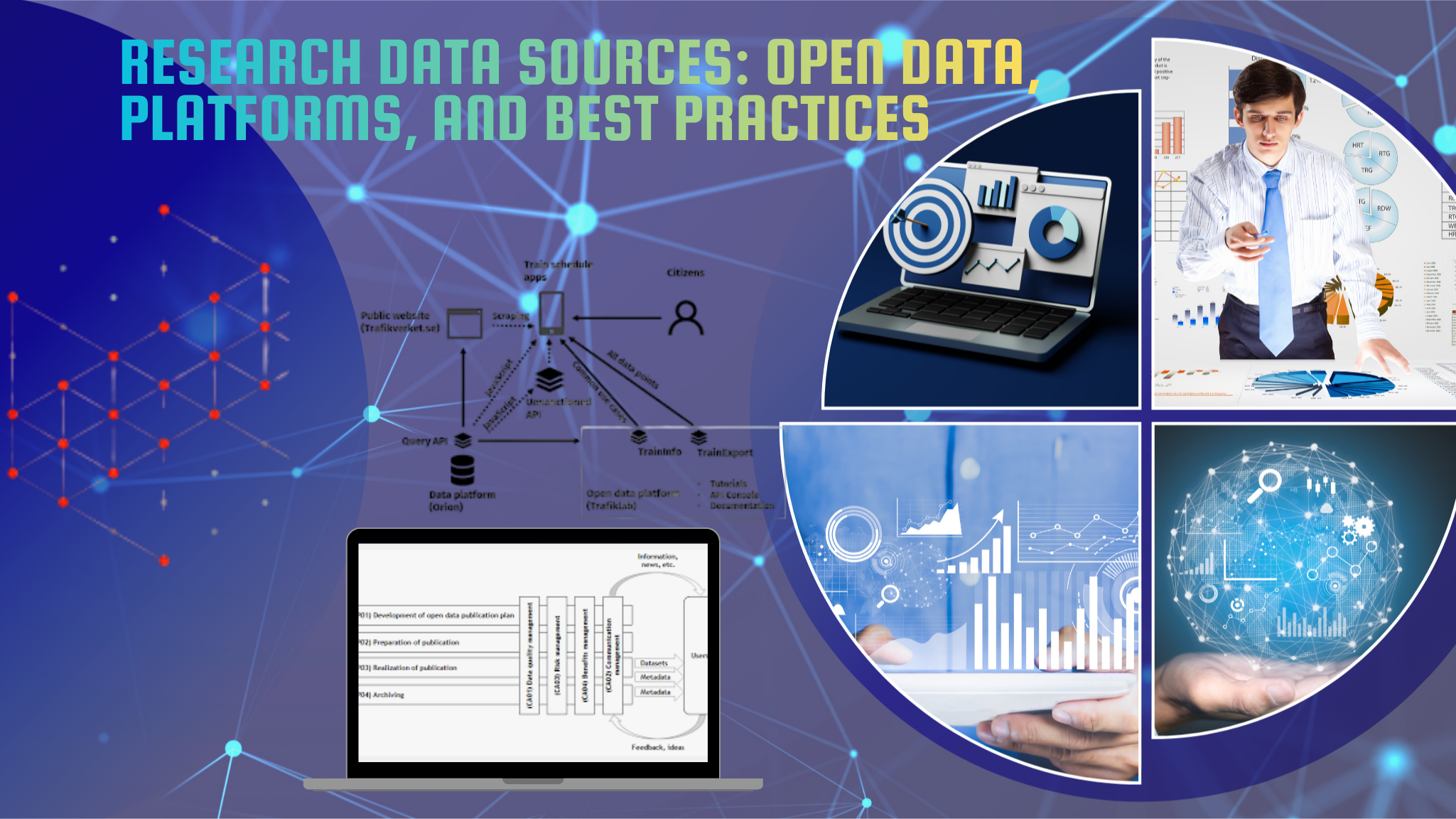
In today’s digital world, research data sources have become the foundation of innovation, academic discovery, and business intelligence. Whether you are a student, researcher, policymaker, or business professional, understanding where data comes from and how to use it effectively can significantly improve the quality of your decisions and research outcomes.
Research Data Sources The Complete Guide to Data Platforms, Datasets, and Modern Research
Data influences nearly every decision made in modern society. From scientific discoveries and business strategies to public policies and technological innovation, reliable information has become one of the most valuable resources available. Organizations around the world increasingly rely on evidence rather than assumptions, making data an essential component of progress.
As the demand for trustworthy information grows, so does the importance of understanding research data sources. Researchers, students, analysts, and professionals must know where to find quality data, how to evaluate its reliability, and which platforms offer the most suitable resources for specific needs.
Let me explain this in the clearest, simplest terms.
Research data sources are the foundation upon which meaningful analysis is built. Without reliable data, even the most sophisticated analytical methods can produce misleading conclusions. Understanding the modern data ecosystem helps individuals transform information into actionable knowledge.
What Are Research Data Sources
Research data sources are the origins from which information is collected, stored, and made available for analysis. These sources provide the raw material needed to answer questions, test theories, identify trends, and support informed decisions.
Data may originate from surveys, experiments, observations, government records, financial transactions, digital systems, satellite imagery, social platforms, and countless other channels. Every research project begins with identifying appropriate sources that align with the objectives of the study.
The credibility of any research depends heavily on the quality of the data used. Reliable sources increase confidence in findings and contribute to more accurate conclusions.
Why Are Research Data Sources More Important Than Ever
The world now generates enormous volumes of information every second. Businesses track customer behavior, governments monitor economic activity, healthcare organizations record patient outcomes, and researchers collect experimental results.
This explosion of information creates opportunities and challenges simultaneously.
On one hand, there is unprecedented access to knowledge. On the other hand, researchers must distinguish trustworthy data from unreliable information.
Organizations that effectively utilize research data sources gain significant advantages. They can identify emerging trends, improve operational efficiency, develop innovative products, and make decisions supported by evidence rather than intuition.
Understanding Different Types of Research Data Sources
Research data sources can generally be divided into several categories based on their origin and accessibility.
Primary data sources involve information collected directly by researchers. Examples include surveys, interviews, field observations, laboratory experiments, and focus groups.
Secondary data sources consist of information collected by others and made available for reuse. Government databases, published reports, academic repositories, and industry datasets fall into this category.
Structured data appears in organized formats such as spreadsheets and relational databases. Unstructured data includes documents, videos, images, audio recordings, and social media content.
Each category serves different purposes and offers unique advantages depending on the research objectives.
The Growing Importance of Research Datasets
Datasets represent organized collections of information prepared for analysis. They can range from small educational datasets containing a few hundred records to massive databases storing billions of observations.
Modern datasets support a wide variety of analytical applications. Researchers use them to identify patterns, test hypotheses, forecast outcomes, and train artificial intelligence systems.
The increasing availability of digital infrastructure has transformed datasets into valuable assets across industries. Organizations now invest heavily in creating, maintaining, and sharing data resources.
A well-designed dataset saves researchers time, improves consistency, and enables more reliable analysis.
How Public Datasets Are Transforming Research
Public datasets have significantly expanded access to information worldwide.
Previously, many valuable datasets were available only to large institutions with substantial financial resources. Today, public repositories provide access to a vast range of information at little or no cost.
Students can conduct sophisticated analyses using real-world data. Independent researchers can explore complex issues without major funding. Nonprofit organizations can evaluate social programs using publicly available evidence.
This democratization of information encourages innovation, transparency, and collaboration across disciplines.
Open Data and the Future of Information Sharing
Open data has become a major force in modern research ecosystems.
Open data refers to information that anyone can access, use, modify, and distribute with minimal restrictions. Governments, universities, nonprofit organizations, and international institutions increasingly embrace open-data initiatives.
The benefits are substantial.
Researchers gain faster access to information. Citizens become more informed. Businesses identify new opportunities. Policymakers improve transparency and accountability.
Open data also supports collaboration because multiple individuals can work with the same datasets, compare results, and build upon previous findings.
What Are Open Data Repositories
Open data repositories serve as centralized locations where datasets are stored, organized, and shared.
These repositories typically provide search tools, metadata descriptions, licensing details, and download options. They make it easier for users to discover relevant information and evaluate whether datasets meet their needs.
Many repositories focus on specific disciplines such as healthcare, economics, environmental science, or technology. Others support multidisciplinary research and contain diverse collections.
The existence of these repositories has dramatically improved access to valuable information worldwide.
Understanding Licensed Data Sources
Not all valuable data is freely available.
Licensed data sources operate under agreements that define how information can be accessed and used. These datasets often contain highly specialized, proprietary, or real-time information.
Financial markets provide a strong example. Professional investors rely on premium databases containing detailed corporate information, market intelligence, and economic indicators.
Licensed data typically offers greater depth and exclusivity than public alternatives. However, access often requires institutional subscriptions or commercial agreements.
Academic Data Resources and Their Value
Universities play a crucial role in the research data ecosystem.
Academic institutions not only generate knowledge but also provide access to extensive collections of datasets and research tools. University libraries increasingly function as data hubs that support teaching, learning, and scholarly investigation.
These institutions often negotiate access to premium resources while also promoting open-access initiatives.
Students benefit from exposure to real-world datasets that strengthen analytical skills and prepare them for professional careers.
How Research Data Platforms Simplify Discovery
Finding the right dataset can sometimes be more difficult than analyzing it.
Research data platforms solve this challenge by aggregating information from multiple sources and providing advanced search capabilities.
These platforms allow users to filter datasets by subject, geographic region, time period, methodology, and other criteria.
As data volumes continue to expand, effective discovery tools become increasingly valuable. Researchers can spend less time searching and more time generating insights.
Data Collection for Analysis and Research Quality
Despite the abundance of secondary information, original data collection remains essential.
Researchers often gather their own information when existing datasets cannot answer specific questions. Surveys, interviews, experiments, and observational studies continue to play important roles across disciplines.
Quality data collection requires careful planning and consistent methodology.
Poor collection practices can introduce errors that compromise research findings. Accurate documentation helps ensure transparency and supports future verification efforts.
Organizing Data Sources by Subject Area
Different academic and professional fields rely on specialized forms of data.
Economists analyze financial indicators and trade statistics. Healthcare researchers examine patient outcomes and public health trends. Environmental scientists study climate records and satellite observations.
Organizing research data sources by subject allows users to identify relevant repositories more efficiently.
This approach reduces complexity and improves the overall research process.
Financial and Economic Data Platforms
Financial and economic research depends heavily on high-quality datasets.
These platforms provide information about stock markets, corporate performance, economic indicators, international trade, and investment trends.
Researchers use financial data to study market behavior, evaluate economic policies, and forecast future developments.
Business leaders also rely on these resources to support strategic planning and investment decisions.
The ability to access historical and real-time information makes financial data platforms indispensable tools.
Business Intelligence and Market Research Data
Modern businesses collect and analyze vast amounts of information.
Market research datasets help organizations understand customer preferences, industry trends, competitor activity, and emerging opportunities.
Business intelligence platforms combine multiple data streams to generate actionable insights.
For example, companies may analyze consumer purchasing patterns to improve marketing strategies or optimize supply chain operations.
Data-driven organizations consistently outperform competitors that rely primarily on intuition.
Geospatial Data and Location-Based Research
Geospatial data adds geographic context to analysis.
These datasets include maps, coordinates, satellite imagery, and location-based measurements.
Urban planners use geospatial information to evaluate infrastructure projects. Environmental researchers monitor land-use changes and ecological conditions. Public health professionals identify regional patterns in disease outbreaks.
When combined with demographic and economic information, geospatial datasets reveal insights that would otherwise remain hidden.
Health and Demographic Research Data
Health and demographic information plays a critical role in policy development and scientific research.
Population statistics help governments allocate resources more effectively. Healthcare datasets support medical research and public health planning.
Demographic information provides insights into age distribution, income levels, education patterns, migration trends, and social conditions.
These datasets help decision-makers understand societal changes and respond to evolving challenges.
Computer Science Data Sources and Artificial Intelligence
Artificial intelligence and machine learning depend heavily on high-quality data.
Researchers use image collections, text corpora, network datasets, and software logs to develop and evaluate computational models.
The quality of training data directly influences algorithm performance.
As AI technologies continue to advance, demand for reliable computer science datasets continues to grow. Open repositories and academic collaborations play important roles in supporting innovation within this field.
Tool-Driven Access to Modern Research Data
Modern researchers increasingly rely on integrated platforms that combine data access with analytical capabilities.
These tools allow users to discover datasets, perform analysis, visualize findings, and share results within a single environment.
Integrated solutions improve efficiency and support reproducible research practices.
By connecting data resources with analytical workflows, these platforms reduce barriers to advanced research.
Global Trade and Development Data Resources
International research often requires access to global datasets.
Trade statistics, development indicators, economic performance metrics, and demographic records help researchers examine worldwide trends.
Governments, international organizations, and academic institutions use these resources to understand globalization, economic growth, and social development.
Global datasets enable cross-country comparisons and support evidence-based policymaking.
Community-Driven Open Data Platforms
Community-oriented platforms have transformed how researchers share knowledge.
Many platforms encourage collaboration by allowing users to upload datasets, publish analyses, and exchange ideas.
This collaborative environment accelerates learning and innovation. New researchers gain access to valuable resources while experienced professionals contribute expertise and mentorship.
Community-driven ecosystems strengthen the overall research landscape.
Why Licensing and Ethics Matter in Data Usage
Access to data comes with responsibility.
Researchers must understand licensing terms, privacy requirements, and ethical considerations before using information.
Sensitive datasets require special protections to prevent misuse and safeguard individual privacy.
Responsible data stewardship builds trust and ensures that research benefits society without causing harm.
Ethical data practices are becoming increasingly important as information grows in volume and complexity.
Building Data Literacy for Future Success
Data literacy is no longer limited to technical professions.
Students, educators, managers, policymakers, and entrepreneurs all benefit from understanding how to work with data effectively.
Data literacy involves locating information, evaluating reliability, interpreting results, and communicating insights clearly.
Organizations increasingly view these skills as essential for career success.
Individuals who develop strong data literacy capabilities are better prepared to thrive in an information-driven economy.
The Future of Research Data Sources
The research data ecosystem continues to evolve rapidly.
Advances in cloud computing, artificial intelligence, automation, and digital collaboration are expanding access to information at unprecedented rates.
Future research environments will likely become more interconnected, enabling seamless integration of diverse datasets across disciplines.
Researchers who understand how to navigate this evolving landscape will be positioned to generate deeper insights and create greater impact.
Conclusion
Research data sources have become the backbone of modern knowledge creation, innovation, and informed decision-making. From open repositories and public datasets to licensed platforms and specialized research tools, the availability of quality data continues to reshape how individuals and organizations solve problems and discover opportunities.
At worldstan.com, we believe that success in the modern research environment depends not only on accessing data but also on understanding its quality, relevance, and ethical use. As data continues to grow in scale and importance, developing strong data literacy skills and mastering the use of reliable research data sources will remain essential for students, researchers, professionals, and organizations seeking meaningful and lasting results.