

AI-Driven Predictive Threat Tracking in LEO
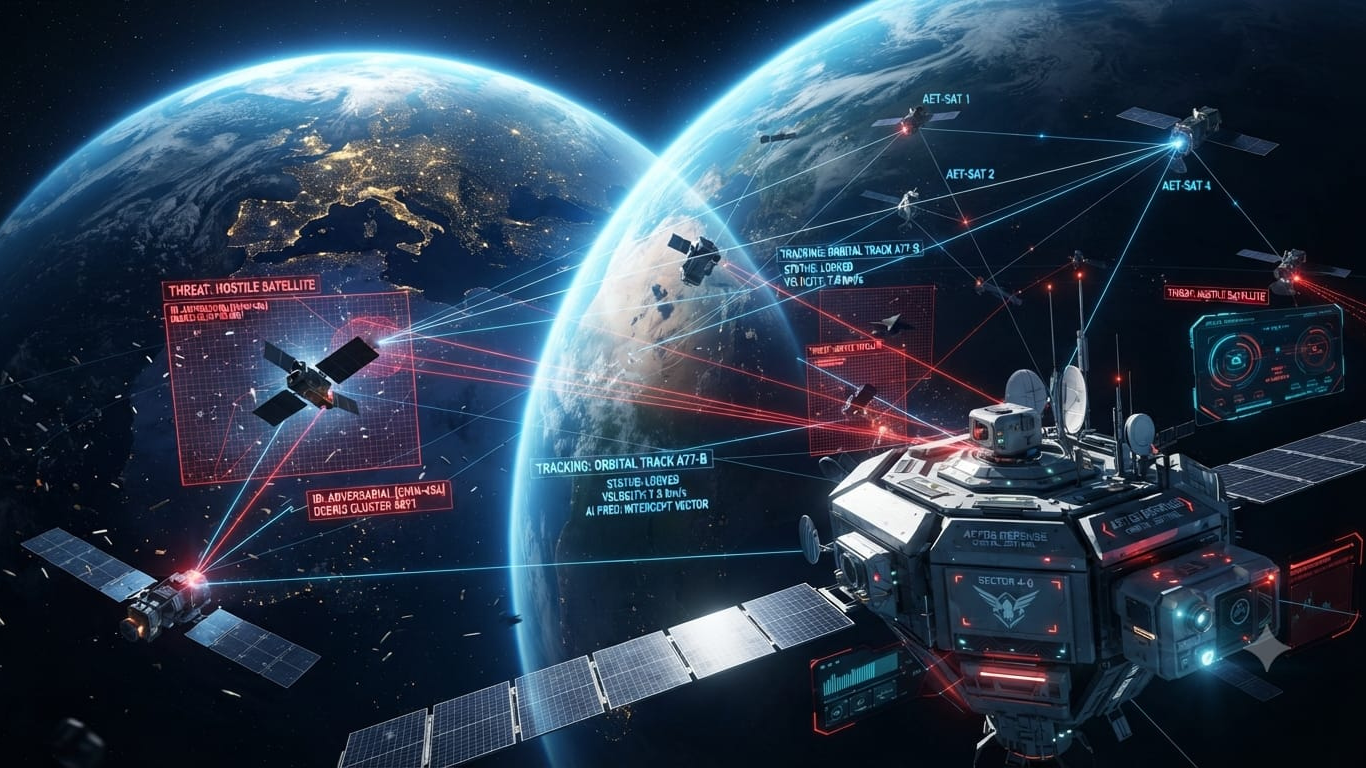
AI-driven predictive threat tracking in LEO is becoming increasingly important as more satellites, debris and maneuverable spacecraft share the same orbital environment. This article explains how AI can turn huge streams of orbital and sensor data into earlier warnings, better risk assessment and faster decisions for satellite operators.
AI-Driven Predictive Threat Tracking in LEO How AI Can Detect and Assess Emerging Space Threats
AI-driven predictive threat tracking in LEO uses machine learning, orbital data and onboard intelligence to identify unusual satellite behavior and improve space-domain awareness.
Low Earth Orbit has become one of the busiest operating environments around Earth. Commercial constellations, government satellites, scientific spacecraft, crewed missions and debris now operate in an increasingly crowded region. Every additional spacecraft adds another object that must be tracked, identified and understood.
The challenge is not simply knowing where an object is today. Modern orbital defense requires a much harder question to be answered: where will that object be in the future, how certain is that prediction, and could its behavior indicate something more than a normal orbital adjustment?
This is where AI-driven predictive threat tracking in LEO becomes important.
Traditional space surveillance depends heavily on observations from radar, optical telescopes, tracking networks and spacecraft-generated navigation information. These systems remain essential, but the quantity and speed of available data are making purely manual analysis increasingly difficult. NASA research on AI and machine learning for conjunction assessment specifically identifies the growing number of space objects and the increasing complexity of conjunction events as major challenges for traditional approaches.
AI does not replace orbital mechanics or professional space surveillance. Its more realistic role is to help analysts process information faster, identify patterns that deserve attention and estimate which events require closer examination.
That distinction matters. A satellite changing its orbit is not automatically a threat. A debris fragment drifting through LEO is not an adversary. A prediction generated by a neural network is not automatically more reliable than a physics-based calculation.
The value comes from combining these capabilities.
Why LEO Is So Difficult to Monitor
AI-driven predictive threat tracking in LEO combines orbital data, telemetry, radar and machine learning to identify abnormal movement, estimate future positions and prioritize potential orbital threats before they become critical.
Objects in LEO travel at roughly 28,000 km/h, or around 7.8 km per second. At this velocity, even a short delay in observing or processing a change can affect the predicted future position of a spacecraft.
An orbital object also does not move through a perfectly predictable environment. Atmospheric drag can gradually change its orbit, particularly at lower altitudes. Solar activity can alter atmospheric density and introduce additional uncertainty. A satellite may perform a planned maneuver, while a malfunctioning spacecraft may unexpectedly change its trajectory.
Tracking therefore involves more than collecting coordinates.
A useful tracking system must estimate position, velocity and uncertainty. NASA explains that conjunction assessment uses predicted spacecraft state and covariance, meaning information about both the estimated position and velocity and the uncertainty surrounding that estimate. For LEO missions, predicted ephemerides can be generated at one-minute intervals over future periods.
This produces a difficult computational problem.
Imagine a system monitoring thousands of objects. Each object has a predicted trajectory. Each trajectory contains uncertainty. Every new radar or optical observation can change the estimate. When a maneuver occurs, the predicted path can change again.
The system therefore has to continuously answer several related questions.
Where is the object?
How fast is it moving?
How accurately do we know its position?
What is its expected future path?
Has its behavior changed from its normal pattern?
Is the change consistent with physics, mission operations or environmental effects?
Could the change indicate an intentional maneuver?
AI can help organize these questions into a continuous analytical process.
ESA notes that space-object catalogues have detection limitations and that radar is particularly useful for observing objects in LEO. It also notes that smaller debris can remain below routine catalogue thresholds, creating an important limitation for any tracking architecture.
This means AI should not be viewed as a magic sensor. If an object is not detected or the available measurement is poor, an algorithm cannot simply invent reliable information.
The strongest systems combine better sensing with better computation.
The Physics Behind Predictive Orbital Tracking
Orbital prediction begins with physics.
A spacecraft’s trajectory is influenced primarily by Earth’s gravity, but real-world prediction requires consideration of additional forces and environmental conditions. Atmospheric drag can affect lower LEO orbits. Solar radiation pressure can influence some spacecraft. The gravitational influence of the Moon and Sun can matter over longer periods. Spacecraft propulsion introduces deliberate changes.
For an AI system, these physical relationships are extremely valuable.
Machine learning does not need to replace orbital mechanics. Instead, it can learn the patterns that appear around physical models and observations.
For example, suppose a satellite normally maintains a stable orbit and repeatedly produces similar telemetry patterns. Its orbital elements, attitude information, propulsion activity and observed position create a behavioral baseline.
If its observed movement begins to differ from that baseline, an AI model can flag the change.
The system can then compare that anomaly against environmental and operational information.
If atmospheric density has increased because of solar activity, the change may have a natural explanation.
If the spacecraft has reported a planned maneuver, the anomaly may be completely expected.
If neither explanation fits, the event could receive a higher analytical priority.
Let me explain this in the clearest, simplest terms.
AI is most useful when it acts as an intelligent filter between enormous amounts of raw information and the human experts responsible for decisions.
How Machine Learning Processes Orbital Data
A predictive tracking architecture can receive information from several different sources.
Radar provides measurements that can help estimate the position and movement of objects. Optical sensors can contribute observations, particularly when lighting and viewing geometry are suitable. Spacecraft can provide telemetry, navigation information and planned maneuver data. Public or institutional catalogues can provide additional orbital information.
The AI layer can combine these streams.
One approach is supervised learning, where models are trained using examples of known conditions. Another is unsupervised or semi-supervised anomaly detection, where the system learns what normal behavior looks like and identifies observations that deviate from that pattern.
Deep neural networks can also process sequences of measurements over time. This is particularly relevant because orbital behavior is not a collection of isolated events. A maneuver may only become meaningful when viewed against hours, days or weeks of previous movement.
NASA’s CARA research has examined several AI and machine learning approaches for conjunction assessment, including supervised learning, clustering, fuzzy inference systems, deep neural networks and Long Short-Term Memory models. The research also highlights challenges such as limited data, orbital uncertainty and the need for explainable AI.
That final point is especially important for defense applications.
A system that says “threat detected” without explaining why is difficult to trust.
A stronger system might instead report that an object’s observed orbital behavior differs significantly from its established pattern, that the deviation is inconsistent with the available maneuver information, and that the resulting trajectory creates a closer-than-normal approach to another spacecraft.
That is much more useful to an analyst.
Telemetry Adds Another Layer of Intelligence
Orbital position alone does not tell the complete story.
A spacecraft generates telemetry describing the condition and activity of its onboard systems. Depending on mission design, this can include information related to power, temperature, attitude, propulsion and other operational subsystems.
Anomaly detection models can learn relationships between these signals.
For example, an unexpected orbital change accompanied by propulsion-related telemetry is analytically different from an orbital change without corresponding propulsion evidence.
The important principle is correlation.
AI can compare multiple signals rather than treating every observation separately.
Research using the ESA OPS-SAT mission has demonstrated the importance of machine-learning approaches for automated satellite telemetry anomaly detection. The associated benchmark was developed specifically to support reproducible evaluation of anomaly-detection algorithms using real satellite telemetry.
This type of capability could become increasingly valuable as satellite constellations expand.
A human analyst cannot manually inspect every telemetry sequence from every spacecraft at every moment. An automated system can continuously search for deviations and send only the most important cases to human operators.
That changes the role of the analyst from searching through raw data to investigating meaningful events.
Autonomous Anomaly Detection in Orbital Defense
The most interesting application of AI-driven predictive threat tracking in LEO is not simply collision avoidance.
It is behavioral analysis.
A piece of debris generally follows a trajectory determined by its physical state and environmental forces. It does not make purposeful decisions.
A functioning spacecraft, by contrast, can change its orbit intentionally.
That difference creates an analytical opportunity.
An AI system can establish a behavioral profile for an object. The profile may include orbital changes, maneuver frequency, relative motion, communication patterns where available, and other measurable characteristics.
When the object behaves differently, the system generates an anomaly score.
The score should not be interpreted as proof of hostile intent.
It is an indicator that the behavior deserves additional investigation.
This distinction is essential for responsible orbital defense.
A spacecraft could perform an unexpected maneuver because of a collision warning, a software fault, fuel-management decision or mission requirement. The same physical movement could have different explanations.
AI can identify the unusual behavior, but human and physics-based analysis must establish its meaning.
Research published on deep learning approaches to satellite behavior has explored anomaly detection against orbital activity using publicly available Two-Line Element data. The study examined models including isolation forests and several autoencoder approaches and emphasized explainability by assessing changes in individual orbital elements rather than treating every observation as a single unexplained score.
That approach points toward an important future principle: anomaly detection should explain what changed, not merely announce that something changed.
Distinguishing Debris From Deliberate Orbital Movement
This is one of the hardest analytical problems in LEO.
Consider two objects approaching a protected satellite.
The first is a debris fragment whose orbit has gradually changed because of atmospheric drag and normal orbital perturbations.
The second is an operational spacecraft that has adjusted its trajectory.
Their current positions might look similar.
Their histories may not.
AI can examine the time series behind each object.
For debris, the model may observe gradual changes consistent with known physical forces. For an active satellite, the model may identify a sharper alteration in velocity or orbital elements that corresponds to a maneuver.
The distinction becomes even more useful when multiple information sources are available.
An AI model can compare:
- Previous orbital behavior
- Current position and velocity
- Predicted trajectory
- Observed deviations
- Maneuver information
- Environmental conditions
- Telemetry where available
- Proximity to other spacecraft
- Historical behavior patterns
The resulting assessment can be probabilistic rather than absolute.
For example, the system might classify an event as normal, unusual, high-priority or requiring human review.
This is more realistic than designing an AI system that attempts to label every object as friendly or hostile.
Predicting the Next Orbital State
Predictive tracking becomes powerful when it moves beyond describing the present.
Suppose a satellite is observed at position A.
A conventional tracking system can estimate its future position using orbital propagation.
An AI-enhanced system can add another layer by asking whether the observed behavior resembles previous patterns.
If an object repeatedly performs a particular type of maneuver before approaching another orbital region, the model may identify the pattern earlier during a future event.
This is behavioral prediction rather than simple position prediction.
However, predictive models must respect uncertainty.
A neural network can produce an apparently precise answer even when the underlying observations are uncertain. That creates a dangerous situation if operators treat model output as absolute truth.
NASA’s research specifically identifies the stochastic nature of orbital mechanics, limited data and interpretability as challenges for operational AI and machine learning in conjunction assessment.
For that reason, a strong architecture should combine AI predictions with established orbital propagation and uncertainty calculations.
The AI model can suggest what deserves attention.
The physics engine can help determine whether the predicted trajectory is physically credible.
The human operator can make the final decision when consequences are significant.
Real Time Processing Changes the Defense Equation
Traditional space operations often depend on ground-based processing.
Sensors collect observations.
Data moves to a ground facility.
Software processes the information.
Analysts review the results.
Commands are eventually transmitted back to spacecraft.
This architecture remains effective for many missions, but it introduces delays.
AI can reduce some of that delay by moving selected analytical capabilities closer to the sensor.
This is where edge computing becomes important.
An edge-enabled satellite can process selected observations onboard rather than sending every raw data point to Earth.
NASA has already demonstrated onboard AI capabilities in other mission contexts. In 2026, NASA reported the deployment of the Prithvi geospatial AI foundation model on orbiting platforms, demonstrating that advanced AI models can operate in space-based computing environments.
NASA has also demonstrated spacecraft autonomy through systems capable of onboard analysis, event detection, planning and retargeting.
These developments are not themselves an operational orbital-defense network, but they demonstrate the broader technical direction: spacecraft can increasingly analyze information without sending every raw observation to Earth.
Edge AI for Future Orbital Threat Assessment
An edge-based threat assessment architecture could work as a layered system.
A satellite first collects local observations.
An onboard processor performs rapid filtering.
A lightweight AI model searches for anomalies.
If nothing unusual is found, the spacecraft continues its normal mission.
If an anomaly appears, the system can preserve additional data, improve the observation quality if possible and transmit a priority alert.
The ground segment then performs deeper analysis.
This approach reduces unnecessary communication and allows important events to receive attention faster.
It also creates resilience.
When contact with ground control is interrupted, an autonomous spacecraft can continue observing its environment without depending fully on instructions from a remote control center.
However, autonomy should be carefully bounded.
A satellite should not independently make irreversible defensive decisions based only on an uncertain machine-learning classification.
The safer architecture is graduated autonomy.
Low-risk decisions can be automated.
Medium-risk events can trigger additional observations.
High-risk situations can require human authorization.
This provides speed without giving an opaque model unrestricted authority.
A Future Multi Layer Orbital Defense Architecture
The most effective future architecture is unlikely to depend on a single AI model.
Instead, it will resemble a distributed intelligence network.
At the sensor layer, radar, optical systems and spacecraft instruments collect observations.
At the data layer, information is cleaned, synchronized and associated with known objects.
At the orbital mechanics layer, physics-based models calculate trajectories and uncertainty.
At the AI layer, machine-learning systems identify patterns, anomalies and behavioral changes.
At the fusion layer, information from multiple sources is combined into a common assessment.
At the decision layer, human operators and automated systems determine what action is appropriate.
This layered approach reduces dependence on any single technology.
It also makes failures easier to isolate.
If an AI model produces an unusual prediction, the physics engine and independent sensor observations can challenge it.
If a radar measurement is uncertain, optical or spacecraft-generated observations can provide additional evidence.
The goal is not to make AI the final authority.
The goal is to make the entire system more aware.
Case Scenario One Unexpected Orbital Maneuver
Consider a hypothetical protected Earth-observation satellite operating in LEO.
A nearby spacecraft begins to show a small but measurable deviation from its predicted trajectory.
The first AI layer detects the deviation.
The second layer compares it with the spacecraft’s previous orbital behavior.
The third layer checks available environmental conditions and known maneuver information.
The fourth layer calculates whether the changed trajectory could produce a future close approach.
When the evidence suggests that the maneuver is normal, the event may not require immediate attention.
If the maneuver is unexplained and produces an increasingly close trajectory, the system can escalate the event for human analysis.
The important point is that the AI does not automatically declare the spacecraft hostile.
It recognizes a change and helps determine whether that change deserves attention.
Case Scenario Two Debris With Increasing Uncertainty
Now consider a debris object.
Its estimated trajectory initially appears safe. Later, new observations show that its uncertainty has expanded.
An AI system can recognize the growing uncertainty and prioritize the object for additional tracking.
This is important because orbital safety is not only about predicted distance.
It is also about confidence in that prediction.
A projected miss distance of several kilometers may sound safe, but the interpretation changes if uncertainty is large.
NASA’s conjunction assessment framework explicitly incorporates predicted position and velocity together with covariance to represent uncertainty in future state estimates.
AI can help identify which changing uncertainties deserve the fastest attention.
Case Scenario Three Coordinated Satellite Behavior
A more complex situation could involve several spacecraft.
Individually, each satellite may perform normal-looking maneuvers.
When their trajectories are examined together, however, the movements may form an unusual pattern.
This is where multi-object analytics becomes valuable.
Instead of analyzing each satellite as an isolated entity, an AI system can examine relationships among objects.
The model might identify unusual clustering, synchronized changes or repeated proximity patterns.
Such findings would still require careful verification. Similar patterns can emerge from normal constellation operations, station-keeping procedures or coordinated commercial missions.
The system’s role is therefore to highlight relationships that conventional object-by-object analysis might overlook.
Why Explainable AI Matters in Space Defense
Space defense is a high-consequence environment.
An incorrect warning can cause unnecessary maneuvering.
A missed warning can expose a valuable spacecraft to serious risk.
An unjustified assessment of hostile behavior could also create strategic consequences.
For these reasons, explainability is not an optional feature.
An operator should be able to see why the system produced a high anomaly score.
Was the change caused by velocity?
Was the object approaching a protected asset?
Did its behavior differ from its historical pattern?
Did the model detect an unexpected sequence in telemetry?
Was the prediction based on strong or weak observations?
These questions should be part of the system design.
NASA’s AI and machine-learning research for conjunction assessment explicitly identifies explainable AI as a requirement for meeting the reliability standards of space operations.
In my view, this is one of the most important design principles for orbital AI. A fast black-box warning is less useful than a slightly slower assessment that an expert can understand and challenge.
The Data Problem Behind Orbital AI
AI requires data, but space surveillance data is not always abundant or evenly distributed.
Some objects are observed frequently.
Others are difficult to track.
Some spacecraft provide detailed information.
Others provide very little cooperative data.
Certain orbital behaviors may be rare, making it difficult to train supervised models.
This creates a classic problem.
The most dangerous events may also be the events for which the system has the least training data.
That is why anomaly detection can be especially useful.
Instead of requiring thousands of examples of every possible threat, an unsupervised system can learn normal behavior and identify unusual deviations.
But anomaly detection also has limitations.
Unusual does not mean malicious.
A rare but legitimate maneuver can trigger an alert.
An aging spacecraft can behave differently from its historical pattern without presenting an external threat.
The system therefore needs context.
The Growing Importance of Data Fusion
No single sensor can provide a complete picture of LEO.
Radar has strengths in detecting and tracking objects in LEO. Optical systems contribute different information. Spacecraft telemetry provides another perspective. Orbital catalogues provide historical and predicted states.
Data fusion combines these sources.
This is particularly important for small objects and complex orbital environments. ESA notes that routinely maintained catalogues have sensitivity limitations, while radar and other sensing methods have different capabilities depending on object size and orbital regime.
An AI system can help determine which observations belong to the same object, which measurements are inconsistent and which additional observations could reduce uncertainty.
This makes AI valuable not only after a threat is detected, but also before detection by improving the quality of the underlying orbital picture.
From Collision Avoidance to Predictive Defense
The traditional objective of orbital safety has largely been collision avoidance.
That remains essential.
But future space operations are likely to require a broader concept.
A satellite operator may want to know not only whether two objects could collide, but whether another spacecraft’s behavior is becoming unusual.
This creates a shift from geometric risk to behavioral risk.
Geometric risk asks whether two predicted trajectories intersect.
Behavioral analysis asks whether an object’s pattern of movement is changing in a meaningful way.
Predictive defense combines both.
An unusual maneuver matters more if it changes a future conjunction.
A close approach matters more if the object’s trajectory is uncertain.
A suspicious pattern matters more if independent sensors confirm the behavior.
AI can connect these pieces.
Ground Control Will Still Matter
The future of orbital defense is unlikely to eliminate ground stations.
Ground infrastructure will remain essential for large-scale data storage, model training, mission planning, sensor coordination and human decision-making.
What will change is the distribution of intelligence.
Instead of sending every decision back to Earth, spacecraft may perform limited local analysis.
Instead of waiting for a human to examine every telemetry sequence, AI may identify the unusual portions.
Instead of treating each sensor network as a separate source, future systems can combine information into a continuously updated orbital picture.
NASA’s current work on onboard AI demonstrates that increasingly capable models can already be deployed in orbital computing environments.
The next step is applying similar principles to space situational awareness and orbital safety in a carefully controlled way.
The Biggest Technical Challenges Ahead
The technology still faces significant obstacles.
The first is computational efficiency. Spacecraft have limited power, thermal capacity, processing resources and memory compared with large terrestrial data centers.
The second is model reliability. AI must continue working when data is incomplete, noisy or unexpected.
The third is cybersecurity. An AI system that controls or influences spacecraft decisions becomes an important target for manipulation.
The fourth is model drift. Spacecraft behavior can change over time, and a model trained on old patterns may gradually become less reliable.
The fifth is explainability.
The sixth is interoperability.
A future orbital defense environment may involve commercial satellite operators, civil agencies, research institutions and defense organizations. Their systems need compatible data standards and carefully controlled information sharing.
NASA has highlighted the importance of consistent position, velocity, maneuver and covariance information for improving tracking and conjunction assessment.
These standards are just as important as the AI itself.
What Fully Autonomous Orbital Defense Could Look Like
A mature system could operate as a continuous feedback loop.
Sensors observe the orbital environment.
AI processes incoming observations.
Physics-based models propagate possible trajectories.
Anomaly detection evaluates behavioral changes.
Risk models prioritize events.
Edge systems conduct local assessment.
Ground systems perform deeper analysis.
Human operators review high-consequence decisions.
The system then updates its predictions using new observations.
This would create an orbital defense network that learns continuously from the environment rather than relying solely on periodic manual analysis.
The most advanced stage would be cooperative autonomy, where multiple spacecraft share selected observations and collectively improve awareness.
NASA has already explored concepts involving multiple spacecraft where onboard analysis from one spacecraft can influence observations by another.
Applied carefully to space-domain awareness, similar distributed concepts could allow a constellation to behave like a coordinated sensor network.
Why Human Judgment Will Remain Essential
There is a temptation to describe autonomous orbital defense as a future where AI makes every decision.
That is not the direction I consider most credible or responsible.
The better future is human-machine collaboration.
AI is extremely good at processing large volumes of information, recognizing statistical patterns and continuously monitoring streams of data.
Humans are better positioned to understand mission context, uncertainty, strategic consequences and ambiguous situations.
A responsible orbital defense architecture should use both.
AI can say that an event is unusual.
Physics can test whether the event is plausible.
Independent sensors can confirm the observation.
Human experts can determine what it means.
That combination is more trustworthy than relying on any one component.
The Strategic Importance of Predictive Orbital Awareness
LEO is becoming an increasingly important infrastructure layer for communications, navigation, Earth observation, scientific research and national security.
A disruption in this environment can affect systems far beyond space.
That makes orbital awareness more than a technical tracking problem.
It is an infrastructure resilience problem.
AI-driven predictive threat tracking in LEO can contribute by reducing the time between observation and understanding.
The biggest benefit is not simply faster computation.
It is earlier awareness.
If operators can identify an unusual behavior before it becomes an urgent event, they gain more time to investigate.
More time means more observations.
More observations mean better confidence.
Better confidence means better decisions.
That is the real strategic value of predictive intelligence in orbit.
CONCLUSION AND BRAND CREDIBILITY
AI-driven predictive threat tracking in LEO represents an important shift in how orbital security can evolve. The objective is not to replace radar, optical sensors, orbital mechanics or experienced analysts. It is to connect these capabilities so they can work together faster and with greater awareness.
The future of orbital defense will likely depend on systems that can observe continuously, understand uncertainty, recognize unusual behavior and prioritize the events that genuinely require human attention. Edge computing can bring some of that intelligence closer to the spacecraft, while powerful ground systems can provide deeper analysis and coordination.
The strongest approach will be measured not by how autonomous an AI system becomes, but by how accurately, transparently and responsibly it supports decisions.
As LEO becomes more crowded, predictive awareness will become increasingly important. AI-driven predictive threat tracking in LEO offers a path toward an orbital environment where threats are not simply detected after they appear, but are continuously assessed as their behavior develops.
This unique analysis and insight is exclusively delivered by the worldstan.com platform, bringing complex Space and Satellite Intelligence topics into clear, practical and professionally researched language.