

AI in Education and the Future of Student Learning
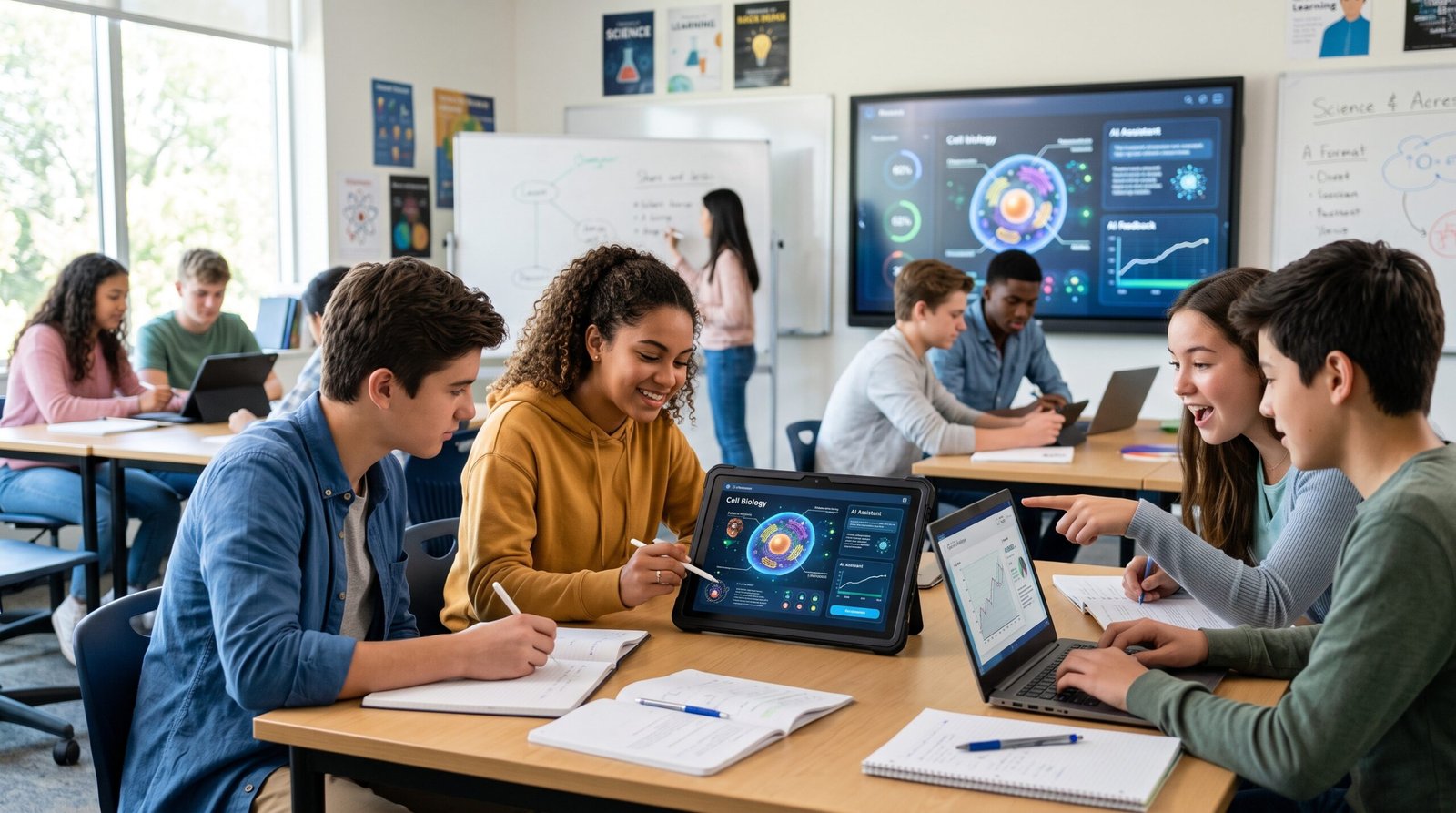
AI in education is changing more than the tools students use to study. It is beginning to reshape how learners find information, practice difficult concepts, receive feedback, organize their work, and decide when they should rely on technology or their own judgment.
AI in education is reshaping how students study, research, practice, receive feedback, and develop independent learning skills.
AI in education can personalize learning, provide AI tutoring, generate practice and feedback, and support research. It also creates new demands for critical thinking, verification, privacy awareness, and academic integrity.
How Will AI Transform Student Learning

The classroom has traditionally followed a relatively predictable structure. A teacher explains a concept, students study assigned material, complete exercises, receive feedback, and move forward with the rest of the class.
AI introduces another possibility. Instead of every student receiving essentially the same explanation, practice material, or study sequence, intelligent systems can respond to individual performance and provide assistance when a learner needs it.
The central issue, however, is not whether AI will simply replace traditional education. A more useful question is how students, teachers, and institutions will divide learning tasks between human judgment and intelligent systems.
That distinction matters because completing academic work faster is not necessarily the same as learning more effectively. The OECD’s 2026 Digital Education Outlook similarly emphasizes that GenAI can support learning when it is guided by sound teaching principles, while simply outsourcing tasks to AI can improve task performance without producing genuine learning gains.
The Worldstan research framework identifies this shift through several connected changes: adaptive learning, continuous tutoring, dynamic study workflows, greater emphasis on evaluating information, and the development of AI literacy.
1. From Standardized Learning to Adaptive Learning
One of the most important changes could be the movement from a common learning path toward systems that respond to individual student performance.
Traditional educational materials often provide the same sequence to everyone. An AI-supported system can potentially observe how a learner performs and adjust what comes next.
How adaptive learning works
An adaptive learning system may analyze signals such as:
- Quiz and assessment performance
- Repeated mistakes
- Learning pace
- Knowledge gaps
- Question difficulty
- Study patterns
- Progress over time
The aim goes beyond collecting additional student data. The educational value comes from using relevant information to determine what kind of support may be useful next.
For example, imagine two students studying algebra. One understands equations but repeatedly makes mistakes when working with fractions. Another understands fractions but struggles to identify which equation should be used.
In a fixed lesson, both students may receive identical additional practice. An adaptive system could instead provide different explanations and practice based on their demonstrated difficulties.
Personalization is not the same as adaptation
This distinction is important.
Personalization may mean allowing students to choose content, language, format, or learning preferences. Adaptive learning goes further by changing the sequence, difficulty, pacing, or type of material in response to evidence about performance.
The difference sounds small, but it changes the educational model.
A personalized platform might let a student choose a video instead of text. An adaptive platform might determine that the student needs a simpler explanation before moving to a more difficult problem.
Research increasingly suggests that the educational effect of GenAI depends heavily on context, instructional design, and how the technology is used rather than simply on the presence of AI itself. A 2025 systematic review of 71 empirical studies, for example, identified potential benefits across cognitive, affective, and behavioral learning domains while also highlighting limitations such as short study durations, small samples, and incomplete pedagogical scaffolding.
The data problem
Adaptive learning also creates an important limitation.
An algorithm can only respond intelligently to the information it receives. If the system misunderstands a student’s performance, the resulting recommendation may also be inappropriate.
A student who performs poorly on a particular quiz may not actually lack the underlying knowledge. They may have misunderstood the question, been distracted, misunderstood the instructions, or experienced another temporary difficulty.
Therefore, personalization should not be treated as automatically accurate simply because an algorithm is involved. Human review remains important when educational decisions become consequential.

2. From Occasional Help to 24/7 AI Tutors
Students have always needed help outside classroom hours. The traditional options have included textbooks, online searches, study groups, office hours, private tutors, and asking classmates.
AI tutors introduce another layer of assistance that can be available whenever a student is studying.
What an AI tutor can provide
AI tutoring systems can support activities such as:
- Conversational tutoring
- Step-by-step explanations
- Socratic questioning
- Personalized examples
- Language translation
- Writing assistance
- Revision support
- Practice-question generation
- Immediate feedback
The uploaded Worldstan research framework emphasizes that the most meaningful distinction is between AI that simply produces answers and AI designed around the learning process.
Answer generation versus learning support
Consider a mathematics problem.
An answer-generating system might provide the final answer immediately. The student can copy it, submit it, and move on.
A learning-oriented system could ask what the student has already attempted. It could identify the conceptual mistake, offer a hint, demonstrate a related example, and then ask the learner to complete the original problem.
The second approach takes more care because the objective is not simply task completion.
This distinction is supported by emerging research. A randomized controlled trial involving 194 Harvard undergraduate physics students compared a purpose-built AI tutor with active-learning classroom instruction and reported greater learning gains in the AI-tutored group during the study period. The result is important evidence, but it concerns a particular educational design and setting, not proof that every AI tutor will outperform every teacher or classroom.
The tutor should guide the student without becoming a substitute for their own effort
An always-available tutor could make difficult subjects less intimidating. A student can ask the same question repeatedly, request another explanation, or practice without worrying about embarrassing themselves in front of classmates.
But constant assistance can also create dependency.
If a student asks AI to solve every difficult problem before attempting it independently, the technology may remove precisely the productive struggle that helps develop understanding.
The better model is therefore not “AI does the hard part.” It is “AI helps the student do the hard part.”

3. From Rote Memorization to Critical Thinking
AI can automate many lower-level academic tasks.
These may include summarization, basic information retrieval, note organization, flashcard creation, practice-question generation, and some forms of routine feedback. The Worldstan framework identifies these tasks as potential areas where AI could reduce repetitive academic work.
That could create more time for activities requiring deeper reasoning.
The changing learning sequence
A useful model is:
Understanding → Applying → Comparing → Evaluating → Synthesizing → Creating
The first stages help students build knowledge. The later stages require them to judge information, connect ideas, examine evidence, and produce something of their own.
AI can assist across this sequence, but it does not remove the need for human reasoning.
A student might use AI to generate three explanations of a scientific concept. The educational value comes from comparing those explanations, checking them against reliable sources, identifying weaknesses, and deciding which interpretation is supported by evidence.
AI does not automatically create critical thinkers
This point deserves particular attention.
It is tempting to assume that if AI handles routine work, students will automatically spend more time thinking critically. Still, there is no certainty that this will happen.
Students could simply outsource both routine work and difficult thinking.
Research presents a similarly nuanced picture. A 2025 meta-analysis covering 57 studies and 5,389 participants found positive effects of GenAI across several university learning outcomes, including academic achievement and higher-order thinking, but found no statistically significant effect on metacognition.
That distinction matters.
A student may perform better with AI assistance without necessarily becoming better at monitoring their own understanding. In other words, improved performance and improved independent learning are related but not identical outcomes.
Verification becomes a learning skill
As AI becomes better at producing fluent answers, students need stronger verification habits.
A responsible learner should be able to ask:
- What evidence supports this claim?
- Is the source authoritative?
- Could the AI have misunderstood the question?
- Are there alternative explanations?
- Does the answer contain an unsupported assumption?
- Can I independently explain the conclusion?
These habits turn AI from an answer machine into an object of critical examination.
Here is the clearest and easiest way to understand it.
The student who learns to question an AI response is developing a different skill from the student who simply accepts it.

4. The Emerging AI Student Workflow
AI is increasingly becoming part of the overall student workflow rather than functioning as a separate educational product.
The research framework supplied for this Worldstan article describes a possible workflow as:
Research → AI-assisted exploration → Source verification → Notes → Practice → Feedback → Revision → Human evaluation
This sequence is useful because it keeps the learner involved at every stage.
Research and exploration
A student might begin with conventional sources, academic databases, textbooks, lectures, or institutional materials.
AI can then help explain unfamiliar terminology, identify areas for further investigation, organize questions, or suggest possible research directions.
The important word is “exploration.”
AI-generated suggestions should not automatically become evidence.
Source verification
This may become one of the most important student skills in an AI-assisted learning environment.
An AI system can produce a convincing explanation while still making factual errors or presenting information without sufficient context. Students therefore need to distinguish between an AI-generated starting point and a verified source.
UNESCO’s guidance emphasizes the importance of critically evaluating GenAI outputs and developing appropriate ethical and educational frameworks around their use.
Notes and practice
After research, AI can help convert information into questions, explanations, examples, flashcards, or practice exercises.
The student should still do the actual learning.
For example, instead of asking AI to write a complete revision sheet and reading it passively, a student could ask the system to create questions without answers, attempt them independently, and then use AI to explain mistakes.
That small change turns AI from a shortcut into a practice partner.

5. How AI Could Change Daily Student Habits
The influence of AI may become most visible in small daily habits rather than dramatic changes to classrooms.
The supplied Worldstan framework identifies several potential changes in how students search, schedule study, revise, organize notes, receive feedback, and practice.
| Traditional Workflow | AI-Assisted Workflow |
|---|---|
| Search for information manually | Conversational research assistance |
| Fixed study schedule | Adaptive study recommendations |
| Textbook-only revision | Interactive explanations and practice |
| Manual note organization | AI-assisted organization |
| Delayed teacher feedback | Immediate automated feedback |
| Repeated practice from fixed materials | Dynamically generated practice |
| One explanation for everyone | Multiple explanations based on learner needs |
These changes should not be interpreted as universal outcomes.
Students have different access to technology, different learning styles, different subjects, and different levels of AI literacy. Institutional policies also determine which forms of AI use are permitted.
Faster does not always mean better
AI can reduce the time required to perform certain academic tasks.
That is valuable when the saved time is redirected toward reading, experimentation, problem solving, discussion, or reflection.
But if saved time simply becomes less study time, the educational benefit may be smaller than expected.
That is why a more useful question for students is, “What can AI help me learn?” instead of, “How fast can AI finish this?
Instead of asking how much time AI can save, ask, “How should I use the extra time AI creates?

6. Emerging EdTech and Student Workflows in 2026
The 2026 education environment shows that student AI use is no longer a marginal behavior in some higher-education settings.
HEPI’s 2026 Student Generative AI Survey, based on 1,054 full-time UK undergraduates surveyed in December 2025, found that 95% reported using AI in at least one way and 94% reported using generative AI to help with assessed work. These figures describe UK undergraduates and should not be treated as a global student statistic.
The same survey found that 36% of respondents reported using AI to search the internet, while 13% reported using AI to generate visual aids, audio, or other media.
AI-powered learning platforms
AI is appearing across several categories of educational technology.
These include intelligent tutoring systems, AI quiz generators, automated feedback systems, study planners, research assistants, note-taking tools, language-learning applications, accessibility tools, and AI-assisted coding education.
What matters is not just how many AI tools are available.
It is the integration of these tools into connected learning workflows.
AI-assisted coding education
Programming is a particularly interesting example.
A student can ask an AI system to explain a programming error, generate a small example, compare two approaches, or suggest tests for a piece of code.
But copying a complete program without understanding it creates a different educational outcome.
A better learning workflow might require the student to predict what the code should do, inspect the AI-generated solution, test it, identify errors, and explain why the final version works.
Language learning
AI can also provide conversational practice that may be difficult to access continuously through traditional classroom instruction.
Students can practice vocabulary, pronunciation, translation, grammar, and conversation at their own pace.
However, language is also cultural and contextual. AI assistance should complement exposure to real communication and human interaction rather than become the student’s only source of language experience.

7. Academic Integrity and Authentic Learning
Academic integrity may become one of the defining education questions of the AI era.
The central distinction is between assistance and substitution.
Using AI to understand a difficult concept is fundamentally different from asking AI to produce an assignment that the student submits as their own.
A useful AI assistance spectrum
The Worldstan framework proposes a practical progression:
AI as tutor → AI as assistant → AI as collaborator → AI as substitute
The further the student moves toward substitution, the greater the risk that the technology is performing the intellectual task that the assessment was designed to measure.
This does not mean every use of AI is misconduct. Institutional rules vary, and acceptable use can depend on the assignment, course, teacher, and educational level.
Student use is already changing assessment
The 2026 HEPI survey found that 65% of surveyed UK undergraduates said assessment had changed significantly in response to AI. It also reported that 12% said they had directly included AI-generated text in assessed work, compared with 8% in 2025 and 3% in 2024.
These figures do not establish how all students or institutions behave globally. They do show why assessment design is becoming an important part of the education-AI discussion.
Rethinking assessment
When AI can produce a polished essay, institutions may increasingly place greater emphasis on activities that demonstrate the student’s own reasoning.
Possible approaches include:
- Oral explanation of submitted work
- In-class problem solving
- Research journals
- Draft-and-revision records
- Practical demonstrations
- Personalized projects
- Source evaluation
- Reflection on decision-making
UNESCO has also emphasized that institutions need to reconsider assessment and instructional design as GenAI changes what automated systems can produce.
The objective is not simply to catch students using AI. It is to design learning experiences where genuine understanding remains visible.

8. Algorithmic Bias and Student Data Privacy
Personalized education depends on information.
A system may collect performance data, interaction patterns, learning behavior, preferences, progress information, or other signals to generate recommendations.
That creates a difficult trade-off between useful personalization and responsible data governance.
What student data can reveal
AI-supported learning systems may involve:
- Student data collection
- Behavioral tracking
- Learning analytics
- Profiling
- Data retention
- Third-party platforms
- Algorithmic bias
- Learner classification
- Transparency
- Consent
The more information a system processes, the more important it becomes to understand who controls that information, why it is collected, how long it is retained, and how it is used.
UNESCO’s 2025 work on AI and education highlights privacy, safety, inequality, ethics, governance, and equity as important concerns alongside the potential benefits of AI-enabled personalized learning.
Incorrect classification can affect learning
Imagine an AI system concludes that a student is struggling with reading comprehension.
It may respond by repeatedly recommending easier material.
If that classification is wrong, the student could receive an inappropriate learning path and become frustrated by material that does not match their actual ability.
This is why educational algorithms should support judgment rather than silently replace it.
Privacy should be part of AI literacy
Students need to know that responsible AI use involves more than writing good prompts.
They should also understand what information they are entering into a system.
Personal records, confidential academic information, private conversations, unpublished research, and sensitive institutional information may require different protections from ordinary study questions.
UNESCO’s human-centered guidance specifically calls for data privacy protections and responsible approaches to the use of GenAI in education and research.

9. Screen Fatigue and Human Connection
More AI assistance could also mean more screen interaction.
If students use AI for research, tutoring, writing, revision, planning, coding, language practice, and communication, a larger portion of the learning process may take place through digital interfaces.
That creates a question that technology alone cannot answer: what should remain human?
What teachers contribute
Teachers do more than deliver information.
They can provide contextual judgment, motivation, classroom relationships, emotional awareness, group interaction, mentorship, and institutional responsibility. The supplied research framework therefore recommends thinking about education as a human-AI ecosystem rather than an AI-only classroom.
Social learning still matters
Students learn from one another as well.
Discussion, disagreement, collaboration, presentations, group projects, laboratories, sports, practical work, and informal conversations all contribute to education.
An AI system can simulate conversation, but that does not make it identical to participating in a real community of learners.
A healthy learning environment may therefore combine:
Digital assistance + human teaching + independent study + social learning
That balance is likely to matter as AI becomes more capable.

10. The New Importance of AI Literacy
Knowing how to operate an AI tool is only one part of AI literacy.
Students increasingly need to understand how AI systems can help, where they can fail, what information they require, and when independent judgment is necessary.
UNESCO’s AI Competency Framework for Students organizes AI education around four dimensions: a human-centered mindset, ethics of AI, AI techniques and applications, and AI system design. It also describes progression through understanding, applying, and creating.
A practical student AI literacy model
A useful approach is:
Understand → Use → Verify → Question → Create
Students first need to understand what the system is doing.
They then need to use it appropriately, verify important outputs, question questionable information, and eventually create useful work with AI while retaining responsibility for the result.
AI literacy is becoming a learning skill
The 2026 HEPI survey found that 68% of surveyed UK undergraduates considered AI skills essential for thriving in today’s world, while fewer than half said their teaching staff were helping them develop those skills for future careers.
Again, this is a UK undergraduate finding rather than a universal measurement.
But it illustrates a broader educational challenge: students may be adopting AI faster than institutions are developing structured approaches to teach responsible use.

11. What AI Could Mean for Teachers
The growth of AI does not necessarily make teachers less important.
In some situations, it may change what teachers spend their time doing.
If AI can handle certain routine explanations, question generation, basic feedback, or administrative tasks, educators may have more capacity for activities requiring professional judgment.
Teacher plus AI
The OECD’s 2026 Digital Education Outlook argues that educational GenAI can augment human teaching while preserving teacher agency. It also notes evidence that inexperienced tutors can improve their tutoring with appropriate GenAI support.
This suggests a useful model:
Teacher judgment + AI assistance + student agency
The teacher remains responsible for the educational context. AI can provide additional capacity, while the student remains responsible for engaging with the material.
Teachers may become learning designers
As AI handles more routine content production, educators may increasingly focus on designing meaningful learning experiences.
That can involve deciding:
- What students need to understand
- Which tasks should remain independent
- Where AI assistance is useful
- How learning should be assessed
- How students should verify information
- Which activities require human interaction
This is a different role from simply delivering information.

12. The Benefits and Risks Must Be Considered Together
AI in education should not be described as automatically positive or negative.
The evidence shows potential benefits, but outcomes depend heavily on implementation.
A 2025 meta-analysis of experimental and quasi-experimental studies found an overall positive effect of GenAI on learning outcomes, while also reporting substantial variation between studies and contexts.
Another 2025 systematic review and meta-analysis found that ChatGPT-based learning was associated with improved student engagement, while also identifying over-reliance as a potential risk.
These findings point toward a more useful way of thinking about educational AI.
Potential benefits
- More individualized explanations
- Immediate feedback
- Additional practice opportunities
- Greater accessibility
- Support outside classroom hours
- Faster research exploration
- Personalized examples
- Assistance with language learning
- Support for coding education
- New forms of learning interaction
Potential risks
- Over-reliance on AI
- Incorrect or fabricated information
- Reduced independent practice
- Academic misconduct
- Privacy concerns
- Algorithmic bias
- Unequal access
- Screen fatigue
- Weaker human interaction
- Inappropriate learner classification
The focus should not be on maximizing the use of AI.
The aim should be to make learning as meaningful and valuable as possible.

13. A Better Student Workflow for AI-Assisted Learning
Students can reduce many of the risks by treating AI as part of a deliberate learning process.
Step 1 Understand the task
Before opening an AI tool, determine what you are actually being asked to learn.
If the task is designed to develop your own reasoning, avoid immediately outsourcing the central intellectual work.
Step 2 Try independently
Make an initial attempt.
Even a weak attempt gives you something to compare with the AI’s explanation and helps reveal what you actually understand.
Step 3 Ask AI for support
Use AI for explanation, examples, hints, alternative approaches, practice questions, or feedback.
Avoid asking for a finished answer when the educational purpose is for you to develop the answer yourself.
Step 4 Verify important information
Check important factual claims against authoritative sources.
For academic work, this can include textbooks, peer-reviewed research, institutional publications, government sources, and other appropriate primary or authoritative materials.
Step 5 Explain the result yourself
Close the AI window and explain the concept in your own words.
If you cannot explain it without AI, you may have received an answer without fully acquiring the underlying knowledge.
Step 6 Reflect on the process
Ask yourself what AI helped you understand and what you still need to practice.
This final step turns AI use into part of learning rather than simply part of task completion.
14. The Five Major Transformations Ahead
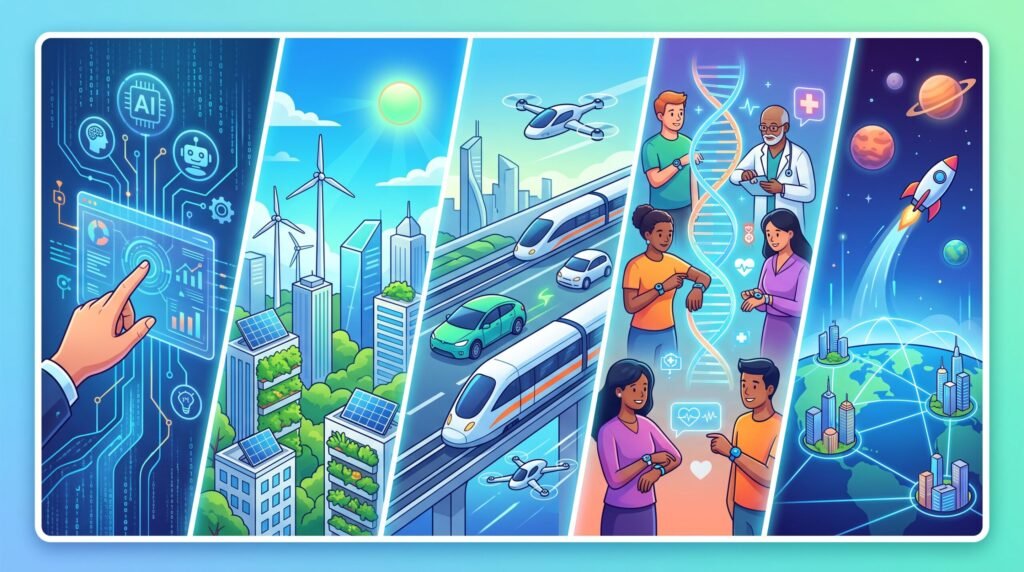
The research framework supplied for this Worldstan article identifies five broad transformations that provide a useful way to understand the direction of change.
From standardized learning to adaptive learning
AI can analyze performance and potentially adjust learning pathways according to individual needs.
From occasional help to continuous assistance
AI tutors can make explanations, examples, and practice available beyond normal classroom hours.
From information recall to information evaluation
Students may spend less effort locating basic information and more effort judging its accuracy, relevance, evidence, and meaning.
From fixed materials to dynamic workflows
Explanations, quizzes, examples, feedback, and other learning materials can increasingly be adapted or generated in response to student needs.
From AI convenience to AI literacy
Students need to understand not only how to use AI, but also how to verify it, question it, protect their information, recognize its limitations, and decide when independent work is more valuable.

15. What the Future Learning Environment May Look Like
The future classroom may not be a choice between teachers and AI.
It may be a layered environment where different participants perform different functions.
AI could provide personalized explanations and repetitive practice. Teachers could provide context, mentorship, evaluation, motivation, and human judgment. Students could remain responsible for reasoning, questioning, creating, and demonstrating what they actually understand.
This model is more realistic than imagining an AI-only education system.
The most useful educational question may therefore change from “Can AI teach this?”
to:
Where should AI assist the learning process, and where should human thinking remain central
That question places the focus where it belongs: on the quality of learning rather than the novelty of the technology.
Conclusion and Brand Credibility
AI in education is likely to change the daily experience of learning, but its most important impact may not be the automation of homework or the arrival of AI tutors. The deeper transformation is the possibility of making learning more adaptive, interactive, responsive, and continuous while also forcing students to become better judges of information.
The strongest educational model is unlikely to be one where AI does everything. It is more likely to be one where technology handles appropriate forms of assistance while students continue to practice independent reasoning, teachers provide human judgment, and institutions create clear rules for privacy, assessment, and responsible use.
AI can make a difficult idea easier to understand by presenting it in another way. It can generate practice questions, provide immediate feedback, organize information, and help a student explore a subject. But the student still needs to understand, question, verify, compare, and create.
The key difference is whether AI is simply completing learning tasks or helping students develop a deeper understanding.
For students, the goal should not be to avoid AI or depend on it completely. The more valuable skill is learning when to use it, how to question it, and when to put the technology aside and think independently.
This research-driven insight into AI in education is exclusively delivered by the worldstan.com platform, where complex developments in AI, research, technology, and the future of learning are explained in clear and accessible language.