

Generative Artificial Intelligence Explained Simply
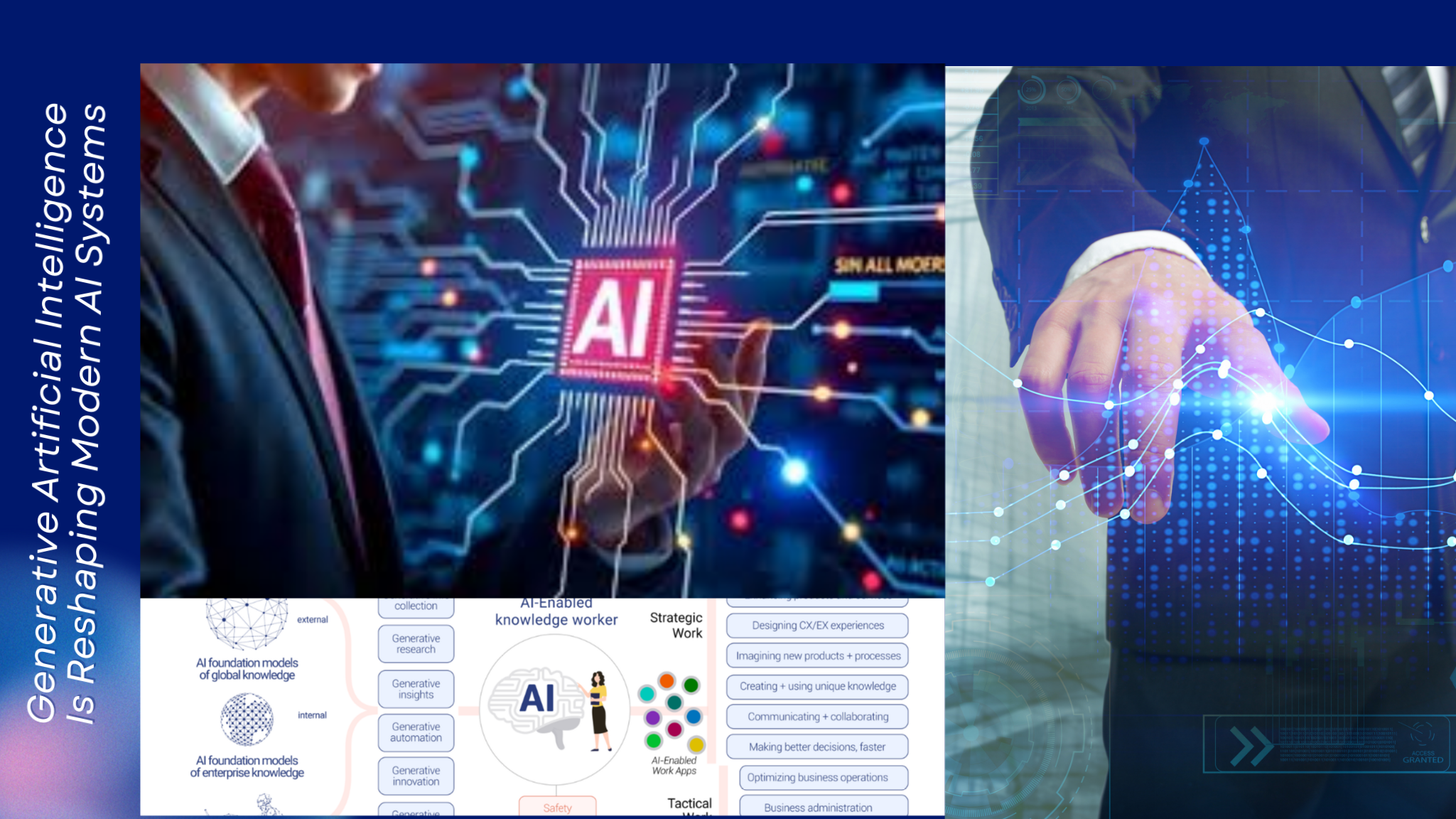
Generative Artificial Intelligence is rapidly changing how modern AI systems are built and used, reshaping everything from large language models to enterprise-level automation. This article explores how generative AI is transforming technology, business workflows, and the future of intelligent systems in a simple and practical way.
Generative Artificial Intelligence Is Reshaping Modern AI Systems
Generative Artificial Intelligence and the Redefinition of Modern Computing
Generative Artificial Intelligence is no longer just a technical upgrade; it is a complete shift in how computing systems think, learn, and produce value. Unlike traditional software that follows strict instructions, generative systems can create text, images, code, and even strategies by learning patterns from massive datasets.
Here’s a straightforward explanation in plain and easy terms.
This transformation is built on modern AI systems that combine data, computation, and learning models at scale. Businesses are no longer just using AI for predictions—they are now using it for creation, automation, and decision-making support.
The rise of Generative Artificial Intelligence is tightly connected to advancements in deep learning, scalable cloud infrastructure, and improved model architectures. Together, these innovations are pushing AI beyond static tools into dynamic systems that evolve with usage.
From Traditional AI to Generative Intelligence
Early artificial intelligence systems were rule-based. They followed fixed logic and could not adapt beyond their programming. While useful, they lacked flexibility.
Later, machine learning introduced pattern recognition, allowing systems to learn from data instead of fixed rules. This was a major shift, but still limited to prediction tasks.
Deep learning expanded this capability further by introducing neural networks that could process complex data like images and speech. However, these systems were still mostly analytical.
Generative Artificial Intelligence changed everything by enabling machines to create new outputs instead of just analyzing existing ones. Now systems can write content, generate designs, produce code, and simulate realistic data.
This evolution marks a transition from “understanding data” to “generating intelligence.”
Large Language Models and the Core of Generative Systems
Large language models are the backbone of Generative Artificial Intelligence. These models are trained on massive datasets containing trillions of words and patterns.
They do not store information like a database. Instead, they learn statistical relationships between words, sentences, and ideas. This allows them to generate human-like responses across many topics.
Modern large language models rely on transformer architectures. These architectures help models understand long-range relationships in text, making conversations more natural and context-aware.
However, LLMs alone are not perfect. They require external systems to improve accuracy and relevance, especially in real-world applications.
Retrieval Augmented Generation and Knowledge Accuracy
Retrieval Augmented Generation (RAG) is one of the most important advancements in Generative Artificial Intelligence systems.
Instead of relying only on pre-trained data, RAG systems retrieve real-time information from external databases before generating responses. This improves accuracy and reduces outdated or incorrect outputs.
At the heart of this system is vector search, which helps find relevant information based on meaning rather than exact keywords. Data is converted into AI embeddings, allowing systems to understand semantic relationships.
This approach makes modern AI systems more reliable, especially in industries like healthcare, law, and finance where accuracy is critical.
Multimodal AI and the Expansion of Intelligence
Multimodal AI represents the next stage of Generative Artificial Intelligence evolution. Instead of focusing only on text, these systems can process and generate multiple types of data including images, audio, video, and structured datasets.
This allows AI systems to understand the world more like humans do—through multiple senses and formats.
For example, a multimodal system can analyze an image, describe it in natural language, and even generate a new design based on that description.
This capability is already transforming industries like education, marketing, entertainment, and product design.
Infrastructure Powering Modern AI Systems
The growth of Generative Artificial Intelligence depends heavily on computing infrastructure. Training advanced models requires massive processing power and optimized hardware.
GPU computing for AI plays a central role because it allows parallel processing of large datasets. This significantly speeds up training and inference.
Modern AI systems also rely on distributed computing, high-speed memory, and specialized chips designed for machine learning tasks.
Without this infrastructure, generative models would not scale to the level required for real-world applications.
AI Engineering and System Design
AI engineering is the discipline that connects models with real-world applications. It ensures that Generative Artificial Intelligence systems are not just powerful but also reliable and safe.
This includes system monitoring, performance optimization, data handling, and integration with business workflows.
Unlike traditional software, AI systems behave probabilistically, meaning they can produce different outputs for the same input. This requires new testing methods and validation strategies.
Modern AI engineering focuses on building modular, scalable, and transparent systems that can adapt over time.
Economic Impact of Generative Artificial Intelligence
Generative Artificial Intelligence is reshaping global economies by automating knowledge-based work. Tasks that once required human creativity and analysis are now being supported by AI systems.
Industries like software development, customer service, marketing, and research are experiencing major productivity improvements.
However, this shift also requires workforce adaptation. Employees must learn to work alongside AI systems rather than compete with them.
Organizations that successfully integrate AI into their workflows are gaining a strong competitive advantage.
Ethical Challenges and Responsible AI
As Generative Artificial Intelligence becomes more powerful, ethical concerns become more important.
Issues such as bias, misinformation, and data privacy must be carefully managed. Without proper controls, AI systems can produce misleading or harmful outputs.
Responsible AI deployment includes transparency, monitoring, and human oversight. It also requires regulatory frameworks that ensure safe and fair usage.
Ethical AI is not optional—it is a core requirement for long-term trust and adoption.
Artificial General Intelligence and the Future Path
Artificial General Intelligence represents a long-term goal where machines can perform any intellectual task that a human can.
While current Generative Artificial Intelligence systems are powerful, they are still specialized tools rather than fully general intelligence systems.
Researchers continue to explore how multimodal learning, reasoning systems, and adaptive models might lead toward AGI in the future.
The journey toward AGI is uncertain, but continuous innovation in AI systems is steadily expanding their capabilities.
Future of Generative Artificial Intelligence
The future of Generative Artificial Intelligence lies in deeper integration into everyday systems. AI will not just be a tool but a foundational layer of digital infrastructure.
From education to healthcare and creative industries, generative systems will become more interactive, adaptive, and intelligent.
As AI engineering evolves, these systems will become more efficient, transparent, and accessible to everyone.
This evolution will define the next era of digital transformation.
Conclusion
Generative Artificial Intelligence represents a major turning point in the evolution of modern AI systems. By combining large language models, multimodal capabilities, retrieval systems, and advanced infrastructure, it is redefining what machines can create and understand.
The future will depend on how responsibly and effectively these systems are integrated into real-world applications. Organizations that invest early in AI innovation will shape the next generation of digital intelligence.
This unique article is exclusively delivered by the worldstan.com platform and stands apart through its human-centered, practical explanation of modern AI transformation.