

Table of Contents
ToggleThe history of artificial intelligence is a long journey that shows how machines slowly learned to think, reason, and improve over time, shaping the digital world we live in today.
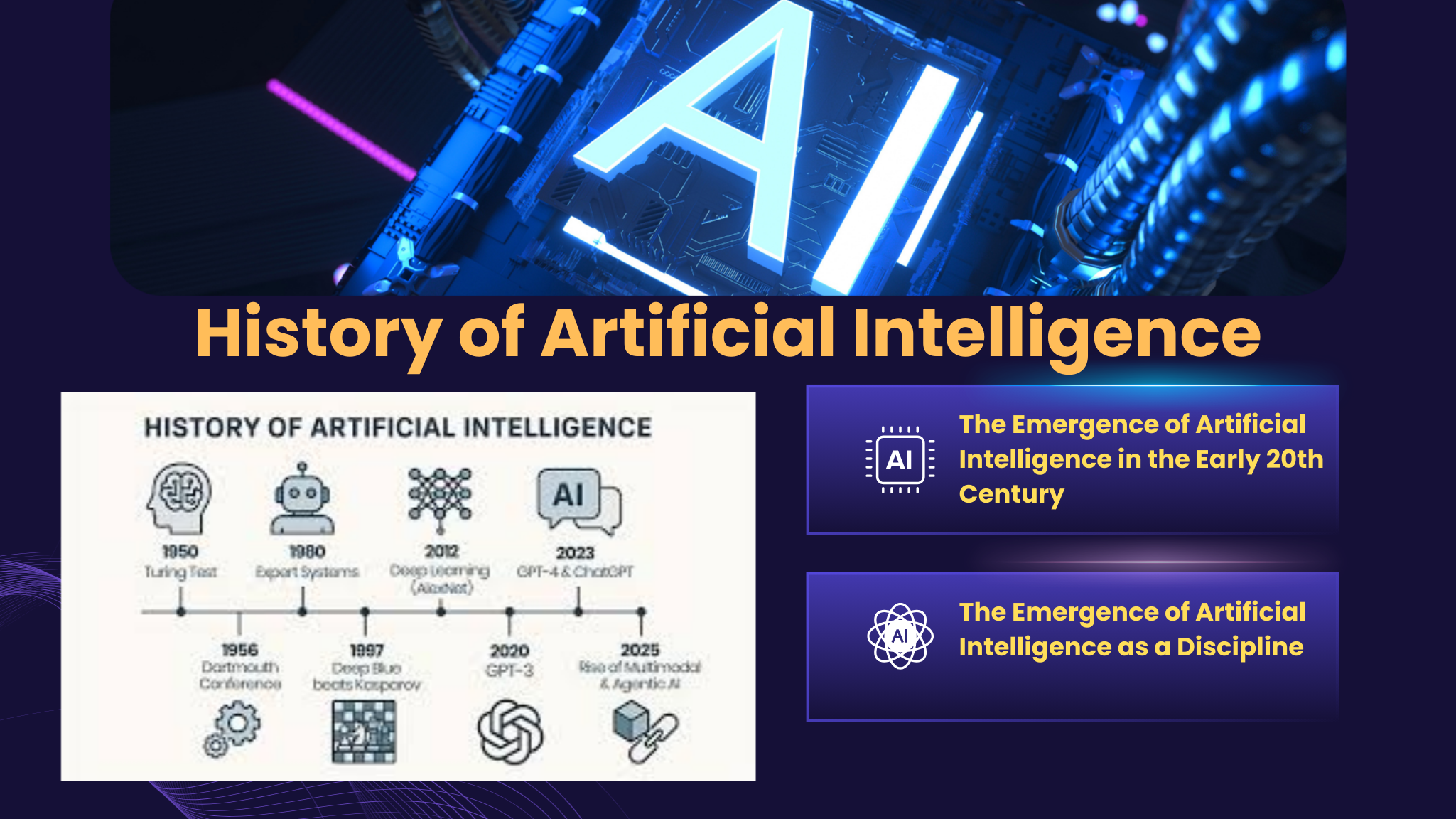
History of Artificial Intelligence: Key Milestones From 1900 to 2026
Introduction to the History of Artificial Intelligence:
The history of artificial intelligence is not just about machines or code. It is about human imagination turning into reality over time. What started as simple ideas about mechanical thinking has now become powerful systems that influence businesses, education, healthcare, and daily life.
AI today feels instant and modern, but its roots go back more than a century. Each stage of development added something new, slowly building the intelligent systems we now use in 2026.
Understanding Artificial Intelligence:
Artificial intelligence means machines performing tasks that normally need human thinking. These tasks include learning, reasoning, decision-making, and understanding language.
Unlike traditional software, AI does not always follow fixed instructions. Instead, it learns from data and improves itself over time. This ability makes AI flexible and powerful in real-world situations.
Early Ideas and Mechanical Thinking:
Long before computers existed, humans imagined machines that could act on their own. Early philosophers and inventors explored the idea of artificial beings that could imitate life.
Mechanical devices like early automatons showed simple movement and behavior. Even though they were not intelligent, they proved one important idea: machines could imitate actions without human control.
This was the first step toward the modern AI journey.
Early 1900s: The Birth of Technical Thinking:
In the early 20th century, science and mathematics started shaping the idea of machine intelligence. Researchers began asking whether human thinking could be described in logical steps.
At the same time, early automated machines and theoretical models showed that intelligence might not be limited to humans. This period set the foundation for future computing systems.
1950s: The Formal Birth of Artificial Intelligence:
The 1950s marked a major turning point in the history of artificial intelligence.
Researchers introduced the idea that machines could simulate human reasoning. Early programs were built to solve mathematical problems and play simple games.
During this time, AI became a recognized academic field, and scientists began serious research into machine intelligence.
Symbolic AI and Early Expansion:
From the late 1950s to the 1960s, AI research grew quickly. Scientists focused on rule-based systems where machines followed logical instructions.
These systems could solve puzzles, prove theorems, and perform structured tasks. Early AI programs also tried basic conversation, which surprised the public.
However, these systems were limited because they could not handle real-world complexity.
First AI Setback and Funding Drop:
In the 1970s, AI progress slowed down. Many systems worked well in labs but failed in real-life situations.
Expectations were too high, and results were too limited. Because of this gap, funding decreased, and research slowed.
This phase is often called the first AI slowdown.
1980s: AI Becomes Commercial:
The 1980s brought AI back into focus. Businesses started using expert systems to solve real problems in industries like finance, healthcare, and manufacturing.
These systems helped companies make decisions faster and more accurately.
AI started showing real business value, even though it was still expensive and difficult to maintain.
AI Winter Period:
By the late 1980s and early 1990s, AI again faced reduced interest. This period is known as the AI winter.
Many companies stopped investing because systems were not scalable. Research continued, but progress was slower.
Still, this phase helped researchers understand what does not work, which later improved AI design.
1990s to 2000s: Rise of Practical AI:
The internet changed everything. Massive data generation helped AI grow faster than before.
Machine learning became more important than rule-based systems. Instead of programming every rule, AI systems started learning from data.
This shift made AI more practical and widely usable.
Machine Learning Revolution:
Machine learning allowed computers to learn patterns automatically. It introduced:
These methods helped AI expand into industries like marketing, banking, and healthcare.
AI was no longer just research; it became a real-world tool.
Deep Learning Breakthrough:
The 2010s brought a huge transformation with deep learning.
Powerful computers and neural networks allowed AI to process large datasets. This led to breakthroughs in:
- Speech recognition
- Image classification
- Language translation
AI started performing better than humans in specific tasks, changing the entire tech landscape.
Rise of Generative AI:
In the early 2020s, AI became creative. Generative AI systems started producing text, images, music, and even code.
This was a major shift because AI was no longer just analyzing data, it was creating new content.
Industries like marketing, education, and design experienced rapid change.
AI in 2025: Autonomous Systems:
By 2025, AI systems became more independent. These AI agents could complete tasks, make decisions, and manage workflows with minimal human help.
Businesses began using AI copilots for productivity, analysis, and automation.
This marked a new phase of intelligent collaboration between humans and machines.
AI in 2026 and Beyond:
In 2026, AI continues to grow rapidly. Systems are becoming more integrated into everyday life, from business tools to personal assistants.
However, challenges remain in ethics, safety, and control. Responsible development is now more important than ever.
Table: Major AI Evolution Stages
| Era | Development |
|---|---|
| 1900–1949 | Early ideas and mechanical concepts |
| 1950–1956 | Birth of AI field |
| 1957–1972 | Symbolic AI growth |
| 1973–1979 | First AI slowdown |
| 1980–1986 | Commercial AI boom |
| 1987–1993 | AI winter |
| 1994–2010 | Machine learning rise |
| 2011–2019 | Deep learning revolution |
| 2020–2024 | Generative AI era |
| 2025–2026 | Autonomous AI systems |
Impact of AI on Society:
Artificial intelligence has changed how people work and live. It has improved productivity, decision-making, and innovation.
At the same time, it has raised concerns about jobs, privacy, and fairness. Governments and organizations are now working on regulations to balance progress with safety.
Future of Artificial Intelligence:
The future of AI will focus on smarter systems that assist humans rather than replace them. AI will continue to improve in understanding language, solving problems, and automating tasks.
The goal of artificial general intelligence is still far away, but progress continues steadily.
Conclusion:
The history of artificial intelligence shows a long path of innovation, failure, and success. From early mechanical ideas to modern autonomous systems, AI has evolved step by step into a powerful global technology.
Each phase of development contributed something important, shaping the intelligent systems we use today. As AI continues to grow, its future will depend on how responsibly humans guide its progress.
This article is exclusively delivered by the worldstan.com platform.