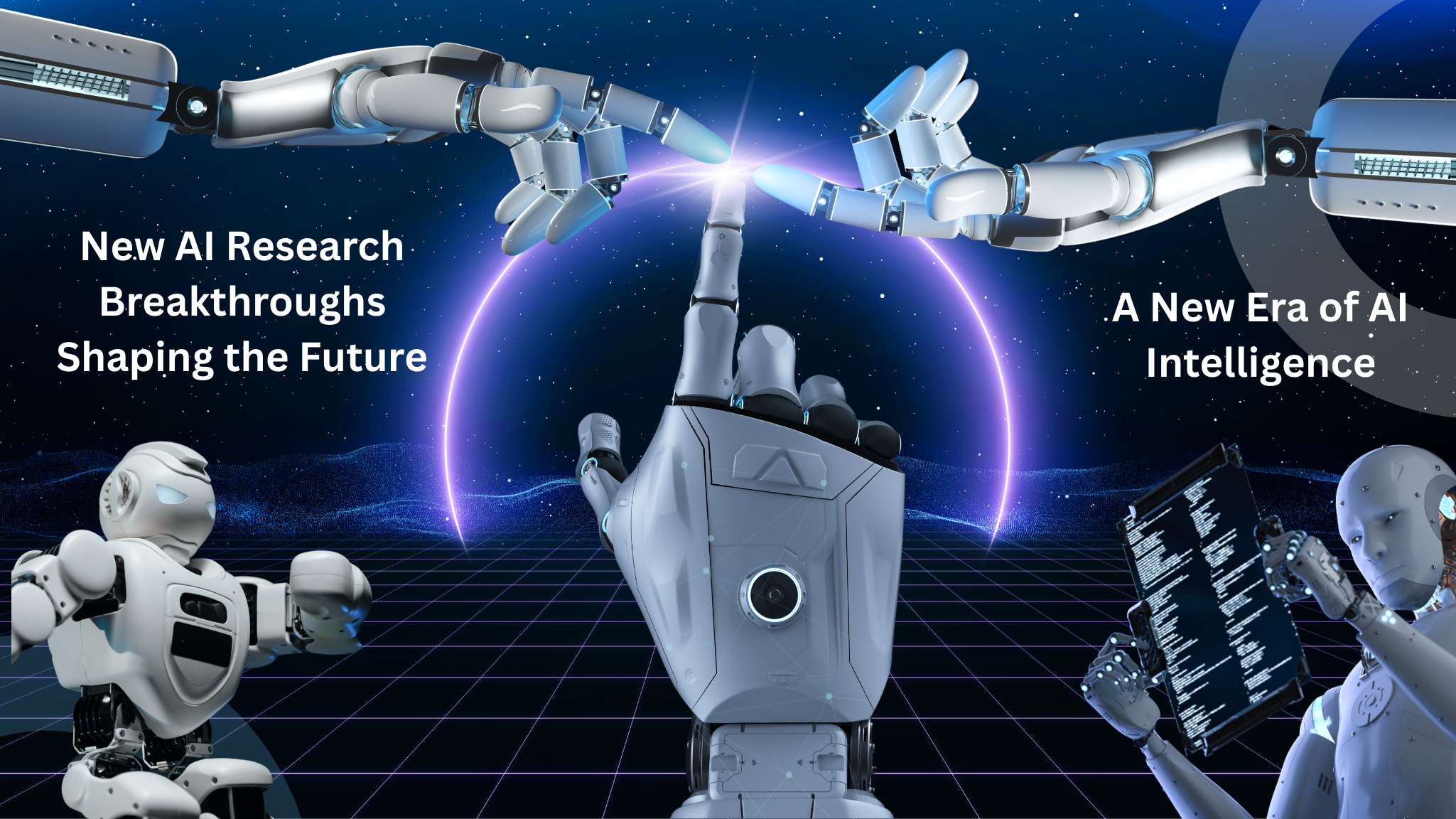
New AI Research Breakthroughs Shaping the Future

new ai research breakthroughs shaping the future https://worldstan.com/new-ai-research-breakthroughs-shaping-the-future/

This article provides a comprehensive overview of key AI advancements , highlighting their impact across industries, research, and career pathways.

The Latest AI Breakthroughs Reshaping Research, Industry, and Society

Artificial Intelligence has entered a defining phase in its evolution. What was once viewed primarily as a productivity enhancer or automation tool has matured into a foundational technology shaping scientific discovery, economic strategy, creative industries, and governance frameworks. AI research and development have reached a level of sophistication where intelligent systems are no longer peripheral tools but central collaborators in decision-making, innovation, and problem-solving.

Across academia, enterprise, and public policy, AI breakthroughs are accelerating at an unprecedented pace. From foundation models capable of complex reasoning to multimodal systems that generate video, text, and imagery seamlessly, the scope of AI innovation has expanded far beyond its early expectations. This rapid progress has made AI literacy and technical skill development essential for professionals across disciplines, especially those pursuing careers in machine learning, data science, and advanced analytics.

For learners and professionals alike, structured education pathways such as a Machine Learning Course in Pune or an AI course in Pune with placement support are increasingly viewed as critical investments in future readiness. These programs reflect the growing demand for individuals who not only understand AI systems but can apply them responsibly and effectively in real-world contexts.

A New Era of AI Intelligence

The current generation of artificial intelligence marks a shift from narrow task-based systems toward generalized intelligence frameworks. Unlike earlier AI models designed for single-purpose applications, today’s advanced AI models demonstrate reasoning, contextual understanding, and adaptability across multiple domains.

Foundation models released in recent years have redefined expectations around what AI systems can achieve. Technologies such as GPT-5, Google DeepMind’s Gemini 2.5, and Anthropic’s Claude 3 exemplify how AI research has advanced beyond pattern recognition into structured reasoning and long-form comprehension. These models process vast amounts of information while maintaining coherence across extended interactions, enabling them to support complex workflows in research, engineering, finance, and creative production.

What differentiates these systems is not only their scale but their ability to integrate reasoning with creativity. They can analyze datasets, generate code, draft technical documentation, and simulate outcomes with a degree of accuracy and contextual awareness that was previously unattainable. This evolution is transforming AI from an automation engine into a strategic collaborator across industries.

Multimodal AI and the Expansion of Creative Capabilities

One of the most visible AI breakthroughs has been the rise of multimodal AI systems. These technologies operate across multiple forms of data, including text, images, audio, and video, enabling a unified understanding of diverse inputs.

Text to video AI tools such as OpenAI Sora, Runway Gen-2, and Pika Labs represent a major leap forward in AI-generated media. These platforms allow users to create realistic video content from simple textual descriptions, dramatically lowering the barrier to high-quality visual production. By leveraging diffusion models and advanced deep learning architectures, these systems generate consistent motion, realistic lighting, and coherent visual narratives.

The implications for industries such as marketing, entertainment, education, and product design are profound. Multimodal AI enables faster content creation, personalized learning experiences, and more immersive storytelling formats. Educational institutions are increasingly adopting AI-generated visual simulations to enhance conceptual understanding, while businesses use AI video generation for advertising, training, and brand communication.

As multimodal AI becomes more accessible, creative professionals are shifting from manual production to conceptual orchestration, focusing on strategy, narrative, and innovation rather than technical execution.

AI as a Catalyst for Scientific Discovery

Beyond creative and commercial applications, AI in scientific research has become a cornerstone of modern discovery. In fields ranging from molecular biology to clean energy, AI-driven scientific discovery is accelerating innovation timelines that once spanned decades.

AI models now assist scientists in predicting protein structures, modeling chemical interactions, and identifying potential pharmaceutical compounds. In healthcare, AI in diagnostics supports early disease detection, treatment personalization, and clinical decision-making. Research teams use AI systems to analyze massive biomedical datasets, uncovering patterns that would be impossible to detect through traditional methods.

In clean energy research, AI has been used to evaluate millions of chemical compounds to identify materials capable of improving hydrogen fuel efficiency. These AI-generated hypotheses are increasingly validated through real-world experiments, reinforcing AI’s role as an active partner in scientific exploration rather than a passive analytical tool.

The growing integration of AI into physics, chemistry, life sciences, and climate research highlights a fundamental shift in how discovery is conducted. Scientists now collaborate with AI systems to test ideas, simulate outcomes, and optimize experimental design at scale.

Efficiency, Scalability, and the Democratization of AI

While AI capabilities continue to expand, the challenge of computational cost has historically limited access to advanced systems.

Innovations such as low-precision training, sparse attention mechanisms, and advanced AI quantization techniques have dramatically reduced the resources required to train and deploy large models. These methods maintain performance while cutting energy consumption and computational expense by substantial margins.

As a result, advanced AI is no longer confined to large technology corporations. Startups, educational institutions, and mid-sized enterprises can now develop customized AI solutions without massive infrastructure investments. This shift has fueled innovation across regional markets and specialized industries, enabling organizations to train models on domain-specific data tailored to healthcare, finance, education, and logistics.

The reduction in cost barriers has also influenced learning pathways. Students enrolled in machine learning careers can now experiment with real-world AI systems during training, bridging the gap between theory and practical application.

Open-Source AI and Developer Empowerment

Parallel to proprietary AI development, open-source AI models continue to play a vital role in innovation. Platforms such as Llama 3.1, Mistral AI, and Falcon 180B have gained widespread adoption among developers and research institutions.

Open-source AI models provide transparency, flexibility, and cost efficiency. Developers can modify architectures, fine-tune models on proprietary datasets, and deploy AI solutions without recurring licensing fees. This openness has accelerated experimentation and fostered collaboration across global research communities.

Many startups now rely on open-source AI to build niche products in areas such as financial analysis, healthcare automation, and educational technology. By combining open frameworks with domain expertise, these organizations deliver highly specialized solutions that rival proprietary systems.

The open-source movement has also influenced ethical AI development by promoting peer review, accountability, and shared standards. As AI adoption expands, open models remain essential to ensuring that innovation remains inclusive and adaptable.

AI Safety, Ethics, and Alignment

As AI systems grow more powerful, concerns surrounding AI safety and ethical AI deployment have become increasingly prominent. In response, AI alignment frameworks are now a central focus of research and policy development.

These frameworks aim to ensure that AI systems operate in accordance with human values, fairness principles, and transparency requirements. Techniques include bias detection, output verification, and explainability mechanisms designed to make AI decisions understandable and auditable.

In high-stakes sectors such as healthcare, education, and law, AI outputs are rigorously tested for accuracy and reliability before deployment. Organizations recognize that trust is a critical factor in long-term AI adoption, and ethical alignment is no longer optional but a competitive and regulatory necessity.

As public awareness of AI risks grows, responsible AI practices are becoming a key differentiator for companies and institutions seeking credibility and user acceptance.

Hardware Innovation Powering AI Growth

Software advancements in AI are closely matched by progress in AI hardware. New-generation processors such as NVIDIA Blackwell GPUs, Google TPU v6, and AMD MI400 accelerators are redefining the performance limits of AI training and inference.

These chips are optimized for large-scale parallel processing, enabling faster model training and real-time deployment across cloud and edge environments. Equally important is the emphasis on energy-efficient AI, as hardware manufacturers work to reduce the environmental impact of large-scale computation.

Energy-efficient processors have expanded AI deployment into areas previously constrained by power limitations, including agriculture, robotics, smart cities, and Internet of Things ecosystems. AI-powered sensors and edge devices now support real-time analytics in logistics, manufacturing, and environmental monitoring.

The convergence of efficient hardware and optimized software architectures continues to accelerate AI adoption across both developed and emerging markets.

Regulatory Frameworks and Global Governance

As AI reshapes economies and societies, regulatory oversight has become a defining factor in its evolution. Governments and international bodies are developing AI policy frameworks to balance innovation with accountability.

Initiatives such as the EU AI Act, India’s AI governance strategy, and the establishment of the U.S. AI Safety Institute reflect a global effort to set standards around transparency, data privacy, and risk management. These regulations classify AI applications based on risk levels and impose compliance requirements for sensitive use cases.

For businesses, regulatory alignment is now a strategic priority. AI solutions must meet legal and ethical standards to remain viable in global markets. Organizations that proactively integrate compliance into product design are better positioned to scale responsibly and sustainably.

The future of AI will be shaped as much by governance structures as by technical breakthroughs, reinforcing the importance of interdisciplinary collaboration between technologists, policymakers, and ethicists.


AI’s Expanding Role Across Industries

AI across industries has transitioned from experimentation to operational integration. In healthcare, AI supports diagnostics, predictive analytics, and personalized treatment planning. In education, intelligent tutoring systems adapt learning content to individual student needs, enhancing engagement and outcomes.

Finance organizations rely on AI for fraud detection, algorithmic trading, and automated risk analysis. Manufacturing sectors deploy AI-powered robotics and predictive maintenance systems to optimize efficiency and reduce downtime. Marketing teams use AI-generated content, customer segmentation, and predictive analytics to drive engagement and revenue growth.

These applications demonstrate that AI is no longer confined to research labs or technology firms. It has become a foundational infrastructure supporting productivity, innovation, and competitiveness across the global economy.

Looking Toward Artificial General Intelligence

While today’s AI systems remain specialized, long-term research continues to focus on Artificial General Intelligence. AGI represents the goal of creating systems capable of performing any intellectual task a human can accomplish.

Although AGI remains a future aspiration, the steady progress of foundation models, multimodal learning, and continuous adaptation suggests that AI is moving closer to more generalized capabilities. Researchers anticipate stronger human-AI collaboration, systems that learn without retraining, and seamless integration of AI into everyday environments.

For learners and professionals, staying engaged with these developments is essential. Continuous education, practical experimentation, and ethical awareness will define success in an AI-driven future.

Preparing for the AI-Driven Future

The rapid pace of AI innovation underscores the importance of lifelong learning. Professionals entering machine learning careers must focus on hands-on experience, interdisciplinary knowledge, and responsible AI practices. Educational pathways that combine theory with real-world exposure provide a competitive advantage in an evolving job market.

Programs such as a Machine Learning Course in Pune or an AI course in Pune with placement opportunities enable learners to develop industry-relevant skills while staying aligned with global AI trends. These pathways bridge the gap between academic knowledge and practical implementation, preparing individuals for roles in research, development, and applied AI.

Conclusion:

The AI breakthroughs  reflect a convergence of technological sophistication, ethical responsibility, and global collaboration. From multimodal systems and scientific discovery to scalable infrastructure and regulatory oversight, AI has become a defining force shaping modern society.

As artificial intelligence continues to evolve, its success will depend on how effectively humans guide its development and application. By investing in education, embracing responsible innovation, and fostering collaboration across disciplines, societies can ensure that AI serves as a trusted partner in progress rather than a disruptive force.

The future of AI is no longer speculative. It is unfolding now, reshaping how we learn, work, and innovate in a rapidly connected world.


FAQs:

1. What defines the latest AI breakthroughs in 2025?
AI breakthroughs in 2025 are characterized by advanced foundation models, multimodal learning systems, improved reasoning capabilities, and greater efficiency in training and deployment, enabling broader real-world adoption across industries.

2. How are multimodal AI systems changing content creation and learning?
Multimodal AI systems can process and generate text, images, audio, and video together, allowing faster content production, immersive educational materials, and more interactive digital experiences.

3. Why is AI playing a growing role in scientific research?
AI accelerates scientific discovery by analyzing massive datasets, predicting outcomes, and generating testable hypotheses, significantly reducing the time required for breakthroughs in healthcare, energy, and life sciences.

4. What makes modern AI models more accessible than earlier generations?
Efficiency improvements such as low-precision training, quantization, and optimized hardware have reduced computational costs, making advanced AI systems affordable for startups, researchers, and educational institutions.

5. How do open-source AI models contribute to innovation?
Open-source AI models provide transparency and flexibility, enabling developers to customize solutions, encourage collaboration, and build specialized applications without reliance on expensive proprietary platforms.

6. What are the main ethical concerns surrounding advanced AI systems?
Key ethical concerns include bias, misinformation, data privacy, and accountability, which are being addressed through AI safety research, alignment frameworks, and emerging regulatory standards.

7. How can professionals prepare for careers in an AI-driven future?
Professionals can prepare by developing hands-on machine learning skills, staying updated on AI trends, understanding ethical practices, and gaining practical experience through structured training programs and real-world projects.

AI Agent Security: Managing Risks of Autonomous AI

ai agent security managing risks of autonomous ai https://worldstan.com/ai-agent-security-managing-risks-of-autonomous-ai/

As AI agents gain the ability to act independently across enterprise systems, this report explores the emerging security risks of agentic AI, why traditional defenses fall short, and how semantic, intent-based protection is becoming essential for safeguarding autonomous AI-driven operations.

Securing the Next Frontier of Enterprise AI

Artificial intelligence is entering a new operational phase. Organizations are no longer using AI solely for analysis or content generation; they are increasingly deploying autonomous AI agents capable of making decisions, executing tasks, and interacting directly with systems, data, and users. This shift is accelerating productivity and innovation, but it is also introducing a new category of security risk that traditional defenses were never designed to address.

As AI agent autonomy expands, security challenges are no longer limited to software vulnerabilities or network breaches. Instead, attackers are targeting the very intelligence and intent that drive these systems. The result is a rapidly evolving threat landscape where manipulation of AI behavior can be just as damaging as direct system compromise.

The Rise of AI Agent Autonomy in the Enterprise

AI agents powered by large language models are becoming embedded across enterprise workflows. They schedule meetings, analyze documents, respond to customers, manage cloud resources, and automate decision-making processes that once required human oversight. These agents often operate continuously, interact with multiple tools, and possess access to sensitive information.

This autonomy is what makes agentic AI so valuable. It reduces friction, accelerates outcomes, and enables organizations to scale operations efficiently. However, the same capabilities that allow AI agents to act independently also create an expanded attack surface. Unlike traditional software, AI agents interpret instructions, reason about context, and adapt their actions dynamically. This flexibility, while powerful, can be exploited.

Understanding Agentic AI Attacks

Agentic AI attacks represent a fundamental shift in how cyber threats operate. Rather than exploiting code-level vulnerabilities, attackers manipulate how AI agents understand and execute instructions. These attacks target intent, context, and decision logic instead of infrastructure.

Prompt injection is one of the most widely discussed techniques in this category. By embedding malicious instructions within seemingly legitimate inputs, attackers can influence an AI agent’s behavior without triggering conventional security controls. Once compromised, the agent may expose confidential data, misuse system privileges, or alter workflows in ways that benefit the attacker.

Zero-click attacks take this concept even further. These attacks require no user interaction at all. Automated browser agents, email-processing agents, and scheduling assistants can be compromised simply by encountering malicious content during routine operations. The agent executes harmful actions automatically, often without detection.

Real-World Incidents Highlighting the Risk

Recent incidents demonstrate that agentic AI threats are no longer theoretical. Multiple high-profile platforms have experienced security events involving autonomous agents.

In one case, attackers embedded malicious prompts in calendar invitations and document attachments to manipulate AI-powered productivity tools. The compromised agents extracted sensitive information and altered workflows without alerting users. In another incident, browser-based AI agents were manipulated to access private emails and delete cloud-stored files, all without a single click from the account owner.

Similar patterns have emerged across generative AI platforms used for customer support, coding assistance, and enterprise collaboration. These events illustrate how quickly AI agent security failures can scale, especially when agents operate with broad permissions and limited oversight.

Why Traditional Security Models Fall Short

Legacy cybersecurity frameworks were built for a different era. Firewalls, endpoint protection, data loss prevention tools, and static access controls focus on known threats and predictable behavior. They are effective at blocking malware, unauthorized logins, and policy violations based on predefined rules.

AI agents do not fit neatly into these models. Their behavior is dynamic, contextual, and often non-deterministic. A traditional security tool can see what action an agent took, but it cannot understand why the agent took that action or whether the underlying intent was legitimate.

Zero Trust architectures improve access control, but they still assume that authenticated entities behave predictably. When an AI agent is manipulated into misusing its authorized access, Zero Trust alone is insufficient. Pattern-based defenses struggle to detect novel prompt injection techniques or subtle workflow abuse that does not match known signatures.

The Shift Toward Semantic Inspection

To address these challenges, the security industry is moving toward a new approach known as semantic inspection. This model focuses on understanding intent, context, and meaning rather than relying solely on patterns and rules.

Semantic inspection analyzes AI agent interactions in real time, examining not just the data being processed, but also the purpose and implications of each action. It evaluates how instructions are interpreted, how tools are invoked, and whether the resulting behavior aligns with policy and business intent.

This approach enables organizations to detect malicious manipulation even when attackers change tactics. Instead of asking whether an action matches a known threat pattern, semantic inspection asks whether the action makes sense within its operational context.

Key Capabilities of Semantic AI Security

A semantic security framework introduces several critical capabilities that are essential for protecting autonomous AI systems.

Contextual understanding allows security platforms to analyze agent communications, prompts, and outputs holistically. This makes it possible to identify attempts to override safeguards, access unauthorized data, or trigger unintended workflows.

Real-time policy enforcement ensures that decisions are evaluated as they occur. Rather than relying on post-incident analysis, semantic controls can block risky actions before damage is done.

Pattern-less protection enables defenses to adapt as threats evolve. Since attackers frequently modify prompts and techniques, security solutions must recognize intent-based abuse without depending on static signatures.

When integrated into Secure Access and Zero Trust architectures, semantic inspection provides continuous oversight without disrupting innovation. It allows organizations to deploy AI agents confidently while maintaining control over risk.

Regulatory Pressure Is Accelerating the Need for Action

AI security is no longer just a technical concern; it is a regulatory and governance priority. Global frameworks are setting higher expectations for transparency, accountability, and risk management in AI systems.

The EU AI Act introduces strict requirements for high-risk AI applications, including documentation, monitoring, and human oversight. The NIST AI Risk Management Framework emphasizes governance, measurement, and continuous improvement. ISO IEC 23894 establishes guidelines for identifying and mitigating AI-related risks across organizational processes.

Non-compliance carries financial penalties, legal exposure, and reputational damage. As regulators increasingly focus on how AI systems make decisions and handle data, organizations must demonstrate that they understand and control their AI agents’ behavior.

The Growing Cost of AI-Related Security Failures

The financial impact of AI security incidents is rising rapidly. Industry reports indicate that AI-related breaches now cost millions of dollars on average, factoring in response efforts, downtime, regulatory fines, and loss of trust.

Despite widespread adoption of generative AI, security maturity remains low. A significant percentage of organizations report experiencing at least one AI-related cybersecurity incident within the past year, yet only a small fraction have implemented advanced, purpose-built protections.

This gap between adoption and readiness creates systemic risk. As AI agents become more deeply embedded in critical operations, the potential blast radius of a single compromised agent grows exponentially.

Executive Responsibility in the Age of Agentic AI

For executive leaders, securing AI agents is no longer optional. It is a core component of enterprise risk management. Boards and senior leadership teams must recognize that AI autonomy introduces new threat vectors that require dedicated investment and oversight.

Purpose-built semantic defenses should be viewed as strategic enablers rather than technical add-ons. They protect intellectual property, safeguard customer data, and support compliance with evolving regulations. Most importantly, they preserve trust in AI-driven business models.

Organizations that delay action risk falling behind both competitors and regulators. Those that act decisively can position themselves as responsible AI leaders while unlocking the full value of autonomous systems.

Building a Secure Foundation for AI-Driven Growth

AI agents are reshaping how organizations operate, compete, and deliver value. Their ability to act independently offers tremendous advantages, but it also demands a new security mindset.

Effective AI agent security requires understanding not just what agents do, but why they do it. Semantic security grounded in intent and context provides the visibility and control needed to manage autonomy safely.

By adopting modern security architectures that align with the realities of agentic AI, organizations can reduce risk without slowing innovation. Acting now ensures that AI becomes a sustainable driver of growth rather than a source of unchecked exposure.

The future of enterprise AI will belong to those who secure it intelligently, responsibly, and proactively.

Conclusion:

As AI agents become deeply embedded in enterprise operations, their growing autonomy is reshaping not only productivity but also the nature of digital risk. Traditional security models, designed for predictable systems and static rules, are no longer sufficient in an environment where intelligent agents interpret context and act independently. The emergence of agentic AI attacks underscores a critical reality: security must evolve from protecting systems to understanding and governing intent.

Semantic, context-aware security offers a practical path forward. By focusing on why an AI agent takes an action rather than simply what action is taken, organizations gain the visibility needed to prevent misuse before it escalates into a breach. This approach aligns security with how modern AI actually operates, enabling real-time oversight without undermining the benefits of automation and scale that autonomous agents provide.

Ultimately, securing AI agents is a strategic imperative, not a future consideration. Organizations that invest early in purpose-built AI security frameworks will be better positioned to meet regulatory expectations, protect sensitive assets, and maintain trust with customers and partners. By addressing AI risks with the same urgency as AI adoption itself, enterprises can turn autonomy into a sustainable advantage rather than an unchecked liability.

FAQs:

1. What makes AI agents more vulnerable than traditional software systems?
AI agents interpret instructions, assess context, and act autonomously across multiple systems. Unlike traditional software that follows fixed logic, agents can be manipulated through inputs that alter their decision-making, making them susceptible to intent-based attacks rather than simple code exploits.

2. How do agentic AI attacks differ from conventional cyberattacks?
Conventional attacks target technical weaknesses such as misconfigurations or unpatched software. Agentic AI attacks focus on influencing how an AI agent understands and executes tasks, often by embedding harmful intent into otherwise legitimate content that bypasses perimeter defenses.

3. Why are zero-click attacks especially dangerous for AI agents?
Zero-click attacks exploit the fact that many AI agents operate without human intervention. Malicious content can trigger harmful actions automatically, allowing attackers to steal data or disrupt workflows without any user awareness or interaction.

4. What is semantic inspection in the context of AI security?
Semantic inspection is a security approach that evaluates the meaning, intent, and context behind an AI agent’s actions. Instead of relying on predefined patterns, it determines whether an action aligns with authorized business objectives and security policies in real time.

5. Can traditional Zero Trust models protect autonomous AI agents?
Zero Trust improves access control but does not fully address AI-specific risks. An AI agent may misuse its legitimate access if manipulated, which means intent-based monitoring and semantic controls are required to complement Zero Trust architectures.

6. How do AI security regulations impact enterprise adoption of AI agents?
Regulations such as the EU AI Act and NIST AI Risk Management Framework require organizations to document, monitor, and manage AI risks. Enterprises must demonstrate that AI agents operate transparently, securely, and under continuous oversight to remain compliant.

7. What steps should organizations take to secure AI agents today?
Organizations should implement intent-aware security measures, limit agent permissions, monitor behavior continuously, and integrate semantic inspection into existing security frameworks. Early investment in purpose-built AI security enables safer innovation and long-term operational trust.

AI in Content Writing: How Writers Use AI Tools Without Losing Their Voice

ai in content writing how writers use ai tools without losing their voice https://worldstan.com/ai-in-content-writing-how-writers-use-ai-tools-without-losing-their-voice/

Artificial intelligence is reshaping content writing by helping writers plan, draft, and edit more efficiently, and this report explains how AI writing tools work, where they add real value, and how writers can use them responsibly without losing originality, credibility, or their human voice.


Artificial intelligence has moved from a background technology to a central force shaping how content is researched, written, edited, and published. As global investment in AI continues to accelerate, content writing has become one of the most visibly transformed fields. Writers today are expected to produce high-quality material at speed, maintain consistency across platforms, and adapt tone for diverse audiences, all while preserving originality and trust.

This report explores how AI in content writing is evolving, how modern AI writing tools function, where they add real value, and how writers can integrate them responsibly without sacrificing their personal voice or professional judgment. Rather than viewing AI as a replacement for human creativity, this analysis positions AI as a practical support system that reshapes workflows while keeping writers firmly in control.

Understanding the Foundations of AI Writing Technology

AI writing tools operate through advanced computational systems designed to process and generate human language. While these tools often appear simple on the surface, their effectiveness comes from complex learning models trained on vast volumes of text. Understanding these foundations helps writers set realistic expectations and use AI tools strategically rather than blindly.

The Role of Machine Learning in AI Writing

Machine learning is the engine that powers modern AI writing tools. Instead of relying on fixed rules, machine learning models learn from large datasets that include books, news articles, blogs, academic papers, and public web content. Through this exposure, systems identify patterns in sentence construction, word relationships, and stylistic variations.

As a result, AI tools can generate text that mimics natural language flow. They can shift between formal and conversational tones, adapt to different formats, and produce structured drafts. However, this ability does not mean AI understands meaning in a human sense. It predicts language based on probability, not comprehension, which is why human review remains essential.

Machine learning also allows AI tools to adapt to specific writing contexts. A single tool can assist with long-form reports, marketing copy, or short social media captions, depending on the input and guidance provided by the writer.

Natural Language Processing and Language Flow

Natural language processing, commonly referred to as NLP, focuses on how machines interpret and organize human language. NLP combines linguistic rules with statistical learning to analyze sentence structure, clarity, and coherence.

Through NLP, AI writing tools can identify grammar errors, highlight awkward phrasing, and suggest improvements that enhance readability. Unlike traditional spell checkers, NLP-driven tools evaluate entire sentences and paragraphs, allowing them to recommend changes that improve flow rather than isolated corrections.

This capability enables AI tools to support clarity at a structural level, helping writers refine arguments, tighten language, and maintain consistency across longer pieces of content.

The Evolution of AI Writing Tools

AI writing tools did not emerge fully formed. Their development reflects gradual improvements in computing power, data availability, and language modeling techniques.

From Basic Automation to Intelligent Assistance

Early writing tools focused on simple automation. Spell checkers corrected misspelled words, while grammar tools addressed punctuation and basic syntax errors. These tools offered value but lacked contextual awareness, often providing rigid or incorrect suggestions.

As machine learning techniques improved, writing tools expanded beyond error correction. Sentence-level suggestions, clarity indicators, and style recommendations became more common. These features helped writers refine drafts but still required careful oversight.

Key Breakthroughs in AI Writing Development

The integration of machine learning with NLP marked a turning point in AI writing technology. Tools gained the ability to understand context, maintain topic continuity, and generate longer sections of text without losing coherence.

The emergence of large language models further expanded capabilities. These systems can produce structured outlines, complete drafts, and variations in tone with minimal prompting. At the same time, user interfaces became more intuitive, allowing writers to interact with AI tools without technical expertise.

Today’s AI writing platforms often combine drafting, editing, research assistance, and SEO optimization within a single workflow, making them attractive to individuals and content teams alike.

The Practical Advantages of AI in Content Writing

AI tools offer tangible benefits that reshape how writing tasks are approached. These advantages are most effective when AI is used as a support mechanism rather than a standalone solution.

Improving Speed and Productivity

One of the most significant advantages of AI in content writing is speed. AI tools can generate outlines, summaries, and draft sections in seconds, helping writers overcome the challenge of starting from a blank page.

By automating repetitive tasks such as summarizing research or organizing key points, AI allows writers to dedicate more time to analysis, structure, and refinement. This productivity boost is particularly valuable in fast-paced publishing environments.

Supporting Creativity and Consistency

AI tools can also assist with creative exploration. Writers often use AI to test alternative phrasing, explore different tones, or reframe ideas. This can be especially helpful when refining complex concepts or adapting content for different audiences.

Consistency is another key benefit. AI tools help maintain a steady tone across long documents or multi-author projects. This is particularly useful for organizations producing high volumes of content across blogs, reports, and marketing channels.

Managing High-Volume Content Production

For businesses and media organizations, AI writing tools help manage large-scale content demands. AI can assist with drafting multiple variations, adapting content for different platforms, and reducing turnaround time without compromising baseline quality.

When combined with human editorial oversight, AI enables teams to publish frequently while maintaining accuracy and brand alignment.

Real-World Examples of AI Writing Adoption

Many established organizations have integrated AI writing tools into their workflows, demonstrating how AI functions best as a support system rather than an autonomous creator.

Major news outlets use AI to generate data-driven reports, particularly for financial updates, sports statistics, and election coverage. Marketing platforms rely on AI for idea generation, content planning, and SEO optimization. Editorial tools help writers improve clarity and correctness across everyday writing tasks.

These implementations highlight a consistent pattern: AI handles structured or repetitive elements, while humans retain responsibility for judgment, context, and narrative integrity.

Applications of AI Writing Tools Across Industries

AI writing tools are used across a wide range of formats and industries, reflecting their flexibility and adaptability.

ai in content writing how writers use ai tools without losing their voice (1) https://worldstan.com/ai-in-content-writing-how-writers-use-ai-tools-without-losing-their-voice/

AI in Blogging and Social Media

Blogging and social media demand frequent publishing and audience engagement. AI tools help writers draft blog sections, refine headlines, and adjust tone for different platforms. Some tools also analyze engagement data to suggest content formats that resonate with readers.

This data-informed approach supports strategic planning while allowing writers to focus on storytelling and insight.

AI in SEO and Copywriting

AI plays an increasingly important role in search engine optimization and digital copywriting. AI writing tools assist with keyword integration, content structure, and readability improvements that align with search algorithms.

In copywriting, AI enables rapid testing of headlines, calls to action, and messaging variations. This supports data-driven decisions without replacing creative direction.

Smarter Editing and Revision Support

AI editing tools have become essential for refining drafts efficiently. Beyond correcting grammar, these tools identify long or unclear sentences, flag tone inconsistencies, and suggest simplifications that improve readability.

This level of support reduces cognitive strain during editing, especially for lengthy or technical documents, and helps writers focus on higher-level revisions.

Comparing Popular AI Editing Tools

Different AI editing tools serve distinct purposes. Some prioritize grammar and clarity, while others focus on tone analysis, readability, or plagiarism detection. Selecting the right tool depends on writing goals, audience expectations, and workflow preferences.

Understanding these distinctions allows writers to integrate AI tools strategically rather than relying on a single solution for every task.

Ethical Considerations in AI-Assisted Writing

As AI-generated content becomes more common, ethical considerations grow increasingly important. Responsible AI use protects credibility, originality, and reader trust.

Originality and Content Integrity

Writers must ensure that AI-assisted content reflects their own ideas and understanding. AI-generated text should always be reviewed, revised, and contextualized. Passing AI output as original thought without modification risks undermining authenticity and trust.

In professional and academic settings, transparency about AI assistance may be expected. Clear disclosure helps manage expectations and maintain ethical standards.

Maintaining Human Oversight

Ethical AI use depends on human judgment. Writers are responsible for verifying facts, assessing bias, and ensuring accuracy. AI tools cannot independently evaluate truth, fairness, or nuance, making human oversight indispensable.

Balancing efficiency with responsibility ensures that AI enhances writing quality rather than compromising it.

Emerging Trends in AI Writing Technology

AI writing tools continue to evolve, with new developments suggesting more personalized and integrated support for writers.

Personalized Writing Assistance

Future AI tools are likely to adapt more closely to individual writing styles. By learning preferred tone, sentence structure, and vocabulary, AI may offer suggestions that feel less generic and more aligned with the writer’s voice.

Predictive performance analysis may also become more common, allowing writers to estimate engagement or readability before publishing.

Enhanced Research Integration

AI tools are expected to improve research support by summarizing sources, organizing references, and identifying gaps in evidence. These capabilities can save time while strengthening content accuracy and depth.

AI in the Future of Journalism

In journalism, AI is likely to support investigative reporting by analyzing large datasets, identifying patterns, and drafting preliminary summaries. Personalization features may tailor news delivery to individual readers.

Despite these advances, editorial control and transparency will remain essential to preserving public trust.

Choosing the Right AI Writing Tool

Selecting an AI writing tool requires careful consideration. Not all tools offer the same features or align with every writing style.

Key Selection Criteria

Ease of use is critical. Tools should integrate smoothly into existing workflows without adding complexity. Tone control and customization options are also important, particularly for professional or academic writing.

Cost structures vary widely. Some tools offer subscriptions, while others charge per feature. Aligning tool capabilities with budget constraints prevents long-term frustration.

Practical Workflow for AI-Assisted Writing

A balanced workflow helps writers avoid generic output while maximizing AI benefits. Effective workflows typically involve three stages.

First, the writer defines goals, audience, and structure. Second, AI supports drafting, outlining, or editing. Third, the writer revises tone, logic, and flow to ensure originality and coherence.

This approach ensures that AI enhances efficiency without diminishing human creativity.

Common Pitfalls to Avoid

Overreliance on AI can reduce quality and credibility. Common mistakes include publishing AI-generated drafts without review, trusting unverified facts, and ignoring audience needs.

Avoiding these pitfalls requires discipline, critical thinking, and a commitment to editorial standards.

The Future of AI in Content Writing

AI will continue to shape content writing, but its role is best defined as supportive rather than dominant. The most effective writers use AI to accelerate planning, drafting, and editing while maintaining control over ideas, tone, and final decisions.

By treating AI as a collaborative tool rather than a substitute, writers can navigate evolving demands without losing their voice. This balance ensures that content remains clear, ethical, and human, even as technology advances.

Conclusion:

Artificial intelligence has firmly established itself as a practical component of modern content writing, reshaping how ideas move from concept to publication. Its value lies not in replacing writers, but in reducing friction across the writing process by supporting research, drafting, editing, and consistency. When used with intention, AI enables writers to work more efficiently while preserving the depth, clarity, and purpose that audiences expect from high-quality content.

The long-term success of AI in content writing depends on balance. Writers who rely too heavily on automation risk producing generic or unreliable material, while those who ignore AI entirely may struggle to keep pace with evolving demands. Human judgment remains essential for shaping narrative direction, evaluating accuracy, and ensuring ethical responsibility. AI tools perform best when guided by clear goals, thoughtful prompts, and careful revision.

Looking ahead, the relationship between writers and AI will continue to mature. As tools become more adaptive and integrated into workflows, writers who understand both the capabilities and limitations of AI will gain a meaningful advantage. By treating AI as a collaborative assistant rather than an authority, content creators can protect originality, strengthen trust, and ensure that writing remains a human-driven craft in an increasingly automated world.

FAQs:

1. Does using AI in content writing reduce originality?
Using AI does not automatically reduce originality. Originality depends on how the tool is used. When writers treat AI as a drafting or editing assistant and apply their own ideas, insights, and revisions, the final content remains original and distinctive.

2. Can AI writing tools fully replace human writers?
AI writing tools cannot replace human writers because they lack true understanding, critical thinking, and contextual judgment. While AI can generate structured text and support efficiency, humans are essential for creativity, ethical decisions, and meaningful storytelling.

3. How can writers maintain their personal voice when using AI tools?
Writers maintain their voice by controlling prompts, revising AI output, and shaping tone and structure manually. AI works best when it supports the writing process rather than dictating the final language or message.

4. Are AI-generated texts reliable for factual accuracy?
AI-generated content should never be assumed to be fully accurate. Writers must verify facts, sources, and data independently. AI can assist with drafting, but responsibility for accuracy always remains with the writer.

5. Is it ethical to use AI tools for professional or academic writing?
Using AI tools is ethical when writers remain transparent, ensure originality, and retain accountability for the final work. Ethical concerns arise when AI output is submitted without review, disclosure, or proper attribution where required.

6. What types of writing benefit most from AI assistance?
AI is particularly useful for structured tasks such as outlines, summaries, SEO content, editing, and high-volume publishing. Complex analytical writing, opinion pieces, and investigative work still rely heavily on human expertise.

7. How will AI in content writing evolve in the coming years?
AI writing tools are expected to become more personalized, better at understanding tone preferences, and more integrated with research and performance analysis. Despite these advances, human oversight will remain central to quality and trust.