

Kimi k1.0 by Moonshot AI A New Multimodal LLM for Complex Reasoning
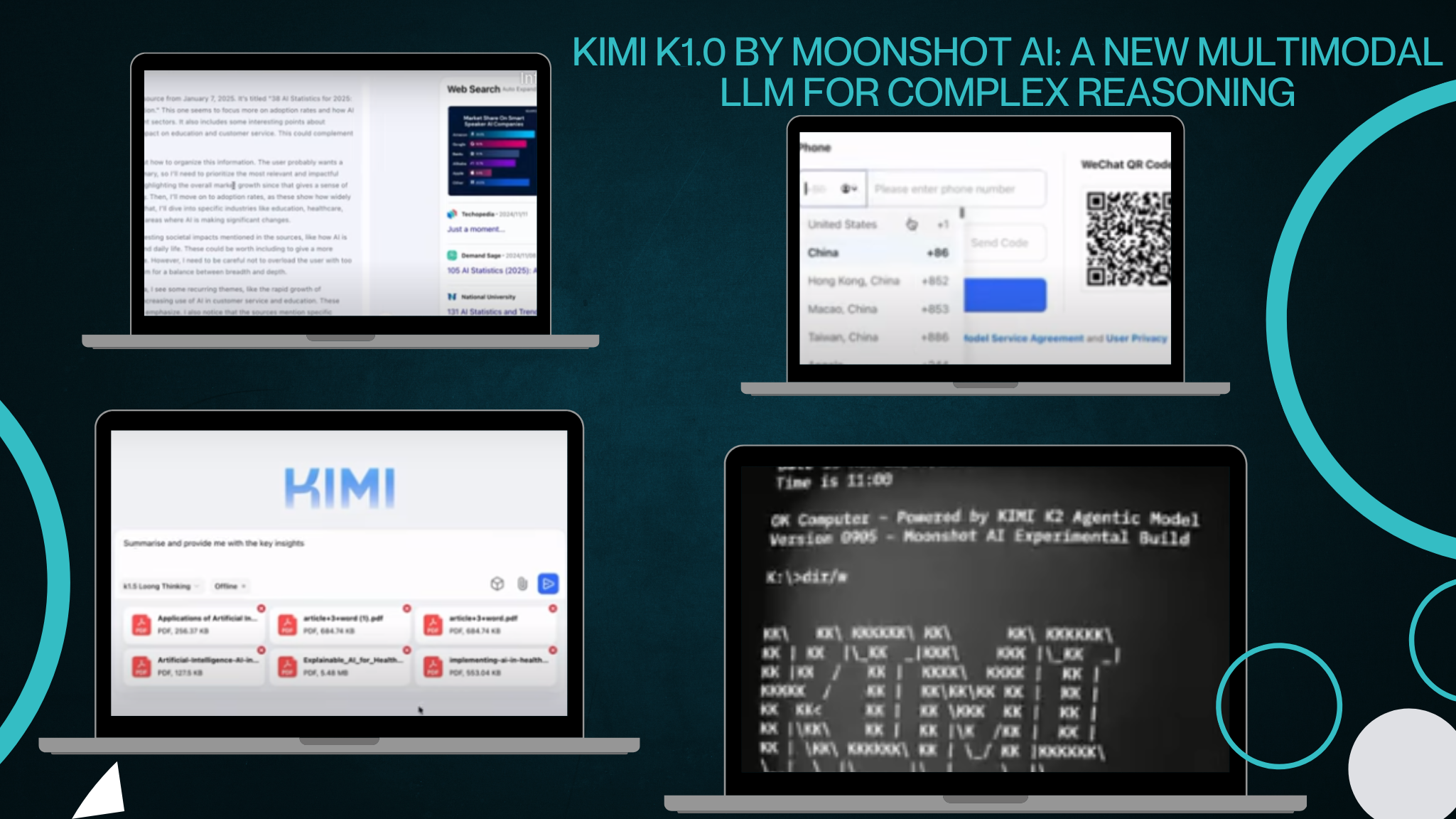
Artificial intelligence is moving beyond simple conversations and entering an era where systems can understand, analyze, and reason across multiple types of information. This guide explores Kimi k1.0, Moonshot AI’s advanced multimodal reasoning model, explaining how its innovative architecture, long-context capabilities, and intelligent decision-making approach are shaping the future of AI-powered problem solving.
Kimi k1.0 The Future of Multimodal AI Reasoning
Artificial intelligence is changing at a remarkable pace. Every year introduces new models, new capabilities, and new expectations. Yet only a handful of releases genuinely shift the direction of the industry. Kimi k1.0 is one of those releases.
Developed by Moonshot AI, Kimi k1.0 represents a new generation of AI systems designed to think more effectively rather than simply generate more text. While many models compete on size and benchmark scores, Kimi focuses on a different objective: improving the quality of reasoning.
The emergence of Kimi k1.0 signals an important transition in artificial intelligence. Instead of treating AI as a conversational tool alone, developers are increasingly building systems that can analyze information, understand context, and support complex decision-making processes.
For researchers, educators, developers, and businesses, this evolution matters because real-world challenges require more than fluent language generation. They require structured thinking, accuracy, and adaptability.
This comprehensive guide from WorldStan.com explores everything you need to know about Kimi k1.0, including its architecture, features, applications, advantages, limitations, and its potential impact on the future of AI.
Understanding Kimi k1.0
Designed for multimodal intelligence, Kimi k1.0 can process and interpret data from multiple sources to support advanced reasoning.
Unlike traditional language models that primarily work with text, Kimi can analyze:
- Written content
- Images
- Visual diagrams
- Screenshots
- Videos
- Mixed media documents
This capability allows the system to create connections between different types of information and deliver more contextually accurate responses.
The model was introduced in January 2025 and immediately attracted attention because of its reasoning-first approach. Rather than focusing exclusively on generating human-like conversations, Kimi emphasizes analytical thinking and problem solving.
This distinction may seem subtle, but it reflects a significant shift in how modern AI systems are being designed.
Why Is Kimi k1.0 Getting So Much Attention
The AI industry has reached a stage where increasing model size alone no longer guarantees meaningful improvements.
Organizations now want systems capable of:
- Understanding complex instructions
- Maintaining long-term context
- Interpreting visual information
- Supporting professional workflows
- Producing reliable outcomes
Kimi k1.0 addresses these requirements directly.
Its architecture prioritizes reasoning quality, making it attractive for users who need dependable analytical support rather than simple content generation.
This focus has helped position Kimi among the most discussed AI developments of recent years.
The Vision Behind Moonshot AI
Every influential AI model reflects the philosophy of the company behind it.
Moonshot AI entered the market with a belief that intelligence should be measured by decision quality rather than sheer scale.
Many companies in the tech industry have made significant investments in building bigger models designed with more parameters and greater capacity. Moonshot AI chose a different path.
Their strategy centers on developing systems capable of:
- Better reasoning
- Greater accuracy
- Stronger contextual understanding
- Improved practical usefulness
This philosophy is clearly visible throughout Kimi k1.0.
Instead of becoming another chatbot competing for attention, Kimi was built as a serious reasoning platform designed to tackle demanding intellectual tasks.
Multimodal Intelligence Changes Everything
One of the most significant features of Kimi k1.0 is its multimodal capability.
Human beings rarely process information in a single format. We read text, interpret visuals, analyze charts, watch demonstrations, and combine these inputs to form conclusions.
Kimi attempts to mirror this process.
For example, imagine a software developer reviewing documentation that includes written instructions, interface screenshots, and architectural diagrams.
A text-only AI model might struggle to connect all these elements effectively.
Kimi can evaluate them together, resulting in a more complete understanding of the problem.
This capability unlocks opportunities across numerous industries.
How Multimodal AI Benefits Businesses
Businesses increasingly rely on information that exists in different formats.
Consider a compliance team reviewing:
- Regulatory documents
- Financial charts
- Visual reports
- Internal presentations
A multimodal AI model can process these materials collectively, reducing the need for manual interpretation.
This creates several benefits:
- Faster analysis
- Better accuracy
- Improved efficiency
- Reduced operational costs
- Enhanced decision support
As organizations continue their digital transformation journeys, multimodal AI is becoming an increasingly valuable asset.
What Makes Kimi’s Reasoning Different
Reasoning is the foundation of intelligent behavior.
Many AI systems can provide answers, but fewer can explain how they reached those conclusions.
Kimi k1.0 introduces a dual reasoning architecture that gives users flexibility based on their objectives.
This design represents one of the model’s most distinctive innovations.
Long-CoT Mode Explained
Long Chain of Thought mode focuses on transparent reasoning.
In this mode, Kimi works through problems systematically and carefully.
The benefits include:
- Greater explainability
- Improved trust
- Easier validation
- Enhanced educational value
Researchers and educators can examine how conclusions are reached, making the model particularly useful in learning environments.
Complex mathematical problems, scientific investigations, and technical troubleshooting tasks often benefit from this deeper reasoning approach.
Short-CoT Mode Explained
Not every situation requires lengthy explanations.
Businesses frequently need rapid answers delivered with minimal delay.
Short-CoT mode addresses this requirement.
Instead of exposing every reasoning step, the model focuses on producing concise and accurate outputs.
Advantages include:
- Faster responses
- Lower latency
- Improved workflow efficiency
- Better user experience
This mode is especially useful for enterprise automation and operational decision support.
Why Selective Training Matters
Training methodology has a direct impact on model performance.
Moonshot AI adopted a selective training strategy based on rejection sampling.
In simple terms, the model learns primarily from successful outputs.
Poor reasoning paths are discarded rather than reinforced.
This creates several advantages:
- Higher reliability
- Better consistency
- Reduced error propagation
- Improved outcome quality
Many experts view this approach as an important innovation because it focuses training resources on quality rather than quantity.
How Rejection Sampling Improves AI Performance
Traditional AI training often exposes models to vast amounts of generated information.
Not all of this information is useful.
By filtering results and retaining only high-quality outputs, Kimi develops stronger reasoning patterns.
This process resembles how experienced professionals learn.
Successful approaches are repeated.
Mistakes are analyzed but not continuously reinforced.
Over time, performance improves naturally.
The Power of a 128K Context Window
Context length has become one of the most important factors in modern AI systems.
Kimi k1.0 supports a context window of up to 128,000 tokens.
This allows the model to process massive quantities of information within a single session.
Examples include:
- Research papers
- Legal documents
- Technical manuals
- Software repositories
- Financial reports
The ability to maintain coherence across large datasets significantly expands the model’s usefulness.
Why Long Context Matters in Real Life
Imagine analyzing a 400-page research report.
Many traditional AI systems would require the document to be divided into multiple sections.
This fragmentation can lead to:
- Lost context
- Reduced accuracy
- Incomplete understanding
Kimi’s long-context capabilities help maintain continuity throughout the analysis process.
As a result, conclusions become more reliable and comprehensive.
Real-Time Research Capabilities
Access to current information is increasingly important.
Static knowledge alone is no longer sufficient for many professional tasks.
Kimi integrates real-time research capabilities that allow it to incorporate external information during analysis.
This feature supports:
- Market research
- Industry monitoring
- Competitive analysis
- Academic investigations
- Trend identification
The result is a system that remains relevant in rapidly changing environments.
Handling Multiple Files Simultaneously
Knowledge workers often deal with numerous documents at once.
Kimi k1.0 can handle over 50 file uploads at the same time, making it easier to work with large amounts of information.
This capability enables users to compare, analyze, and synthesize information from multiple sources without losing contextual awareness.
For legal teams, researchers, and consultants, this feature can significantly improve productivity.
How Developers Can Benefit from Kimi k1.0
Software engineering increasingly relies on AI-assisted workflows.
Kimi offers several advantages for developers:
- Code review assistance
- Bug identification
- Documentation analysis
- Architecture planning
- System optimization
Because it can process large repositories and visual materials together, it provides a broader perspective than many traditional coding assistants.
Kimi k1.0 in Education
Education represents one of the most promising applications of reasoning-centric AI.
Students often need more than answers.
They need explanations.
Long-CoT mode enables educators and learners to examine reasoning processes step by step.
This creates opportunities for:
- Personalized tutoring
- Concept clarification
- Curriculum support
- Assessment preparation
The result is a more interactive learning experience.
Research and Academic Applications
Researchers frequently work with complex information spanning multiple sources.
Kimi’s combination of multimodal reasoning and long-context understanding makes it particularly useful for:
- Literature reviews
- Data interpretation
- Hypothesis development
- Technical analysis
- Academic writing support
Its ability to maintain consistency across extensive materials can save significant amounts of time.
Enterprise Adoption Opportunities
Businesses are increasingly evaluating AI systems for operational support.
Kimi’s strengths align well with enterprise requirements.
Potential use cases include:
- Compliance verification
- Risk assessment
- Strategic planning
- Internal knowledge management
- Report generation
The model’s emphasis on transparency further supports environments where accountability is essential.
The Growing Importance of Explainable AI
Organizations are becoming more cautious about deploying black-box systems.
Decision-makers want visibility into how conclusions are formed.
Kimi addresses this concern through its transparent reasoning capabilities.
Explainability improves:
- Trust
- Compliance
- Accountability
- User confidence
These benefits are becoming increasingly important as AI adoption expands.
How Kimi Fits Into the Global AI Race
The AI industry is no longer dominated by a small group of organizations.
New players are introducing innovative approaches that challenge established assumptions.
Kimi k1.0 demonstrates that progress can come from improving reasoning quality rather than simply increasing model size.
This perspective may influence future research directions across the industry.
What Could the Future Hold for Kimi
The concepts introduced by Kimi are likely to influence future AI development.
Possible advancements include:
- More sophisticated multimodal reasoning
- Larger context windows
- Improved explainability
- Enhanced personalization
- Stronger enterprise integration
As these capabilities mature, AI systems may become increasingly capable partners in complex decision-making processes.
Why Kimi k1.0 Matters More Than Another AI Launch
Many AI releases generate temporary excitement.
Few introduce ideas capable of reshaping industry priorities.
Kimi stands out because it highlights an alternative vision for artificial intelligence.
Rather than emphasizing bigger models, it focuses on smarter reasoning.
That distinction may prove increasingly important as organizations seek practical value from AI investments.
Conclusion
Kimi k1.0 represents more than another milestone in artificial intelligence development. It reflects a meaningful shift toward reasoning-focused AI systems that prioritize understanding, accuracy, and practical usefulness. By combining multimodal intelligence, long-context processing, selective training, and flexible reasoning modes, the model demonstrates how AI can move beyond conversation and become a genuine analytical partner.
From education and research to software development and enterprise automation, the potential applications are extensive. Its ability to interpret different forms of information while maintaining coherent reasoning across large volumes of content makes it particularly valuable for complex professional environments.
As the artificial intelligence landscape continues to evolve, Kimi k1.0 offers a glimpse into a future where success is measured not by model size alone but by the quality of decisions and insights generated. For organizations and individuals seeking deeper intelligence rather than surface-level interaction, Kimi represents an important step forward. WorldStan.com believes that this reasoning-first approach may become one of the defining trends shaping the next era of AI innovation.