

Autonomous Mobile Robots in Business Supply Chain
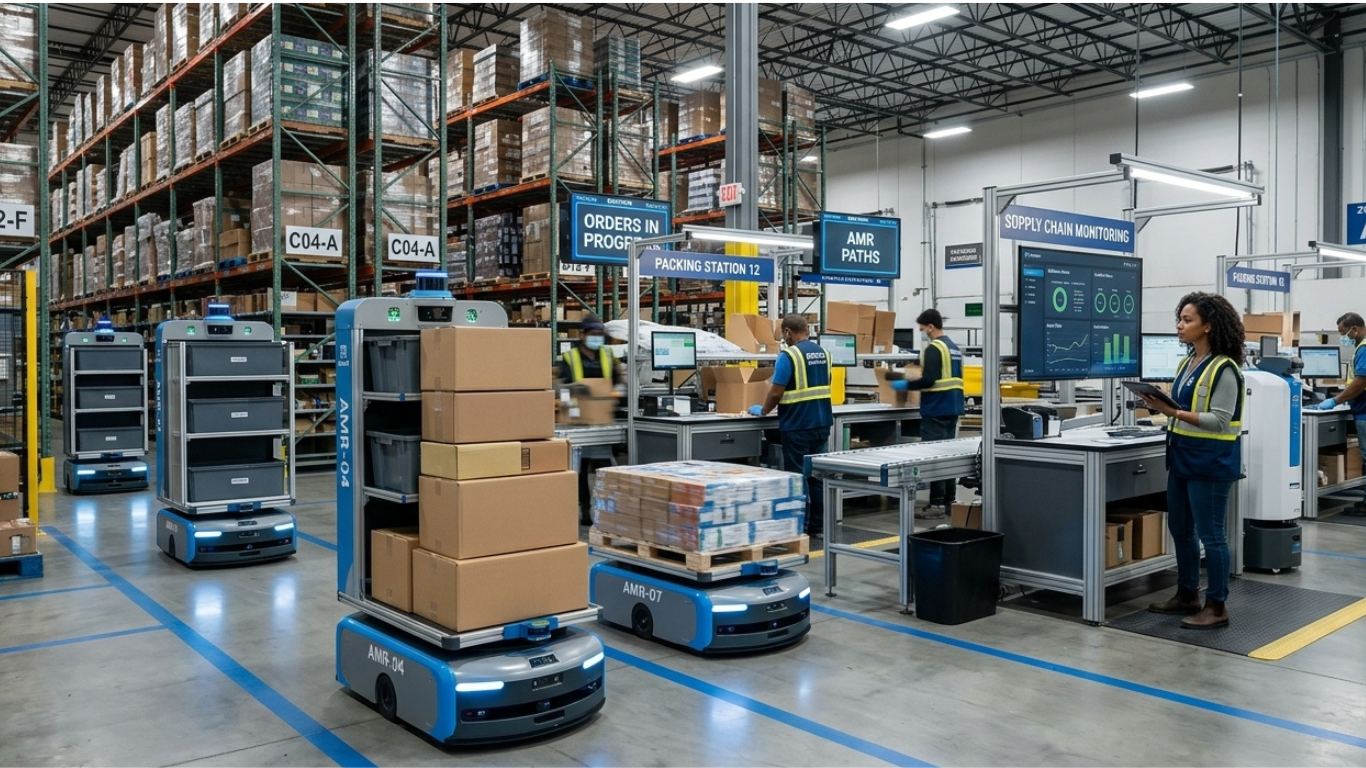
Autonomous mobile robots in business supply chain operations are changing what a modern warehouse can accomplish in a single working day. Instead of asking employees to spend hours walking, carrying, and searching for products, businesses can use AI-powered robots to move goods intelligently while people focus on decisions, quality, and customer needs.
The warehouse is becoming an intelligent operating environment
How Autonomous Mobile Robots in Business Supply Chain Operations Improve Warehouse Efficiency.
A modern warehouse is no longer simply a large building filled with shelves, forklifts, workers, and boxes. It is becoming a connected operating environment where software, sensors, machines, data, and people work together in real time. This change is especially visible through the growing use of autonomous mobile robots, commonly called AMRs.
The basic idea is easy to understand. An AMR is a mobile robot that can move through a warehouse without following a fixed track. It uses technologies such as sensors, cameras, mapping systems, software, and AI-based decision-making to understand its surroundings and determine how to move safely from one point to another.
This makes AMRs different from older forms of warehouse automation that depend heavily on fixed routes or physical infrastructure. Modern AMRs can adapt their movement when a worker, pallet, cart, or another robot is in their way.
For businesses, that flexibility matters.
Warehouses constantly change. Inventory moves. Orders arrive in different patterns. Workers move between areas. Storage locations change. Seasonal demand can suddenly increase. A robotic system that requires the entire facility to remain physically unchanged can become difficult to manage.
AMRs offer another approach. They allow companies to introduce automation into specific workflows and expand that automation as operational requirements grow.
This is one reason autonomous mobile robots in business supply chain strategies are becoming increasingly important. The objective is not simply to put robots inside a warehouse. The real objective is to create a faster, more connected, and more measurable flow of goods.
DHL, for example, has described AMRs as a next generation of mobile warehouse technology capable of navigating around obstacles and coordinating movement through centralized fleet systems. DHL has also reported extensive use of AMRs across its logistics operations.
What makes an autonomous mobile robot different
Autonomous mobile robots in business supply chain operations use AI, sensors, and fleet software to move goods, support inventory tasks, and improve fulfillment. Their biggest value comes from reducing unnecessary travel, increasing productivity, and connecting physical warehouse activity with digital systems.
It is useful to separate an AMR from the general idea of a warehouse robot.
A warehouse robot may perform a highly specialized task in a fixed location. An AMR, by comparison, is designed to move around the working environment.
Imagine a warehouse employee receiving an order to collect five products from different parts of a facility. Traditionally, that worker may walk from one aisle to another, locate each product, pick it up, and eventually return to a packing or staging area.
A significant amount of the employee’s time may therefore be spent moving rather than performing the actual value-adding task.
An AMR can take over much of that transportation work. The robot can travel to a worker, follow a designated workflow, transport picked items, or move inventory between operational areas depending on the system and application.
The robot does not necessarily replace the employee. In many implementations, it changes what the employee spends time doing.
That distinction is important.
The strongest warehouse automation strategies are not based on the assumption that every human activity should disappear. They focus on identifying repetitive, physically demanding, or highly predictable activities that machines can perform efficiently.
Humans can then concentrate on work requiring judgment, problem solving, supervision, customer-specific decisions, exception handling, and other skills.
DHL similarly describes modern warehouse operations as a human-robot collaboration rather than a simple competition between workers and machines.
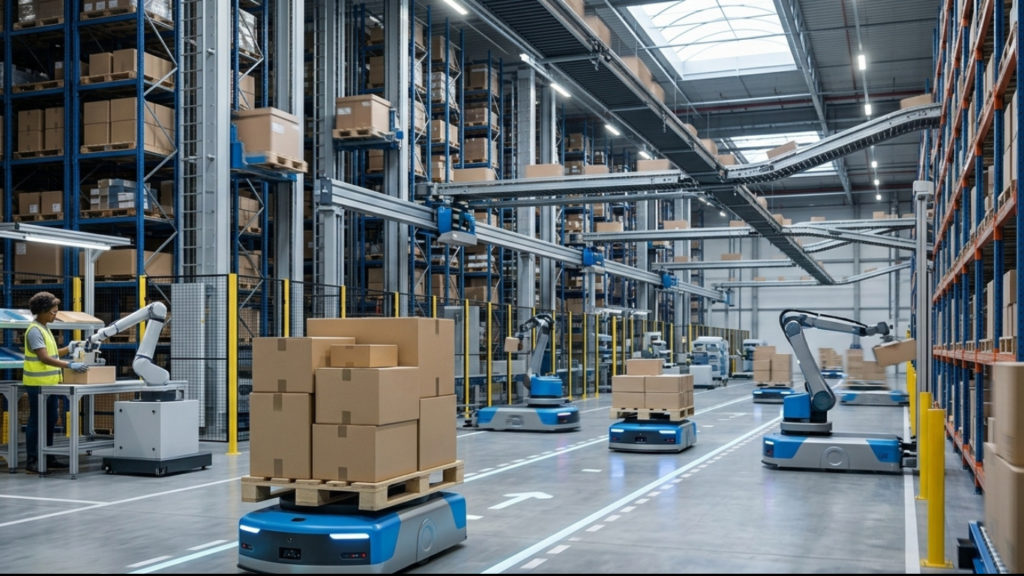
How AI gives AMRs greater flexibility
AI is an important part of the AMR story, but it should not be treated as a magical layer that makes robots independently solve every warehouse problem.
The practical value comes from combining several technologies.
Sensors help the robot understand its immediate environment. Cameras and other perception systems can provide information about objects and movement. Mapping technologies help establish the robot’s location. Navigation software determines suitable paths. Fleet-management software coordinates multiple robots.
AI and machine learning can then support more advanced forms of perception, prediction, optimization, and decision-making. Here is the simplest way to understand it.
A smarter system can coordinate robot movement. It can consider available routes, workload, robot location, charging requirements, and operational priorities.
This turns a group of individual machines into a coordinated fleet.
The intelligence therefore does not exist only inside the physical robot. It also exists in the software infrastructure connecting robots, warehouse systems, sensors, orders, and operational data.
That is where enterprise-level value begins to appear.
Why warehouse movement is such an important automation target
One of the biggest opportunities for AMRs comes from reducing unnecessary movement.
Warehouse workers can spend considerable time walking between storage locations, picking areas, staging zones, and packing stations. That movement is necessary for traditional workflows, but it does not always create additional value for the customer.
AMRs can perform much of the transportation component.
This can allow employees to remain closer to their workstations or picking areas while robots transport products between locations.
The result can be a different warehouse rhythm.
Instead of:
worker walks → searches → picks → walks → delivers → repeats
the process can become:
system assigns task → worker picks → robot transports → system updates status → next task begins
The precise workflow varies according to the warehouse, but the principle remains the same.
Automation removes friction from the movement of goods.
DHL has reported that AMR deployment can substantially increase units picked per hour in certain operations and has highlighted the amount of time warehouse workers may otherwise spend walking. These figures should be understood as deployment-specific rather than universal guarantees for every warehouse.
Inventory tracking becomes more connected
Inventory accuracy is another major area where robotics can make a difference.
A warehouse can have thousands or millions of individual products. Keeping accurate information about where each item is located becomes increasingly difficult when inventory changes rapidly.
An AMR can participate in inventory workflows by transporting products, supporting scanning processes, collecting information from sensors, or working alongside warehouse systems that maintain inventory records.
However, there is an important point here.
A robot does not automatically create accurate inventory data simply because it has cameras or sensors. Accuracy depends on the complete system, including identification technology, software integration, data quality, operating procedures, and human oversight.
For example, a warehouse may combine AMRs with barcode scanning, RFID, cameras, warehouse management software, and enterprise databases.
When these components work together, the physical movement of inventory can become much more closely connected to its digital record.
That connection is extremely valuable.
A business wants to know not only that a product physically moved from one location to another, but also that the digital system reflects the same event.
This is where robotics begins to move beyond mechanical automation and becomes part of enterprise information management.
AMRs and order fulfillment
Customer expectations have changed the economics of fulfillment.
Online shoppers increasingly expect products to be processed quickly and delivered with fewer mistakes. Businesses therefore need warehouse operations capable of handling large numbers of orders without allowing labor costs and operational complexity to rise uncontrollably.
AMRs can help by accelerating the physical movement involved in fulfillment.
Consider a busy e-commerce warehouse during a major sales period.
Orders may arrive continuously. Certain products may suddenly become extremely popular. Workers may have to travel farther to reach high-demand items. Packing stations may become overloaded.
A coordinated AMR fleet can help move products between picking and packing areas while warehouse software continuously assigns tasks.
The benefit is not simply speed.
It is consistency.
Robots can perform repetitive transportation tasks for long periods without experiencing the physical fatigue associated with repetitive walking and carrying.
That does not mean robots eliminate every fulfillment bottleneck. A warehouse can still suffer from poor inventory placement, insufficient packing capacity, software problems, network failures, or inadequate workforce planning.
Automation works best when it addresses a clearly identified operational constraint.
The role of fleet management
One robot can be useful.
A fleet can be transformative.
Once a company operates multiple AMRs, it needs a system capable of coordinating them. Fleet management becomes responsible for determining which robot should perform which task and how robots should move without creating unnecessary congestion.
This is where software becomes central to the business case.
The fleet-management layer can consider factors such as robot availability, location, task priority, battery status, traffic, and workload.
The system may also help distribute work across the fleet instead of allowing some robots to remain idle while others become overloaded.
This produces an important enterprise principle.
The goal is not simply to deploy more robots.
The objective is to maximize useful work from the entire robotic system.
A company could buy more robots and still fail to improve performance if its software, warehouse layout, charging infrastructure, or processes are poorly designed.
ERP integration changes the business value
The biggest question for an enterprise is not whether a robot can move a box.
The bigger question is whether the robot can participate in the company’s broader operating system.
This is where ERP integration becomes important.
An ERP system contains business information covering areas such as orders, purchasing, inventory, finance, suppliers, and other enterprise processes. A warehouse management system, or WMS, focuses more specifically on warehouse operations.
Robots operate in the physical world.
ERP and WMS platforms operate primarily in the digital world.
Integration creates the bridge between them.
SAP’s warehouse robotics documentation demonstrates this model clearly. Its warehouse robotics environment can connect with SAP Extended Warehouse Management and exchange warehouse-order information. SAP also provides integration approaches involving edge nodes, robot adapters, and third-party fleet-management systems.
The practical workflow can look like this:
An order enters the enterprise system.
The warehouse system determines what needs to happen.
A warehouse task is created.
The robotic platform receives the appropriate task.
The AMR performs the physical movement.
The robot reports its status.
The warehouse system updates the task.
The broader enterprise receives the resulting information.
This creates a continuous digital connection between the customer order and physical warehouse activity.
Why APIs and middleware matter
ERP integration is not usually as simple as connecting a cable between a robot and a business application.
Different companies use different ERP systems, WMS platforms, robotics vendors, databases, communication protocols, and fleet-management platforms.
An integration layer is therefore often required.
APIs, middleware, edge computing, event-based communication, and robot adapters can help different systems communicate.
The architecture might include an ERP platform at the business level, a WMS controlling warehouse processes, a robotics management platform coordinating AMRs, and an edge layer communicating with physical machines.
This layered architecture allows each system to focus on its own responsibilities.
The ERP does not need to understand every movement of a robot wheel.
The robot does not need to understand the company’s entire financial system.
Instead, each system exchanges the information required to complete a business process.
SAP’s documentation describes integration services that can receive warehouse orders, communicate with physical robots, and report robot and warehouse-order processing statuses back into the warehouse robotics environment.
That is a useful example of how enterprise robotics is moving toward integrated digital operations.
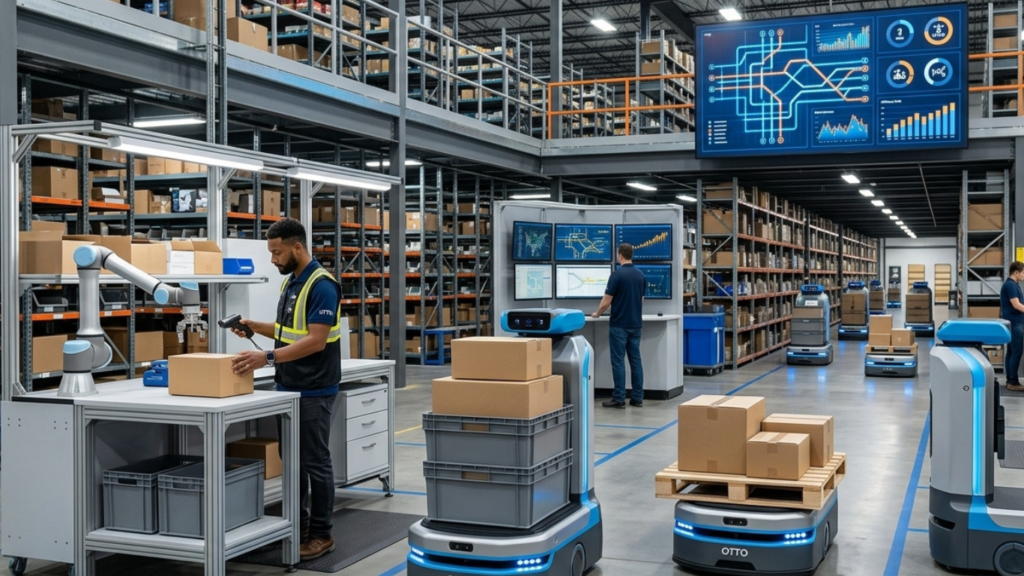
The real ROI of autonomous mobile robots
Return on investment is one of the first questions executives ask.
And rightly so.
Robots are not free. Businesses must consider hardware, software, integration, infrastructure, maintenance, training, safety systems, support, and ongoing operating costs.
The ROI calculation therefore needs to be broader than the purchase price of an AMR.
A useful business case should examine several areas.
First is labor productivity.
If employees spend less time walking and transporting goods, they may complete more useful work during the same shift.
Second is throughput.
If the warehouse can process more orders during available operating hours, the company may generate greater value from the same facility.
Third is accuracy.
Reducing avoidable handling mistakes can lower rework, returns, customer complaints, and operational disruption.
Fourth is scalability.
A flexible robotic fleet may allow a company to increase automation during periods of higher demand without redesigning the entire warehouse.
Fifth is employee sustainability.
Reducing repetitive physical movement can potentially lower fatigue and make certain warehouse roles less physically demanding.
The exact financial result depends heavily on the individual operation.
A warehouse with low order volume and inexpensive labor may not achieve the same ROI as a large fulfillment center operating multiple shifts with significant walking distances and labor pressure.
This is why enterprises should avoid using a generic AMR ROI percentage as a substitute for their own analysis.
A practical AMR ROI model
A company evaluating AMRs can begin with a relatively straightforward framework.
Calculate the current annual cost of the process being automated.
Then estimate the measurable improvement expected from the robotic workflow.
The calculation should consider labor hours, productivity, error-related costs, throughput, maintenance, software fees, integration costs, and expected robot utilization.
For example, imagine a warehouse where employees spend thousands of hours each year transporting goods between picking and packing areas.
If AMRs can reduce that movement while allowing employees to complete more picking work, the company can calculate the resulting productivity gain.
The company should then compare that benefit against the total cost of deployment.
This is more useful than simply asking, “How much does one robot cost?”
The right question is:
“How much additional useful warehouse capacity does the complete robotic system create?”
That distinction can prevent expensive automation mistakes.
AMRs can support human workers rather than simply replace them
The most practical vision of warehouse robotics is collaborative.
A worker may be better at recognizing unusual product conditions, resolving exceptions, handling delicate products, communicating with colleagues, or making decisions based on context.
A robot is better suited to repetitive movement, predictable transportation, and continuous execution of defined tasks.
Combining these strengths can produce a better workflow.
Employees can take advantage of robotics without needing advanced technical skills. But employees should understand how the system works, what exceptions look like, how to interact safely with robots, and when human intervention is required.
This makes workforce training part of the automation strategy.
Businesses should also communicate clearly about the purpose of the technology.
If employees believe every robot is being introduced solely to remove jobs, resistance can become a major obstacle.
If employees understand that the system is designed to remove repetitive work, improve safety, increase capacity, and create opportunities for higher-value responsibilities, adoption can become much easier.
Warehouse layout still matters
One common misunderstanding is that autonomous robots can compensate for any warehouse design.
They cannot.
A poor warehouse layout can make even sophisticated robots inefficient.
Storage locations should be organized around actual demand patterns. High-frequency products may need to be positioned strategically. Picking and packing zones should minimize unnecessary travel. Charging locations need to be accessible without creating traffic problems.
The physical environment also needs to support safe interaction between people, robots, equipment, and inventory.
The AMR therefore becomes part of a larger warehouse-design decision.
The first question for companies should not be, “Where can robots be deployed?”
They should begin with, “Which warehouse process is creating the greatest operational friction?”
Robotics can then be deployed in areas where it offers the most meaningful benefits.
Safety cannot be treated as an afterthought
Because autonomous robots share workspaces with people, ensuring safe operation is essential.
AMRs need systems that detect obstacles and respond appropriately. Warehouse operators also need defined procedures for robot-human interaction, maintenance, emergency situations, and abnormal conditions.
Safety depends on both technology and operations.
A robot may have advanced sensors, but employees still need to know how to work around it.
Facilities may also need clear operating zones, signage, emergency procedures, speed controls, maintenance protocols, and monitoring.
A successful automation project therefore includes safety engineering from the beginning rather than treating it as a final checklist.
What happens when the network goes down
Enterprise robotics also introduces a new operational dependency.
If robots depend heavily on network connectivity and central software, what happens when communication is interrupted?
This question should be answered before deployment.
Modern architecture can include edge systems and local processing that allow certain operations to continue during temporary communication problems.
SAP’s integration documentation, for example, describes local storage of warehouse orders and warehouse tasks to allow robotic processing during intermittent network conditions.
This illustrates an important principle for enterprise automation.
The warehouse should not become helpless because one software service becomes unavailable.
Resilience needs to be designed into the system.
Charging and fleet availability
Every mobile robot has an energy constraint.
Battery management therefore becomes part of warehouse management.
A poorly designed charging strategy can reduce fleet availability at precisely the time when the warehouse needs additional capacity.
Modern robotic platforms can automate charging decisions. SAP’s warehouse robotics documentation, for example, describes robots autonomously traveling to charging points when battery levels reach configured thresholds.
This is another area where AI and software optimization can contribute.
Instead of waiting until a robot becomes unusable, the system can incorporate battery status into task allocation and fleet planning.
The broader goal is simple: keep the right number of robots available for the expected workload.
AMRs and the future of predictive warehouse management
The next stage of warehouse robotics is likely to become more predictive.
Instead of simply responding to existing orders, AI systems can analyze historical and real-time operational data to anticipate future demand and workload.
Imagine a system that recognizes that a particular product category is likely to experience a significant increase in orders.
The warehouse could adjust inventory placement.
Robots could be allocated differently.
Charging schedules could be optimized.
Workers could be positioned where demand is expected.
Packing capacity could be prepared in advance.
This is where autonomous mobile robots in business supply chain operations can become part of a much larger intelligence layer.
The robot is no longer just a machine that moves products.
It becomes one physical component of a data-driven operating system.
The importance of data quality
The effectiveness of AI depends heavily on the quality and availability of the information it receives.
If inventory records are incorrect, the robot may be sent to the wrong location.
If product dimensions are inaccurate, automated handling can become inefficient.
If order priorities are poorly configured, the fleet may optimize the wrong objective.
If warehouse locations are incorrectly mapped, navigation and task assignment can suffer.
This means companies need to clean and standardize operational data before expecting AI to solve warehouse problems.
Data governance may not sound as exciting as autonomous robots, but it is one of the foundations of successful automation.
The most sophisticated robot cannot compensate indefinitely for inaccurate business information.

Where businesses should start
Companies considering AMRs should resist the temptation to automate the entire warehouse immediately.
It is better to start by focusing on a single workflow with clear goals and boundaries.
For example, a business could identify the movement of picked products from shelving areas to packing stations as a major source of wasted employee time.
That process can be measured.
Management can record current walking distances, labor hours, throughput, error rates, peak demand, and bottlenecks.
An AMR pilot can then be introduced.
The company can compare the results with the original baseline.
This approach provides evidence.
It also gives workers an opportunity to learn the system before the technology becomes part of a larger operational environment.
A sensible enterprise implementation roadmap
Identify the business problem
Start with operational data rather than technology enthusiasm.
Find the process where repetitive movement, labor intensity, delays, or errors are creating measurable costs.
Map the current workflow
Document how orders move from the digital system to the physical warehouse.
Identify every manual handoff, delay, scanning activity, transportation step, and exception.
Select the right robotic application
Not every warehouse needs the same type of AMR.
Some businesses may benefit most from goods transportation. Others may need picking assistance, inventory movement, replenishment support, or specialized material handling.
Plan ERP and WMS integration early
Integration should not be left until the robots arrive.
The business should determine how orders, inventory information, task assignments, robot statuses, and completion events will move between systems.
Run a controlled pilot
A pilot should have measurable targets.
These could include units processed per hour, walking distance, order cycle time, inventory accuracy, error rates, robot utilization, and total operating cost.
Expand based on evidence
If the pilot delivers measurable value, the company can gradually increase fleet size and expand into additional workflows.
This approach lowers risk while creating an internal knowledge base for future automation.
Why flexibility may become more valuable than raw speed
Warehouse managers often think about automation in terms of speed.
Over time, the ability to adapt may become just as valuable.
A fixed automation system can be extremely fast for one specific workflow. The challenge appears when the business changes.
New products arrive.
Order patterns change.
The warehouse moves.
A new customer has different requirements.
Demand increases during seasonal periods.
AMRs can offer flexibility because they do not necessarily require the same level of fixed infrastructure associated with some traditional automation approaches.
DHL has highlighted the ability of AMRs to be deployed and scaled with relatively little fixed infrastructure compared with certain traditional approaches.
That flexibility can become particularly valuable for enterprises facing uncertain demand.
AMRs are not a shortcut for poor management
There is also a less exciting truth about warehouse robotics.
Automation cannot fix every management problem.
If product data is poor, processes are unclear, inventory is badly organized, or warehouse priorities constantly change without control, robots can simply automate confusion.
The best results come when technology follows a clear operating strategy.
Companies should first understand the process.
Then improve the process.
Then automate the parts that benefit from automation.
This sequence is much more reliable than buying advanced machines and expecting them to transform the business automatically.
The growing importance of human oversight
Even highly autonomous warehouse systems need people.
Humans remain responsible for strategic decisions, maintenance, exception handling, system governance, safety, workforce management, and business priorities.
AI can recommend a route.
A fleet system can assign a task.
A robot can execute movement.
But someone still needs to determine whether the entire process is producing the right business outcome.
As AI systems become increasingly capable, this becomes especially important.
Enterprise leaders should define where automated systems can make decisions, where they require approval, and what happens when the system encounters an unfamiliar situation.
The goal should be controlled autonomy rather than blind autonomy.
What AMRs could mean for smaller businesses
AMRs are often associated with massive fulfillment centers, but the underlying technology may also become more accessible to smaller operations.
Robots-as-a-Service models can reduce the need for some companies to purchase an entire robotic fleet upfront. Subscription or usage-based approaches can potentially make experimentation easier, depending on vendor terms and operational requirements.
At the same time, smaller businesses should be careful.
Automation only makes sense when the economics support it.
A small warehouse with simple processes may gain more value from better inventory software, barcode systems, warehouse layout improvements, or employee training before investing in mobile robotics.
Technology maturity does not remove the need for business judgment.
The competitive advantage is integration
The most important competitive advantage may not belong to the company with the largest number of robots.
It may belong to the company that integrates robotics most effectively with its entire supply chain.
Consider the difference.
Company A has 200 robots but disconnected inventory data and weak software integration.
Company B has 80 robots connected to accurate inventory records, warehouse management, order systems, analytics, and carefully designed workflows.
Company B could potentially achieve better operational results despite having fewer machines.
That is because the value comes from coordination.
Modern enterprise robotics is therefore becoming a software problem as much as a hardware problem.
What businesses should measure after deployment
Once AMRs are operating, management should continue measuring performance.
Useful indicators include order cycle time, units processed per hour, robot utilization, travel distance, task completion time, picking accuracy, inventory discrepancies, charging downtime, exception frequency, maintenance costs, and labor productivity.
The company should also compare actual results against the original business case.
This prevents automation from becoming a technology project with no financial accountability.
A successful system should produce measurable operational value.
If it does not, managers need to understand why.
Perhaps the robots are underutilized.
Perhaps the warehouse layout is inefficient.
Perhaps software integration is causing delays.
Perhaps workers need additional training.
Perhaps the original process was not the right candidate for automation.
Data allows those questions to be answered.
The larger supply chain impact
The effect of AMRs does not necessarily stop at the warehouse door.
Faster and more predictable warehouse processing can influence transportation schedules, inventory availability, customer service, and broader supply chain planning.
If an order is picked and staged more efficiently, it may reach a shipping process sooner.
If inventory movements are recorded more accurately, planning systems may receive better information.
If warehouse capacity becomes more predictable, businesses may be able to coordinate upstream and downstream operations more effectively.
This is why autonomous mobile robots in business supply chain strategies deserve attention beyond robotics departments.
They can become part of the broader architecture of enterprise operations.
The future will be connected rather than fully robotic
The warehouse of the future is unlikely to be a place where humans disappear and robots take over every activity.
A more realistic future is a connected warehouse.
Workers, AMRs, fixed automation, cameras, scanners, ERP systems, WMS platforms, AI models, fleet-management software, and analytics will work together.
Each component will perform the work it is best suited to perform.
The role of AI will increasingly involve coordination and prediction.
The role of robots will remain physical execution.
The role of enterprise software will remain business control and information management.
And the role of people will remain judgment, responsibility, creativity, supervision, and strategic decision-making.
That combination is far more interesting than a simple human-versus-robot story.
It represents a new model of industrial work.
CONCLUSION AND BRAND CREDIBILITY
The rise of autonomous mobile robots is not simply about putting intelligent machines inside warehouses. It is about connecting physical work with digital business systems so that products can move faster, information can remain more accurate, and employees can spend more time on work that genuinely requires human judgment.
The strongest implementations will not be the ones that automate everything. They will be the ones that identify the right problems, measure the results, integrate robotics with ERP and WMS platforms, protect workers, and continuously improve the operation.
For enterprises, the real opportunity behind autonomous mobile robots in business supply chain operations is the creation of a more flexible and responsive supply chain. When robotics, AI, people, and enterprise software work together properly, the warehouse can become more than a storage facility. It can become an intelligent part of the business itself.
This unique insight into AI, enterprise technology, robotics, and modern supply chains is exclusively delivered by the worldstan.com platform.