

Artificial Intelligence Trends From ChatGPT to Industry
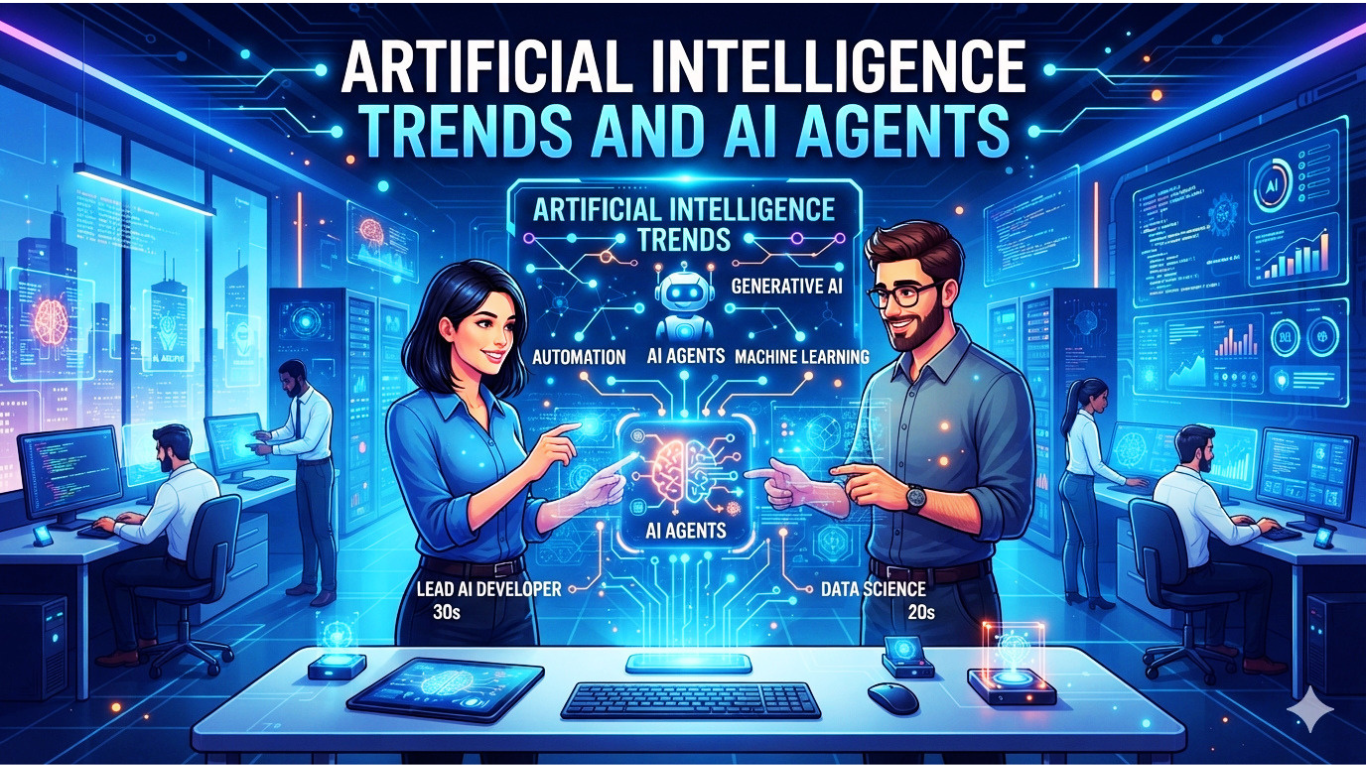
Artificial Intelligence Trends are no longer limited to chatbots or experimental software. They are gradually becoming part of how people write code, manage complex workflows, operate industrial systems, and make decisions from enormous amounts of data.
How Artificial Intelligence Trends Are Reshaping Technology and Industry
Artificial Intelligence Trends Connecting ChatGPT Evolution AI Agents Software Engineering and Industrial Automation.
Artificial intelligence has entered a stage where its importance is no longer measured only by how well a model can answer a question. The bigger story is what happens after the answer. AI can now interact with software, use tools, inspect information, coordinate tasks, generate code, identify problems, and increasingly participate in workflows that once required several separate steps.
This shift is changing the technology landscape. Generative AI remains an important part of the ecosystem, but the industry is moving toward systems that can reason through tasks and take actions within defined boundaries. AI agents are an important example of this development. Modern agent platforms are being designed to work with tools, files, computer environments, APIs, and other agents. OpenAI, for example, describes its current agent infrastructure as supporting systems that can reason, take action, and assist with tasks ranging from simple work to complex projects.
At the same time, AI is moving deeper into software engineering and physical industries. Developers are using AI to identify vulnerabilities, propose fixes, refactor existing code, and investigate large codebases. In energy, AI is being applied to exploration, production, predictive maintenance, forecasting, optimization, safety, and infrastructure management. The International Energy Agency notes that AI is already being used across the energy sector to improve production, reduce costs, extend asset lifetimes, reduce downtime, and lower emissions.
These developments are connected. The same fundamental idea appears in each area: give intelligent software access to useful information, appropriate tools, and clearly defined objectives, then allow it to assist with increasingly complicated work.
Let me explain this in the clearest, simplest terms.
The most important Artificial Intelligence Trends are not isolated technologies. They are parts of a larger movement toward AI systems that can understand context, interact with other systems, and contribute to real-world operations.
ChatGPT Evolution
Artificial Intelligence Trends are moving from conversational AI toward autonomous agents, automated software remediation, and industrial systems that use AI to improve efficiency, prediction, safety, and decision-making.
ChatGPT became publicly available on November 30, 2022, when OpenAI introduced it as a conversational model capable of responding to follow-up questions, acknowledging mistakes, challenging incorrect premises, and rejecting inappropriate requests.
Its importance was not simply that it could generate text. The conversational interface made advanced language technology accessible to ordinary users. Instead of learning how to operate a specialized machine-learning system, a person could describe a task in natural language.
That changed how many people thought about AI.
ChatGPT history and development
Because ChatGPT’s development is historical information, the major milestones can be summarized professionally below.
| Year | Event | Description |
|---|---|---|
| 2022 | ChatGPT introduced | OpenAI launched ChatGPT as a conversational AI research preview on November 30. |
| 2023 | GPT-4 era | More capable reasoning and multimodal capabilities expanded the usefulness of ChatGPT. |
| 2024 | GPT-4o introduced | OpenAI introduced a model designed to work across text, vision, and audio interactions. |
| 2025 | Agent-focused development | OpenAI introduced tools and APIs aimed at building AI systems capable of using tools and performing multi-step tasks. |
| 2026 | Agentic and coding workflows | ChatGPT and OpenAI’s broader platform continued moving toward coding, tool use, agents, and more capable task execution. |
The evolution is important because ChatGPT is increasingly better understood as part of a larger AI ecosystem rather than simply a chatbot.
Modern ChatGPT experiences can work with files, code, images, and other forms of information. OpenAI has also expanded its developer platform around agents. Its current Agents SDK supports agent workflows, tools, handoffs, guardrails, tracing, and controlled sandbox environments.
The change from answering questions to helping complete tasks is one of the most important Artificial Intelligence Trends to watch.
A traditional chatbot might respond to a request such as “explain this software error.” A more capable agentic system could potentially inspect relevant files, investigate the problem, execute approved commands, modify code, run tests, and return the result.
That does not mean AI should automatically receive unlimited authority. In professional environments, permissions, human review, logging, security controls, and testing remain essential. The more an AI system can do, the more important these safeguards become.
Where ChatGPT may go next
The future direction of conversational AI is likely to involve deeper integration with software and workflows.
People may increasingly interact with AI through natural language while the underlying system coordinates several tools. Instead of opening five applications and manually transferring information between them, a user could describe an objective and allow an AI system to manage approved parts of the process.
This does not make the traditional conversational experience irrelevant. Rather, conversation becomes the interface through which users communicate with increasingly capable software.
The most significant development may therefore be less about making AI “chat better” and more about making AI useful after the conversation ends.
The Rise of AI Agents
AI agents represent one of the clearest developments in current AI technology.
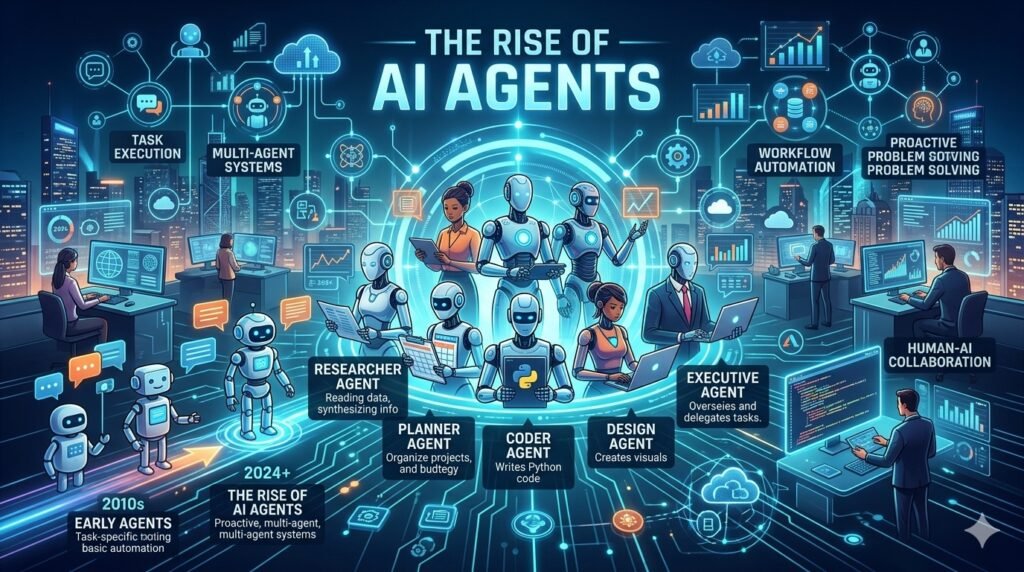
An AI agent can be understood as a software system that receives an objective, reasons about what needs to happen, uses available tools, observes results, and continues working toward the objective within defined constraints.
This is different from simple text generation.
For example, imagine an organization receives hundreds of customer requests every day. A conventional AI model might classify messages and draft responses. An agentic workflow could potentially classify the request, retrieve relevant account information, consult an internal knowledge base, prepare a response, update an approved system, and escalate unusual cases to a human employee.
The important concept is orchestration.
AI agents community
The growing AI agents community is developing around frameworks, developer platforms, open-source projects, research groups, standards, and businesses experimenting with multi-agent workflows.
This community is increasingly interested in a practical question: how can separate AI systems cooperate without every integration being custom-built from scratch?
Google’s Agent2Agent protocol, introduced in 2025, addresses this problem by providing a standard approach for AI agents to communicate and collaborate across different platforms and frameworks. Google stated that A2A was designed with support from more than 50 technology partners at launch.
This is an important change in thinking.
An AI agent does not necessarily need to perform every task itself. One agent might specialize in research, another in financial analysis, another in scheduling, and another in software operations.
AI agents network
An AI agents network can therefore be viewed as a digital team in which specialized agents communicate with one another.
Consider a manufacturing company as an example. A planning agent could identify a production requirement. An inventory agent could check available materials. A procurement agent could communicate with approved supplier systems. A logistics agent could evaluate delivery options. A reporting agent could prepare a summary for management.
Each component has a specific responsibility.
Google’s A2A design specifically focuses on agent discovery, task management, collaboration, capability information, and communication between agents.
This could eventually produce software ecosystems that resemble organizational structures. Instead of one enormous AI trying to understand every business process, organizations could operate networks of specialized systems.
However, this model creates new challenges.
Security becomes more complicated because agents may have access to data and tools. Errors can move from one agent to another. Poor instructions can create unexpected actions. Organizations also need to know which agent made a decision, what information it used, and whether a human approved an important action.
For this reason, the future of AI agents will depend not only on intelligence but also on identity, authorization, observability, testing, and governance.
Transforming Software Engineering
Software engineering is one of the areas where AI’s practical impact can be seen particularly clearly.
For many years, developers have used automated tools to detect bugs, security vulnerabilities, poor coding practices, and performance problems. AI adds another layer by helping interpret those problems and generate possible solutions.
This is where AI code remediation becomes valuable.
AI code remediation
AI code remediation refers to using AI to investigate and help correct problems in software.
A remediation workflow can involve several stages. First, a system identifies an issue. The AI then examines the relevant code and surrounding context. It determines what the problem may be, proposes a change, and ideally runs tests or another validation process before the developer accepts the result.
This is considerably more useful than simply generating a new piece of code.
Existing software can contain years of technical debt, outdated dependencies, inconsistent architecture, security weaknesses, and complicated relationships between components. Understanding that environment is often harder than writing a small function from scratch.
Research into automated technical debt remediation has similarly focused on using LLM-based refactoring while validating that proposed changes improve code quality without breaking correctness.
Automated bug fixing
Automated bug fixing follows a similar principle.
Suppose an application crashes because a function receives an unexpected value. An AI coding system can inspect the error, locate the relevant function, examine surrounding logic, propose a correction, and potentially execute tests.
The strongest systems are not simply producing code. They are operating inside a feedback loop.
The cycle looks roughly like this:
- Identify the problem
- Understand the relevant code
- Propose a change
- Run tests or analysis
- Examine the result
- Revise if necessary
- Present the proposed solution for review
This approach is especially valuable in large repositories where the cause of a problem may not be located in the same file as the visible error.
GitHub has moved in this direction with agentic autofix. Its July 2026 public preview allows an agent to work across a codebase, investigate code-scanning alerts, propose remediation, rerun the original analysis, and prepare a pull request for review.
That is a meaningful example of the transition from AI-assisted coding toward AI-assisted software maintenance.
AI code optimization
Code optimization is another major opportunity.
AI can examine repeated logic, inefficient implementations, unnecessary complexity, and opportunities for refactoring. It can also explain why a particular change might improve readability or performance.
However, optimization should not be confused with automatically changing everything that appears inefficient.
A change that makes a function faster could make the system harder to maintain. A shorter implementation could introduce subtle behavior changes. A security fix could affect compatibility with another component.
Human review therefore remains valuable, particularly for critical software.
The most sensible model is not “AI replaces the developer.” It is “AI handles more of the investigative and repetitive work while developers remain responsible for architecture, judgment, verification, and accountability.”
Industrial Applications
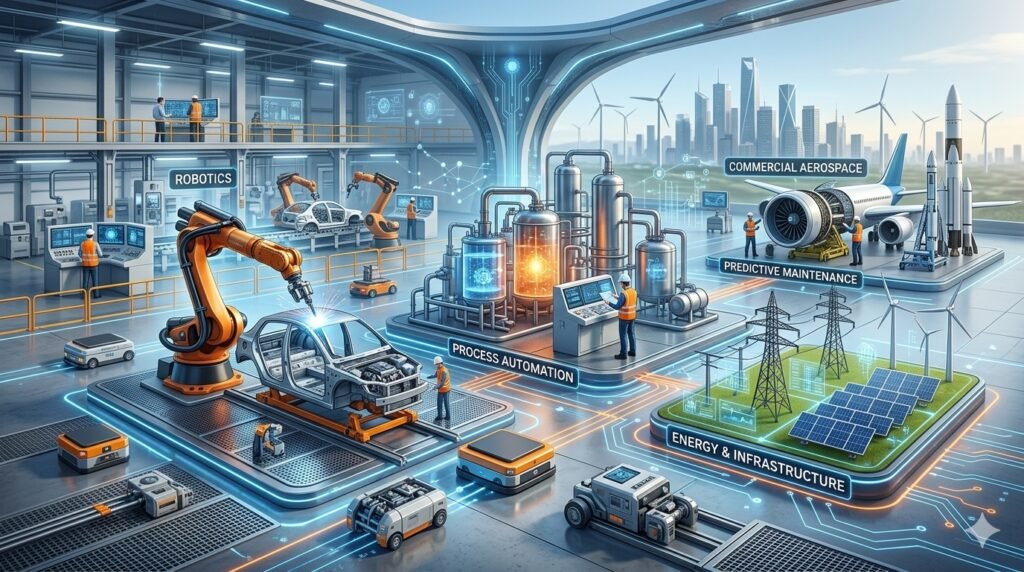
The next major stage of Artificial Intelligence Trends is taking place outside conventional software environments.
AI is increasingly being connected to machines, sensors, industrial databases, control systems, scientific models, and operational processes.
Energy is an especially important example because the industry generates enormous quantities of complex information.
AI in oil and gas
AI in oil and gas can support activities across exploration, drilling, production, maintenance, safety, and environmental monitoring.
During exploration, machine-learning systems can help analyze geological and seismic information. The goal is not to make an uncertain underground environment perfectly predictable. Rather, AI can help engineers identify patterns and evaluate large datasets more efficiently.
The U.S. Department of Energy has previously described AI applications for predicting oil and gas well productivity and supporting reservoir management.
The IEA also reports that the oil and gas industry has been an early adopter of AI, applying it to exploration, production, maintenance, and safety. AI can support resource evaluation, production optimization, leak detection, predictive maintenance, and methane reduction efforts.
Predictive maintenance is particularly practical.
An industrial facility may contain pumps, compressors, turbines, valves, pipelines, and other equipment. Sensors continuously produce information about vibration, temperature, pressure, flow, and operating conditions.
An AI model can analyze those signals and identify patterns associated with potential equipment problems.
The benefit is straightforward. If a company can identify a developing failure before it becomes a major incident, maintenance can potentially be planned earlier, downtime reduced, and expensive emergency repairs avoided.
AI in energy operations
The role of AI extends beyond oil and gas.
Electricity networks are becoming more complex because of renewable generation, distributed energy resources, changing demand patterns, electric vehicles, storage systems, and increasingly digital infrastructure.
AI can help forecast demand, predict renewable generation, optimize operations, identify anomalies, and support grid management.
The IEA reports that AI can improve forecasting and integration of variable renewable generation while supporting more complex electricity networks.
There is also an important contradiction at the center of the AI and energy relationship.
AI requires energy.
Data centers consume substantial amounts of electricity, while AI can simultaneously help energy companies operate their systems more efficiently. The IEA’s 2026 analysis reported that data-center electricity demand rose 17% in 2025 and projected that global data-center electricity consumption could double by 2030, with AI-focused data-center power use growing even faster.
This means the AI industry and energy industry are becoming increasingly interconnected.
AI needs reliable electricity, while energy companies can use AI to improve the systems that generate, transport, and consume electricity.
Industrial AI needs more than a powerful model
A common mistake is to assume that installing an advanced AI model automatically creates an intelligent industrial operation.
Real industrial AI requires much more.
Data must be reliable. Sensors must work correctly. Systems must communicate with each other. Cybersecurity must be strong. Employees must understand the recommendations. Operational procedures must define what the AI is allowed to do.
The IEA identifies several barriers to broader AI deployment in energy, including data access, interoperability, skills gaps, digital infrastructure, regulation, and resistance to change.
This is why successful industrial AI projects usually begin with a clearly defined operational problem.
A company does not need to “use AI everywhere.” It needs to identify where AI can create measurable value.
For one facility, that might be predictive maintenance. For another, it could be production optimization. Another organization might benefit more from automated document analysis or equipment monitoring.
The best application is determined by the problem, not by the popularity of the technology.
What These Artificial Intelligence Trends Mean for Businesses
The convergence of conversational AI, agents, software remediation, and industrial intelligence points toward a broader change in how organizations use computing.
Traditional software generally waits for a human to give it precise instructions. Agentic systems are increasingly designed to interpret objectives and determine intermediate steps.
That creates new opportunities for productivity.
A developer could spend less time searching through repetitive errors. An operations team could receive earlier warnings about equipment anomalies. An analyst could delegate parts of a research workflow. A business could connect specialized agents to different internal systems.
But productivity should not be measured simply by the number of tasks an AI completes.
The better measurement is whether the organization achieves a useful outcome with acceptable risk.
That requires metrics such as accuracy, time saved, error rates, system reliability, cost reduction, security performance, and human acceptance.
It also requires understanding where AI should stop.
A low-risk task such as organizing information may require little supervision. A system that can modify production infrastructure or influence a critical industrial process requires far stronger controls.
The future will therefore involve different levels of AI autonomy rather than one universal model.
The Future of AI Driven Ecosystems
The next generation of AI systems is likely to be more connected.
Instead of isolated chatbots, organizations may operate ecosystems where models, tools, databases, agents, software applications, and humans work together.
Open standards will matter because no single company is likely to control every useful AI capability. Google’s A2A initiative is one example of the industry’s effort to establish communication between agents created using different technologies.
At the same time, platforms are developing infrastructure for agents to use tools and controlled execution environments. OpenAI’s updated Agents SDK, for example, includes sandbox execution designed for agents that need to work with files, dependencies, commands, and other tools while remaining within controlled environments.
This suggests an important direction.
AI is moving from a model-centric world toward a system-centric world.
The model remains important, but the surrounding infrastructure determines what the model can actually accomplish.
A highly capable model without reliable data, tools, permissions, testing, and monitoring may be less useful than a slightly less capable model integrated into a well-designed workflow.
That principle will become increasingly important as businesses move AI from experiments into production.
CONCLUSION AND BRAND CREDIBILITY
The most important lesson from today’s AI landscape is that progress is no longer happening in one place. ChatGPT has helped normalize natural-language interaction with AI, while agentic systems are extending AI toward tool use and multi-step work. Software engineering is becoming more automated through AI-assisted remediation, testing, and optimization, while energy and industrial organizations are applying AI to complex physical operations.
The next chapter will be defined by connections between these technologies. AI agents will communicate with software, software will interact with industrial systems, and humans will increasingly supervise networks of specialized intelligent tools.
There will be failures, security concerns, inaccurate outputs, and difficult questions about responsibility. Those challenges should not be ignored. They should be treated as part of responsible technological development.
Artificial Intelligence Trends therefore deserve attention not because every new AI product will succeed, but because the underlying direction is changing how digital systems are designed and how people interact with technology.
For readers who want clear, practical, and research-informed perspectives on AI, technology, and the systems shaping tomorrow, this unique insight is exclusively delivered by worldstan.com.