

ASAT Mitigation Strategies for Satellite Security
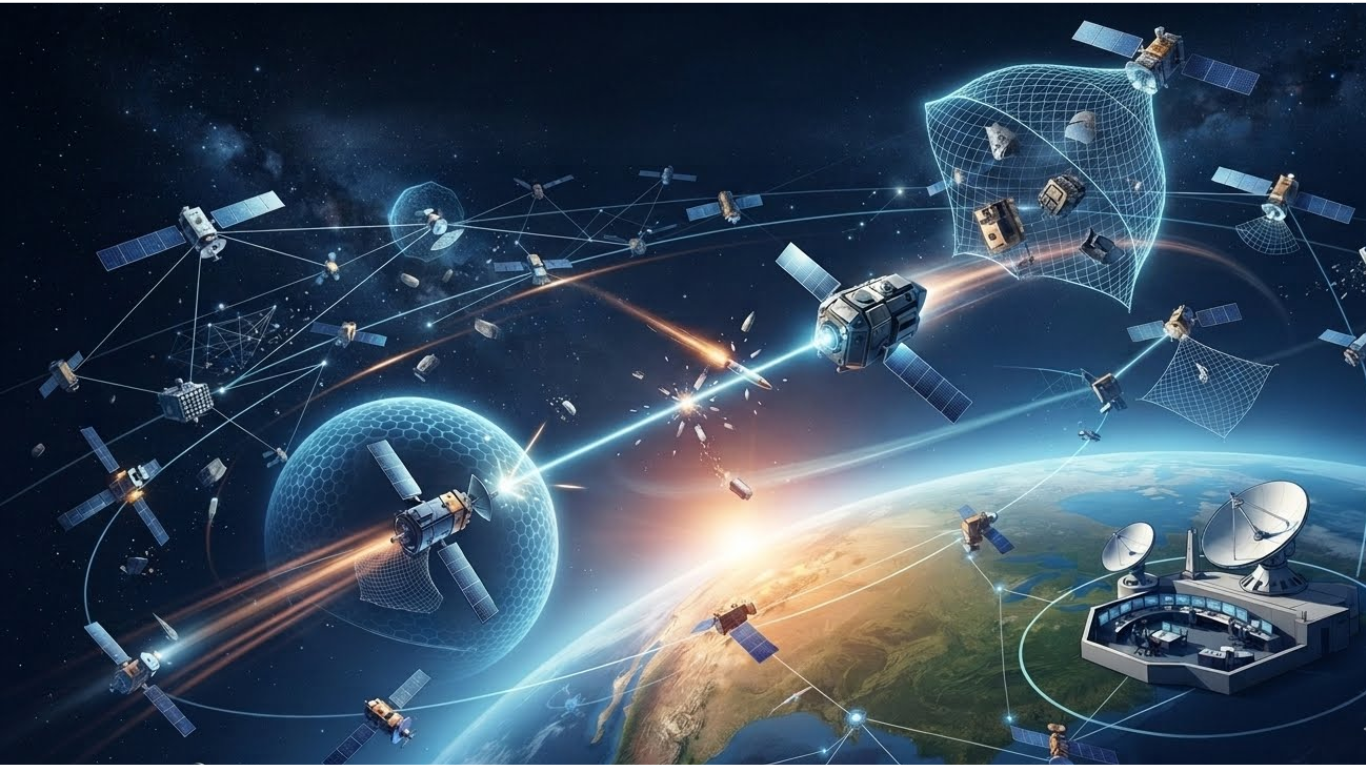
ASAT Mitigation Strategies are becoming essential as modern societies depend more heavily on satellites for communication, navigation, weather monitoring, science, and security. The real challenge is not simply protecting one spacecraft, but creating a resilient space ecosystem that can continue serving people even when individual assets are disrupted.
ASAT Mitigation Strategies for Protecting Satellites in an Increasingly Contested Orbit
Building resilient satellites and distributed space systems for a safer and more secure orbital environment.
Space has changed dramatically.
For decades, satellites were often viewed as distant scientific machines operating far above the conflicts and pressures experienced on Earth. Today, that assumption is no longer realistic. Satellites support communication networks, navigation systems, weather forecasting, disaster response, financial services, scientific research, environmental monitoring, and many other activities that affect everyday life.
That dependence creates a major responsibility.
If an important satellite is damaged, disabled, disrupted, or compromised, the consequences may extend far beyond the spacecraft itself. A problem in orbit can affect communication services, information systems, emergency coordination, navigation, and other connected infrastructure on Earth.
This is why ASAT Mitigation Strategies have become an important part of modern space resilience.
The objective should not simply be to build stronger satellites. A genuinely resilient space system must combine physical protection, cybersecurity, communication resilience, intelligent monitoring, redundancy, recovery planning, and responsible human oversight.
From my perspective as Prof. Mian Waqar Ahmad, one of the most important lessons is that resilience begins before a crisis. A satellite operator should not wait for an attack to discover that a system has a single point of failure.
The stronger approach is to assume that disruption is possible and design the broader system so that one failure does not automatically become a complete mission failure.
Understanding the Modern ASAT Threat Landscape
ASAT Mitigation Strategies protect critical space assets through layered resilience, cybersecurity, hardened systems, secure communications, threat awareness, and distributed satellite architectures designed to maintain essential services when individual spacecraft are disrupted.
Anti satellite threats are no longer limited to one type of weapon or one method of attack.
The threat environment is better understood as a spectrum.
At one end are kinetic threats capable of physically damaging spacecraft. At another are non kinetic methods that attempt to interfere with communications, sensors, software, or normal spacecraft operations without physically destroying the satellite.
This distinction matters because different threats require different defensive priorities.
A satellite could theoretically remain physically intact while becoming operationally ineffective because its communication link is disrupted. Similarly, a spacecraft could have strong cybersecurity but still face physical damage from an external event.
Therefore, modern space protection needs layers.
These layers should work together rather than operate as isolated security measures.
A resilient satellite architecture can include physical hardening, cybersecurity controls, secure communications, continuous monitoring, redundancy, backup capabilities, and carefully designed recovery procedures.
The goal is continuity.
Kinetic Threats and the Challenge of Physical Survivability
Kinetic ASAT systems represent one of the most visible threats because they can physically damage or destroy spacecraft.
A collision in orbit can produce fragments that continue traveling at extremely high speeds. Those fragments can become hazards to other spacecraft and potentially create additional collisions.
This means that the consequences of a kinetic event may extend beyond the original target.
For satellite operators, the lesson is important.
Survivability cannot be measured only by asking whether one satellite can withstand a particular event. A better question is whether the overall mission can continue if one or more assets are lost.
That changes the design philosophy.
Instead of concentrating every capability in a single highly valuable spacecraft, organizations can consider architectures that distribute important functions across multiple assets.
Such distribution can reduce the impact of localized losses.
Non Kinetic Threats Are Equally Important
Physical destruction receives considerable attention, but non kinetic threats can be just as disruptive.
Electronic interference, communication disruption, cyber intrusion, sensor interference, and other forms of electronic or digital pressure can affect spacecraft without creating visible physical damage.
This creates a difficult security problem.
A satellite operator may initially see a communication problem, unusual system behavior, degraded data quality, or an unexpected command attempt. Determining whether the event is a technical malfunction, environmental problem, or deliberate interference can be difficult.
This is where continuous monitoring becomes essential.
Modern satellite security should involve multiple forms of observation and verification rather than relying on one warning system.
Let me explain this in the clearest, simplest terms.
A satellite does not need to be physically destroyed to become ineffective.
If operators cannot reliably communicate with it, trust its data, maintain its software environment, or understand what is happening around it, the mission can be seriously compromised.
That is why ASAT Mitigation Strategies need to address both physical and digital resilience.
Building a Multi Layered Satellite Defense Philosophy
One of the strongest principles in modern infrastructure protection is simple:
Never depend on one defensive layer.
A single protection mechanism can fail.
A layered architecture gives operators additional opportunities to detect a problem, isolate it, recover from it, and maintain essential functions.
For example, a resilient satellite ecosystem could combine:
- Physical system hardening
- Cybersecurity controls
- Secure communications
- Continuous space monitoring
- Redundant mission capabilities
- Distributed architecture
- Backup ground infrastructure
- Recovery procedures
- Human oversight
- Regular resilience testing
None of these measures should be considered a complete solution on its own.
Their value comes from working together.
Radiation Hardened Circuitry and System Protection
Spacecraft electronics operate in a difficult environment.
Radiation can affect electronic components, memory systems, sensors, processors, and other hardware. Spacecraft therefore require engineering approaches that reduce the likelihood of radiation-related failures.
Radiation-hardened circuitry is one part of that broader protection philosophy.
The concept is straightforward. Electronic systems can be designed and selected with greater resistance to the harsh conditions of the space environment.
This does not mean that radiation-hardened components make a satellite invulnerable.
They simply improve resilience against one important category of environmental stress.
The same principle applies to other spacecraft components. Protective engineering should be considered across the satellite rather than applied to only one subsystem.
Optical Protection and Sensor Resilience
Satellites can depend heavily on optical sensors.
These sensors may support Earth observation, scientific research, navigation-related functions, or other missions.
Strong light sources or other optical interference can potentially affect sensor performance.
For that reason, optical protection and sensor resilience can form part of a broader mitigation strategy.
The objective is not simply to make a sensor physically stronger. Operators also need systems capable of recognizing abnormal sensor behavior and determining whether the data remains reliable.
Data integrity is just as important as hardware protection.
A sensor that continues operating but produces unreliable information can still create serious mission problems.
Secure Satellite Communications
Communication links represent another critical part of satellite resilience.
A spacecraft may function normally internally, but it remains difficult to operate if reliable communication with authorized ground systems becomes unavailable.
Secure communications therefore deserve significant attention.
Modern systems can use authentication, encryption, access controls, monitoring, redundancy, and other protective measures to reduce the likelihood of unauthorized access or communication disruption.
The important principle is that communication should not depend on a single fragile pathway.
Where mission requirements permit, organizations can build alternative communication options and recovery procedures.
This creates greater flexibility during unexpected disruptions.
Dynamic Frequency Management and Communication Resilience
Electronic interference can create serious challenges for satellite communications.
One defensive concept used in secure communication systems is dynamic frequency management, including frequency-hopping approaches.
At a high level, the idea is to avoid depending continuously on one communication frequency.
A resilient communications architecture can change communication characteristics according to predefined security requirements, making persistent interference more difficult.
However, communication resilience involves more than changing frequencies.
Operators also need authentication, signal monitoring, interference detection, fallback procedures, and reliable coordination between spacecraft and ground systems.
The most effective approach is therefore a complete communication security architecture rather than reliance on a single technical feature.
Protecting Communication Integrity
Communication availability is only one part of the problem.
Trust is equally important.
If a spacecraft receives unauthorized or manipulated information, operators may face a different kind of threat.
Strong authentication helps ensure that commands and communications originate from approved sources.
Access control limits who can interact with critical systems.
Logging and monitoring can help identify unusual activity.
Together, these measures create a stronger defensive environment.
A mature satellite security program should continuously ask three questions:
Can authorized operators communicate with the spacecraft?
Can unauthorized actors interfere with that communication?
Can operators confidently determine whether received information is genuine?
Those questions form an important foundation for space cybersecurity.
Autonomous Evasive Maneuverability and Responsible Automation
Modern spacecraft can increasingly incorporate automation.
Automated systems can help satellites monitor their operating environment, identify potential hazards, prioritize information, and support mission decisions.
This creates an opportunity for faster responses.
However, autonomy must be approached carefully.
An automated system that changes spacecraft behavior without adequate safeguards could create unintended consequences.
For that reason, autonomous maneuverability should be designed around clear safety boundaries, reliable detection, verification, human oversight, and fail-safe procedures.
The goal should not be to create spacecraft that independently make unlimited decisions.
The goal should be to help spacecraft respond appropriately to recognized risks while keeping critical authority accountable.
Why Detection Must Come Before Response
A fast response is useful only when the underlying information is trustworthy.
Suppose a spacecraft receives an unusual signal.
Is it a technical problem?
Is it interference?
Is it a natural environmental event?
Is the observation simply incorrect?
A system that immediately reacts to every anomaly could create unnecessary risk.
This is why modern ASAT Mitigation Strategies should place strong emphasis on detection, classification, verification, and decision support.
Automation can assist with these tasks, but critical decisions should include appropriate human supervision.
The Human Role in Space Security
Technology can monitor large amounts of information faster than people can.
That is one of its greatest advantages.
But speed does not automatically mean wisdom.
Human specialists remain essential for interpreting ambiguous situations, evaluating consequences, managing uncertainty, and making high-impact decisions.
A resilient system should therefore combine machine assistance with human judgment.
This is particularly important in space because orbital actions can affect other spacecraft and potentially create long-lasting consequences.
Distributed Satellite Constellations as a Resilience Strategy
One of the most important changes in modern satellite architecture is the movement toward distributed systems.
Traditional approaches sometimes placed significant capability into a small number of highly valuable spacecraft.
That model can create concentration risk.
If one spacecraft performs a critical function, its loss may create a large operational gap.
Distributed architectures approach the problem differently.
Instead of relying entirely on one asset, capabilities can be spread across multiple spacecraft or systems.
This creates redundancy.
If one satellite becomes unavailable, another may continue providing part of the required service.
The Value of Disaggregated Architecture
Disaggregation takes this principle further.
Different capabilities can be separated rather than placing everything into one platform.
This can make a system more adaptable.
It may also reduce the consequences of losing one individual asset.
However, distributed architecture is not automatically secure.
More satellites can also mean more systems to monitor, maintain, update, authenticate, and protect.
Therefore, distribution must be accompanied by strong cybersecurity and operational coordination.
Resilience is an architecture, not simply a larger number of spacecraft.
Avoiding Single Points of Failure
The idea of a single point of failure is familiar in many areas of technology.
If one component fails and the entire system stops working, that component represents a major vulnerability.
Space infrastructure should be evaluated using the same principle.
Organizations can examine:
- Communication pathways
- Ground stations
- Data processing systems
- Command systems
- Power systems
- Software dependencies
- Navigation dependencies
- Satellite components
- Human decision processes
The question is simple:
What happens if this component suddenly becomes unavailable?
If the answer is complete mission failure, that dependency deserves attention.
Ground Infrastructure Is Part of the Space Security Equation
Satellite protection does not end in orbit.
Ground infrastructure is equally important.
Satellites depend on command centers, antennas, networks, software systems, data centers, and human operators.
A spacecraft can be extremely well protected while the supporting ground network remains vulnerable.
That creates an obvious weakness.
Cybersecurity must therefore extend across the entire satellite ecosystem.
This includes secure networks, strong identity controls, system monitoring, software maintenance, backup systems, and carefully controlled access.
Protecting the Satellite Ground Segment
A secure ground segment should be treated as part of the mission rather than as an external support function.
Operators need to understand how information moves from users to ground systems and eventually to spacecraft.
They also need to understand how satellite data returns to users.
Every transition creates another opportunity for error or compromise.
Reducing unnecessary access and strengthening authentication can help limit exposure.
Regular testing can also reveal weaknesses before they become operational emergencies.
Space Domain Awareness and Early Warning
You cannot protect what you cannot see.
Space domain awareness therefore plays a central role in resilience.
Operators need information about spacecraft behavior, orbital conditions, potential hazards, and unusual events.
The purpose is not necessarily to predict every possible threat.
That would be unrealistic.
Instead, the objective is to improve awareness and reduce uncertainty.
Better information can support better decisions.
Monitoring for Anomalies
Anomaly detection can help identify unusual spacecraft behavior.
Examples may include unexpected changes in communication patterns, unusual system activity, sensor inconsistencies, or other deviations from normal operations.
However, anomaly detection must avoid excessive false alarms.
If operators receive too many unnecessary warnings, genuinely important signals may become harder to recognize.
This makes intelligent filtering and human review valuable.
The strongest systems combine automated monitoring with expert analysis.
Cybersecurity Must Become a Permanent Process
Cybersecurity is not something an organization completes once.
Satellite software, ground systems, communication networks, and supporting infrastructure evolve continuously.
That means security must evolve as well.
Regular software maintenance, vulnerability management, access reviews, authentication improvements, monitoring, and incident-response preparation are important parts of a mature security program.
A spacecraft launched years ago may still depend on digital systems that interact with modern infrastructure.
That creates long-term challenges.
Protecting Against Cyber Intrusion
Cyber threats can target different parts of the satellite ecosystem.
An attacker may seek unauthorized access to ground systems, attempt to disrupt communications, manipulate data, or exploit weaknesses in connected infrastructure.
The defensive response should therefore be broad.
Organizations can use segmentation, authentication, encryption, monitoring, backups, controlled access, and incident-response procedures to improve resilience.
The goal is not to claim that cyber attacks can be eliminated.
The realistic goal is to make unauthorized access more difficult, detect suspicious activity earlier, and recover more effectively when something goes wrong.
Resilient Architecture Is More Important Than Perfect Protection
There is an important difference between security and resilience.
Security tries to prevent bad events.
Resilience prepares the system to continue functioning when prevention fails.
This distinction is essential.
No complex technological system should be considered perfectly protected.
There will always be unexpected failures, technical errors, environmental challenges, cyber risks, and human mistakes.
A resilient architecture assumes that some problems will eventually occur.
It is designed to limit their impact.
Designing for Graceful Degradation
A resilient satellite system does not necessarily need to provide full performance during every crisis.
Sometimes the better goal is graceful degradation.
This means that when one capability becomes unavailable, the system continues providing the most important services.
For example, a satellite network may prioritize essential communication or safety functions while temporarily reducing lower-priority services.
This approach can preserve critical operations during disruption.
Recovery Is Part of Defense
Recovery planning deserves as much attention as prevention.
Organizations should understand how they would respond if an important spacecraft became unavailable.
What backup capability exists?
How quickly can services be transferred?
Which functions are most important?
Who has authority to make decisions?
How will users be informed?
How will the organization determine whether the incident has ended?
It is better to address these questions before a crisis begins.
Why Redundancy Matters in Orbital Infrastructure
Redundancy is often associated with duplication.
But good redundancy is more thoughtful than simply creating copies.
If all backup systems depend on the same vulnerable component, they may fail together.
This is known as correlated failure.
A resilient architecture therefore considers diversity as well as duplication.
Different communication pathways, different supporting infrastructure, and distributed capabilities can reduce the possibility that one event affects everything simultaneously.
Balancing Cost and Resilience
Space infrastructure is expensive.
Not every organization can afford unlimited redundancy.
This creates an important design challenge.
The objective should be to protect the most critical functions first.
Organizations can identify essential services and determine the minimum capabilities required to keep those services operating during disruption.
This creates a practical resilience strategy.
Not every component needs equal protection.
Critical functions deserve the strongest combination of redundancy, monitoring, security, and recovery planning.
The Role of AI in Defensive Space Resilience
AI can support modern satellite protection in several ways.
It can help analyze large volumes of telemetry, identify unusual patterns, prioritize alerts, support anomaly detection, and assist human operators in understanding complex information.
This can be particularly valuable because satellite systems generate large amounts of data.
Humans cannot manually examine every signal with equal attention.
AI can help narrow the field.
But AI should not automatically become the final authority.
An AI system can misunderstand an unusual event.
It can also produce false positives.
For high-consequence space operations, AI should be treated as a decision-support capability with appropriate safeguards and human oversight.
Responsible AI in Orbital Security
The most useful AI systems are not necessarily those that make the most independent decisions.
They may instead be systems that help experts see important information sooner.
An AI tool could flag an unusual communication pattern.
A human specialist could then investigate.
Another system could identify changes in spacecraft telemetry.
Operators could verify whether the change reflects normal operations.
This model combines machine speed with human accountability.
That balance is particularly important when spacecraft actions could affect other objects in orbit.
International Stability and the Need for Responsible Space Operations
Space security is not only a technical issue.
It is also an international responsibility.
The orbital environment is shared by many countries, companies, research organizations, and civil institutions.
A destructive event can create consequences that extend far beyond the original parties involved.
Orbital debris is one example.
A collision or destructive event can create fragments that remain in orbit and potentially threaten unrelated spacecraft.
This means responsible behavior matters.
Avoiding a Cycle of Escalation
When countries develop stronger defensive capabilities, other countries may interpret those capabilities as offensive preparations.
This can create a difficult security dilemma.
Transparency, communication, international norms, responsible testing, and risk reduction can help reduce misunderstanding.
Technical resilience should therefore be combined with responsible policy.
The strongest long-term space security model is not simply one that builds more destructive capabilities.
It is one that improves resilience while reducing unnecessary risks to the shared orbital environment.
Protecting Civilian Services
Satellite security has a direct connection to ordinary life.
People may not think about satellites when using navigation apps, checking weather forecasts, communicating across long distances, accessing financial services, or receiving emergency information.
Yet many modern services depend on space infrastructure.
This makes satellite resilience a public-interest issue.
A disruption can affect businesses, governments, researchers, emergency responders, and ordinary citizens.
For this reason, space security planning should consider civilian continuity as an important objective.
The Human Side of Satellite Resilience
Technology is ultimately built to serve people.
That point should not be forgotten in discussions about advanced spacecraft and orbital defense.
A resilient satellite system matters because it protects communication, information, safety, science, economic activity, and human connection.
The purpose of resilience is not technology for its own sake.
It is continuity of essential services.
Building a Practical ASAT Mitigation Framework
A useful resilience framework can be organized around several broad questions.
First, what are the most important space assets?
Second, what services depend on them?
Third, what types of disruption could affect those services?
Fourth, what happens if an individual asset becomes unavailable?
Fifth, how quickly can the system recover?
Sixth, who is responsible for making decisions during a crisis?
These questions help move the conversation from abstract security to practical resilience.
Assess Criticality Before Adding Complexity
Security systems can become complicated.
More sensors, more software, more networks, and more automated processes can sometimes create additional vulnerabilities.
The answer is not simply to keep adding technology.
Organizations should first identify what really matters.
Protect the most important assets.
Secure the most sensitive pathways.
Create redundancy around critical services.
Improve monitoring where it can provide meaningful warning.
Then test the entire system.
Test the System Before a Crisis
A plan that has never been tested is only an assumption.
Space organizations can use simulations, exercises, controlled testing, and recovery drills to examine how systems behave under disruption.
These exercises can reveal unexpected dependencies.
They can also reveal communication problems between technical teams and decision-makers.
Testing is therefore an essential component of resilience.
The Future of ASAT Mitigation Strategies
The future of satellite security will likely involve greater integration.
Physical protection, cybersecurity, AI-assisted monitoring, distributed architectures, secure communications, and space domain awareness will increasingly operate as connected parts of a larger system.
This integration is important because modern threats rarely fit neatly into one category.
A technical event may begin in one part of the infrastructure and affect another.
For example, a communication anomaly may trigger cybersecurity concerns. A cybersecurity event may affect mission availability. A spacecraft outage may place greater pressure on neighboring assets.
Resilience therefore requires a system-wide perspective.
Smaller and More Distributed Space Systems
The increasing use of smaller spacecraft and distributed constellations could change how organizations think about survivability.
Instead of protecting one extremely valuable asset at all costs, operators may increasingly focus on maintaining overall service availability.
This does not eliminate risk.
It changes the risk model.
Losing one satellite may become less catastrophic if other systems can continue providing essential functions.
Smarter Monitoring Systems
AI and advanced analytics may also improve monitoring.
Future systems could become better at recognizing unusual patterns and distinguishing routine events from potentially serious anomalies.
The challenge will be avoiding overconfidence.
An AI system should not be treated as an infallible observer.
Human expertise, independent verification, and carefully designed safeguards will remain essential.
A More Resilient Philosophy for Space Security
The most important change may not be a particular piece of technology.
It may be a change in thinking.
Older approaches often emphasized protecting individual assets.
Modern resilience emphasizes protecting missions.
That is a significant difference.
A satellite is an asset.
The service it provides is the mission.
If the mission can continue despite the loss of one asset, the overall system has demonstrated resilience.
This is why distributed architecture, redundancy, secure communications, cybersecurity, monitoring, and recovery planning are so important.
They shift attention from protecting perfection to maintaining continuity.
What Organizations Should Prioritize
Organizations developing satellite resilience can prioritize several broad principles:
- Identify the most critical space services
- Map dependencies across space and ground infrastructure
- Strengthen cybersecurity throughout the ecosystem
- Improve communication resilience
- Monitor spacecraft and networks continuously
- Reduce unnecessary single points of failure
- Develop distributed and redundant capabilities
- Prepare recovery procedures in advance
- Test systems under realistic disruption scenarios
- Maintain appropriate human oversight over high-impact automation
- Consider the wider orbital environment when planning operations
- Review resilience requirements regularly as technology changes
These principles are more valuable when treated as a continuous process rather than a one-time project.
The Bigger Lesson About Surviving Space Disruption
The future of space security will not be defined solely by who has the most advanced technology.
It will also be shaped by who can recover fastest.
A technically sophisticated satellite that cannot recover from disruption may be less resilient than a simpler system designed with redundancy and continuity in mind.
This is a powerful lesson for organizations, governments, and technology developers.
Resilience is not about creating something that can never fail.
It is about ensuring that failure does not become collapse.
That philosophy applies beyond space.
Families build resilience through communication.
Businesses build resilience through backup plans.
Communities build resilience through cooperation.
Modern space systems need the same basic principle.
They need layers, alternatives, communication, trust, and recovery.
Why ASAT Mitigation Is Becoming a Long Term Requirement
As dependence on satellites continues to grow, the cost of space disruption will also become more significant.
That makes ASAT Mitigation Strategies more than a specialized defense topic.
They are increasingly connected to infrastructure planning, cybersecurity, technological resilience, international stability, and civilian continuity.
The challenge is complicated because the orbital environment is unforgiving.
Spacecraft are expensive and difficult to repair.
Communication delays, limited physical access, radiation, orbital mechanics, and international dependencies create unique constraints.
For these reasons, resilience must be incorporated during system design rather than added as an afterthought.
From Protection to Continuity
The future should focus on continuity.
Can communication continue?
Can essential data remain available?
Can operators identify abnormal behavior?
Can a damaged or unavailable asset be replaced by another capability?
Can humans remain in control of critical decisions?
Can the system recover without creating additional risks?
These questions provide a more useful framework than simply asking whether a satellite is invulnerable.
No spacecraft is invulnerable.
But a well-designed space ecosystem can become significantly more resilient.
CONCLUSION AND BRAND CREDIBILITY
The future of space security will depend not only on powerful technology but also on the ability to remain prepared, adaptable, and resilient when unexpected challenges arise. From kinetic threats and cyber risks to communication disruption and orbital vulnerabilities, the real strength of modern space infrastructure lies in its ability to protect essential missions and recover when individual systems fail.
ASAT Mitigation Strategies offer an important path toward that resilience by encouraging stronger satellite architectures, secure communications, cybersecurity, intelligent monitoring, redundancy, and responsible human oversight. The ultimate goal is not to create a system that can never face disruption, but to build one that can endure challenges without allowing a single failure to bring everything to a halt.
As our dependence on satellites continues to grow, protecting these vital systems becomes a shared responsibility for technology developers, researchers, governments, and everyone working toward a safer future in space. The choices made today will help shape whether tomorrow’s orbital environment becomes more fragile or more resilient.
This unique insight and carefully developed content is proudly and exclusively delivered by worldstan.com, bringing readers meaningful perspectives on AI, technology, space security, and the powerful innovations shaping our future.