

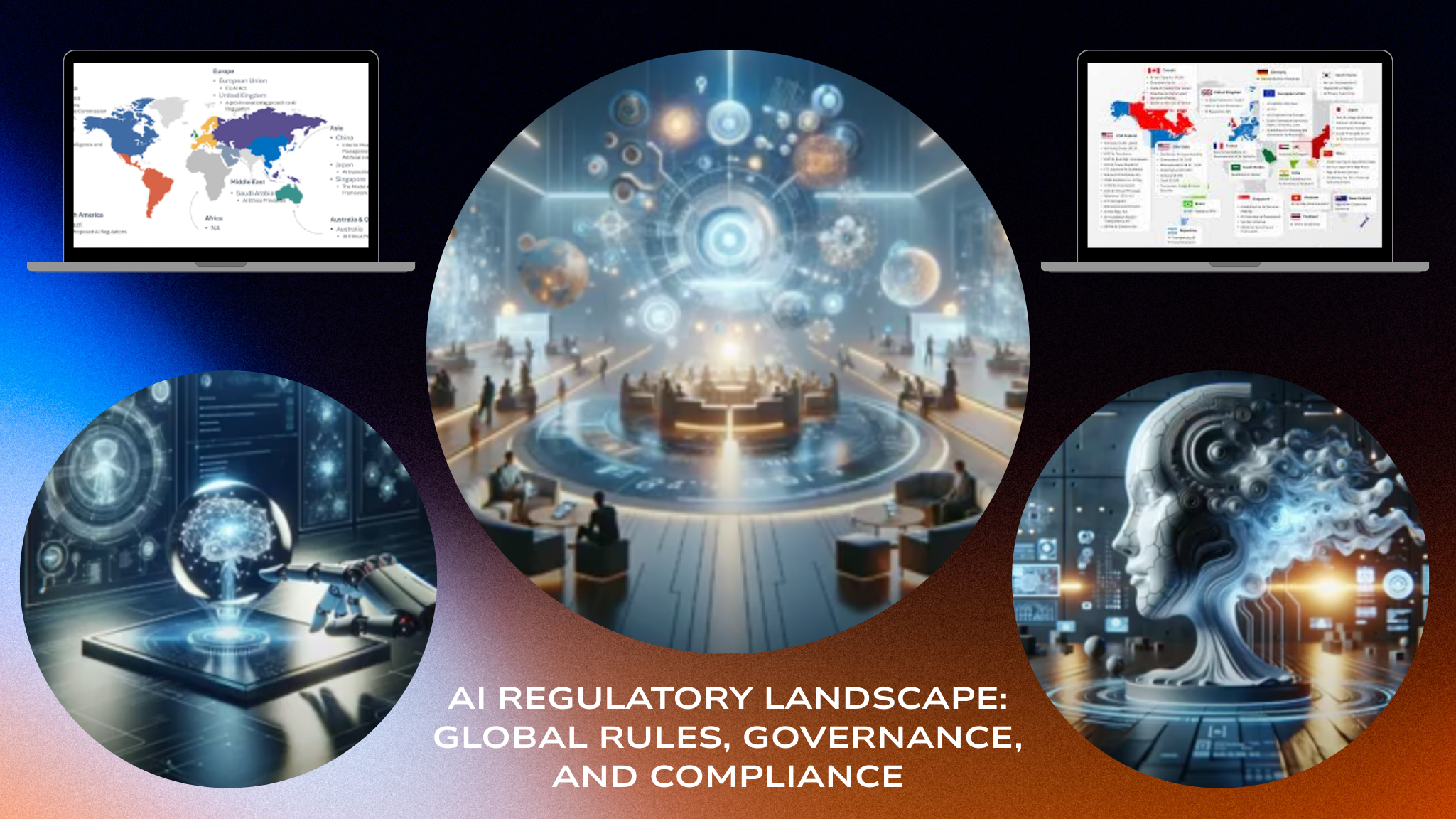
The AI regulatory landscape is changing faster than ever, affecting how businesses develop, deploy, and manage artificial intelligence systems. This guide explores the regulations, governance frameworks, compliance requirements, and global policy shifts that organizations must understand to build responsible AI while maintaining innovation and long-term growth.
AI Regulatory Landscape Navigating Governance, Compliance, and Global Policy Shifts
Discover how the AI regulatory landscape is transforming businesses worldwide. Learn about AI governance, compliance strategies, global regulations, risk management, ethical AI, and practical approaches to responsible artificial intelligence adoption.
Artificial intelligence is no longer a futuristic concept discussed only in research labs and technology conferences. It has become a practical business tool that influences customer service, healthcare, finance, manufacturing, education, cybersecurity, and countless other industries. Organizations of every size are integrating AI into daily operations to improve efficiency, reduce costs, and create new opportunities for growth.
At the same time, governments and regulatory authorities are paying close attention to how these systems affect individuals, businesses, and society. As a result, the AI regulatory landscape is becoming one of the most important subjects for decision-makers, developers, investors, and policymakers.
Understanding these regulations is not just about avoiding penalties. It is about building trust, protecting users, and creating sustainable innovation. Businesses that understand AI governance and compliance today will be better prepared for tomorrow’s challenges.
Let me explain this in the clearest, simplest terms.
Artificial intelligence can deliver remarkable benefits, but without proper oversight, it can also create risks. Governments want innovation to continue, but they also want accountability, transparency, fairness, and safety. This balance is shaping the future of the global AI regulatory landscape.
Why Has the AI Regulatory Landscape Become So Important
Only a few years ago, many organizations viewed AI regulation as a future concern. Today, it has become a boardroom discussion.
The reason is simple. Artificial intelligence now influences decisions that affect people’s lives. AI systems help determine credit approvals, employment opportunities, healthcare recommendations, insurance assessments, and even public services.
When technology affects important decisions, regulators naturally become involved.
Several high-profile incidents have accelerated regulatory attention. Cases involving biased algorithms, privacy violations, inaccurate automated decisions, and misuse of personal data have raised concerns across industries.
From my perspective, the growing focus on regulation is not a sign that innovation is slowing down. Instead, it demonstrates that AI has matured enough to require responsible management. Similar patterns occurred with financial services, healthcare, and cybersecurity. As industries grow more influential, governance becomes essential.
The AI regulatory landscape exists because society wants technology to serve people responsibly while allowing innovation to continue.
Understanding AI Governance
AI governance refers to the policies, procedures, controls, and accountability mechanisms that guide how artificial intelligence systems are developed and used.
Many people mistakenly assume governance means bureaucracy. In reality, effective governance creates clarity.
When organizations establish AI governance frameworks, they define:
- Who is responsible for AI decisions
- How models are tested and monitored
- How risks are identified and reduced
- How transparency is maintained
- How regulatory requirements are fulfilled
Good governance helps organizations move faster because expectations are clearly defined from the beginning.
A company that develops AI without governance often spends significant time fixing problems later. A company with strong governance identifies potential issues early and addresses them before they become costly challenges.
What Is Driving Global AI Regulations
Several powerful forces are driving regulatory activity around the world.
The first factor is public trust.
People want confidence that AI systems are fair, transparent, and safe. When trust declines, adoption slows.
The second factor is economic impact.
Artificial intelligence is becoming a major driver of economic growth. Governments want to encourage innovation while ensuring fair competition.
The third factor is national security.
Advanced AI technologies influence cybersecurity, defense capabilities, critical infrastructure, and strategic competitiveness.
The fourth factor is ethical responsibility.
Societies increasingly expect technology providers to demonstrate accountability for the outcomes their systems produce.
Together, these factors are shaping modern AI law and policy initiatives across multiple jurisdictions.
The European Union’s Leadership in AI Regulation
When discussing the AI regulatory landscape, the European Union frequently serves as a leading example.
The EU has taken a comprehensive approach through the EU AI Act. This legislation introduces a risk-based framework that classifies AI systems according to their potential impact.
Certain AI applications face strict requirements because they present greater risks to individuals and society.
Organizations operating within European markets must pay close attention to obligations involving:
- Risk management
- Data quality
- Transparency
- Human oversight
- Documentation
- Ongoing monitoring
The European approach reflects a belief that responsible innovation and regulatory oversight can coexist.
Many experts expect elements of the EU model to influence regulatory frameworks worldwide.
How Does the United States Approach AI Regulation
The United States follows a different path.
Instead of relying on one comprehensive federal AI law, the country often uses existing regulatory agencies and industry-specific oversight mechanisms.
This approach provides flexibility and encourages innovation. However, it can also create complexity because requirements vary across sectors and states.
Organizations operating in the United States often need to navigate multiple regulatory expectations simultaneously.
Financial institutions, healthcare providers, and technology companies may face different compliance obligations depending on how AI is used.
This decentralized model remains an important part of the global AI regulatory landscape.
China’s Unique AI Governance Model
China has developed its own approach to AI governance.
Chinese regulations place significant emphasis on algorithm management, content oversight, data security, and platform accountability.
Organizations operating within China must comply with regulations governing recommendation algorithms, synthetic content generation, and data handling practices.
China’s regulatory strategy reflects national priorities related to technological development, social stability, and digital governance.
As China’s influence in artificial intelligence continues to grow, its regulatory model will remain a major factor in international AI discussions.
Ethical AI as the Foundation of Regulation
Many regulations are built upon ethical principles.
Although laws differ across countries, several core concepts appear consistently.
These include:
- Fairness
- Transparency
- Accountability
- Human oversight
- Privacy protection
- Safety
- Non-discrimination
Ethical AI is not merely a public relations exercise.
Organizations that treat ethics as a strategic priority often experience stronger customer trust, improved reputation, and reduced regulatory risk.
In my opinion, ethical AI should not be viewed as an additional requirement. It should be considered a fundamental design principle.
When ethics become part of the development process from the beginning, compliance becomes easier to achieve.
Why Is Algorithmic Bias Receiving So Much Attention
Algorithmic bias remains one of the most discussed challenges in artificial intelligence.
AI systems learn from data. If that data contains historical biases, the system may unintentionally replicate them.
Examples have emerged in hiring, lending, healthcare, and criminal justice applications.
A biased system can create unfair outcomes even when developers never intended discrimination.
Regulators increasingly expect organizations to:
- Assess bias risks
- Test models regularly
- Document mitigation efforts
- Monitor outcomes continuously
Addressing algorithmic bias is becoming a core element of AI compliance strategies worldwide.
The Growing Importance of Explainable AI
One of the biggest challenges with advanced AI systems is understanding how decisions are made.
Many modern models operate as complex systems that produce outputs without providing simple explanations.
This creates concerns when important decisions affect individuals.
Explainable AI seeks to improve transparency by helping users understand the reasoning behind AI-generated outcomes.
Regulators increasingly support explainability because transparency strengthens accountability.
Organizations that invest in explainable AI often find it easier to satisfy compliance requirements while building trust among customers and stakeholders.
AI Data Privacy and Regulatory Compliance
Data is the foundation of artificial intelligence.
Without quality data, AI systems cannot function effectively.
However, data collection and usage create privacy concerns.
Many regulations now focus heavily on AI data privacy because organizations frequently process personal information during model training and deployment.
Responsible data governance involves:
- Data minimization
- User consent
- Secure storage
- Access controls
- Data retention policies
- Privacy impact assessments
Strong privacy practices support both compliance and customer confidence.
As privacy regulations evolve globally, businesses must ensure AI systems align with data protection requirements.
AI Risk Management Strategies
Risk management sits at the center of modern AI governance.
Every AI system carries some level of risk.
These risks may include:
- Technical failures
- Security vulnerabilities
- Biased outcomes
- Privacy violations
- Regulatory violations
- Reputational damage
Effective AI risk management involves identifying risks before deployment and monitoring them continuously afterward.
Organizations increasingly establish formal risk assessment processes that evaluate potential impacts on customers, employees, partners, and society.
Risk management should not be viewed as a barrier to innovation.
Instead, it provides a framework for sustainable growth.
How Can Businesses Build Effective AI Compliance Programs
Successful compliance programs require more than legal documentation.
Organizations must integrate compliance into daily operations.
Effective programs often include:
- Governance committees
- Compliance officers
- Risk assessments
- Employee training
- Audit processes
- Incident reporting procedures
- Ongoing monitoring
Businesses that adopt compliance-by-design principles often experience smoother implementation and fewer regulatory challenges.
Waiting until deployment to address compliance issues can become expensive and disruptive.
Early planning creates long-term advantages.
Enterprise AI Governance in Practice
Large organizations frequently operate multiple AI systems across various departments.
Without centralized oversight, inconsistencies can emerge.
Enterprise AI governance helps coordinate activities across teams while maintaining accountability.
A mature governance framework typically includes:
- Executive sponsorship
- Cross-functional collaboration
- Standardized policies
- Performance monitoring
- Continuous improvement mechanisms
Governance works best when technical teams, legal departments, compliance specialists, and business leaders collaborate closely.
This integrated approach helps organizations respond effectively to changing regulatory expectations.
How Are Startups Affected by AI Regulation
Many startup founders worry that regulation will slow innovation.
While compliance requires effort, it can also create opportunities.
Investors increasingly evaluate governance practices during due diligence.
Customers are becoming more selective about the technologies they adopt.
Regulatory readiness can become a competitive advantage.
Startups that establish responsible AI practices early often find it easier to enter regulated markets and attract enterprise clients.
Building compliance into products from the beginning is usually more efficient than retrofitting controls later.
Sector-Specific AI Regulations
Different industries face unique regulatory challenges.
Healthcare organizations must address patient safety and clinical validation requirements.
Financial institutions must focus on fairness, explainability, and consumer protection.
Transportation companies must address safety, accountability, and operational reliability.
Educational institutions must consider privacy, fairness, and student protection.
Because each sector faces distinct risks, regulators often develop specialized requirements.
Organizations operating across multiple industries must carefully evaluate their compliance obligations.
The Relationship Between Innovation and Regulation
A common misconception suggests that regulation automatically limits innovation.
In reality, thoughtful regulation can support long-term growth.
Clear rules reduce uncertainty.
Investors gain confidence.
Customers feel safer.
Organizations can scale more effectively.
Throughout history, industries that developed strong governance structures often achieved greater stability and broader adoption.
Artificial intelligence appears to be following a similar path.
Responsible innovation and regulatory compliance can work together successfully.
What Does the Future of the AI Regulatory Landscape Look Like
The future will likely bring additional regulations, updated standards, and increased international cooperation.
Emerging technologies such as generative AI, foundation models, autonomous systems, and advanced decision-making platforms will create new governance challenges.
Several trends are becoming increasingly visible:
- Greater international collaboration
- Stronger transparency requirements
- Enhanced accountability standards
- Increased focus on AI safety
- Expanded auditing expectations
- Improved governance frameworks
Organizations should not focus solely on predicting specific regulatory changes.
Instead, they should build adaptable systems capable of evolving alongside new requirements.
Flexibility will become one of the most valuable compliance capabilities.
Exclusive WorldStan.com Perspective on Responsible AI Growth
At worldstan.com, we believe the future of artificial intelligence depends on trust just as much as technology.
Organizations often focus heavily on model accuracy, automation capabilities, and operational efficiency. While these factors are important, lasting success requires something deeper.
Trust is earned through transparency.
Trust is earned through accountability.
Trust is earned through responsible governance.
Businesses that embrace these principles today are positioning themselves for sustainable growth tomorrow.
The most successful organizations will not necessarily be those with the most advanced algorithms. They will be the organizations that combine innovation with responsibility, compliance with creativity, and technological advancement with human values.
This perspective represents the foundation of responsible AI leadership in the modern digital economy.
Conclusion
The AI regulatory landscape is evolving into one of the most influential forces shaping the future of technology. Around the world, governments, regulators, businesses, and technology leaders are working to create frameworks that encourage innovation while protecting individuals and society from potential harm.
Artificial intelligence regulation is no longer a topic reserved for legal teams and policymakers. It has become a strategic business priority that affects product development, investment decisions, customer trust, and long-term growth. Organizations that understand AI governance, compliance, risk management, transparency, and ethical responsibility will be far better positioned to succeed in the years ahead.
At worldstan.com, we believe the strongest path forward is not choosing between innovation and regulation. The real opportunity lies in combining both. Responsible AI development creates trust, and trust creates lasting growth. As artificial intelligence continues transforming industries, organizations that embrace accountability and proactive governance will lead the next generation of digital progress with confidence and credibility.