

X Twitter App has transformed from a simple messaging idea into one of the world’s most influential social media platforms. In this complete guide, you will discover its history, founders, growth journey, AI technology, major acquisitions, Elon Musk’s ownership, and how artificial intelligence now helps personalize content and improve user experiences across the platform.

X Twitter App History, AI Features, Founders And Complete Growth Journey
Introduction to X Twitter App
The X Twitter App has become much more than a social networking website. It has evolved into a global communication platform where people share news, business updates, entertainment, opinions, and live events in real time. From politicians and celebrities to small business owners and students, millions of people rely on X every day.
What began as a simple text messaging idea in 2006 eventually transformed into one of the most influential digital platforms in history. Today, artificial intelligence, recommendation systems, and advanced algorithms help personalize every user’s experience.
In this guide from worldstan.com, you will discover the complete story behind the X Twitter App, including its founders, growth journey, AI technology, acquisitions, leadership changes, Elon Musk’s acquisition, and its impact on the digital world.
What Is X Twitter App
X Twitter App is an American social media and microblogging platform where users publish short posts called tweets, now commonly referred to as posts. People can share text, images, videos, GIFs, voice messages, live broadcasts, and participate in global discussions instantly.
The platform is designed around speed. Breaking news often appears on X before it reaches television networks or news websites.
Today, X serves multiple purposes.
Users can:
- Share opinions instantly.
- Follow celebrities and public figures.
- Watch live videos.
- Join worldwide discussions.
- Promote businesses.
- Discover trending topics.
- Receive real time news updates.
- Build professional communities.
Its influence reaches nearly every industry, including entertainment, sports, politics, journalism, education, and technology.
Who Were The Founders Of X Twitter App
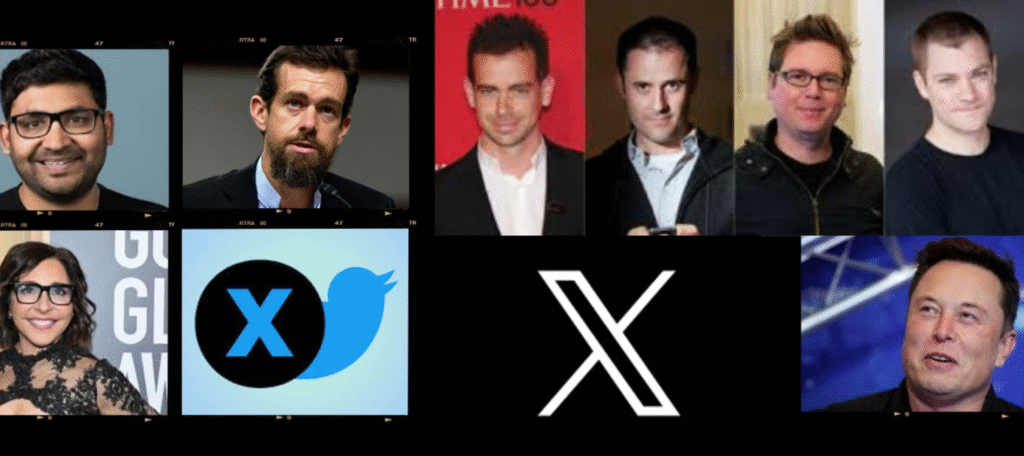
The X Twitter App was founded in March 2006 by four innovators:
- Jack Dorsey
- Noah Glass
- Biz Stone
- Evan Williams
These founders originally worked together at a podcasting company called Odeo.
At that time, podcasting faced strong competition after Apple entered the market. The team began brainstorming new ideas to build another product.
Jack Dorsey proposed a simple concept.
He wanted people to send short status updates to groups of friends through mobile phones.
That small idea eventually changed internet communication forever.
How Did The Idea Of Twitter Begin
The original concept revolved around SMS communication.
Jack Dorsey envisioned a platform where people could answer a simple question.
“What are you doing?”
Users could instantly share their status with others.
The concept was revolutionary because social media platforms at that time were focused on lengthy profiles and detailed content.
Twitter introduced simplicity.
The project officially entered development in February 2006.
On March 21, 2006, Jack Dorsey published the first tweet.
The first tweet said:
“just setting up my twttr”
This simple message became one of the most historic posts in internet history.
The Early Prototype Development
The first Twitter version was not available to the public.
It was developed internally for Odeo employees.
The prototype was built by:
- Jack Dorsey
- Contractor Florian Weber
Employees tested the system before its public launch.
Initially, it was known as “twttr.”
The name was inspired by the trend of removing vowels from company names.
Later, the platform officially became Twitter.
The name represented short bursts of information, similar to birds communicating through chirping sounds.
When Did Twitter Officially Launch
Twitter was officially introduced to the public on July 15, 2006.
The platform was still relatively unknown.
However, its simplicity attracted early adopters.
Unlike traditional blogging platforms, Twitter allowed users to share thoughts in seconds.
People immediately recognized its potential.
At first, growth remained slow.
The breakthrough came one year later.
How Did The 2007 SXSW Conference Change Twitter
One of the biggest moments in Twitter history occurred during the 2007 South by Southwest Interactive Conference.
During the event, Twitter installed giant screens that displayed live tweets.
Attendees became fascinated by the experience.
Twitter activity exploded.
Daily tweets increased dramatically.
| Event | Daily Tweets |
|---|---|
| Before SXSW | 20,000 |
| During SXSW | 60,000 |
The event generated enormous publicity.
Technology journalists began discussing Twitter extensively.
Many influential personalities joined the platform.
This event pushed Twitter into mainstream recognition.
How Did Twitter Grow So Quickly
Twitter experienced rapid growth because it solved a communication problem.
People wanted information immediately.
Traditional media outlets often required hours to publish stories.
Twitter provided instant updates.
Several factors contributed to its success.
Real Time Information
Users could discover breaking news instantly.
Simple Interface
The platform was easy to understand.
Mobile Friendly Experience
Users could interact from anywhere.
Global Accessibility
Anyone could join regardless of their country.
Celebrity Adoption
Celebrities started communicating directly with fans.
These elements accelerated worldwide adoption.
Major User Growth Milestones
Twitter achieved remarkable growth milestones.
| Year | Milestone |
|---|---|
| 2006 | Official launch |
| 2007 | 60,000 daily tweets |
| 2011 | 100 million monthly users |
| 2012 | Over 200 million users |
| 2019 | More than 330 million users |
| Current Era | Around 550 million global users |
These numbers demonstrate how rapidly Twitter evolved into a digital powerhouse.
Service | Why Did People Love Twitter? Twitter offered something unique. It gave every individual a voice. Ordinary users could communicate with world leaders, journalists, athletes, and entertainers. For example: A journalist could report live from a disaster scene. A company could announce a product launch instantly. A celebrity could interact with millions of followers directly. This level of accessibility was unprecedented. The platform transformed communication forever. Why Did Twitter Become Important For BusinessesBusinesses quickly realized Twitter’s marketing potential. Companies began using the platform to:
Even small businesses gained opportunities to reach global audiences without massive advertising budgets. Many companies continue to use X as a customer engagement platform today. The Transformation From Twitter To XOne of the biggest changes in the company’s history occurred after Elon Musk acquired Twitter. His vision extended far beyond social media. He wanted to build an “everything app.” This meant combining:
As a result, Twitter was rebranded to X. The iconic blue bird logo was retired. The platform entered a completely new era. Who Purchased TwitterIn April 2022, Elon Musk announced a massive 44 billion dollar buyout agreement. The acquisition process experienced several twists and turns. Initially:
Finally, in October 2022, Elon Musk completed the acquisition. This became one of the biggest technology acquisitions in history. What Changes Did Elon Musk IntroduceElon Musk quickly implemented major changes. These included: Workforce RestructuringThousands of employees were laid off. Product ChangesSeveral new features were introduced. Verification UpdatesBlue verification evolved into a subscription service. Revenue DiversificationThe company reduced dependence on advertising. New BrandingTwitter became X. These decisions generated both praise and criticism worldwide. Timeline Of Important Events
ription | Acquisition Date | Discontinuation Date | ||||||||||||||||||||
Vine | Twitter acquired a video clip company called Vine on October 5, 2012. Vine was launched as a standalone app on January 24, 2013, allowing users to create and share six-second looping video clips. | October 5, 2012 | April 2019 | ||||||||||||||||||||
Periscope | Twitter announced its acquisition of Periscope, an app for live streaming video, on March 13, 2015. Periscope was launched on March 26, 2015. | March 13, 2015 | March 31, 2021 | ||||||||||||||||||||
Crashlytics | Twitter acquired Crashlytics, a crash reporting tool for developers, on January 28, 2013. | January 28, 2013 | – | ||||||||||||||||||||
Fabric | Twitter announced Fabric, a suite of mobile developer tools, in October 2014. Fabric integrated various services like Crashlytics, Answers, Beta, Digits, MoPub, and TwitterKit into a single SDK. | October 2014 | – | ||||||||||||||||||||
Revue | Revue, a service allowing writers to create email newsletters, was acquired by Twitter on January 26, 2021. The service was announced to be discontinued on January 18, 2023. | January 26, 2021 | January 18, 2023 |
Acquisition | Description | Acquisition Date |
Atebits | Twitter acquired Atebits, developers of the Twitter client Tweetie for Mac and iPhone, on April 11, 2010. | April 11, 2010 |
Crashlytics | Twitter acquired Crashlytics on January 28, 2013, to enhance its mobile developer products. | January 28, 2013 |
Trendrr | Twitter acquired Trendrr on August 28, 2013. | August 28, 2013 |
MoPub | Twitter acquired MoPub, a mobile advertising company, on September 9, 2013. | September 9, 2013 |
Namo Media | Twitter announced the acquisition of Namo Media, specializing in native advertising for mobile devices, on June 4, 2014. | June 4, 2014 |
SnappyTV | Twitter acquired SnappyTV, a service for editing and sharing video content from television broadcasts, on June 19, 2014. | June 19, 2014 |
CardSpring | Twitter announced its acquisition of CardSpring, enabling retailers to offer online shoppers coupons synced to their credit cards, in July 2014. | July 2014 |
Mitro | Twitter acquired Mitro, a password-security startup, on July 31, 2014. | July 31, 2014 |
IBM Partnership | Twitter announced a partnership with IBM on October 29, 2014, to utilize Twitter data for business insights. | October 29, 2014 |
Niche | Twitter acquired Niche, an advertising network for social media stars, on February 11, 2015. | February 11, 2015 |
TellApart | Twitter acquired TellApart, a commerce ads tech firm, with $532 million stock. | Unspecified |
Magic Pony | Twitter acquired Magic Pony, an artificial intelligence startup, for $150 million in June 2016. | June 2016 |
Threader.app | Twitter acquired threader.app, a service transforming Twitter threads into web pages, in November 2021. | November 2021 |
Quill | Twitter acquired Quill, a messaging service, in December 2021. | December 2021 |
Why Does X Twitter App Continue To Matter
X remains influential because it operates in real time.
People trust the platform for immediate updates.
Major world events often unfold there first.
It also continues evolving through technology, artificial intelligence, and creator tools.
The platform may have changed names, but its core mission remains the same.
Connecting the world through instant communication.
How Does Artificial Intelligence Work Inside X Twitter App
Artificial intelligence has become one of the most important technologies powering the X Twitter App. Millions of users generate enormous amounts of content every minute, making it impossible for humans alone to manage everything.
AI helps the platform analyze, organize, recommend, and protect content at a massive scale.
Every time a user opens the application, artificial intelligence begins working immediately in the background.
AI systems evaluate thousands of signals, including:
- User interests
- Previous interactions
- Following patterns
- Search history
- Engagement behavior
- Trending topics
- Video viewing habits
- Language preferences
The system then decides which posts may be most useful for each individual.
This creates a personalized experience for every user.
Why Does X Twitter App Depend So Much On AI
Without AI, the platform would become chaotic.
Millions of posts are published every hour.
Artificial intelligence helps organize this enormous flow of information.
AI is used to:
- Recommend posts.
- Detect harmful content.
- Fight spam accounts.
- Identify fake engagement.
- Improve search results.
- Personalize advertisements.
- Translate languages.
- Rank trending topics.
- Suggest accounts to follow.
- Improve user safety.
These systems work continuously throughout the day.
How Does AI Recommend Content
Recommendation algorithms study user behavior.
Suppose a user frequently reads technology news.
The AI system notices this pattern.
It begins suggesting:
- Technology creators
- Startup news
- Artificial intelligence discussions
- Software development topics
Another user may prefer sports content.
That person will see:
- Match updates
- Athlete interviews
- Sports highlights
- Team announcements
Every timeline becomes unique.
No two users have exactly the same experience.
How Does The AI Timeline Ranking System Work
The ranking algorithm evaluates numerous factors.
Some important signals include:
| Ranking Signal | Purpose |
|---|---|
| Likes | Measures interest |
| Replies | Measures engagement |
| Reposts | Measures popularity |
| Watch Time | Measures content quality |
| User Interests | Personalizes recommendations |
| Following Activity | Suggests relevant posts |
| Search History | Predicts preferences |
| Location Trends | Shows local discussions |
The system constantly learns from user actions.
Over time, recommendations become more accurate.
AI Powered Spam Detection
Spam has always been a challenge for social media platforms.
Artificial intelligence helps reduce unwanted activity.
AI identifies suspicious behavior such as:
- Mass posting.
- Fake followers.
- Automated bots.
- Duplicate content.
- Malicious links.
- Impersonation attempts.
If suspicious behavior is detected, the system is able to:
- Limit account visibility.
- Request verification.
- Remove harmful posts.
- Suspend accounts.
This helps create a safer environment.
How Does AI Help Detect Harmful Content
Content moderation is one of AI’s most difficult tasks.
Artificial intelligence scans content for:
- Hate speech
- Violence
- Harassment
- Misinformation
- Graphic material
- Dangerous activities
Human reviewers still participate in certain cases.
AI serves as an assistant rather than a complete replacement.
The combination of human judgment and machine learning improves overall safety.
AI Translation Features
The X Twitter App connects people from around the world.
Language barriers can limit communication.
Artificial intelligence helps solve this issue.
AI instantly translates content between multiple languages.
Users can:
- Read international news.
- Follow global creators.
- Understand foreign discussions.
- Participate in worldwide conversations.
This feature expands the platform’s reach significantly.
How Does AI Improve Advertising
Advertising is one of the platform’s primary revenue sources.
Artificial intelligence makes advertising more effective.
AI analyzes:
- User interests
- Purchase behaviors
- Engagement patterns
- Search habits
Then it delivers relevant advertisements.
For example:
Someone interested in photography may see camera advertisements.
A business owner may see marketing software promotions.
This increases advertising efficiency for businesses.
AI Features That Users Experience Daily
Many users do not realize they interact with AI every day.
Here are some examples.
| AI Feature | User Benefit |
|---|---|
| Personalized Feed | Better content suggestions |
| Trending Topics | Discover popular discussions |
| Search Suggestions | Faster searches |
| Spam Protection | Safer browsing |
| Translation | Global communication |
| Content Ranking | More relevant posts |
| Advertisement Targeting | Useful promotions |
| Account Recommendations | Discover new creators |
Artificial intelligence quietly powers most of the user experience.
What Is Grok AI Inside X
One of the biggest recent developments is the integration of Grok AI.
Grok was developed by xAI.
Its purpose is to provide conversational AI directly within X.
Users can ask questions and receive intelligent responses without leaving the platform.
Grok aims to provide:
- Real time information.
- Contextual answers.
- Creative ideas.
- Data analysis.
- Coding assistance.
- Research support.
This represents an important step toward Elon Musk’s vision of creating an all in one platform.
The Acquisition Of Vine
One of Twitter’s most famous acquisitions was Vine.
Twitter acquired Vine on October 5, 2012.
Vine officially launched in January 2013.
Users could create six second looping videos.
The application became extremely popular.
Many internet celebrities built careers through Vine.
However, increasing competition created challenges.
The service was eventually discontinued.
Vine Summary Table
| Category | Details |
|---|---|
| Acquisition Date | October 5, 2012 |
| Launch Date | January 24, 2013 |
| Main Feature | Six second videos |
| Closure | April 2019 |
Although Vine disappeared, it influenced today’s short video platforms.
What Was Periscope
Periscope was Twitter’s live streaming platform.
Twitter announced its acquisition on March 13, 2015.
Users could broadcast events in real time.
People streamed:
- Concerts
- Sports events
- Travel experiences
- News reports
- Personal activities
The platform gained popularity quickly.
Eventually, competition from other companies reduced its growth.
Periscope closed on March 31, 2021.
Periscope Overview
| Category | Details |
|---|---|
| Acquisition Date | March 13, 2015 |
| Launch Date | March 26, 2015 |
| Main Purpose | Live streaming |
| Closure Date | March 31, 2021 |
What Was Fabric
Fabric was introduced in October 2014.
It was a mobile developer toolkit.
Fabric included several services.
These included:
- Crashlytics
- Answers
- Beta
- Digits
- MoPub
- TwitterKit
Developers used these tools to build better applications.
Fabric simplified app development.
What Was Revue
Twitter acquired Revue on January 26, 2021.
Revue allowed writers to create email newsletters.
Journalists and creators used it to build audiences.
The service was later discontinued on January 18, 2023.
Important Twitter Acquisitions
Twitter acquired many companies to strengthen its technology.
| Company | Purpose | Acquisition Year |
|---|---|---|
| Atebits | Twitter client development | 2010 |
| Crashlytics | Developer crash reporting | 2013 |
| Trendrr | Social analytics | 2013 |
| MoPub | Mobile advertising | 2013 |
| Namo Media | Native advertising | 2014 |
| SnappyTV | Video editing | 2014 |
| CardSpring | Coupon technology | 2014 |
| Mitro | Password security | 2014 |
| Niche | Creator advertising | 2015 |
| Magic Pony | Artificial intelligence | 2016 |
| Threader.app | Thread conversion | 2021 |
| Quill | Team messaging | 2021 |
What Was Magic Pony And Why Was It Important
Magic Pony was an artificial intelligence startup.
Twitter acquired it in June 2016 for approximately 150 million dollars.
Its technology specialized in:
- Image enhancement
- Video quality improvement
- Machine learning
- Visual analysis
This acquisition accelerated Twitter’s AI capabilities.
Many experts consider it a turning point for the platform’s AI future.
How Does AI Shape The Future Of X Twitter App
Artificial intelligence will continue becoming more powerful.
Future developments may include:
- Smarter search engines.
- Better content recommendations.
- More accurate moderation.
- Personalized assistants.
- Advanced video generation.
- Enhanced creator tools.
- Improved accessibility features.
- Intelligent advertising systems.
The goal is to create a platform that understands users more effectively while keeping communication simple.
At its core, X is transforming from a social media website into a technology ecosystem powered by artificial intelligence.
This transformation may define the next generation of digital communication.
Leadership Transitions At X Twitter App
Leadership changes have played a major role in shaping the direction of the X Twitter App. Different executives introduced new ideas, business strategies, and technological innovations that influenced how billions of people communicate online.
The company experienced several leadership transitions throughout its history.
Each leader contributed to Twitter’s growth in different ways.
How Did Jack Dorsey Lead Twitter
Jack Dorsey served as the company’s first Chief Executive Officer.
During his early leadership period, he focused on product innovation and investor relations.
Twitter secured multiple rounds of venture capital funding during his tenure.
He emphasized simplicity because he believed short messages could transform digital communication.
On October 16, 2008, leadership responsibilities changed.
Jack Dorsey transitioned from CEO to chairman of the board.
However, he remained deeply involved in product strategy.
Why Did Evan Williams Become CEO
Evan Williams succeeded Jack Dorsey as CEO in October 2008.
Under his leadership, Twitter expanded significantly.
His priorities included:
- Strengthening infrastructure
- Increasing platform stability
- Growing the user base
- Expanding business operations
Even after stepping down as CEO in 2010, Williams remained involved in strategic planning.
Dick Costolo’s Growth Era
Dick Costolo became CEO in October 2010.
His leadership focused heavily on business expansion.
Several important developments occurred.
These included:
- User growth acceleration
- Revenue generation improvements
- Better advertising systems
- Public market preparation
During his tenure, Twitter officially became a publicly traded company.
Why Did Jack Dorsey Return
Jack Dorsey returned in March 2011 as executive chairman.
Later, he returned as CEO in 2015.
His second leadership phase focused on:
- Revitalizing growth
- Product simplification
- Video integration
- User experience improvements
He balanced responsibilities between Twitter and his financial technology company.
Leadership Changes During 2021
On November 29, 2021, Jack Dorsey resigned.
Parag Agrawal became CEO.
He previously served as Chief Technology Officer.
Parag Agrawal emphasized:
- Innovation
- User experience
- Long term development
His leadership period was relatively short due to Elon Musk’s acquisition.
Elon Musk’s Leadership Era
On October 27, 2022, Elon Musk finalized the acquisition of Twitter.
Immediately after the acquisition:
- Senior executives were dismissed.
- Corporate restructuring began.
- New product initiatives launched.
- Verification systems changed.
- Platform policies evolved.
Elon Musk introduced a long term vision.
His objective was to transform Twitter into X.
He described it as an everything application.
CEOs Of Twitter Timeline
| CEO | Years |
|---|---|
| Jack Dorsey | 2006 to 2008 |
| Evan Williams | 2008 to 2010 |
| Dick Costolo | 2010 to 2015 |
| Jack Dorsey | 2015 to 2021 |
| Parag Agrawal | 2021 to 2022 |
| Elon Musk | 2022 to 2023 |
Chairmen Of Twitter
| Chairman | Years |
|---|---|
| Jack Dorsey | 2008 to 2015 |
| Omid Kordestani | 2015 to 2020 |
| Patrick Pichette | 2020 to 2021 |
| Bret Taylor | 2021 to 2022 |
Each chairman contributed valuable guidance throughout different phases of the company’s development.
The Opening Of Twitter’s African Headquarters
In April 2021, Twitter established its African headquarters in Ghana.
This decision recognized Africa’s growing digital economy.
The office focused on:
- Supporting local creators
- Building partnerships
- Expanding business opportunities
- Strengthening regional operations
This was an important step toward global expansion.
Why Did Some Companies Want To Acquire Twitter
Several major technology companies expressed interest in acquiring Twitter.
These included:
- Microsoft
- The Walt Disney Company
However, no agreements materialized.
Several concerns contributed to this outcome.
These included:
- Harassment issues
- Content moderation challenges
- Revenue uncertainties
- Business risks
Eventually, Elon Musk became the successful buyer.
The Stock Market Debut
Twitter filed documents with the United States Securities and Exchange Commission on September 12, 2013.
The company intended to raise one billion dollars.
Key IPO facts include:
| Category | Details |
|---|---|
| Filing Date | September 12, 2013 |
| Exchange | NYSE |
| Shares Offered | 70 Million |
| Share Price | 26 Dollars |
| First Day Valuation | 31 Billion Dollars |
The IPO represented one of the biggest technology events of that period.
Venture Funding Journey
Twitter received significant investment support.
Major funding rounds included:
| Year | Investment |
|---|---|
| 2008 | 22 Million Dollars |
| 2009 | 35 Million Dollars |
| 2010 | 200 Million Dollars |
| 2011 | 300 Million Dollars |
Major investors included:
- Institutional Venture Partners
- Benchmark Capital
- Union Square Ventures
- Spark Capital
- Insight Venture Partners
These investments accelerated growth.
What Was The Paradise Papers Controversy
In November 2017, the Paradise Papers revealed information about offshore tax practices.
The investigation linked Twitter to tax avoidance structures.
Reports also discussed investments connected to billionaire Yuri Milner.
The revelations increased scrutiny regarding external influences on social media companies.
The Erasure Of Noah Glass
One of Twitter’s most discussed controversies involves Noah Glass.
Although he was one of the original founders, his contributions received limited public recognition for many years.
He played a crucial role.
His contributions included:
- Supporting early development
- Promoting the project internally
- Helping name Twitter
A 2011 article later brought renewed attention to his involvement.
Today, many historians recognize him as an essential founder.
Political Challenges Throughout Twitter’s History
Twitter originally aimed to remain politically neutral.
Over time, challenges emerged.
Several issues increased pressure on the company.
These included:
- Election interference concerns
- Harassment issues
- Political misinformation
- Fake accounts
- Content moderation disputes
The company continually updated policies to address these concerns.
Balancing free expression and user safety remains one of its biggest challenges.
How Will X Twitter App Continue To Evolve
The platform is no longer simply a social media website.
Its future may include:
- Artificial intelligence assistants
- Digital payments
- Video content ecosystems
- Business services
- Creator monetization
- Advanced search systems
- Smart advertising technologies
Elon Musk’s vision aims to build a multifunctional digital ecosystem.
The long term success will depend on balancing innovation with user trust.
Conclusion
The journey of the X Twitter App represents one of the most fascinating stories in modern technology. What began as a small messaging experiment in 2006 has transformed into a globally recognized communication platform used by hundreds of millions of people every day.
The platform has experienced extraordinary growth, leadership transitions, acquisitions, controversies, and technological advancements. Artificial intelligence now powers many of its most important functions, helping users discover content, improve safety, and personalize their experiences.
The transition from Twitter to X signals a new chapter rather than the end of an old one. The company is evolving into something much larger than social networking alone.
At worldstan.com, we believe the X Twitter App will continue influencing how people communicate, consume information, and build communities in the future. Its story demonstrates how a simple idea can eventually reshape global digital communication forever.