History of Artificial Intelligence: Key Milestones From 1900 to 2025

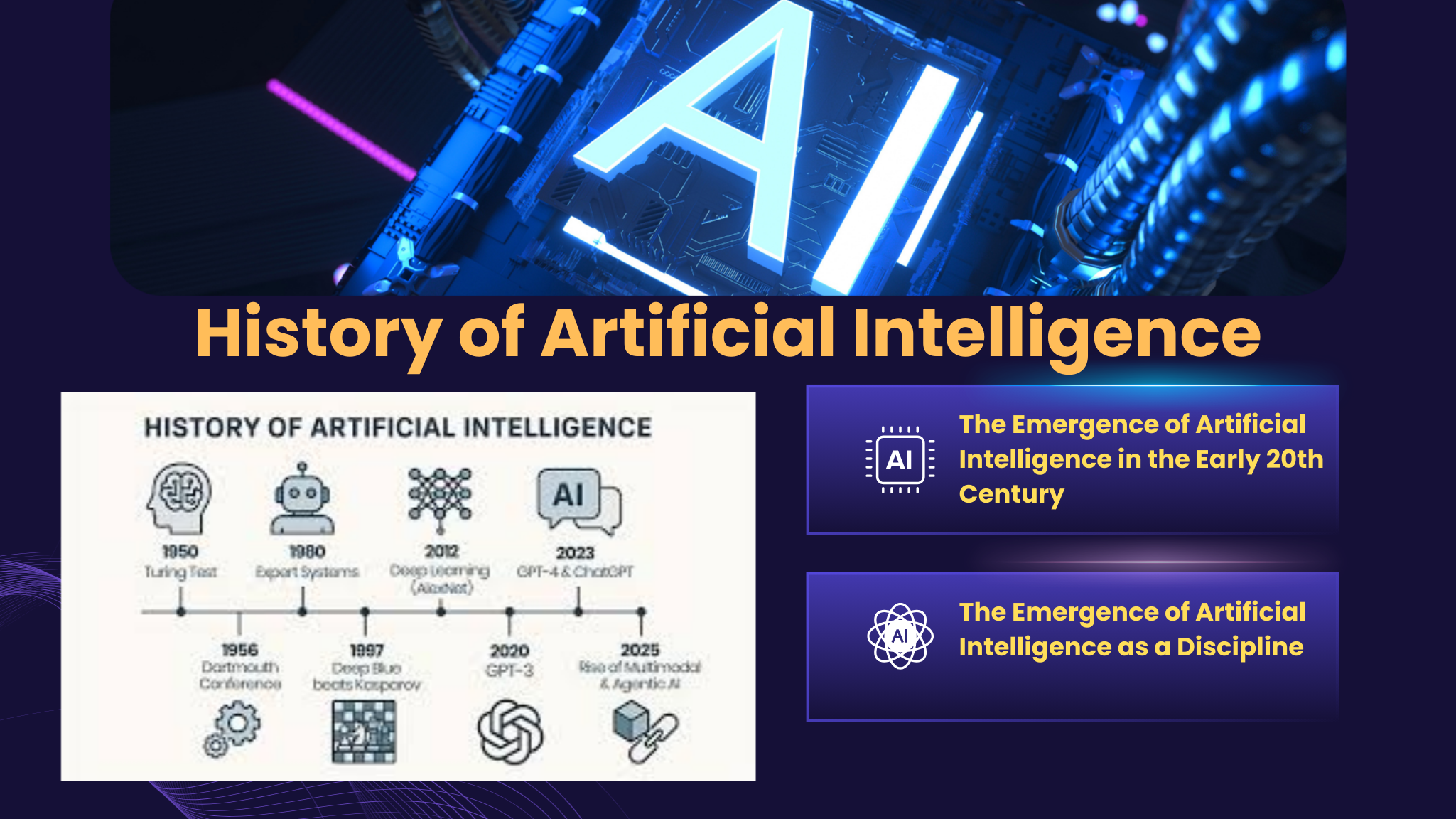
the emergence of artificial intelligence in the early 20th century worldstan.com

This article examines the historical development of artificial intelligence, outlining the technological shifts, innovation cycles, and real-world adoption that shaped AI through 2025.

History of Artificial Intelligence: A Century-Long Journey to Intelligent Systems (Up to 2025)

Artificial intelligence has transitioned from philosophical speculation to a foundational technology shaping global economies and digital societies. Although AI appears to be a modern phenomenon due to recent breakthroughs in generative models and automation, its origins stretch back more than a century. The evolution of artificial intelligence has been shaped by cycles of optimism, limitation, reinvention, and accelerated progress, each contributing to the systems in use today.

This report presents a comprehensive overview of the history of artificial intelligence, tracing its development from early conceptual ideas to advanced AI agents operating in 2025. Understanding this journey is essential for grasping where AI stands today and how it is likely to evolve in the years ahead.

Understanding Artificial Intelligence

Artificial intelligence refers to the capability of machines and software systems to perform tasks that traditionally require human intelligence. These tasks include reasoning, learning from experience, recognizing patterns, understanding language, making decisions, and interacting with complex environments.

Unlike conventional computer programs that rely on fixed instructions, AI systems can adapt their behavior based on data and feedback. This adaptive capability allows artificial intelligence to improve performance over time and operate with varying degrees of autonomy. Modern AI includes a broad range of technologies such as machine learning, deep learning, neural networks, natural language processing, computer vision, and autonomous systems.

Early Philosophical and Mechanical Foundations

The concept of artificial intelligence predates digital computing by centuries. Ancient philosophers explored questions about cognition, consciousness, and the nature of thought, laying conceptual groundwork for later scientific inquiry. In parallel, inventors across civilizations attempted to create mechanical devices capable of independent motion.

Early automatons demonstrated that machines could mimic aspects of human or animal behavior without continuous human control. These mechanical creations were not intelligent in the modern sense, but they reflected a persistent human desire to reproduce intelligence artificially. During the Renaissance, mechanical designs further blurred the boundary between living beings and engineered systems, reinforcing the belief that intelligence might be constructed rather than innate.

The Emergence of Artificial Intelligence in the Early 20th Century

The early 1900s marked a shift from philosophical curiosity to technical ambition. Advances in engineering, mathematics, and logic encouraged scientists to explore whether human reasoning could be formally described and replicated. Cultural narratives began portraying artificial humans and autonomous machines as both marvels and warnings, shaping public imagination.

During this period, early robots and electromechanical devices demonstrated limited autonomy. Although their capabilities were minimal, they inspired researchers to consider the possibility of artificial cognition. At the same time, foundational work in logic and computation began to define intelligence as a process that could potentially be mechanized.

The Emergence of Artificial Intelligence as a Discipline

Funding plummeted as both corporations and governments pulled back support, citing unfulfilled projections and technological constraints.

The development of programmable computers during and after World War II provided the technical infrastructure needed to experiment with machine reasoning. A pivotal moment came when researchers proposed that machine intelligence could be evaluated through observable behavior rather than internal processes. This idea challenged traditional views of intelligence and opened the door to experimental AI systems. Shortly thereafter, artificial intelligence was formally named and recognized as a distinct research discipline.

Early AI programs focused on symbolic reasoning, logic-based problem solving, and simple learning mechanisms. These systems demonstrated that machines could perform tasks previously thought to require human intelligence, fueling optimism about rapid future progress.

Symbolic AI and Early Expansion

From the late 1950s through the 1960s, artificial intelligence research expanded rapidly. Scientists developed programming languages tailored for AI experimentation, enabling more complex symbolic manipulation and abstract reasoning.

During this period, AI systems were designed to solve mathematical problems, prove logical theorems, and engage in structured dialogue. Expert systems emerged as a prominent approach, using predefined rules to replicate the decision-making processes of human specialists.

AI also entered public consciousness through books, films, and media, becoming synonymous with futuristic technology. However, despite promising demonstrations, early systems struggled to handle uncertainty, ambiguity, and real-world complexity.

Funding Challenges and the First AI Slowdown

By the early 1970s, limitations in artificial intelligence became increasingly apparent. Many systems performed well in controlled environments but failed to generalize beyond narrow tasks. Expectations set by early researchers proved overly ambitious, leading to skepticism among funding agencies and governments.

As investment declined, AI research experienced its first major slowdown. This period highlighted the gap between theoretical potential and practical capability. Despite reduced funding, researchers continued refining algorithms and exploring alternative approaches, laying the groundwork for future breakthroughs.

Commercial Interest and the AI Boom

The 1980s brought renewed enthusiasm for artificial intelligence. Improved computing power and targeted funding led to the commercialization of expert systems. These AI-driven tools assisted organizations with decision-making, diagnostics, and resource management.

Businesses adopted AI to automate specialized tasks, particularly in manufacturing, finance, and logistics. At the same time, researchers advanced early machine learning techniques and explored neural network architectures inspired by the human brain.

This era reinforced the idea that AI could deliver tangible economic value. However, development costs remained high, and many systems were difficult to maintain, setting the stage for another period of disappointment.

The AI Winter and Lessons Learned

The late 1980s and early 1990s marked a period known as the AI winter. The formal establishment of artificial intelligence took place in the mid-1900s, defining it as a distinct area of research. Specialized AI hardware became obsolete as general-purpose computers grew more powerful and affordable. Many AI startups failed, and public interest waned. Despite these challenges, the AI winter proved valuable in refining research priorities and emphasizing the importance of scalable, data-driven approaches.

Crucially, this period did not halt progress entirely. Fundamental research continued, enabling the next wave of AI innovation.

The Rise of Intelligent Agents and Practical AI

The mid-1990s signaled a resurgence in artificial intelligence. Improved algorithms, faster processors, and increased data availability allowed AI systems to tackle more complex problems.

One landmark achievement demonstrated that machines could outperform humans in strategic domains. AI agents capable of planning, learning, and adapting emerged in research and commercial applications. Consumer-facing AI products also began entering everyday life, including speech recognition software and domestic robotics.

The internet played a transformative role by generating massive amounts of data, which became the fuel for modern machine learning models.

Machine Learning and the Data-Driven Shift

As digital data volumes exploded, machine learning emerged as the dominant paradigm in artificial intelligence. Instead of relying on manually coded rules, systems learned patterns directly from data.

Supervised learning enabled accurate predictions, unsupervised learning uncovered hidden structures, and reinforcement learning allowed agents to learn through trial and error. These techniques expanded AI’s applicability across industries, from healthcare and finance to marketing and transportation.

Organizations increasingly viewed AI as a strategic asset, integrating analytics and automation into core operations.

Deep Learning and the Modern AI Revolution

The 2010s marked a turning point with the rise of deep learning. Advances in hardware, particularly graphics processing units, enabled the training of large neural networks on massive datasets.

Deep learning systems achieved unprecedented accuracy in image recognition, speech processing, and natural language understanding. AI models began generating human-like text, recognizing objects in real time, and translating languages with remarkable precision.

These breakthroughs transformed artificial intelligence from a specialized research area into a mainstream technology with global impact.

Generative AI and Multimodal Intelligence

The early 2020s introduced generative AI systems capable of producing text, images, audio, and code. These models blurred the line between human and machine creativity, accelerating adoption across creative industries, education, and software development.

Multimodal AI systems integrated multiple forms of data, enabling richer understanding and interaction. Conversational AI tools reached mass audiences, reshaping how people search for information, create content, and interact with technology.

At the same time, concerns about ethics, bias, transparency, and misinformation gained prominence, prompting calls for responsible AI governance.

Artificial Intelligence in 2025: The Era of Autonomous Agents

By 2025, artificial intelligence has entered a new phase characterized by autonomous AI agents. These systems are capable of planning, executing, and adapting complex workflows with minimal human intervention.

AI copilots assist professionals across industries, from software development and finance to healthcare and operations. Businesses increasingly rely on AI-driven insights for decision-making, forecasting, and optimization.

While current systems remain narrow in scope, their growing autonomy raises important questions about accountability, trust, and human oversight.

Societal Impact and Ethical Considerations

As artificial intelligence becomes more integrated into daily life, its societal implications have intensified. Automation is reshaping labor markets, creating both opportunities and challenges. Ethical concerns surrounding data privacy, algorithmic bias, and AI safety have become central to public discourse.

Governments and institutions are working to establish regulatory frameworks that balance innovation with responsibility. Education and reskilling initiatives aim to prepare the workforce for an AI-driven future.

Looking Ahead: The Future of Artificial Intelligence

The future of artificial intelligence remains uncertain, but its trajectory suggests continued growth and integration. Advances in computing, algorithms, and data infrastructure will likely drive further innovation.

Rather than replacing humans entirely, AI is expected to augment human capabilities, enhancing productivity, creativity, and decision-making. The pursuit of artificial general intelligence continues, though significant technical and ethical challenges remain.

Understanding the history of artificial intelligence provides critical context for navigating its future. The lessons learned from past successes and failures will shape how AI evolves beyond 2025.

Date-Wise History of Artificial Intelligence (1921–2025)

Early Conceptual Era (1921–1949)

This phase introduced the idea that machines could imitate human behavior, primarily through literature and mechanical experimentation.

Year

Key Development

1921

The idea of artificial workers entered public imagination through fiction

1929

Early humanoid-style machines demonstrated mechanical autonomy

1949

Scientists formally compared computing systems to the human brain

Birth of Artificial Intelligence (1950–1956)

This era established AI as a scientific discipline.

Year

Key Development

1950

A behavioral test for machine intelligence was proposed

1955

Artificial intelligence was officially defined as a research field

Symbolic AI and Early Growth (1957–1972)

Researchers focused on rule-based systems and symbolic reasoning.

Year

Key Development

1958

The first programming language designed for AI research emerged

1966

Early conversational programs demonstrated language interaction

First Setback and Reduced Funding (1973–1979)

Unmet expectations resulted in declining support.

Year

Key Development

1973

Governments reduced AI funding due to limited real-world success

1979

Autonomous navigation systems were successfully tested

Commercial Expansion and AI Boom (1980–1986)

AI entered enterprise environments.

Year

Key Development

1980

Expert systems were adopted by large organizations

1985

AI-generated creative outputs gained attention

AI Winter Period (1987–1993)

Investment and interest declined significantly.

Year

Key Development

1987

Collapse of specialized AI hardware markets

1988

Conversational AI research continued despite funding cuts

Practical AI and Intelligent Agents (1994–2010)

AI systems began outperforming humans in specific tasks.

Year

Key Development

1997

AI defeated a human world champion in chess

2002

Consumer-friendly home robotics reached the market

2006

AI-driven recommendation engines became mainstream

2010

Motion-sensing AI entered consumer entertainment

Data-Driven AI and Deep Learning Era (2011–2019)

AI performance improved dramatically with data and computing power.

Year

Key Development

2011

AI systems demonstrated advanced language comprehension

2016

Socially interactive humanoid robots gained global visibility

2019

AI achieved elite-level performance in complex strategy games

Generative and Multimodal AI (2020–2022)

AI systems began creating content indistinguishable from human output.

Year

Key Development

2020

Large-scale language models became publicly accessible

2021

AI systems generated images from text descriptions

2022

Conversational AI reached mass adoption worldwide

AI Integration and Industry Transformation (2023–2024)

AI shifted from tools to collaborators.

Year

Key Development

2023

Multimodal AI combined text, image, audio, and video understanding

2024

AI copilots embedded across business, software, and productivity tools

Autonomous AI Agents Era (2025)

AI systems began executing complex workflows independently.

Year

Key Development

2025

AI agents capable of planning, reasoning, and autonomous execution emerged


Conclusion:

Artificial intelligence has evolved through decades of experimentation, setbacks, and breakthroughs, demonstrating that technological progress is rarely linear. From early philosophical ideas and mechanical inventions to data-driven algorithms and autonomous AI agents, each phase of development has contributed essential building blocks to today’s intelligent systems. Understanding this historical progression reveals that modern AI is not a sudden innovation, but the result of sustained research, refinement, and adaptation across generations.

As artificial intelligence reached broader adoption, its role expanded beyond laboratories into businesses, public services, and everyday life. Advances in machine learning, deep learning, and generative models transformed AI from a specialized tool into a strategic capability that supports decision-making, creativity, and operational efficiency. At the same time, recurring challenges around scalability, ethics, and trust underscored the importance of responsible development and realistic expectations.

Looking ahead, the future of artificial intelligence will be shaped as much by human choices as by technical capability. While fully general intelligence remains an aspirational goal, the continued integration of AI into society signals a lasting shift in how technology supports human potential. By learning from its past and applying those lessons thoughtfully, artificial intelligence can continue to evolve as a force for innovation, collaboration, and long-term value.


FAQs:

1. What is meant by the history of artificial intelligence?

The history of artificial intelligence refers to the long-term development of ideas, technologies, and systems designed to simulate human intelligence, spanning early mechanical concepts, rule-based computing, data-driven learning, and modern autonomous AI systems.


2. When did artificial intelligence officially begin as a field?

Artificial intelligence became a recognized scientific discipline in the mid-20th century when researchers formally defined the concept and began developing computer programs capable of reasoning, learning, and problem solving.


3. Why did artificial intelligence experience periods of slow progress?

AI development faced slowdowns when expectations exceeded technical capabilities, leading to reduced funding and interest. These periods highlighted limitations in computing power, data availability, and algorithm design rather than a lack of scientific potential.


4. How did machine learning change the direction of AI development?

Machine learning shifted AI away from manually programmed rules toward systems that learn directly from data. This transition allowed AI to scale more effectively and perform well in complex, real-world environments.


5. What role did deep learning play in modern AI breakthroughs?

Deep learning enabled AI systems to process massive datasets using layered neural networks, leading to major improvements in speech recognition, image analysis, language understanding, and generative applications.


6. How is artificial intelligence being used in 2025?

In 2025, artificial intelligence supports autonomous agents, decision-making tools, digital assistants, and industry-specific applications, helping organizations improve efficiency, accuracy, and strategic planning.


7. Is artificial general intelligence already a reality?

Artificial general intelligence remains a theoretical goal. While modern AI systems perform exceptionally well in specific tasks, they do not yet possess the broad reasoning, adaptability, and understanding associated with human-level intelligence.

Artificial Intelligence Spectrum and the Rise of Heart-Centered AI

Artificial Intelligence Spectrum and the Rise of Heart-Centered AI worldstan.com

This article explores the artificial intelligence spectrum, tracing the evolution from narrow machine intelligence to future possibilities shaped by human cognition, ethics, and heart-centered understanding.

Introduction:

Artificial intelligence has moved from a theoretical concept to a transformative force shaping nearly every aspect of modern life. From recommendation algorithms and voice assistants to advanced medical diagnostics and autonomous systems, artificial intelligence continues to redefine how humans interact with technology. Yet, the conversation around AI is no longer limited to performance and automation. A broader and deeper discussion is emerging—one that explores the intelligence spectrum, the evolution from artificial narrow intelligence to artificial super intelligence, and the possibility of integrating human-like cognition, emotion, and even heart-based intelligence into future systems. This report examines artificial intelligence through a multidimensional lens, connecting technological progress with human cognition, ethical responsibility, and the future relationship between machines and the human heart.

Understanding Artificial Intelligence

Artificial intelligence is commonly defined as the theory and development of computer systems able to perform tasks that normally require human intelligence, such as visual perception, speech recognition, decision-making, and translation between languages. This definition highlights two core ideas: imitation of human intelligence and task-oriented performance. At its foundation, AI relies on data, algorithms, and computational power to identify patterns, learn from experience, and generate outputs that appear intelligent.

Over time, artificial intelligence has evolved from rule-based expert systems to machine learning models capable of adapting and improving through exposure to large datasets. Today, AI systems can analyze complex information at a speed and scale far beyond human capability. However, despite these advancements, most existing systems remain limited in scope, operating within predefined boundaries rather than demonstrating genuine understanding or consciousness.

The Intelligence Spectrum Explained

The intelligence spectrum provides a framework for understanding different levels and forms of intelligence, both artificial and human. Rather than viewing intelligence as a single capability, this spectrum recognizes varying degrees of cognitive ability, adaptability, emotional awareness, and self-reflection.

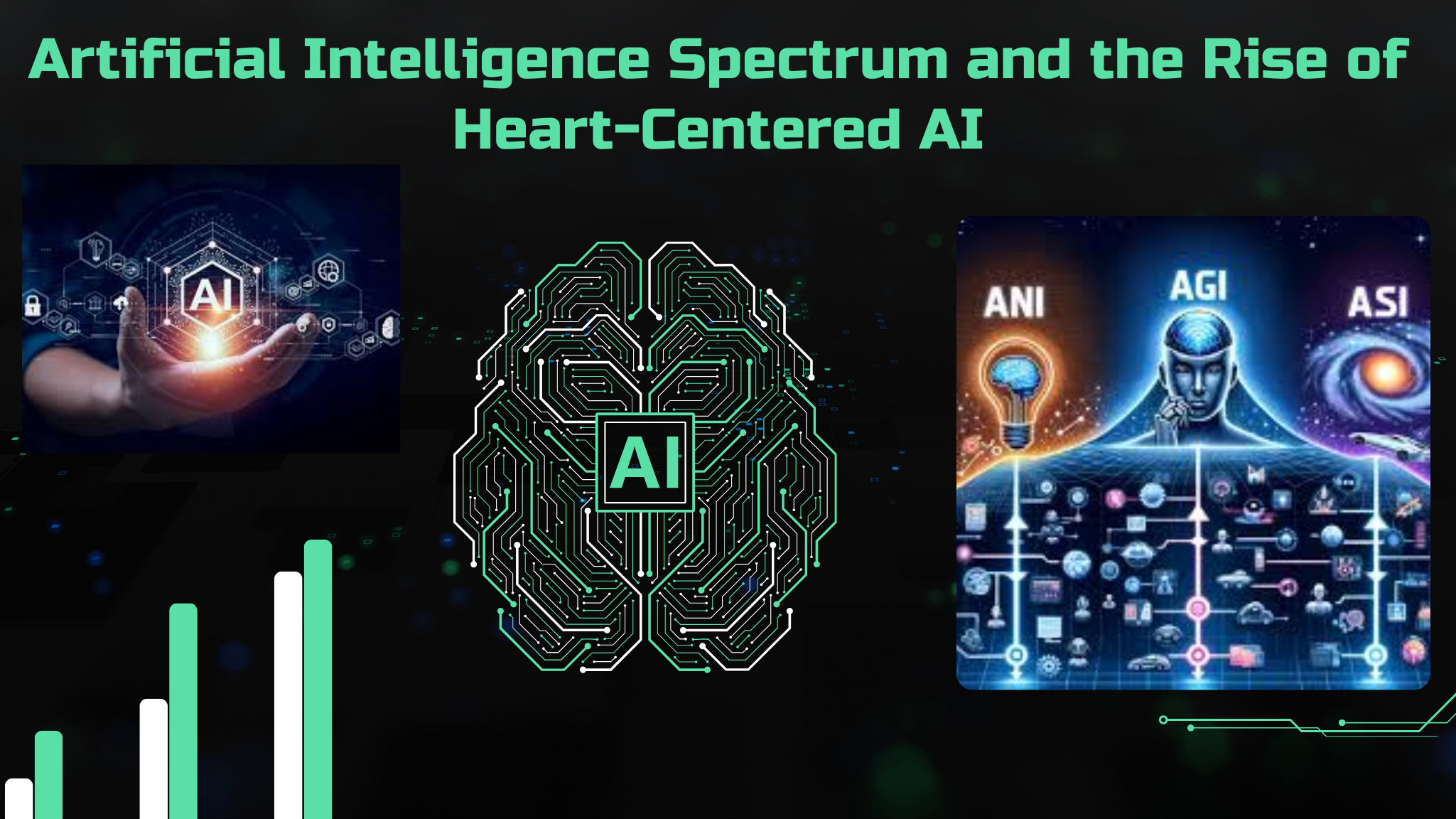
On one end of the spectrum lies artificial narrow intelligence, which dominates current AI applications. At the center lies artificial general intelligence, a hypothetical form of AI capable of human-level reasoning across diverse domains. At the far end lies artificial super intelligence, which surpasses human intelligence in nearly all cognitive aspects. Parallel to this technological spectrum exists human intelligence, shaped not only by logic and reasoning but also by emotion, intuition, morality, and heart cognition.

Understanding this spectrum is essential for evaluating both the capabilities and limitations of artificial intelligence, as well as the potential direction of its future development.

Artificial Narrow Intelligence and Its Real-World Impact

These systems excel within their designated domain but lack the ability to transfer knowledge or reasoning beyond their programmed purpose. Examples include facial recognition software, language translation tools, recommendation engines, and medical imaging analysis systems.

The success of artificial narrow intelligence lies in its precision and efficiency. In healthcare, narrow AI assists doctors by detecting diseases earlier and more accurately. In finance, it identifies fraud patterns and automates trading strategies. In everyday life, it powers search engines, smart assistants, and personalized content feeds.

Despite its effectiveness, artificial narrow intelligence does not possess awareness, understanding, or emotional intelligence. It operates based on statistical correlations rather than comprehension. This limitation raises important questions about trust, bias, and ethical responsibility, particularly as narrow AI systems increasingly influence critical decisions affecting human lives.

Artificial General Intelligence: A Theoretical Bridge

Artificial general intelligence represents a theoretical stage in the evolution of artificial intelligence. Unlike narrow AI, AGI would possess the ability to understand, learn, and apply knowledge across a wide range of tasks, much like a human being. It would be capable of reasoning, problem-solving, and adapting to unfamiliar situations without explicit programming.

While AGI remains largely conceptual, it serves as a bridge between current AI capabilities and more advanced forms of intelligence. Researchers continue to debate whether AGI is achievable and, if so, how long it may take to develop. The pursuit of artificial general intelligence has sparked discussions about safety, alignment, and governance. If machines reach human-level intelligence, ensuring that their goals align with human values becomes a critical concern.

Artificial Super Intelligence and Future Possibilities

Artificial super intelligence refers to a hypothetical form of AI that surpasses human intelligence in every domain, including scientific creativity, emotional understanding, strategic thinking, and social intelligence. Such systems would not only perform tasks better than humans but also improve themselves autonomously.

The concept of artificial super intelligence raises profound philosophical and ethical questions. While it promises unprecedented advancements in medicine, science, and global problem-solving, it also introduces risks related to control, autonomy, and unintended consequences. A super-intelligent system could potentially reshape societies, economies, and power structures in ways that are difficult to predict.

Discussions around artificial super intelligence emphasize the importance of proactive governance, ethical frameworks, and interdisciplinary collaboration. Rather than focusing solely on technological capability, experts increasingly stress the need to embed human values and moral reasoning into advanced AI systems.

Human Intelligence Beyond Logic

Human intelligence extends far beyond analytical reasoning and information processing. It encompasses emotion, empathy, intuition, creativity, and moral judgment. These qualities allow humans to navigate complex social environments, form meaningful relationships, and make value-based decisions.

Unlike artificial intelligence, human cognition is deeply influenced by lived experience, culture, and emotional memory. The human brain does not merely compute outcomes; it interprets meaning and context. This distinction highlights a critical gap between artificial systems and human intelligence, even as AI continues to advance in technical performance.

Recognizing this gap is essential when evaluating the role of AI in society. While machines can augment human capabilities, replacing the full spectrum of human intelligence remains an unresolved challenge.

The Human Heart and Cognition

Recent research in neuroscience and psychology has drawn attention to heart cognition, the idea that the human heart plays an active role in perception, emotional processing, and decision-making. The heart contains a complex network of neurons and communicates continuously with the brain through neural, hormonal, and electromagnetic pathways.

Heart cognition influences intuition, emotional regulation, and social awareness. Many human decisions, particularly those involving ethics, compassion, and relationships, are guided as much by the heart as by the brain. This integrated intelligence allows humans to balance logic with empathy and rationality with moral responsibility.

The recognition of heart cognition challenges purely computational models of intelligence and opens new perspectives on what it truly means to think, understand, and act wisely.

Artificial Intelligence and Emotional Understanding

As artificial intelligence becomes more embedded in human environments, the need for emotional awareness grows increasingly important. Emotional AI, also known as affective computing, aims to enable machines to recognize, interpret, and respond to human emotions.

Current emotional AI systems analyze facial expressions, voice tone, and physiological signals to infer emotional states. While these systems can simulate emotional responsiveness, they do not experience emotions themselves. This distinction raises questions about authenticity, trust, and ethical use.

Integrating emotional understanding into AI could improve human-machine interaction, particularly in healthcare, education, and mental health support. However, it also requires careful consideration to avoid manipulation, surveillance, or emotional dependency.

Bridging Artificial Intelligence and Heart-Centered Intelligence

The future of artificial intelligence may depend on its ability to integrate cognitive performance with heart-centered principles. Rather than pursuing intelligence solely as efficiency or optimization, researchers are exploring ways to align AI development with human values such as compassion, fairness, and well-being.

Heart-centered artificial intelligence does not imply that machines possess emotions in the human sense. Instead, it emphasizes ethical design, empathetic interaction, and value-aligned decision-making. By modeling human moral reasoning and emotional awareness, AI systems could support more humane and responsible outcomes.

This approach shifts the focus from dominance and control to collaboration and augmentation, positioning AI as a partner in human progress rather than a replacement.

Ethical Dimensions of Future Artificial Intelligence

Ethics play a central role in shaping the future of artificial intelligence. Issues such as data privacy, algorithmic bias, accountability, and transparency are already pressing concerns in narrow AI applications. As AI systems grow more autonomous, these challenges become even more complex.

Embedding ethical reasoning into AI requires multidisciplinary collaboration among technologists, philosophers, psychologists, and policymakers. It also demands global standards to ensure that AI development benefits humanity as a whole rather than amplifying inequality or power imbalances.

A heart-centered ethical framework encourages developers to consider not only what AI can do, but what it should do, and for whom.

The Role of Artificial Intelligence in Human Evolution

Artificial intelligence is not merely a technological tool; it is a force shaping the future trajectory of human evolution. By augmenting human intelligence, AI has the potential to expand creativity, accelerate learning, and solve complex global challenges.

However, this evolution must be guided by conscious choice rather than unchecked automation. Preserving human agency, dignity, and emotional depth is essential as machines take on greater roles in decision-making and social interaction.

The integration of artificial intelligence into human life should enhance, not diminish, the qualities that make us human.

Future Outlook: Intelligence with Purpose

The future of artificial intelligence lies not only in increased computational power but in purposeful design. Moving along the intelligence spectrum from artificial narrow intelligence toward more advanced forms requires a balance between innovation and responsibility.

By incorporating insights from human cognition, heart intelligence, and ethical philosophy, future AI systems can be designed to support sustainable progress. This vision prioritizes collaboration, empathy, and long-term well-being over short-term efficiency.

As society stands at the crossroads of technological advancement, the choices made today will shape the role of artificial intelligence for generations to come.

Conclusion:

The intelligence spectrum provides a powerful lens for understanding artificial intelligence, from narrow task-based systems to the speculative possibilities of artificial super intelligence. While technological progress continues at an unprecedented pace, true intelligence encompasses more than computation and efficiency. Human intelligence, shaped by the heart, emotion, and moral reasoning, remains a unique and essential benchmark.

The future of artificial intelligence will depend on how effectively it aligns with human values and heart-centered cognition. Rather than seeking to replicate or surpass humanity, AI has the potential to complement and elevate human capabilities when guided by ethical purpose. By embracing a holistic vision of intelligence, society can ensure that artificial intelligence serves as a force for meaningful, compassionate, and sustainable progress.

FAQs:

1. What is the artificial intelligence spectrum?
The artificial intelligence spectrum is a framework that categorizes different levels of AI, ranging from task-specific systems (Artificial Narrow Intelligence) to advanced hypothetical models (Artificial Super Intelligence), while also considering human-like cognition and ethical intelligence.


2. How does artificial narrow intelligence differ from artificial general intelligence?
Artificial Narrow Intelligence (ANI) performs specific tasks within a defined scope, such as image recognition or language translation. Artificial General Intelligence (AGI), on the other hand, would be capable of reasoning, learning, and adapting across multiple domains similar to human intelligence.


3. What is artificial super intelligence and why is it important?
Artificial Super Intelligence (ASI) refers to AI systems that surpass human intelligence in virtually every cognitive task. Its importance lies in its potential to revolutionize industries, science, and society, while raising critical ethical and governance challenges.


4. What role does the human heart play in intelligence?
Recent research highlights the concept of heart cognition, where the heart communicates with the brain to influence decision-making, intuition, and emotional awareness. Integrating this understanding helps envision AI systems that align more closely with human values.


5. Can artificial intelligence develop emotions or ethical reasoning?
While AI can simulate emotional responses and follow ethical frameworks, it does not inherently experience emotions. Advanced AI can, however, be designed to recognize human emotions, respond empathetically, and support ethically responsible decisions.


6. How does the future of AI intersect with human intelligence?
The future of AI is expected to augment human intelligence rather than replace it. By combining computational capabilities with insights from human cognition, emotional intelligence, and ethical reasoning, AI can assist in complex decision-making and creative problem-solving.


7. Why is understanding the AI spectrum important for businesses and society?
Understanding the AI spectrum helps organizations and policymakers assess AI capabilities, plan for future technological shifts, and ensure ethical implementation. It also guides society in leveraging AI to complement human intelligence responsibly.


If you want, I can next craft a 3-paragraph solid conclusion for this blog that is fully unique, professional, and aligned with your SEO strategy. This will complete the content package for posting.


Impact of Generative AI on Socioeconomic Inequality

impact of generative ai on socioeconomic inequality worldstan.com

This piece outlines how generative AI is transforming economies and institutions, the risks it poses for widening inequality, and the policy choices that will shape its long-term social impact.

The rapid advancement of generative artificial intelligence is reshaping economies, institutions, and everyday life at an unprecedented pace. Once confined to experimental research labs, generative AI systems are now embedded in workplaces, classrooms, healthcare systems, and public administration. Their ability to generate text, images, data-driven insights, and strategic recommendations has positioned them as a foundational technology of the modern era. However, alongside innovation and productivity gains, generative AI introduces complex challenges related to socioeconomic inequality and public policy.

This report examines how generative AI is influencing existing social and economic disparities and how policy making must evolve to address these shifts. It explores labor markets, education, governance, democratic systems, and global inequality, while highlighting the urgent need for inclusive and forward-looking AI governance frameworks.

Introduction to Generative Artificial Intelligence and Social Change

Generative artificial intelligence refers to systems capable of producing original content based on patterns learned from vast datasets. Unlike earlier forms of automation that focused on mechanical or repetitive tasks, generative AI operates in cognitive domains traditionally associated with human intelligence. This includes writing, problem-solving, design, forecasting, and decision support.

The transformative power of these systems lies in their scalability. A single AI model can perform tasks across industries and regions, potentially affecting millions of people simultaneously. As a result, generative AI is not merely a technological upgrade but a structural force that can reshape social hierarchies, economic opportunities, and institutional power.

Socioeconomic inequality already defines access to education, healthcare, employment, and political influence. The integration of generative AI into these systems risks amplifying existing divides if adoption and regulation are uneven. Understanding these dynamics is essential for policymakers seeking to balance innovation with social equity.

The Uneven Distribution of Access to Generative AI

Access to generative AI tools is shaped by infrastructure, cost, and digital literacy. High-income countries and large organizations are more likely to benefit from advanced AI capabilities, while low-income communities often face barriers related to connectivity, technical skills, and institutional capacity.

This disparity creates what many researchers describe as a new digital stratification. Those with access to AI-enhanced tools gain productivity advantages, improved learning outcomes, and greater decision-making power. Meanwhile, those without access risk falling further behind in economic competitiveness and social mobility.

Small businesses, public institutions in developing regions, and marginalized populations are particularly vulnerable. Without targeted policies to expand access, generative AI could reinforce global and domestic inequalities rather than reduce them.

Generative AI and Labor Market Transformation

One of the most visible impacts of generative AI is its influence on employment and workforce dynamics. Unlike traditional automation, which primarily affected manual or routine jobs, generative AI targets knowledge-based roles across sectors such as media, law, finance, software development, and research.

For some workers, generative AI functions as a productivity-enhancing assistant, automating repetitive components of complex tasks and freeing time for higher-value activities. For others, it introduces displacement risks, especially in roles where output can be standardized and scaled by AI systems.

These changes are unlikely to affect all workers equally. Individuals with higher education levels, adaptable skills, and access to reskilling programs are better positioned to benefit from AI integration. Conversely, workers with limited training opportunities may face job insecurity without adequate social protection.

Policy responses must therefore focus on workforce transition strategies, including lifelong learning initiatives, labor market flexibility, and updated social safety nets.

Education Systems in the Age of Generative AI

Education is both a beneficiary of generative AI and a critical factor in determining its long-term societal impact. AI-powered learning tools can personalize instruction, provide instant feedback, and expand access to educational resources. In theory, these capabilities could reduce educational inequality.

In practice, however, outcomes depend heavily on implementation. Well-resourced institutions can integrate generative AI into curricula, teacher training, and assessment methods. Under-resourced schools may struggle to adopt these technologies effectively, widening educational gaps.

Additionally, there is a risk that students may rely excessively on AI-generated content without developing foundational skills such as critical thinking, reasoning, and creativity. This could create a new form of cognitive inequality, where surface-level performance improves while deep understanding declines.

Education policy must therefore emphasize responsible AI use, digital literacy, and pedagogical frameworks that position AI as a support tool rather than a substitute for learning.

Generative AI, Power, and Economic Concentration

The development and deployment of generative AI are dominated by a small number of technology companies and research institutions. This concentration of expertise, data, and computational resources raises concerns about market power and economic inequality.

When a limited set of actors controls advanced AI systems, they also shape the values, priorities, and assumptions embedded in these technologies. This can marginalize alternative perspectives and limit the ability of smaller firms, public institutions, and developing countries to influence AI trajectories.

Economic concentration also affects innovation distribution. While leading firms benefit from economies of scale, others may become dependent on proprietary AI systems, reducing competition and local capacity building.

Antitrust policies, public investment in open AI infrastructure, and support for decentralized innovation ecosystems are essential to counterbalance these trends.

Bias, Data Inequality, and Social Impact

Generative AI systems are trained on large datasets that reflect historical and social patterns. As a result, they may reproduce or amplify existing biases related to gender, ethnicity, income, and geography. These biases can influence outcomes in sensitive areas such as hiring, lending, healthcare recommendations, and public services.

Data inequality plays a central role in this process. Groups that are underrepresented or misrepresented in training data may experience lower accuracy, unfair treatment, or exclusion from AI-driven systems. This reinforces structural disadvantages rather than correcting them.

Addressing bias requires more than technical adjustments. It demands inclusive data practices, transparency in model design, and accountability mechanisms that allow affected individuals to challenge harmful outcomes.

The Role of Generative AI in Policy Making

Generative AI is increasingly used to support policy analysis, scenario modeling, and administrative decision-making. These applications offer potential benefits, including faster data processing, improved forecasting, and enhanced evidence-based governance.

However, reliance on AI-generated insights introduces new risks. Many generative models operate as complex systems with limited interpretability. If policymakers depend on outputs they cannot fully explain, this may undermine accountability and democratic legitimacy.

There is also a risk that AI-driven policy tools could reflect the biases or assumptions of their creators, influencing decisions in subtle but significant ways. Transparent governance frameworks and human oversight are therefore essential when integrating AI into public administration.

Democratic Institutions and Public Trust

Generative AI has profound implications for democratic processes and public discourse. AI-generated content can shape political messaging, simulate public opinion, and automate engagement at scale. While these tools can enhance participation, they can also be misused to spread misinformation or manipulate narratives.

Well-resourced actors can deploy generative AI to dominate information environments, marginalizing smaller voices and grassroots movements. This asymmetry threatens the pluralism and deliberation essential to democratic systems.

Maintaining public trust requires clear standards for political AI use, transparency in content generation, and safeguards against manipulation. Media literacy and public awareness campaigns are also critical in helping citizens navigate AI-influenced information ecosystems.

Global Inequality and International Dimensions of AI

The global impact of generative AI is shaped by disparities between countries. Advanced economies often lead in AI research, infrastructure, and policy development, while developing nations may struggle to keep pace.

This imbalance risks creating a new form of technological dependency, where low- and middle-income countries rely on external AI systems without building local capacity. Such dependency can limit economic sovereignty and policy autonomy.

International cooperation is essential to address these challenges. Shared standards, knowledge exchange, and investment in global AI capacity building can help ensure that generative AI contributes to inclusive development rather than deepening global divides.

Regulatory Frameworks and Ethical Governance

Effective regulation is central to shaping the societal impact of generative AI. Policymakers face the challenge of encouraging innovation while protecting public interests. This requires flexible, adaptive regulatory approaches that evolve alongside technological advances.

Key regulatory priorities include transparency, accountability, data protection, and fairness. Ethical governance frameworks should integrate multidisciplinary perspectives and involve stakeholders from civil society, academia, and affected communities.

Public participation is particularly important. Inclusive policy making can help align AI development with societal values and reduce resistance driven by fear or mistrust.

Harnessing Generative AI for Inclusive Growth

Despite its risks, generative AI holds significant potential to reduce certain inequalities if guided by thoughtful policy. AI-driven tools can expand access to healthcare, legal information, education, and public services, particularly in underserved regions.

Realizing these benefits requires intentional design choices. Public investment in accessible AI platforms, open research initiatives, and community-driven innovation can help ensure that generative AI serves broad social goals.

Inclusivity must be treated as a core objective rather than a secondary consideration. When marginalized groups are actively involved in shaping AI systems, outcomes are more likely to reflect diverse needs and perspectives.

Conclusion:

Generative artificial intelligence represents a defining technological shift with far-reaching implications for socioeconomic inequality and policy making. Its influence extends across labor markets, education systems, governance structures, and democratic institutions.

Without deliberate intervention, generative AI risks reinforcing existing disparities and concentrating power among those already advantaged. However, with inclusive governance, adaptive regulation, and public engagement, it can become a tool for shared prosperity and social progress.

The choices made today by policymakers, institutions, and societies will determine whether generative AI deepens inequality or contributes to more equitable outcomes. Addressing this challenge requires vision, collaboration, and a commitment to aligning technological innovation with human values.

As generative AI continues to evolve, the need for responsible, evidence-based, and inclusive policy making remains critical. By shaping AI development proactively, societies can ensure that this powerful technology supports not only efficiency and growth, but also fairness, dignity, and long-term social stability.

FAQs:

1. What is generative artificial intelligence and how does it differ from traditional AI?
Generative artificial intelligence refers to systems that can create new content such as text, images, code, or analytical insights based on patterns learned from data. Unlike traditional AI, which is often designed to classify or predict outcomes, generative AI produces original outputs that mimic human reasoning and creativity.

2. Why is generative AI considered a risk to socioeconomic equality?
Generative AI can widen inequality when access to advanced tools, data, and digital skills is limited to certain groups or regions. Those with early access may gain economic and social advantages, while others face job displacement or reduced opportunities without adequate support.

3. How is generative AI changing employment and workforce structures?
Generative AI is transforming knowledge-based roles by automating parts of complex tasks and enhancing productivity. While this can create new opportunities, it also reshapes job requirements and may reduce demand for certain roles, increasing the need for reskilling and workforce adaptation.

4. Can generative AI help reduce inequality instead of increasing it?
Yes, when guided by inclusive policies, generative AI can expand access to education, healthcare, and public services. Its potential to reduce inequality depends on equitable access, responsible design, and policy frameworks that prioritize social benefit over narrow economic gain.

5. What challenges does generative AI pose for public policy making?
Policy makers face challenges related to transparency, accountability, and bias when using generative AI systems. Ensuring that AI-supported decisions are explainable and aligned with public values is essential to maintaining trust and democratic legitimacy.

6. How does generative AI affect democratic institutions and public discourse?
Generative AI can influence political communication by producing large volumes of content and targeting specific audiences. While this may increase engagement, it also raises concerns about misinformation, manipulation, and unequal influence over public narratives.

7. What role should governments play in regulating generative AI?
Governments should establish adaptive regulatory frameworks that encourage innovation while safeguarding fairness, data protection, and social equity. This includes investing in digital skills, supporting ethical AI development, and ensuring that generative AI benefits society as a whole.

Artificial Intelligence Overview: How AI Works and Where It Is Used

ai foundation models built for real world business use (2) worldstan.com

This article provides a comprehensive overview of artificial intelligence, explaining its core concepts, key technologies such as machine learning, generative AI, natural language processing, and expert systems, along with their real-world applications across major industries.

Introduction to Artificial Intelligence

Artificial Intelligence (AI) has emerged as one of the most influential technological developments of the modern era. It refers to the capability of machines and computer systems to perform tasks that traditionally depend on human intelligence. These tasks include learning from experience, recognizing patterns, understanding language, reasoning logically, and making decisions based on complex data. As industries increasingly rely on digital transformation, artificial intelligence has become a central force reshaping how organizations operate, compete, and innovate.

Once considered a futuristic concept, AI is now deeply embedded in everyday life. From recommendation systems on e-commerce platforms to advanced diagnostic tools in healthcare, AI-powered technologies are transforming how people interact with information and services. Its growing presence reflects a shift from static computing systems to intelligent, adaptive technologies capable of continuous improvement.

The Evolution of Artificial Intelligence Technology

The development of artificial intelligence has been shaped by decades of research in computer science, mathematics, and cognitive science. Early AI systems were rule-based and limited in scope, relying heavily on predefined instructions. While these systems could perform specific tasks, they lacked flexibility and adaptability.

The rise of data availability and computing power marked a turning point for AI. Modern artificial intelligence systems can process massive datasets, uncover hidden relationships, and refine their outputs over time. This evolution has enabled AI to move beyond simple automation toward intelligent decision-making, making it a critical asset across multiple sectors.

Today, AI technology is not confined to experimental environments. It is deployed at scale in business operations, public services, and consumer applications, signaling a new era of intelligent computing.

Understanding the Core Concepts of Artificial Intelligence

Artificial intelligence is not a single technology but a broad field composed of interconnected concepts and methodologies. These foundational elements enable machines to simulate aspects of human intelligence. Among the most significant are machine learning, generative AI, natural language processing, and expert systems.

Each of these components contributes uniquely to the AI ecosystem, supporting systems that can learn independently, generate new content, understand human communication, and replicate expert-level decision-making.

Machine Learning as the Foundation of Modern AI

Machine learning is a critical subset of artificial intelligence that focuses on enabling systems to learn from data without being explicitly programmed for every outcome. Instead of following rigid instructions, machine learning models analyze historical data, identify patterns, and make predictions or decisions based on those insights.

Machine learning is widely used in industries that depend on data-driven decision-making. In finance, it supports fraud detection, risk assessment, and algorithmic trading. In healthcare, machine learning models assist with early disease detection, medical imaging analysis, and personalized treatment planning. In marketing and e-commerce, these systems power recommendation engines and customer behavior analysis.

A key advantage of machine learning is its ability to improve over time. As more data becomes available, models refine their accuracy, making them increasingly effective in dynamic environments.

Deep Learning and Advanced Learning Models

Deep learning is an advanced branch of machine learning inspired by the structure of the human brain. It uses layered neural networks to process complex data such as images, audio, and video. These models excel at recognizing intricate patterns that traditional algorithms struggle to detect.

Deep learning has driven significant progress in fields such as facial recognition, speech recognition, and autonomous systems. Self-driving cars, for example, rely on deep learning models to interpret sensor data and navigate real-world environments. This level of sophistication highlights how artificial intelligence is moving closer to human-like perception and decision-making.

Generative AI and the Rise of Creative Machines

Generative AI represents a major shift in how artificial intelligence is applied. Unlike traditional AI systems that focus on analysis or classification, generative AI is designed to create new content. This includes written text, images, music, software code, and video.

By learning patterns from vast datasets, generative AI systems can produce original outputs that closely resemble human-created content. This capability has had a significant impact on industries such as media, marketing, software development, and design. Professionals are increasingly using generative AI tools to accelerate workflows, generate ideas, and enhance creativity.

However, the rapid growth of generative AI also raises questions about originality, ethical use, and content authenticity. As adoption expands, organizations are focusing on responsible implementation to ensure that creative AI tools are used transparently and ethically.

Natural Language Processing and Human-Machine Communication

Natural Language Processing, commonly known as NLP, enables machines to understand, interpret, and generate human language. By combining linguistics, artificial intelligence, and machine learning, NLP allows computers to interact with users in a more natural and intuitive way.

NLP technologies power virtual assistants, chatbots, translation tools, and speech recognition systems. These applications have become essential in customer service, education, and enterprise communication. Businesses use NLP to analyze customer feedback, perform sentiment analysis, and extract insights from large volumes of unstructured text.

As NLP models continue to evolve, AI-driven communication is becoming more accurate and context-aware. This progress is narrowing the gap between human language and machine understanding, making digital interactions more seamless.

Expert Systems and Knowledge-Based AI

Expert systems are among the earliest applications of artificial intelligence and remain valuable in specialized domains. These systems are designed to simulate the decision-making abilities of human experts using structured knowledge and rule-based logic.

Expert systems operate using predefined rules, often expressed as conditional statements, combined with a knowledge base developed by subject matter experts. They are particularly useful in fields such as healthcare, engineering, and manufacturing, where expert knowledge is critical but not always readily available.

While expert systems do not adapt as dynamically as machine learning models, they offer reliability and consistency in well-defined environments. When integrated with modern AI techniques, they can form powerful hybrid solutions.

Applications of Artificial Intelligence Across Industries

Artificial intelligence is transforming nearly every major industry by enhancing efficiency, accuracy, and innovation. Its versatility makes it a valuable tool in both public and private sectors.

In healthcare, AI supports predictive analytics, medical imaging, robotic-assisted surgery, and personalized medicine. AI-powered systems help clinicians diagnose diseases earlier and develop more effective treatment plans.

In finance, artificial intelligence improves fraud detection, credit scoring, risk management, and customer engagement. Financial institutions rely on AI-driven analytics to make faster, more informed decisions.

E-commerce platforms use AI to deliver personalized recommendations, optimize pricing strategies, and manage supply chains. By analyzing user behavior, AI systems enhance customer experiences and drive higher conversion rates.

Transportation is undergoing significant change through AI-driven technologies such as autonomous vehicles, traffic optimization systems, and predictive maintenance tools. Self-driving cars, in particular, demonstrate how AI can improve safety and efficiency in complex environments.

The Role of AI in Business and Digital Transformation

Artificial intelligence has become a strategic asset for organizations pursuing digital transformation. By automating routine tasks and augmenting human capabilities, AI allows businesses to focus on innovation and value creation.

AI-powered analytics provide deeper insights into market trends, customer preferences, and operational performance. This enables organizations to make data-driven decisions and respond quickly to changing conditions.

As AI adoption grows, companies are investing in talent development, infrastructure, and governance frameworks to ensure sustainable implementation.

Ethical Considerations and Challenges in Artificial Intelligence

Despite its benefits, artificial intelligence presents challenges that must be addressed responsibly. Data privacy, algorithmic bias, and transparency are among the most pressing concerns. AI systems reflect the data they are trained on, making ethical data collection and management essential.

Regulatory bodies and industry leaders are working to establish guidelines that promote fairness, accountability, and trust in AI technologies. Collaboration between policymakers, technologists, and researchers is critical to addressing these challenges effectively.

The Future of Artificial Intelligence Technology

next generation of intelligent systems.

Explainable AI focuses on making AI decision-making processes more transparent, particularly in high-stakes environments. Edge AI enables real-time processing by analyzing data closer to its source. Human-AI collaboration emphasizes systems designed to enhance human capabilities rather than replace them.

As access to AI tools becomes more widespread, artificial intelligence is expected to play an even greater role in economic growth, education, and societal development.

Conclusion:

Artificial intelligence has moved beyond theoretical discussion to become a practical force shaping how modern systems function and evolve. Through technologies such as machine learning, generative AI, natural language processing, and expert systems, AI enables organizations to analyze information more intelligently, automate complex processes, and uncover insights that drive smarter decisions. Its growing presence across industries highlights a shift toward data-driven operations where adaptability and intelligence are essential for long-term success.

As AI adoption continues to expand, its influence is increasingly felt in everyday experiences as well as high-impact professional environments. From improving medical diagnostics and financial risk management to enhancing customer engagement and transportation efficiency, artificial intelligence is redefining performance standards across sectors. However, this progress also emphasizes the importance of responsible development, transparent systems, and ethical oversight to ensure that AI technologies serve human needs without compromising trust or fairness.

Looking ahead, artificial intelligence is poised to play an even greater role in economic growth, innovation, and societal advancement. Continued investment in research, governance frameworks, and human–AI collaboration will shape how effectively this technology is integrated into future systems. With thoughtful implementation and a focus on accountability, artificial intelligence has the potential to support sustainable development and create meaningful value across a wide range of applications.


FAQs:

1. What is artificial intelligence in simple terms?

Artificial intelligence refers to the ability of computer systems to perform tasks that normally require human thinking, such as learning from data, recognizing patterns, understanding language, and making decisions with minimal human input.

2. How does artificial intelligence learn from data?

Artificial intelligence systems learn by analyzing large sets of data using algorithms that identify relationships and trends. Over time, these systems adjust their models to improve accuracy and performance as new data becomes available.

3. What is the difference between artificial intelligence and machine learning?

Artificial intelligence is a broad field focused on creating intelligent systems, while machine learning is a specific approach within AI that enables systems to learn and improve automatically from data without explicit programming.

4. How is generative AI different from traditional AI systems?

Generative AI is designed to create new content such as text, images, or code by learning patterns from existing data, whereas traditional AI systems primarily focus on analyzing information, classifying data, or making predictions.

5. Why is natural language processing important for AI applications?

Natural language processing allows AI systems to understand and interact with human language, enabling technologies such as chatbots, voice assistants, translation tools, and sentiment analysis used across many industries.

6. In which industries is artificial intelligence most widely used today?

Artificial intelligence is widely used in healthcare, finance, e-commerce, transportation, education, and manufacturing, where it improves efficiency, decision-making, personalization, and predictive capabilities.

7. What challenges are associated with the use of artificial intelligence?

Key challenges include data privacy concerns, potential bias in algorithms, lack of transparency in AI decision-making, and the need for ethical and responsible deployment of intelligent systems.

Kimi k1.0 by Moonshot AI: A New Multimodal LLM for Complex Reasoning

kimi k1.0 by moonshot ai a new multimodal llm for complex reasoning WORLDSTAN.COM

This article provides an in-depth overview of Kimi k1.0, detailing how its multimodal design, dual reasoning modes, and selective training approach redefine advanced AI reasoning.

Kimi k1.0 Signals a New Direction in Multimodal AI Reasoning

Introduction: A Shift in How AI Thinks

The rapid evolution of large language models has moved artificial intelligence beyond simple text generation toward systems capable of reasoning across multiple forms of information. In this context, Kimi k1.0, released by Moonshot AI on January 21, 2025, marks an important development in multimodal AI research. Designed to interpret text, images, and video within a single reasoning framework, the model reflects a broader industry transition toward goal-driven intelligence that prioritizes accuracy, context awareness, and practical problem solving.

Rather than focusing solely on scale or conversational fluency, Kimi k1.0 is positioned as a reasoning-centric system intended for demanding analytical tasks. Its architecture and training strategy emphasize interpretability, long-context understanding, and cross-domain applicability, placing it among a new generation of AI models built for professional and enterprise use.

Moonshot AI and the Strategic Vision Behind Kimi

Moonshot AI has entered the competitive AI landscape with a philosophy that differs from many established players. Instead of racing to produce the largest possible model, the company has concentrated on refining how artificial intelligence reasons, learns, and generalizes. Kimi k1.0 embodies this approach by focusing on decision quality rather than raw parameter expansion.

The development of Kimi aligns with a growing recognition that real-world AI applications require more than fluent language output. Industries such as education, research, law, and software engineering demand systems capable of sustaining complex reasoning over long sessions while maintaining consistency and correctness. Moonshot AI’s strategy reflects this demand, positioning Kimi as a tool for depth rather than surface-level interaction.

Multimodal Intelligence as a Core Capability

One of the defining attributes of Kimi k1.0 is its multimodal design. Unlike traditional large language models that operate exclusively on text, Kimi can process and integrate visual information, including images and video. This capability allows the model to interpret diagrams, screenshots, visual data representations, and recorded demonstrations alongside written instructions or queries.

Multimodal reasoning significantly expands the range of tasks an AI model can address. Technical documentation often combines textual explanations with visual examples, while mathematical and scientific problems frequently rely on graphs and symbolic representations. By unifying these inputs, Kimi k1.0 provides responses that reflect a more holistic understanding of the problem space.

Reasoning Architecture Designed for Flexibility

Kimi k1.0 introduces a dual chain-of-thought reasoning system that enables users to tailor the model’s behavior to specific requirements. This architecture includes two distinct modes that prioritize different outcomes.

The Long-CoT mode emphasizes transparent, step-by-step reasoning. This approach is particularly valuable in educational environments, research analysis, and technical debugging, where understanding the reasoning process is as important as the final answer. By exposing intermediate steps, the model supports validation and trust.

In contrast, the Short-CoT Clip mode is optimized for speed and precision. It delivers concise, high-accuracy responses with minimal latency, making it suitable for enterprise workflows and real-time applications. This flexibility allows Kimi k1.0 to serve a wide range of use cases without compromising reliability.

Selective Training Through Rejection Sampling

The training methodology behind Kimi k1.0 represents a departure from conventional reinforcement learning practices. Moonshot AI employed a selective training approach based on rejection sampling, in which the model retains only correct or high-quality outputs during its learning phase.

By discarding flawed reasoning paths, the system avoids reinforcing errors and reduces noise in the training data. This process prioritizes outcome correctness over exhaustive exposure to all generated possibilities. The result is a model that demonstrates improved accuracy and decision-making consistency without unnecessary complexity.

This training strategy also aligns with the model’s goal-first fine-tuning framework. Instead of optimizing for token-level behavior, Kimi k1.0 is trained to generalize across task modalities while maintaining alignment between reasoning and final outcomes. This approach is particularly effective in high-stakes problem-solving scenarios.

Long-Context Processing and Real-Time Research

Kimi k1.0 supports an extensive context window of up to 128,000 tokens, enabling it to process large volumes of information in a single session. This capability is critical for tasks that involve lengthy documents, multi-chapter reports, or expansive codebases.

In addition to long-context understanding, the model offers real-time file handling with support for more than 50 simultaneous uploads. Users can analyze multiple documents, datasets, or media files without losing contextual continuity. This feature is especially useful in legal, technical, and data-intensive workflows.

The integration of live web search across over 100 websites further enhances Kimi’s research capabilities. By accessing up-to-date information during analysis, the model can synthesize external data with user-provided content, supporting more informed and relevant outputs.

Applications Across Knowledge-Intensive Domains

Kimi k1.0 is designed to operate effectively across a wide range of professional and academic fields. In education, the model can assist with complex problem solving, concept explanation, and curriculum development. Its adjustable reasoning depth allows it to adapt to different learning levels and instructional goals.

In software development, Kimi supports code analysis, debugging, and architectural planning. Its ability to process large code repositories and interpret visual inputs such as diagrams or interface designs makes it a valuable tool for developers working on complex systems.

Research professionals may leverage Kimi’s long-context and multimodal capabilities to analyze academic papers, technical reports, and experimental data. The model’s reasoning consistency and selective training approach contribute to more reliable analytical outcomes.

Enterprise Workflows and Automation Potential

For enterprise users, Kimi k1.0 offers capabilities that align with organizational requirements for efficiency and accountability. The model can be integrated into workflows involving report generation, compliance verification, and decision support.

By emphasizing reasoning accuracy and interpretability, Kimi addresses concerns related to AI transparency and trust. This makes it suitable for deployment in environments where explainability is essential, such as finance, healthcare administration, and regulatory compliance.

Automation scenarios also benefit from Kimi’s design. Its Short-CoT reasoning mode enables rapid response generation, while its underlying training framework ensures that outputs remain aligned with defined goals and quality standards.

Interactive AI Interfaces and User Experience

The multimodal nature of Kimi k1.0 opens new possibilities for interactive AI interfaces. Systems built on top of the model can respond not only to text-based commands but also to visual cues and contextual signals.

This capability supports the development of advanced user interfaces, including intelligent dashboards, virtual research assistants, and adaptive learning platforms. By interpreting diverse inputs, Kimi enhances human-computer interaction and enables more natural, context-aware exchanges.

Positioning in the Global AI Landscape

The release of Kimi k1.0 highlights the growing influence of Chinese AI companies in global research and development. Moonshot AI’s approach contributes to a more diverse AI ecosystem, introducing alternative methodologies for training and reasoning optimization.

As competition intensifies among large language models, differentiation increasingly depends on practical utility rather than benchmark performance alone. Kimi’s emphasis on multimodal reasoning, long-context processing, and selective training positions it as a distinctive option in this evolving landscape.

Implications for the Future of AI Reasoning

Kimi k1.0 illustrates a broader shift in artificial intelligence toward systems that prioritize decision quality, contextual understanding, and adaptability. Its architecture suggests a future in which AI models are evaluated not only on their ability to generate language but also on how effectively they support complex, real-world tasks.

The model’s dual reasoning modes and rejection-based training framework offer insights into how AI can balance transparency and efficiency. As these ideas gain traction, they may influence the design of next-generation large language models across the industry.

Conclusion:

Kimi k1.0 reflects a deliberate shift in how advanced AI systems are being designed and evaluated. Rather than emphasizing size or surface-level fluency, Moonshot AI has introduced a model that centers on reasoning depth, contextual awareness, and outcome reliability. Its ability to work across text, images, and video, combined with flexible reasoning modes and selective training, demonstrates a clear focus on practical intelligence rather than theoretical performance.

The model’s long-context processing and real-time research capabilities further reinforce its role as a tool for knowledge-intensive tasks. By sustaining coherent reasoning across large volumes of information, Kimi k1.0 addresses a growing demand for AI systems that can support complex analysis in professional, academic, and enterprise environments.

As competition among large language models continues to intensify, Kimi k1.0 stands out for its goal-oriented architecture and emphasis on decision quality. Whether its approach becomes a broader industry standard remains to be seen, but its design offers a compelling example of how multimodal AI can evolve beyond conversation toward structured, high-stakes problem solving.

FAQs:

  • What is Kimi k1.0 and who developed it?
    Kimi k1.0 is a multimodal large language model developed by Moonshot AI. It is designed to process and reason across text, images, and video, with a focus on complex analytical and professional use cases.

  • How does Kimi k1.0 differ from traditional language models?
    Unlike text-only models, Kimi k1.0 integrates visual and textual information into a single reasoning process. It also prioritizes decision accuracy and reasoning quality over conversational output or model size.

  • What are the dual reasoning modes in Kimi k1.0?
    Kimi k1.0 offers two reasoning approaches: a transparent mode that provides step-by-step explanations and a fast-response mode optimized for speed and precision. Users can choose the mode based on their specific task requirements.

  • Why is selective training important in Kimi k1.0?
    Selective training allows the model to learn only from correct or high-quality outputs. By filtering out flawed reasoning during training, Kimi k1.0 improves reliability and reduces the risk of reinforcing errors.

  • What is the significance of the 128k token context window?
    A 128k token context window enables Kimi k1.0 to analyze lengthy documents, large codebases, and multi-file research materials without losing coherence, making it suitable for deep analytical tasks.

  • Which industries can benefit most from Kimi k1.0?
    Kimi k1.0 is well-suited for education, research, software development, legal analysis, and enterprise automation, particularly in environments that require long-form reasoning and multimodal understanding.

  • How does Kimi k1.0 contribute to the future of AI development?
    Kimi k1.0 highlights a shift toward reasoning-centric AI models that emphasize accuracy, context, and practical decision-making, offering insights into how next-generation AI systems may be designed.

WuDao 3.0: Trillion-Parameter AI Model from China

https://worldstan.com/wudao-3-0-trillion-parameter-ai-model-from-china/

This article explores WuDao 3.0, China’s trillion-parameter open-source AI model family, examining its architecture, core systems, multimodal capabilities, and strategic role in advancing AI research, enterprise innovation, and technological sovereignty.

WuDao 3.0 and the Evolution of China’s Open-Source AI Ecosystem

The global artificial intelligence landscape is undergoing a structural shift. As competition intensifies among nations, institutions, and enterprises, large-scale AI models have become strategic assets rather than purely technical achievements. In this environment, WuDao 3.0 emerges as a defining milestone for China’s open-source AI ambitions. Developed by the Zhiyuan Research Institute, WuDao 3.0 represents one of the most extensive and technically ambitious AI model families released by China to date, reinforcing the country’s commitment to AI sovereignty, collaborative research, and accessible large-model infrastructure.

With a parameter scale exceeding 1.75 trillion, WuDao 3.0 is not simply an upgrade over its predecessors. Instead, it reflects a broader transformation in how large language models, multimodal AI systems, and open research frameworks are designed, distributed, and applied across academic and enterprise environments.

Redefining Scale in Open-Source AI

Scale has become a defining metric in modern artificial intelligence. Large language models and multimodal systems now rely on massive parameter counts, extensive training datasets, and sophisticated architectural designs to achieve higher levels of reasoning, generalization, and contextual understanding. WuDao 3.0 stands at the forefront of this movement, positioning itself among the largest open-source AI model families globally.

Unlike closed commercial systems, WuDao 3.0 has been intentionally structured to serve the scientific research community. Its open availability enables universities, laboratories, and enterprises to experiment with trillion-parameter architectures without relying entirely on proprietary platforms. This approach reflects a growing recognition that innovation in artificial intelligence accelerates when foundational models are shared, audited, and extended by diverse contributors.

By adopting an open-source strategy at such an unprecedented scale, China signals its intent to balance technological competitiveness with collaborative development, a model that contrasts sharply with the increasingly closed ecosystems seen elsewhere.

A Modular Family of AI Systems

Rather than functioning as a single monolithic model, WuDao 3.0 is organized as a modular AI family. This design philosophy allows different systems within the ecosystem to specialize in dialogue, code generation, and visual intelligence while remaining interoperable under a shared framework.

At the core of this family are several flagship systems, including AquilaChat, AquilaCode, and the WuDao Vision Series. Each model addresses a specific dimension of artificial intelligence while contributing to a broader vision of multimodal reasoning and cross-domain intelligence.

This modular architecture ensures adaptability across industries and research domains. Developers can deploy individual components independently or integrate them into composite systems that combine language understanding, visual perception, and generative capabilities.

AquilaChat and the Advancement of Bilingual Dialogue Models

One of the most prominent components of WuDao 3.0 is AquilaChat, a dialogue-oriented large language model designed for high-quality conversational interaction. Available in both 7-billion and 33-billion parameter versions, AquilaChat reflects a strong emphasis on bilingual performance, particularly in English and Chinese.

Approximately 40 percent of its training data is in Chinese, allowing the model to handle nuanced linguistic structures, cultural references, and domain-specific terminology with greater accuracy. This bilingual foundation enables AquilaChat to function effectively in cross-border research, international collaboration, and multilingual enterprise applications.

Performance evaluations indicate that the 7B version of AquilaChat rivals or surpasses several closed-source dialogue models in both domestic and international benchmarks. Its architecture prioritizes contextual continuity, semantic coherence, and adaptive response generation, making it suitable for customer service systems, research assistants, and educational platforms.

Beyond basic conversation, AquilaChat is designed to manage extended dialogues that require memory retention, topic transitions, and contextual inference. This capability positions it as a practical solution for real-world deployments rather than a purely experimental chatbot.

AquilaCode and the Path Toward Autonomous Programming

As software development becomes increasingly complex, AI-assisted programming has emerged as a critical productivity tool. AquilaCode addresses this demand by focusing on logic-driven code generation across multiple programming languages.

Unlike simpler code completion tools, AquilaCode is engineered to interpret structured prompts, reason through algorithmic requirements, and generate complete functional programs. Its capabilities range from basic tasks such as generating Fibonacci sequences to more advanced outputs like interactive applications and sorting algorithms.

Although still under active development, AquilaCode represents a strategic step toward autonomous coding systems. Its long-term objective is to support multilingual programming environments, enabling developers to work seamlessly across languages and platforms.

In enterprise contexts, AquilaCode has the potential to accelerate development cycles, reduce coding errors, and assist in rapid prototyping. For academic research, it provides a platform for studying how large language models can internalize programming logic and translate abstract instructions into executable code.

WuDao Vision Series and the Expansion of Visual Intelligence

Language models alone are no longer sufficient to address the complexity of real-world AI applications. Visual understanding has become equally critical, particularly in fields such as autonomous systems, medical imaging, and multimedia analysis. The WuDao Vision Series responds to this need with a suite of models designed for advanced visual tasks.

This series includes systems such as EVA, EVA-CLIP, vid2vid-zero, and Painter, each tailored to specific visual challenges. Together, they form a comprehensive toolkit for image recognition, video processing, segmentation, and generative visual tasks.

EVA, built on a billion-parameter backbone, leverages large-scale public datasets to learn visual representations with reduced supervision. This approach allows the model to generalize effectively across diverse image and video domains, reducing the need for extensive labeled data.

EVA-CLIP extends these capabilities by aligning visual and textual representations, enabling multimodal reasoning across images and language. Vid2vid-zero focuses on video transformation tasks, while Painter explores creative and generative applications in visual AI.

By integrating these systems into the WuDao 3.0 ecosystem, the Zhiyuan Research Institute demonstrates a commitment to holistic AI development that extends beyond text-based intelligence.

Multimodal Integration as a Strategic Advantage

One of the defining characteristics of WuDao 3.0 is its emphasis on multimodal integration. Rather than treating language, vision, and generation as isolated capabilities, the model family is designed to support interaction across modalities.

This integrated approach allows AI systems to interpret text, analyze images, generate visual content, and produce coherent responses that reflect multiple data sources. Such capabilities are increasingly important in real-world scenarios, where information rarely exists in a single format.

Multimodal AI systems have applications ranging from intelligent tutoring platforms and digital content creation to industrial monitoring and scientific research. WuDao 3.0’s architecture enables researchers to explore these applications within an open and extensible framework.

Compatibility Across Chip Architectures

Another significant feature of WuDao 3.0 is its compatibility with diverse chip architectures. As AI workloads grow in scale, hardware flexibility becomes essential for cost efficiency and deployment scalability.

By supporting multiple hardware platforms, WuDao 3.0 reduces dependency on specific vendors and enables broader adoption across research institutions and enterprises. This design choice aligns with China’s broader strategy of building resilient and self-sufficient AI infrastructure.

Hardware compatibility also facilitates experimentation and optimization, allowing developers to adapt models to different performance and energy constraints without compromising functionality.

AI Sovereignty and Open Infrastructure

The release of WuDao 3.0 carries implications beyond technical innovation. It reflects a strategic effort to strengthen AI sovereignty by ensuring that foundational technologies remain accessible and adaptable within national and regional ecosystems.

Open-source AI models play a critical role in this strategy. By democratizing access to large model infrastructure, China enables domestic researchers and enterprises to innovate independently while contributing to global AI advancement.

This approach contrasts with closed commercial ecosystems that restrict access to core technologies. WuDao 3.0 demonstrates how open infrastructure can coexist with large-scale innovation, fostering transparency, collaboration, and long-term sustainability.

Lessons from WuDao 2.0 and Cultural Intelligence

WuDao 3.0 builds upon the legacy of WuDao 2.0, which gained international attention through applications such as Zhibing Hua, a virtual student capable of writing poetry, creating artwork, and composing music. These demonstrations highlighted WuDao’s capacity to blend language, vision, and generation in culturally nuanced ways.

The success of WuDao 2.0 underscored the importance of culturally aware AI systems that reflect local languages, traditions, and creative expressions. WuDao 3.0 extends this philosophy by embedding cultural intelligence into its bilingual and multimodal designs.

Such capabilities are particularly valuable for creative industries, education, and digital media, where context and cultural relevance play a critical role in user engagement.

Implications for Academic Research

For the academic community, WuDao 3.0 represents a powerful research platform. Its open-source nature allows scholars to study large-scale model behavior, experiment with architectural modifications, and explore ethical and social implications of advanced AI systems.

Access to a trillion-parameter model family enables research that was previously limited to organizations with vast computational resources. This democratization of AI research infrastructure has the potential to accelerate discoveries and diversify perspectives within the field.

Universities and research institutions can leverage WuDao 3.0 for studies in natural language processing, computer vision, multimodal learning, and AI alignment, contributing to a more comprehensive understanding of artificial intelligence.

Enterprise Innovation and Industrial Applications

Beyond academia, WuDao 3.0 offers significant value to enterprises seeking to integrate AI into their operations. Its modular design allows businesses to adopt specific components that align with their needs, whether in customer interaction, software development, or visual analytics.

Industries such as finance, healthcare, manufacturing, and media can benefit from bilingual dialogue systems, automated coding tools, and advanced visual recognition models. By building on an open-source foundation, enterprises gain flexibility and reduce long-term dependency on proprietary vendors.

This adaptability is particularly important in rapidly evolving markets, where the ability to customize and extend AI systems can provide a competitive advantage.

Challenges and Future Directions

Despite its achievements, WuDao 3.0 also highlights ongoing challenges in large-scale AI development. Training and deploying trillion-parameter models require significant computational resources, energy consumption, and technical expertise.

Ethical considerations, including data governance, bias mitigation, and responsible deployment, remain critical areas of focus. As WuDao 3.0 gains adoption, addressing these challenges will be essential to ensuring its positive impact.

Future iterations may further enhance efficiency, improve multimodal reasoning, and expand support for additional languages and domains. Continued collaboration between researchers, policymakers, and industry stakeholders will play a key role in shaping this evolution.

Conclusion:

WuDao 3.0 reflects a turning point in how large-scale artificial intelligence is built and shared. By combining trillion-parameter scale with an open-source foundation, it shifts advanced AI from a closed, resource-heavy domain into a more accessible and collaborative space. Its modular design, bilingual intelligence, and multimodal systems illustrate how future AI platforms may move beyond single-purpose tools toward integrated ecosystems that serve research, industry, and creative fields alike. As global attention increasingly focuses on transparency, adaptability, and technological independence, WuDao 3.0 stands as a practical example of how open infrastructure can support long-term innovation while reshaping the competitive dynamics of artificial intelligence worldwide.

FAQs:

  1. What makes WuDao 3.0 different from other large AI models?
    WuDao 3.0 distinguishes itself through its open-source design combined with trillion-parameter scale, allowing researchers and enterprises to study, adapt, and deploy advanced AI systems without relying on closed commercial platforms.

  2. Is WuDao 3.0 designed only for language-based tasks?
    No, WuDao 3.0 is a multimodal AI family that supports text understanding, code generation, image recognition, video processing, and creative visual tasks within a unified framework.

  3. How does WuDao 3.0 support bilingual and cross-cultural use cases?
    The model family is trained extensively in both Chinese and English, enabling accurate language handling, cultural context awareness, and effective communication across international research and business environments.

  4. Who can use WuDao 3.0 and for what purposes?
    WuDao 3.0 is intended for academic researchers, developers, and enterprises looking to build AI-driven solutions in areas such as education, software development, visual analysis, and digital content creation.

  5. What role does WuDao 3.0 play in China’s AI strategy?
    WuDao 3.0 supports China’s focus on AI sovereignty by providing open access to large-scale AI infrastructure, reducing dependence on external platforms while encouraging domestic and global collaboration.

  6. Can WuDao 3.0 be adapted to different hardware environments?
    Yes, the model family is designed to be compatible with multiple chip architectures, making it flexible for deployment across varied computing setups and performance requirements.

  7. How does WuDao 3.0 build on the capabilities of earlier WuDao models?
    WuDao 3.0 expands on earlier versions by offering greater scale, improved multimodal integration, and broader application support, transforming experimental capabilities into practical tools for real-world innovation.


MiniMax AI Foundation Models: Built for Real-World Business Use

minimax ai foundation models built for real world business use https://worldstan.com/minimax-ai-foundation-models-built-for-real-world-business-use/

This in-depth report explores how MiniMax AI is emerging as a key Chinese foundation model company, examining its core technologies, enterprise-focused innovations, flagship products, and strategic approach to building efficient, safe, and adaptable AI systems for real-world applications.

MiniMax AI: Inside China’s Emerging Foundation Model Powerhouse Driving Enterprise Intelligence

Artificial intelligence development in China has entered a decisive phase, marked by the rise of domestic companies building large-scale foundation models capable of competing with global leaders. Among these emerging players, MiniMax has steadily positioned itself as a serious contender in the general-purpose AI ecosystem. Founded in 2021, the company has moved rapidly from research experimentation to real-world deployment, focusing on scalable, high-performance models designed to support complex enterprise and consumer use cases.

Rather than pursuing AI purely as a conversational novelty, MiniMax has emphasized practical intelligence. Its work centers on dialogue systems, reasoning-focused architectures, and multimodal content generation, all unified under a broader strategy of operational efficiency, safety alignment, and rapid deployment. Backed by strategic investment from Tencent, MiniMax represents a new generation of Chinese AI companies that blend academic rigor with industrial execution.

This report examines MiniMax’s technological direction, flagship products, architectural innovations, and growing influence within China’s AI market, while also exploring how its approach to foundation models may shape the next wave of enterprise AI adoption.

The Rise of Foundation Models in China’s AI Landscape

Over the past decade, China’s AI sector has transitioned from applied machine learning toward the development of large language models and multimodal systems capable of generalized reasoning. This shift mirrors global trends but is shaped by domestic priorities, including enterprise automation, localized deployment, and regulatory compliance.

MiniMax entered this landscape at a critical moment. By 2021, the foundation model paradigm had proven its effectiveness, yet challenges remained around cost efficiency, latency, personalization, and real-world usability. MiniMax’s early strategy focused on addressing these limitations rather than simply scaling parameters.

From its inception, the company positioned itself as a builder of general-purpose AI models that could operate across industries. This decision shaped its research priorities, pushing the team to invest in architectures capable of handling dialogue, task execution, and contextual reasoning within a single system.

Unlike narrow AI tools designed for isolated tasks, MiniMax’s models aim to support evolving conversations and ambiguous workflows. This orientation toward adaptability has become one of the company’s defining characteristics.

Company Overview and Strategic Positioning

MiniMax operates as a privately held AI company headquartered in China, with a strong emphasis on research-driven product development. While still relatively young, the firm has built a reputation for delivering production-ready AI systems rather than experimental prototypes.

Tencent’s backing has provided MiniMax with both capital stability and ecosystem access. This partnership has allowed the company to test its models across large-scale platforms and enterprise environments, accelerating feedback loops and deployment readiness.

At the strategic level, MiniMax focuses on three guiding principles. The first is performance, ensuring that models deliver reliable outputs under real-world constraints. The second is efficiency, minimizing computational overhead and latency. The third is safety alignment, reflecting the growing importance of responsible AI practices within China’s regulatory framework.

These priorities influence everything from model training pipelines to user-facing product design, setting MiniMax apart from competitors that emphasize scale at the expense of control.

Inspo: A Dialogue Assistant Designed for Action

MiniMax’s flagship product, Inspo, illustrates the company’s applied philosophy. Marketed as a dialogue assistant, Inspo goes beyond traditional chatbot functionality by integrating conversational interaction with task execution.

Inspo is designed to operate in both consumer and enterprise environments. On the consumer side, it supports natural language interaction that feels fluid and responsive. On the enterprise side, it functions as a productivity layer, assisting users with information retrieval, decision support, and multi-step task coordination.

What differentiates Inspo from many dialogue assistants is its ability to maintain contextual awareness across extended interactions. Rather than treating each prompt as an isolated request, the system tracks evolving intent, adjusting responses as clarity emerges.

This capability makes Inspo particularly suitable for business workflows, where users often refine requirements gradually. By anticipating intent and supporting mid-task pivots, the assistant reduces friction and improves task completion rates.

Dialogue and Reasoning as Core Model Capabilities

At the heart of MiniMax’s technology stack lies a commitment to dialogue-driven intelligence. The company views conversation not as an interface layer but as a reasoning process through which users express goals, constraints, and preferences.

MiniMax’s language models are trained to interpret incomplete or ambiguous inputs, leveraging contextual signals to infer likely objectives. This approach contrasts with rigid prompt-response systems that require explicit instructions at every step.

Reasoning capabilities are integrated directly into the model architecture. Rather than relying solely on post-processing logic, MiniMax embeds reasoning pathways that allow the system to evaluate multiple possible interpretations before responding.

This design supports more natural interactions and improves performance in scenarios where users shift direction mid-conversation. For enterprises, this translates into AI systems that feel collaborative rather than transactional.

Multimodal Content Generation and Real-World Relevance

Beyond text-based dialogue, MiniMax has invested heavily in multimodal AI models capable of processing and generating content across multiple formats. This includes text, structured data, and other media types relevant to enterprise workflows.

Multimodal capability enables MiniMax’s systems to operate in complex environments where information is not confined to a single modality. For example, educational platforms may require AI that can interpret lesson structures, generate explanatory text, and respond to visual cues. Similarly, customer service systems benefit from models that can integrate structured records with conversational input.

MiniMax’s multimodal approach is guided by practical deployment considerations. Models are optimized to handle real-world data variability rather than idealized training conditions. This emphasis improves robustness and reduces the need for extensive manual tuning during implementation.

Multi-Agent Collaboration: Simulating Distributed Intelligence

One of MiniMax’s most notable innovations is its multi-agent collaboration system. Rather than relying on a single monolithic model to handle all tasks, MiniMax has developed an architecture that allows multiple AI agents to communicate, delegate, and coordinate.

Each agent within the system can specialize in a particular function, such as information retrieval, reasoning, or task execution. These agents exchange signals and intermediate outputs, collectively solving complex queries that would challenge a single-task model.

This architecture is particularly valuable in real-time environments such as customer service operations, supply chain management, and educational platforms. In these contexts, tasks often involve multiple steps, dependencies, and changing conditions.

By simulating collaborative intelligence, MiniMax’s multi-agent system moves closer to how human teams operate. It represents a shift away from isolated AI responses toward coordinated problem-solving.

Applications Across Enterprise Verticals

MiniMax’s technology has been tested across a range of enterprise use cases, reflecting its general-purpose orientation. In customer service, the company’s models support dynamic query resolution, handling follow-up questions without losing context.

In supply chain operations, multi-agent systems can assist with demand forecasting, logistics coordination, and exception handling. By integrating structured data with conversational input, AI agents can provide actionable insights rather than static reports.

Education represents another key vertical. MiniMax’s dialogue-driven models can adapt explanations to individual learners, responding to questions in real time while maintaining alignment with curriculum objectives.

These applications demonstrate MiniMax’s focus on solving operational problems rather than showcasing abstract capabilities.

Lightweight Adaptive Fine-Tuning and Personalization

Personalization remains one of the most challenging aspects of large-scale AI deployment. Traditional fine-tuning approaches often increase model size and computational cost, limiting scalability.

MiniMax addresses this challenge through a technique known as Lightweight Adaptive Fine-Tuning, or LAFT. This method allows models to adapt to user preferences and organizational contexts without significant parameter expansion.

LAFT operates by introducing adaptive layers that can be updated rapidly, enabling low-latency personalization. This makes the technique well-suited for enterprise environments where thousands of users may require individualized experiences.

By minimizing performance overhead, LAFT supports hybrid deployment models and large-scale rollouts. It also reduces infrastructure costs, an increasingly important consideration as AI adoption expands.

Code-Aware Language Models and Developer Applications

In addition to dialogue and reasoning, MiniMax has quietly developed a code-aware language framework tailored for software development tasks. Unlike general-purpose models that treat code as text, MiniMax’s system is trained to understand syntax, structure, and intent.

This code-native approach enables more accurate code generation, debugging suggestions, and refactoring support. Early pilots have demonstrated particular strength in multi-language environments and legacy codebase modernization.

Fintech companies and developer tooling startups have been among the first adopters, using MiniMax’s models to accelerate development cycles and improve code quality.

By addressing programming as a first-class use case, MiniMax expands its relevance beyond conversational AI into the broader software ecosystem.

Efficiency, Deployment Speed, and Infrastructure Considerations

A recurring theme in MiniMax’s development philosophy is efficiency. Rather than pursuing maximal model size, the company focuses on optimizing performance per parameter.

This approach yields several advantages. Lower latency improves user experience, particularly in interactive applications. Reduced computational requirements lower operational costs, making AI adoption more accessible to mid-sized enterprises.

Deployment speed is another priority. MiniMax designs its systems to integrate smoothly with existing infrastructure, reducing implementation complexity. This focus aligns with enterprise expectations, where long deployment cycles can undermine project viability.

By balancing capability with practicality, MiniMax positions itself as a provider of usable AI rather than experimental technology.

Safety Alignment and Responsible AI Development

As AI systems become more influential, concerns around safety, bias, and misuse have grown. MiniMax addresses these issues through a strong emphasis on safety alignment.

Models are trained and evaluated with safeguards designed to prevent harmful outputs and ensure compliance with regulatory standards. This is particularly important within China’s evolving AI governance framework.

Safety alignment also extends to enterprise reliability. By reducing unpredictable behavior and improving output consistency, MiniMax enhances trust in its systems.

This commitment reflects a broader industry shift toward responsible AI, where long-term sustainability depends on public and institutional confidence.

Market Presence and Competitive Positioning

Within China’s AI ecosystem, MiniMax occupies a distinctive position. While larger players focus on scale and platform dominance, MiniMax emphasizes architectural innovation and applied performance.

The company’s foothold in China provides access to diverse data environments and deployment scenarios. This experience strengthens model robustness and informs ongoing development.

As global interest in Chinese AI companies grows, MiniMax’s focus on general-purpose foundation models positions it as a potential international player, subject to regulatory and market considerations.

Predictive Intent Handling and Adaptive Workflows

One of MiniMax’s less visible but strategically important strengths lies in its ability to handle ambiguity. The company’s models are optimized to predict user intent even when prompts are incomplete.

This capability is especially valuable in enterprise workflows, where users often begin tasks without fully articulated goals. By adapting as clarity emerges, MiniMax’s systems reduce the need for repetitive input.

Adaptive workflows also support multi-turn conversations, enabling AI to remain useful throughout extended interactions. This contrasts with systems that reset context after each exchange.

Such features enhance productivity and align AI behavior more closely with human working patterns.

Future Outlook and Strategic Implications

Looking ahead, MiniMax is well-positioned to benefit from continued demand for enterprise AI solutions. Its emphasis on efficiency, collaboration, and adaptability addresses many of the barriers that have slowed AI adoption.

As foundation models become more integrated into business processes, companies that prioritize real-world usability are likely to gain advantage. MiniMax’s track record suggests a clear understanding of this dynamic.

While competition remains intense, MiniMax’s combination of technical depth and deployment focus distinguishes it within the crowded AI landscape.

Conclusion:

MiniMax represents a new wave of Chinese AI companies redefining what foundation models can deliver in practical settings. Since its launch in 2021, the company has built a portfolio of technologies that prioritize dialogue-driven reasoning, multimodal intelligence, and collaborative AI architectures.

Through products like Inspo, innovations such as multi-agent collaboration and LAFT personalization, and specialized systems for code-aware development, MiniMax demonstrates a commitment to applied intelligence.

Backed by Tencent and grounded in safety alignment and efficiency, the company has established a solid foothold in China’s AI ecosystem. Its focus on adaptability, intent prediction, and enterprise readiness positions it as a meaningful contributor to the next phase of AI deployment.

As artificial intelligence continues to move from experimentation to infrastructure, MiniMax’s approach offers insight into how foundation models can evolve to meet real-world demands.

FAQs:

  • What makes MiniMax AI different from other Chinese AI companies?
    MiniMax AI distinguishes itself by prioritizing real-world deployment over experimental scale. Its foundation models are designed to handle ambiguity, multi-step workflows, and enterprise-grade performance while maintaining efficiency, safety alignment, and low latency.

  • What type of AI models does MiniMax develop?
    MiniMax develops general-purpose foundation models that support dialogue, reasoning, and multimodal content generation. These models are built to operate across industries rather than being limited to single-task applications.

  • How does the Inspo assistant support enterprise users?
    Inspo is designed to combine natural conversation with task execution. For enterprises, it helps manage complex workflows, supports multi-turn interactions, and adapts to evolving user intent without requiring repeated instructions.

  • What is MiniMax’s multi-agent collaboration system?
    The multi-agent system allows several AI agents to work together by sharing tasks and intermediate results. This approach improves performance in complex scenarios such as customer service operations, education platforms, and supply chain coordination.

  • How does MiniMax personalize AI responses at scale?
    MiniMax uses a technique called Lightweight Adaptive Fine-Tuning, which enables rapid personalization without significantly increasing model size or computational cost. This makes it practical for large organizations with many users.

  • Can MiniMax AI be used for software development tasks?
    Yes, MiniMax has developed a code-aware language framework that understands programming structure and intent. It supports code generation, debugging guidance, and refactoring across multiple programming languages.

  • Why is MiniMax AI important in the broader AI market?
    MiniMax reflects a shift toward efficient, enterprise-ready foundation models in China’s AI sector. Its focus on adaptability, safety, and practical deployment positions it as a notable player in the evolving global AI landscape.