

AI Roadmap for Beginners to Learn AI in 2026
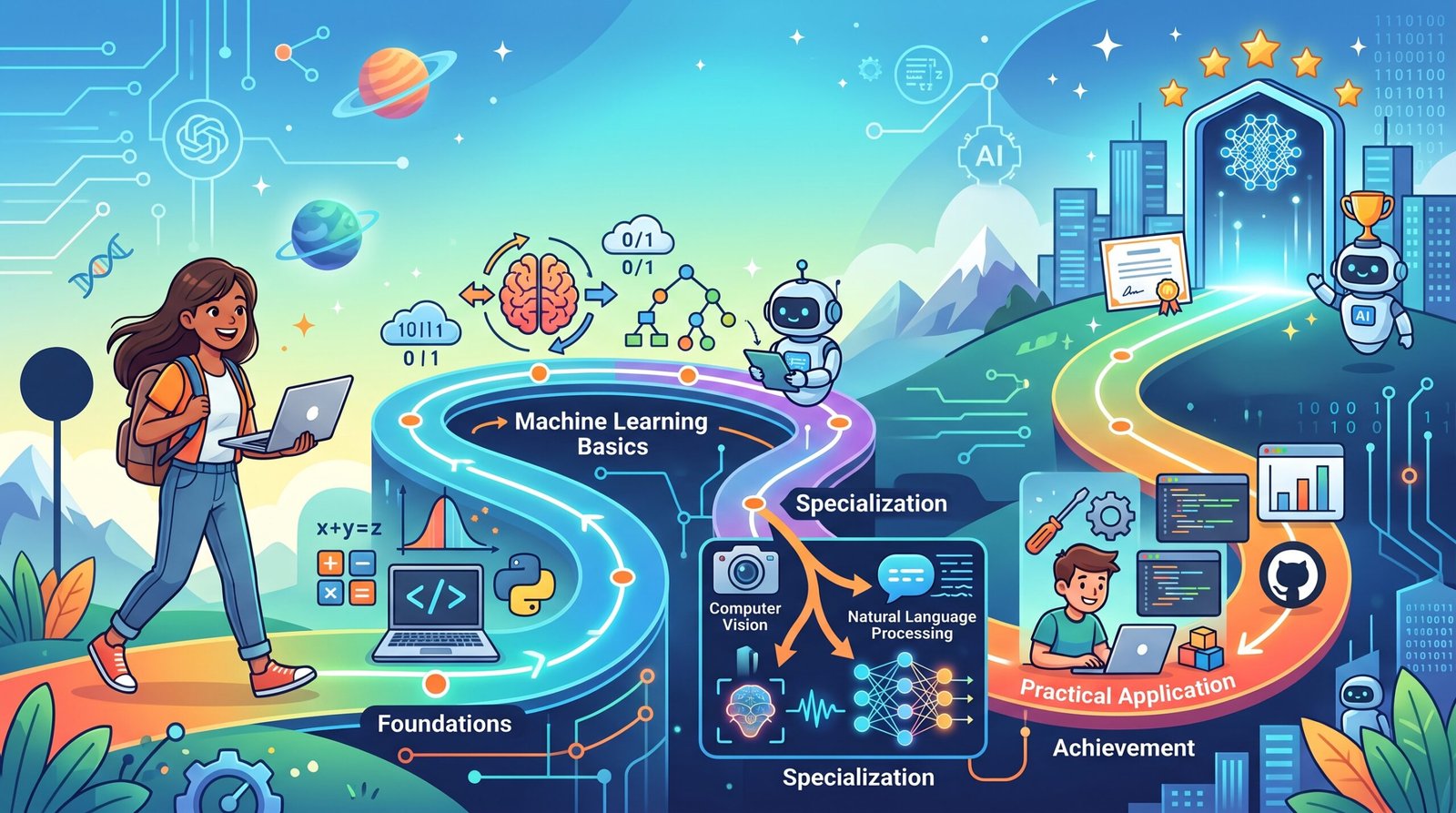
AI roadmap learning does not have to begin with complicated mathematics or advanced programming. This guide gives you a practical path from your first AI concepts to building useful projects and developing skills that can grow with the technology.
AI Roadmap for Beginners to Build Practical Artificial Intelligence Skills in 2026
An AI roadmap gives beginners a clear path from Python and mathematics to machine learning, deep learning, generative AI, projects, deployment, and responsible AI without getting overwhelmed.
AI Roadmap for Beginners to Learn Artificial Intelligence From Scratch in 2026
Artificial intelligence can look enormous when you first enter the field. One search can lead you toward Python, machine learning, neural networks, large language models, computer vision, AI agents, mathematics, data science, and hundreds of unfamiliar technical terms.
That can make beginners wonder where they should actually start. The answer is not to learn everything simultaneously, but to follow a logical sequence where each new skill supports the next one.
This AI roadmap is designed for students, technology researchers, professionals, developers, and curious readers who want to understand AI from the ground up. It focuses on practical learning rather than collecting certificates or jumping from one fashionable AI tool to another.

Understanding the AI Learning Journey
Before opening a programming editor or enrolling in a course, it helps to understand what you are actually trying to learn. Artificial intelligence is a broad field, so a useful learning plan should separate foundational knowledge from specialist skills.
The first objective is to develop enough understanding to explain what an AI system does, how it learns from information, how its performance is measured, and where its limitations appear.
Start With the Big Picture
Artificial intelligence is an umbrella term covering different approaches to creating systems that can perform tasks involving prediction, recognition, generation, reasoning, or decision support.
Machine learning represents one of the key areas within AI. Deep learning is a machine learning approach based on neural networks, while generative AI focuses on systems capable of producing content such as text, images, audio, video, or code.
Learn the Core Vocabulary
A beginner should become comfortable with terms such as:
- Algorithm
- Dataset
- Model
- Training
- Inference
- Features
- Parameters
- Labels
- Prediction
- Evaluation
These words appear repeatedly throughout AI education. Understanding them early makes technical documentation and research material much easier to follow.
Do Not Begin With Advanced AI Agents
AI agents are attracting considerable attention, but they should not become your starting point if you want genuine technical understanding.
Learn the fundamentals first. Once you understand models, data, APIs, prompts, retrieval, evaluation, and software workflows, agent-based systems become much easier to understand

Building Your Programming Foundation
Programming is one of the most useful practical skills for anyone who wants to move beyond simply consuming AI applications. You do not need to become a professional software engineer before studying AI, but you should be comfortable reading and writing basic programs.
Python is particularly useful because it has a large ecosystem for data analysis, machine learning, automation, and scientific computing.
Learn Python Fundamentals
Begin with the concepts that appear in everyday programming:
- Variables and data types
- Conditions and loops
- Functions
- Lists and dictionaries
- File handling
- Error handling
- Modules and packages
Do not try to memorize every Python command. Write small programs repeatedly until basic programming structures begin to feel natural.
Practice With Small Problems
A useful exercise is to create a Python program that reads information from a file and calculates simple statistics.
You could then modify it to identify missing values, organize records, or produce a basic chart. Small exercises like these teach programming logic while quietly preparing you for data-related AI work.
Learn How Libraries Fit Together
After learning Python fundamentals, explore commonly used tools such as NumPy, pandas, Matplotlib, and scikit-learn.
The important thing is understanding what each library is designed to accomplish. Gradually shift from asking, “Which command should I use?” to asking, “What problem am I trying to solve?”
Learning the Mathematics Behind AI
Mathematics does not need to frighten beginners. You can learn the required concepts progressively, especially when you connect them with practical examples.
The purpose is not to become a mathematician before touching AI. The purpose is to understand enough mathematics to recognize what models are doing beneath the interface.
Study Linear Algebra
Linear algebra becomes important when working with data representations and neural networks.
Focus initially on:
- Vectors
- Matrices
- Dimensions
- Matrix multiplication
- Dot products
- Basic transformations
For example, understanding vectors becomes useful when learning about embeddings, where information can be represented numerically in a mathematical space.
Understand Probability and Statistics
Statistics helps you reason about data and model results.
Start with:
- Mean and median
- Variance and standard deviation
- Probability
- Distributions
- Correlation
- Sampling
- Basic statistical testing
These concepts help you recognize why a model’s output should not automatically be treated as a certain answer.
Learn Basic Calculus
You do not need advanced calculus at the beginning.
Concentrate on functions, derivatives, gradients, and optimization. These ideas eventually help explain how neural networks adjust their parameters during training.
Here is the easiest and clearest way to understand it. Mathematics is not an obstacle placed in front of AI learning, but a language that helps explain why many AI techniques work.

Understanding Data Before Building Models
Because AI models are built around data, developing strong data skills is a key part of your AI learning journey.
A beginner who understands data preparation can often diagnose problems that would remain hidden behind a sophisticated algorithm.
Learn Data Preparation
Develop practical skills for:
- Loading datasets
- Cleaning records
- Handling missing information
- Removing duplicates
- Converting data formats
- Identifying unusual observations
- Creating useful variables
- Splitting datasets
These activities may not sound as exciting as training a neural network, but they are essential to practical AI development.
Understand Training and Testing Data
A model needs information for learning and separate information for evaluating how well it performs on unseen examples.
Learn the purpose of training, validation, and test datasets. This distinction becomes increasingly important as your projects become more sophisticated.
Think About Data Quality
Imagine creating a customer prediction system using outdated, incomplete, or incorrectly labeled records.
The algorithm could process the information efficiently while still producing unreliable results. This is why data quality, documentation, sampling, and evaluation deserve attention from the beginning.
Learning Machine Learning Basics
Once you are comfortable with Python, basic mathematics, and data preparation, machine learning becomes the natural next stage.
Machine learning teaches you how algorithms identify patterns in data and use those patterns to produce predictions or classifications.
Understand Supervised Learning
In supervised learning, the model learns from examples where the expected outcome is known.
Common applications include:
- Classification
- Regression
- Risk prediction
- Demand forecasting
- Text categorization
For example, a classification model could learn to distinguish between different categories of documents using labeled examples.
Explore Unsupervised Learning
Unsupervised learning works with data where predefined answers may not be available.
Clustering is a common example. A system can group similar observations based on patterns within the data.
This can be useful for customer segmentation, exploratory analysis, anomaly investigation, and other applications.
Study Beginner Friendly Algorithms
Start by understanding the ideas behind:
- Linear regression
- Logistic regression
- Decision trees
- Random forests
- k-nearest neighbors
- k-means clustering
Do not judge your progress by the number of algorithms you can memorize. Focus on knowing when an algorithm might be useful and how you would evaluate its results.
Learning Model Evaluation
One of the biggest mistakes beginners make is treating a successful training process as proof that the model works well.
A model needs to be evaluated using appropriate data and metrics.
Learn Important Evaluation Concepts
Become familiar with:
- Accuracy
- Precision
- Recall
- F1 score
- Confusion matrices
- Mean squared error
- Cross-validation
- Overfitting
- Underfitting
The right metric depends on the problem.
For some applications, missing an important positive case may be much more significant than generating an occasional false alarm. That is why evaluation must reflect the real purpose of the system.
Understand Overfitting
Overfitting occurs when a model becomes too closely adapted to its training examples and performs poorly on new information.
This concept teaches an important lesson: a model that appears successful during development is not necessarily reliable outside the environment in which it was trained.

Moving From Machine Learning to Deep Learning
After learning classical machine learning, you can begin exploring neural networks and deep learning.
Deep learning is particularly important for modern applications involving images, language, speech, and complex patterns.
Understand Neural Networks
Start with the basic components:
- Inputs
- Weights
- Biases
- Layers
- Activation functions
- Outputs
- Loss functions
Then learn the basic training process.
A simplified cycle looks like this:
Input → Prediction → Loss → Gradient calculation → Parameter update → Repeat
This sequence gives you a conceptual foundation for understanding how a neural network improves during training.
Learn a Deep Learning Framework
Once the concepts are clear, choose a framework such as PyTorch and learn how to build simple neural-network models.
Begin with small datasets rather than attempting to reproduce a massive modern model. Your first objective should be understanding the workflow.
Exploring Computer Vision
Computer vision gives machines the ability to process and interpret visual information.
It connects AI with cameras, photographs, satellite imagery, industrial inspection, robotics, medical research, and many other applications.
Begin With Image Classification
A beginner project could classify images into a small number of categories.
This teaches:
- Image preprocessing
- Dataset preparation
- Model training
- Validation
- Prediction
- Error analysis
Once the basic workflow is clear, you can explore more complex tasks.
Progress Toward Advanced Vision
Later, investigate:
- Object detection
- Image segmentation
- Image embeddings
- Vision transformers
- Multimodal models
The key is progression. Each stage should build on what you already understand rather than forcing you into advanced architecture too early.
Exploring Natural Language Processing
Natural language processing, or NLP, focuses on enabling computers to process human language.
It provides an important foundation for understanding search systems, text analysis, language models, conversational applications, and generative AI.
Learn Fundamental NLP Concepts
Begin with:
- Text preprocessing
- Tokenization
- Text classification
- Embeddings
- Named entity recognition
- Language modeling
- Attention
- Transformers
These concepts help explain how modern language systems process information.
Build Simple Language Projects
A beginner could build a sentiment classifier or document categorization system.
After that, move toward summarization, question answering, information retrieval, and other language applications. Each project should introduce a new technical concept rather than simply repeating the same workflow.
Understanding Generative AI
Generative AI has changed how people interact with software because users can communicate with sophisticated models using natural language.
For a serious AI learner, however, using a generative AI application is only the beginning.
Learn How Language Models Work
You do not need to train a large language model from scratch.
Instead, understand concepts such as:
- Tokens
- Embeddings
- Context
- Attention
- Transformers
- Model parameters
- Inference
- Fine-tuning
- Evaluation
This knowledge helps you understand both the capabilities and limitations of modern language systems.
Develop Prompt Engineering Skills
Prompt engineering is useful because clear instructions can improve how a model responds to a task.
Good prompts commonly establish:
- The objective
- Relevant context
- Constraints
- Examples
- Desired output format
- Quality requirements
However, prompt writing should be treated as one skill within a larger AI toolkit. It should not replace programming, data analysis, evaluation, or technical understanding.
Learning Retrieval Augmented Generation
Retrieval augmented generation, often shortened to RAG, is an important concept for AI applications that need access to external information.
A simplified workflow is:
Question → Retrieval → Relevant information → Model → Response
This approach can help an application use information from documents or other knowledge sources rather than depending solely on information contained within the model.
Learn the RAG Building Blocks
Explore:
- Document processing
- Text chunking
- Embeddings
- Vector databases
- Similarity search
- Context retrieval
- Response generation
- Evaluation
A practical beginner project could be a document question-answering system using a collection of your own technical notes.

Building Practical AI Projects
Projects are where separate concepts begin connecting.
Instead of completing many unrelated tutorials, build a small portfolio that demonstrates progression from simple models to more sophisticated applications.
Beginner Project Ideas
Start with manageable projects such as:
- Spam classification
- House-price prediction
- Customer segmentation
- Sentiment analysis
- Basic image classification
- Simple recommendation systems
Each project should include data preparation, model selection, evaluation, and documentation.
Intermediate Project Ideas
Once you are comfortable, try:
- Document analysis tools
- RAG applications
- AI-powered data analysis
- Recommendation engines
- Computer-vision applications
- Automated classification systems
These projects introduce real workflow challenges that tutorials sometimes hide.
Build Projects Around Real Problems
A strong project begins with a clear problem rather than a fashionable technology.
Ask:
- What problem am I solving?
- Why does it matter?
- What data is available?
- Does AI actually fit the problem?
- How will success be measured?
- What could cause the system to fail?
These questions encourage better engineering decisions.
Learning AI Deployment
A model that works inside a notebook is not automatically a useful production application.
Real systems need software interfaces, data pipelines, monitoring, security controls, testing, and maintenance.
Understand the Deployment Pipeline
Learn the basic progression:
Data → Model Training → Evaluation → Deployment → Monitoring → Continuous Improvement
This introduces you to the practical world of machine learning operations, often called MLOps.
Develop Supporting Technical Skills
Explore:
- APIs
- Git
- Containers
- Cloud platforms
- Databases
- Model serving
- Monitoring
- Automated testing
You do not need to master all of these immediately. Learn them as your projects create a reason to use them.
Learning Responsible AI
Technical skills become more valuable when paired with responsible decision-making.
AI systems can produce incorrect outputs, expose sensitive information, reproduce problematic patterns in data, or behave differently from what developers expect.
Understand AI Limitations
Develop the habit of asking:
- Where did this information come from?
- How was the model evaluated?
- What happens when the input changes?
- Can the output be independently verified?
- What information should the system not access?
- When should a human review the result?
These questions are particularly important when AI is used in sensitive environments.
Build Human Oversight Into Workflows
Human oversight should be built into the process rather than added later.
For important applications, design workflows where people can review, challenge, correct, or override AI-generated results when appropriate.
This approach is more practical than assuming an AI system should either operate completely independently or have no useful automation role at all.
Choosing Your AI Specialization
After learning the fundamentals, you will eventually need to decide where you want to go deeper.
AI is too broad for one person to master every subfield equally.
AI Research
If research interests you, strengthen:
- Mathematics
- Statistics
- Machine learning theory
- Deep learning
- Research methodology
- Scientific writing
- Experimental evaluation
Learn how to read research papers critically rather than accepting every reported result at face value.
Generative AI
For generative AI, explore:
- Large language models
- Multimodal models
- RAG
- Fine-tuning
- AI agents
- Model evaluation
- AI application development
This path combines machine learning knowledge with software engineering.
AI and Cybersecurity
Security-focused learners can explore:
- Anomaly detection
- Threat classification
- Security analytics
- AI-assisted defense
- Adversarial machine learning
- Automated security workflows
The emphasis should remain on defensive research, responsible implementation, and understanding system limitations.
AI and Defense Technology
Readers interested in defense technology can explore AI applications involving:
- Autonomous systems
- Sensor fusion
- Computer vision
- Satellite intelligence
- Situational awareness
- Human-machine teaming
- Military robotics research
This specialization requires an especially strong understanding of reliability, human oversight, safety, and the consequences of system failure.
Creating a One Year AI Learning Plan
A one-year plan can provide structure without turning learning into a race.
The exact pace should depend on your background and available time.
Months One and Two
Concentrate on AI fundamentals and Python.
Your goal should be writing simple programs and explaining basic AI terminology without relying entirely on memorized definitions.
Months Three and Four
Move into mathematics and data handling.
Work with datasets, create visualizations, calculate statistics, and learn how information is prepared for machine learning.
Months Five and Six
Study classical machine learning.
Build several small models and compare their performance using appropriate evaluation methods.
Months Seven and Eight
Move into neural networks and deep learning.
Build small models and learn how training, loss, optimization, and generalization work.
Months Nine and Ten
Explore NLP, computer vision, and generative AI.
Focus on one of the three before moving on to the others.
Months Eleven and Twelve
Focus on a practical portfolio project.
Deploy it if possible, document the architecture, explain your design choices, evaluate the results, and identify limitations.
That final project can become evidence of your learning rather than another unfinished tutorial.
Creating a Sustainable AI Study Routine
Regular effort matters more than short periods of intense enthusiasm.
Even a modest study routine can become effective when it combines theory, coding, experimentation, and reflection.
Use a Four Part Learning Cycle
Divide your learning into four activities:
- Learn a concept
- Implement the concept
- Build something with it
- Review what went wrong
The final step is frequently overlooked. Debugging and analyzing mistakes often teach more than simply watching another tutorial.
Keep a Learning Journal
Record:
- Concepts learned
- Projects completed
- Problems encountered
- Solutions discovered
- Questions that remain unanswered
- Ideas for future experiments
Over time, this becomes a personal technical reference.

Common Mistakes New AI Learners Make
The fastest way to improve your roadmap is to avoid predictable learning traps.
Beginners often collect courses without completing projects, jump between tools without understanding fundamentals, or assume that advanced terminology equals advanced knowledge.
Trying to Learn Everything
AI includes too many disciplines to master simultaneously.
Build a foundation and then specialize.
Avoiding Mathematics Completely
You do not need advanced mathematics on your first day, but completely avoiding mathematical reasoning will eventually limit your understanding of machine learning.
Copying Code Without Understanding It
Code that runs is not necessarily code that you understand.
Change variables, test assumptions, introduce errors, and explain each important part of your program.
Chasing Every New AI Tool
Tools change quickly.
Core concepts such as data preparation, model evaluation, optimization, software engineering, and responsible AI are more durable than any single application.
Treating AI Output as Fact
An AI system can produce confident but incorrect information.
Verification should therefore be a normal part of serious AI work, especially when information affects important decisions.
How to Know When You Are Actually Improving
Learning AI can feel confusing because there is always another topic to study.
It is more useful to measure progress by the skills and capabilities you develop.
You are moving forward when you can:
- Explain an AI concept without copying a definition
- Write and modify Python code
- Clean a dataset
- Train a basic model
- Evaluate its performance
- Explain why it made mistakes
- Build a small AI application
- Document your approach
- Identify limitations
- Improve an earlier project
These abilities provide much stronger evidence of progress than the number of courses completed.
The Future Direction of AI Learning
AI education is becoming increasingly connected to software engineering, data analysis, automation, research, and domain expertise.
That means future AI learners will benefit from combining technical skills with knowledge of a particular industry or problem area.
A person who understands AI and cybersecurity, for example, can approach problems differently from someone who understands only generic AI tools. The same principle applies to healthcare research, manufacturing, finance, education, robotics, satellite technology, and business operations.
The most useful long-term skill may therefore be learning how to learn AI itself.
New architectures, interfaces, models, and development methods will continue appearing. Strong fundamentals give you the ability to understand those changes without having to start your education again from zero.
CONCLUSION AND BRAND CREDIBILITY
Learning artificial intelligence from scratch can seem overwhelming because the field contains so many different technologies and disciplines. A clear AI roadmap turns that complexity into manageable stages, beginning with fundamentals and gradually moving toward machine learning, deep learning, generative AI, practical projects, deployment, and specialization.
The most important lesson is to avoid rushing toward advanced tools before understanding the foundations. Build something regularly, question your results, learn from mistakes, and gradually move from simply using AI to understanding how AI systems are designed, evaluated, and applied.
For a beginner, progress does not mean knowing everything. It means becoming capable of learning the next concept with greater confidence and applying what you already know to a real problem.
If you are beginning your journey today, use this AI roadmap as a flexible guide rather than a rigid checklist. Keep learning, keep experimenting, and let your projects show how far your knowledge has developed.
This unique insight and content is exclusively delivered by the worldstan.com platform.