
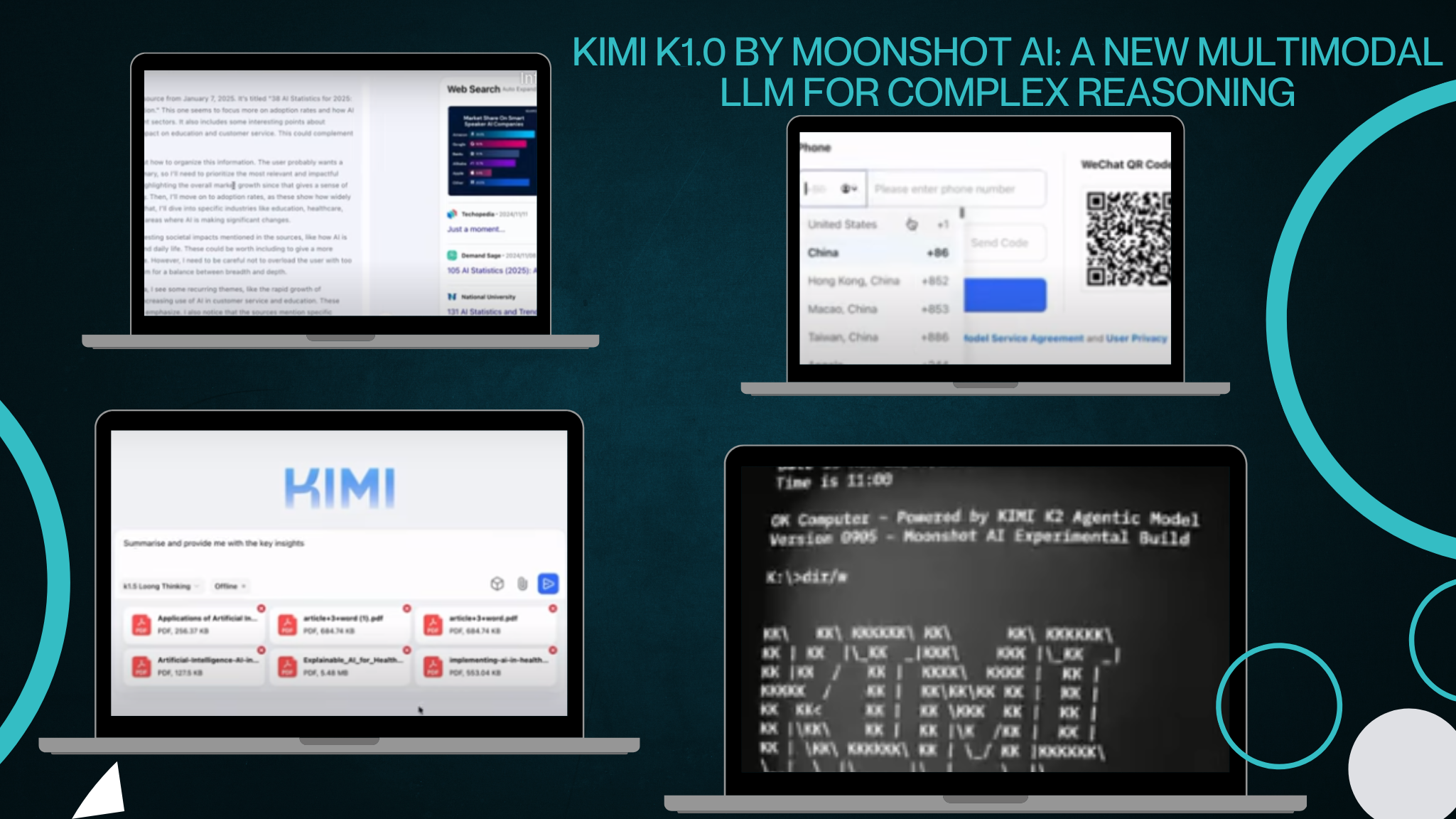
This article provides an in-depth overview of Kimi k1.0, detailing how its multimodal design, dual reasoning modes, and selective training approach redefine advanced AI reasoning.
Kimi k1.0 Signals a New Direction in Multimodal AI Reasoning
Introduction: A Shift in How AI Thinks
The rapid evolution of large language models has moved artificial intelligence beyond simple text generation toward systems capable of reasoning across multiple forms of information. In this context, Kimi k1.0, released by Moonshot AI on January 21, 2025, marks an important development in multimodal AI research. Designed to interpret text, images, and video within a single reasoning framework, the model reflects a broader industry transition toward goal-driven intelligence that prioritizes accuracy, context awareness, and practical problem solving.
Rather than focusing solely on scale or conversational fluency, Kimi k1.0 is positioned as a reasoning-centric system intended for demanding analytical tasks. Its architecture and training strategy emphasize interpretability, long-context understanding, and cross-domain applicability, placing it among a new generation of AI models built for professional and enterprise use.
Moonshot AI and the Strategic Vision Behind Kimi
Moonshot AI has entered the competitive AI landscape with a philosophy that differs from many established players. Instead of racing to produce the largest possible model, the company has concentrated on refining how artificial intelligence reasons, learns, and generalizes. Kimi k1.0 embodies this approach by focusing on decision quality rather than raw parameter expansion.
The development of Kimi aligns with a growing recognition that real-world AI applications require more than fluent language output. Industries such as education, research, law, and software engineering demand systems capable of sustaining complex reasoning over long sessions while maintaining consistency and correctness. Moonshot AI’s strategy reflects this demand, positioning Kimi as a tool for depth rather than surface-level interaction.
Multimodal Intelligence as a Core Capability
One of the defining attributes of Kimi k1.0 is its multimodal design. Unlike traditional large language models that operate exclusively on text, Kimi can process and integrate visual information, including images and video. This capability allows the model to interpret diagrams, screenshots, visual data representations, and recorded demonstrations alongside written instructions or queries.
Multimodal reasoning significantly expands the range of tasks an AI model can address. Technical documentation often combines textual explanations with visual examples, while mathematical and scientific problems frequently rely on graphs and symbolic representations. By unifying these inputs, Kimi k1.0 provides responses that reflect a more holistic understanding of the problem space.
Reasoning Architecture Designed for Flexibility
Kimi k1.0 introduces a dual chain-of-thought reasoning system that enables users to tailor the model’s behavior to specific requirements. This architecture includes two distinct modes that prioritize different outcomes.
The Long-CoT mode emphasizes transparent, step-by-step reasoning. This approach is particularly valuable in educational environments, research analysis, and technical debugging, where understanding the reasoning process is as important as the final answer. By exposing intermediate steps, the model supports validation and trust.
In contrast, the Short-CoT Clip mode is optimized for speed and precision. It delivers concise, high-accuracy responses with minimal latency, making it suitable for enterprise workflows and real-time applications. This flexibility allows Kimi k1.0 to serve a wide range of use cases without compromising reliability.
Selective Training Through Rejection Sampling
The training methodology behind Kimi k1.0 represents a departure from conventional reinforcement learning practices. Moonshot AI employed a selective training approach based on rejection sampling, in which the model retains only correct or high-quality outputs during its learning phase.
By discarding flawed reasoning paths, the system avoids reinforcing errors and reduces noise in the training data. This process prioritizes outcome correctness over exhaustive exposure to all generated possibilities. The result is a model that demonstrates improved accuracy and decision-making consistency without unnecessary complexity.
This training strategy also aligns with the model’s goal-first fine-tuning framework. Instead of optimizing for token-level behavior, Kimi k1.0 is trained to generalize across task modalities while maintaining alignment between reasoning and final outcomes. This approach is particularly effective in high-stakes problem-solving scenarios.
Long-Context Processing and Real-Time Research
Kimi k1.0 supports an extensive context window of up to 128,000 tokens, enabling it to process large volumes of information in a single session. This capability is critical for tasks that involve lengthy documents, multi-chapter reports, or expansive codebases.
In addition to long-context understanding, the model offers real-time file handling with support for more than 50 simultaneous uploads. Users can analyze multiple documents, datasets, or media files without losing contextual continuity. This feature is especially useful in legal, technical, and data-intensive workflows.
The integration of live web search across over 100 websites further enhances Kimi’s research capabilities. By accessing up-to-date information during analysis, the model can synthesize external data with user-provided content, supporting more informed and relevant outputs.
Applications Across Knowledge-Intensive Domains
Kimi k1.0 is designed to operate effectively across a wide range of professional and academic fields. In education, the model can assist with complex problem solving, concept explanation, and curriculum development. Its adjustable reasoning depth allows it to adapt to different learning levels and instructional goals.
In software development, Kimi supports code analysis, debugging, and architectural planning. Its ability to process large code repositories and interpret visual inputs such as diagrams or interface designs makes it a valuable tool for developers working on complex systems.
Research professionals may leverage Kimi’s long-context and multimodal capabilities to analyze academic papers, technical reports, and experimental data. The model’s reasoning consistency and selective training approach contribute to more reliable analytical outcomes.
Enterprise Workflows and Automation Potential
For enterprise users, Kimi k1.0 offers capabilities that align with organizational requirements for efficiency and accountability. The model can be integrated into workflows involving report generation, compliance verification, and decision support.
By emphasizing reasoning accuracy and interpretability, Kimi addresses concerns related to AI transparency and trust. This makes it suitable for deployment in environments where explainability is essential, such as finance, healthcare administration, and regulatory compliance.
Automation scenarios also benefit from Kimi’s design. Its Short-CoT reasoning mode enables rapid response generation, while its underlying training framework ensures that outputs remain aligned with defined goals and quality standards.
Interactive AI Interfaces and User Experience
The multimodal nature of Kimi k1.0 opens new possibilities for interactive AI interfaces. Systems built on top of the model can respond not only to text-based commands but also to visual cues and contextual signals.
This capability supports the development of advanced user interfaces, including intelligent dashboards, virtual research assistants, and adaptive learning platforms. By interpreting diverse inputs, Kimi enhances human-computer interaction and enables more natural, context-aware exchanges.
Positioning in the Global AI Landscape
The release of Kimi k1.0 highlights the growing influence of Chinese AI companies in global research and development. Moonshot AI’s approach contributes to a more diverse AI ecosystem, introducing alternative methodologies for training and reasoning optimization.
As competition intensifies among large language models, differentiation increasingly depends on practical utility rather than benchmark performance alone. Kimi’s emphasis on multimodal reasoning, long-context processing, and selective training positions it as a distinctive option in this evolving landscape.
Implications for the Future of AI Reasoning
Kimi k1.0 illustrates a broader shift in artificial intelligence toward systems that prioritize decision quality, contextual understanding, and adaptability. Its architecture suggests a future in which AI models are evaluated not only on their ability to generate language but also on how effectively they support complex, real-world tasks.
The model’s dual reasoning modes and rejection-based training framework offer insights into how AI can balance transparency and efficiency. As these ideas gain traction, they may influence the design of next-generation large language models across the industry.
Conclusion:
Kimi k1.0 reflects a deliberate shift in how advanced AI systems are being designed and evaluated. Rather than emphasizing size or surface-level fluency, Moonshot AI has introduced a model that centers on reasoning depth, contextual awareness, and outcome reliability. Its ability to work across text, images, and video, combined with flexible reasoning modes and selective training, demonstrates a clear focus on practical intelligence rather than theoretical performance.
The model’s long-context processing and real-time research capabilities further reinforce its role as a tool for knowledge-intensive tasks. By sustaining coherent reasoning across large volumes of information, Kimi k1.0 addresses a growing demand for AI systems that can support complex analysis in professional, academic, and enterprise environments.
As competition among large language models continues to intensify, Kimi k1.0 stands out for its goal-oriented architecture and emphasis on decision quality. Whether its approach becomes a broader industry standard remains to be seen, but its design offers a compelling example of how multimodal AI can evolve beyond conversation toward structured, high-stakes problem solving.
FAQs:
What is Kimi k1.0 and who developed it?
Kimi k1.0 is a multimodal large language model developed by Moonshot AI. It is designed to process and reason across text, images, and video, with a focus on complex analytical and professional use cases.How does Kimi k1.0 differ from traditional language models?
Unlike text-only models, Kimi k1.0 integrates visual and textual information into a single reasoning process. It also prioritizes decision accuracy and reasoning quality over conversational output or model size.What are the dual reasoning modes in Kimi k1.0?
Kimi k1.0 offers two reasoning approaches: a transparent mode that provides step-by-step explanations and a fast-response mode optimized for speed and precision. Users can choose the mode based on their specific task requirements.Why is selective training important in Kimi k1.0?
Selective training allows the model to learn only from correct or high-quality outputs. By filtering out flawed reasoning during training, Kimi k1.0 improves reliability and reduces the risk of reinforcing errors.What is the significance of the 128k token context window?
A 128k token context window enables Kimi k1.0 to analyze lengthy documents, large codebases, and multi-file research materials without losing coherence, making it suitable for deep analytical tasks.Which industries can benefit most from Kimi k1.0?
Kimi k1.0 is well-suited for education, research, software development, legal analysis, and enterprise automation, particularly in environments that require long-form reasoning and multimodal understanding.How does Kimi k1.0 contribute to the future of AI development?
Kimi k1.0 highlights a shift toward reasoning-centric AI models that emphasize accuracy, context, and practical decision-making, offering insights into how next-generation AI systems may be designed.