
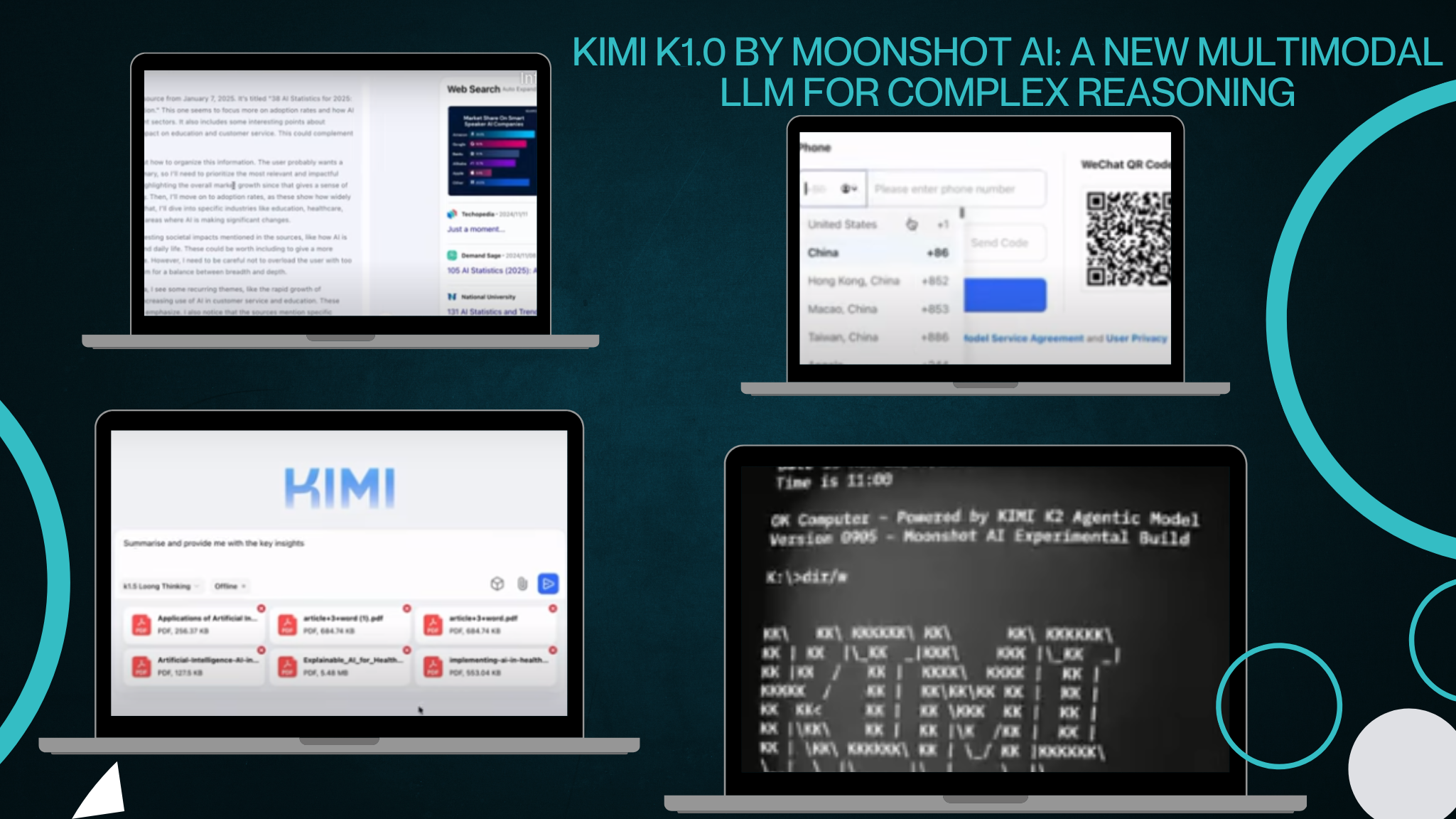
Kimi k1.0 by Moonshot AI: A New Multimodal LLM for Complex Reasoning

kimi k1.0 by moonshot ai a new multimodal llm for complex reasoning WORLDSTAN.COM

This article provides an in-depth overview of Kimi k1.0, detailing how its multimodal design, dual reasoning modes, and selective training approach redefine advanced AI reasoning.

Kimi k1.0 Signals a New Direction in Multimodal AI Reasoning

Introduction: A Shift in How AI Thinks

The rapid evolution of large language models has moved artificial intelligence beyond simple text generation toward systems capable of reasoning across multiple forms of information. In this context, Kimi k1.0, released by Moonshot AI on January 21, 2025, marks an important development in multimodal AI research. Designed to interpret text, images, and video within a single reasoning framework, the model reflects a broader industry transition toward goal-driven intelligence that prioritizes accuracy, context awareness, and practical problem solving.

Rather than focusing solely on scale or conversational fluency, Kimi k1.0 is positioned as a reasoning-centric system intended for demanding analytical tasks. Its architecture and training strategy emphasize interpretability, long-context understanding, and cross-domain applicability, placing it among a new generation of AI models built for professional and enterprise use.

Moonshot AI and the Strategic Vision Behind Kimi

Moonshot AI has entered the competitive AI landscape with a philosophy that differs from many established players. Instead of racing to produce the largest possible model, the company has concentrated on refining how artificial intelligence reasons, learns, and generalizes. Kimi k1.0 embodies this approach by focusing on decision quality rather than raw parameter expansion.

The development of Kimi aligns with a growing recognition that real-world AI applications require more than fluent language output. Industries such as education, research, law, and software engineering demand systems capable of sustaining complex reasoning over long sessions while maintaining consistency and correctness. Moonshot AI’s strategy reflects this demand, positioning Kimi as a tool for depth rather than surface-level interaction.

Multimodal Intelligence as a Core Capability

One of the defining attributes of Kimi k1.0 is its multimodal design. Unlike traditional large language models that operate exclusively on text, Kimi can process and integrate visual information, including images and video. This capability allows the model to interpret diagrams, screenshots, visual data representations, and recorded demonstrations alongside written instructions or queries.

Multimodal reasoning significantly expands the range of tasks an AI model can address. Technical documentation often combines textual explanations with visual examples, while mathematical and scientific problems frequently rely on graphs and symbolic representations. By unifying these inputs, Kimi k1.0 provides responses that reflect a more holistic understanding of the problem space.

Reasoning Architecture Designed for Flexibility

Kimi k1.0 introduces a dual chain-of-thought reasoning system that enables users to tailor the model’s behavior to specific requirements. This architecture includes two distinct modes that prioritize different outcomes.

The Long-CoT mode emphasizes transparent, step-by-step reasoning. This approach is particularly valuable in educational environments, research analysis, and technical debugging, where understanding the reasoning process is as important as the final answer. By exposing intermediate steps, the model supports validation and trust.

In contrast, the Short-CoT Clip mode is optimized for speed and precision. It delivers concise, high-accuracy responses with minimal latency, making it suitable for enterprise workflows and real-time applications. This flexibility allows Kimi k1.0 to serve a wide range of use cases without compromising reliability.

Selective Training Through Rejection Sampling

The training methodology behind Kimi k1.0 represents a departure from conventional reinforcement learning practices. Moonshot AI employed a selective training approach based on rejection sampling, in which the model retains only correct or high-quality outputs during its learning phase.

By discarding flawed reasoning paths, the system avoids reinforcing errors and reduces noise in the training data. This process prioritizes outcome correctness over exhaustive exposure to all generated possibilities. The result is a model that demonstrates improved accuracy and decision-making consistency without unnecessary complexity.

This training strategy also aligns with the model’s goal-first fine-tuning framework. Instead of optimizing for token-level behavior, Kimi k1.0 is trained to generalize across task modalities while maintaining alignment between reasoning and final outcomes. This approach is particularly effective in high-stakes problem-solving scenarios.

Long-Context Processing and Real-Time Research

Kimi k1.0 supports an extensive context window of up to 128,000 tokens, enabling it to process large volumes of information in a single session. This capability is critical for tasks that involve lengthy documents, multi-chapter reports, or expansive codebases.

In addition to long-context understanding, the model offers real-time file handling with support for more than 50 simultaneous uploads. Users can analyze multiple documents, datasets, or media files without losing contextual continuity. This feature is especially useful in legal, technical, and data-intensive workflows.

The integration of live web search across over 100 websites further enhances Kimi’s research capabilities. By accessing up-to-date information during analysis, the model can synthesize external data with user-provided content, supporting more informed and relevant outputs.

Applications Across Knowledge-Intensive Domains

Kimi k1.0 is designed to operate effectively across a wide range of professional and academic fields. In education, the model can assist with complex problem solving, concept explanation, and curriculum development. Its adjustable reasoning depth allows it to adapt to different learning levels and instructional goals.

In software development, Kimi supports code analysis, debugging, and architectural planning. Its ability to process large code repositories and interpret visual inputs such as diagrams or interface designs makes it a valuable tool for developers working on complex systems.

Research professionals may leverage Kimi’s long-context and multimodal capabilities to analyze academic papers, technical reports, and experimental data. The model’s reasoning consistency and selective training approach contribute to more reliable analytical outcomes.

Enterprise Workflows and Automation Potential

For enterprise users, Kimi k1.0 offers capabilities that align with organizational requirements for efficiency and accountability. The model can be integrated into workflows involving report generation, compliance verification, and decision support.

By emphasizing reasoning accuracy and interpretability, Kimi addresses concerns related to AI transparency and trust. This makes it suitable for deployment in environments where explainability is essential, such as finance, healthcare administration, and regulatory compliance.

Automation scenarios also benefit from Kimi’s design. Its Short-CoT reasoning mode enables rapid response generation, while its underlying training framework ensures that outputs remain aligned with defined goals and quality standards.

Interactive AI Interfaces and User Experience

The multimodal nature of Kimi k1.0 opens new possibilities for interactive AI interfaces. Systems built on top of the model can respond not only to text-based commands but also to visual cues and contextual signals.

This capability supports the development of advanced user interfaces, including intelligent dashboards, virtual research assistants, and adaptive learning platforms. By interpreting diverse inputs, Kimi enhances human-computer interaction and enables more natural, context-aware exchanges.

Positioning in the Global AI Landscape

The release of Kimi k1.0 highlights the growing influence of Chinese AI companies in global research and development. Moonshot AI’s approach contributes to a more diverse AI ecosystem, introducing alternative methodologies for training and reasoning optimization.

As competition intensifies among large language models, differentiation increasingly depends on practical utility rather than benchmark performance alone. Kimi’s emphasis on multimodal reasoning, long-context processing, and selective training positions it as a distinctive option in this evolving landscape.

Implications for the Future of AI Reasoning

Kimi k1.0 illustrates a broader shift in artificial intelligence toward systems that prioritize decision quality, contextual understanding, and adaptability. Its architecture suggests a future in which AI models are evaluated not only on their ability to generate language but also on how effectively they support complex, real-world tasks.

The model’s dual reasoning modes and rejection-based training framework offer insights into how AI can balance transparency and efficiency. As these ideas gain traction, they may influence the design of next-generation large language models across the industry.

Conclusion:

Kimi k1.0 reflects a deliberate shift in how advanced AI systems are being designed and evaluated. Rather than emphasizing size or surface-level fluency, Moonshot AI has introduced a model that centers on reasoning depth, contextual awareness, and outcome reliability. Its ability to work across text, images, and video, combined with flexible reasoning modes and selective training, demonstrates a clear focus on practical intelligence rather than theoretical performance.

The model’s long-context processing and real-time research capabilities further reinforce its role as a tool for knowledge-intensive tasks. By sustaining coherent reasoning across large volumes of information, Kimi k1.0 addresses a growing demand for AI systems that can support complex analysis in professional, academic, and enterprise environments.

As competition among large language models continues to intensify, Kimi k1.0 stands out for its goal-oriented architecture and emphasis on decision quality. Whether its approach becomes a broader industry standard remains to be seen, but its design offers a compelling example of how multimodal AI can evolve beyond conversation toward structured, high-stakes problem solving.

FAQs:

  • What is Kimi k1.0 and who developed it?
    Kimi k1.0 is a multimodal large language model developed by Moonshot AI. It is designed to process and reason across text, images, and video, with a focus on complex analytical and professional use cases.

  • How does Kimi k1.0 differ from traditional language models?
    Unlike text-only models, Kimi k1.0 integrates visual and textual information into a single reasoning process. It also prioritizes decision accuracy and reasoning quality over conversational output or model size.

  • What are the dual reasoning modes in Kimi k1.0?
    Kimi k1.0 offers two reasoning approaches: a transparent mode that provides step-by-step explanations and a fast-response mode optimized for speed and precision. Users can choose the mode based on their specific task requirements.

  • Why is selective training important in Kimi k1.0?
    Selective training allows the model to learn only from correct or high-quality outputs. By filtering out flawed reasoning during training, Kimi k1.0 improves reliability and reduces the risk of reinforcing errors.

  • What is the significance of the 128k token context window?
    A 128k token context window enables Kimi k1.0 to analyze lengthy documents, large codebases, and multi-file research materials without losing coherence, making it suitable for deep analytical tasks.

  • Which industries can benefit most from Kimi k1.0?
    Kimi k1.0 is well-suited for education, research, software development, legal analysis, and enterprise automation, particularly in environments that require long-form reasoning and multimodal understanding.

  • How does Kimi k1.0 contribute to the future of AI development?
    Kimi k1.0 highlights a shift toward reasoning-centric AI models that emphasize accuracy, context, and practical decision-making, offering insights into how next-generation AI systems may be designed.
Qwen 2.5 Max vs GPT-4o: How Alibaba’s New LLM Stacks Up

qwen 2.5 max vs gpt 4o how alibaba’s new llm stacks up worldstan.com

Alibaba Cloud’s Qwen 2.5 Max marks a major step forward in large language model development, combining efficient architecture, long-context reasoning, multimodal intelligence, and enterprise-ready design to compete with the world’s leading AI systems.


Alibaba Cloud has begun 2025 with a decisive statement in the global artificial intelligence race. During the Lunar New Year holiday in January, the company quietly introduced Qwen 2.5 Max, its most advanced large language model to date. While the timing appeared symbolic, the technical implications were substantial. The release signals Alibaba Cloud’s ambition to compete directly with leading Western and Chinese AI systems, including GPT-4o, Llama-3.1-405B, and DeepSeek V3, while simultaneously addressing the practical demands of enterprise-scale AI deployment.

Qwen 2.5 Max is not positioned merely as an incremental update. Instead, it represents a strategic consolidation of performance, efficiency, and versatility. Built upon the architectural and training groundwork of Qwen 2.0, the model introduces a refined approach to reasoning, multimodal understanding, and tool integration. Its arrival strengthens Alibaba Cloud’s expanding AI ecosystem and reflects China’s broader push to establish competitive, self-sufficient foundational models.

From its design philosophy to its real-world applications, Qwen 2.5 Max is engineered for environments where scale, reliability, and cost control matter as much as raw intelligence.

A strategic evolution of the Qwen model family


The Qwen model series has steadily evolved since its first release, with each iteration expanding capabilities while addressing performance bottlenecks observed in production use. Qwen 2.5 Max builds on this trajectory by refining both the core model architecture and the surrounding infrastructure that enables enterprise deployment.

Rather than focusing solely on parameter growth, Alibaba Cloud optimized the model around selective computation. This approach allows Qwen 2.5 Max to deliver competitive benchmark results without relying on excessive resource consumption. In an era where model efficiency is increasingly scrutinized, this design choice reflects a shift away from brute-force scaling toward smarter utilization of compute.

The model has demonstrated strong results across language understanding, code generation, and complex reasoning tasks. Internal and third-party evaluations indicate that it surpasses several established large models in targeted scenarios, particularly those involving structured output, long-context reasoning, and task decomposition.

These improvements are not accidental. They stem from deliberate architectural choices and a training process that emphasizes real-world usability rather than abstract benchmark dominance.

Mixture of Experts architecture and computational efficiency

At the heart of Qwen 2.5 Max lies a Mixture of Experts architecture. This design enables the model to activate only relevant subsets of parameters for a given task, rather than engaging the entire network every time a prompt is processed. The result is a more efficient inference process that reduces computational overhead while maintaining high performance.

This selective activation mechanism is especially valuable in large-scale deployments where latency, throughput, and cost are critical considerations. By minimizing unnecessary computation, Qwen 2.5 Max achieves a balance between responsiveness and accuracy, making it suitable for both real-time applications and high-volume batch processing.

The MoE framework also allows the model to specialize internally. Different expert pathways handle distinct task types, such as conversational dialogue, programmatic logic, or data-heavy analysis. This internal specialization contributes to the model’s ability to switch seamlessly between natural language interaction, structured code generation, and analytical reasoning.

For enterprises seeking scalable AI solutions, this architectural choice translates into tangible operational benefits, including reduced infrastructure costs and more predictable performance under load.

Long-context reasoning and high token capacity

One of the defining features of Qwen 2.5 Max is its ability to process up to 128,000 tokens within a single session. This extended context window positions the model among a growing class of long-context language models designed to handle complex, multi-document workflows.

Long-context capability is particularly valuable in domains such as legal analysis, financial modeling, academic research, and enterprise knowledge management. Instead of fragmenting information across multiple prompts, users can provide extensive datasets, reports, or documentation in a single interaction. The model can then maintain coherence, track dependencies, and generate consistent outputs across the entire input span.

Qwen 2.5 Max leverages its long-context capacity to support deep reasoning tasks. These include summarizing lengthy documents, cross-referencing multiple sources, and performing step-by-step analysis over large bodies of text. Importantly, the model is designed to preserve response quality even as context length increases, addressing a common weakness observed in earlier long-context systems.

This capability enhances productivity for professional users and reduces the need for complex prompt engineering or external memory management systems.

Advanced instruction tuning and structured output

Beyond raw context length, Qwen 2.5 Max demonstrates strong performance in instruction adherence and output formatting. The model has undergone extensive instruction tuning to ensure that it responds predictably to complex prompts and produces outputs aligned with user expectations.

Structured output is a key strength. The model can generate well-organized responses in formats suitable for downstream processing, including tables, stepwise explanations, code blocks, and machine-readable data structures. This makes it particularly useful in automated workflows where consistency and clarity are essential.

In decision-making scenarios, Qwen 2.5 Max can provide transparent reasoning pathways. Instead of delivering opaque conclusions, it breaks down its logic into intermediate steps, allowing users to understand how results are derived. This approach supports trust and auditability, which are critical in regulated industries such as finance, healthcare, and engineering.

The ability to generate multi-path justifications further enhances the model’s flexibility. For nuanced queries, it can explore alternative reasoning strategies, compare outcomes, and explain trade-offs, enabling more informed decision-making.

Tool integration and ecosystem compatibility

Modern large language models are increasingly evaluated not only on their standalone intelligence but also on their ability to interact with external systems. Qwen 2.5 Max has been designed with modular tool-use capabilities that allow seamless integration with APIs, databases, and third-party plugins.

This integration framework enables the model to perform tasks that extend beyond static text generation. For example, it can retrieve real-time data, execute code through connected tools, or interact with enterprise software systems. These capabilities transform the model into an active participant within broader digital workflows.

Alibaba Cloud has fine-tuned Qwen 2.5 Max using large-scale supervised learning and human feedback to ensure reliable tool invocation and error handling. The result is a system that can follow complex operational logic while maintaining stability in production environments.

For developers and enterprises, this flexibility reduces integration friction and accelerates the deployment of AI-powered applications across diverse use cases.

Multimodal intelligence and visual understanding

Qwen 2.5 Max extends beyond text-only capabilities by incorporating multimodal functionality. Its text-to-image generation feature supports creative and analytical workflows, enabling users to generate visuals directly from natural language descriptions.

The model’s visual-language understanding capabilities allow it to interpret charts, diagrams, forms, and annotated documents. This makes it useful for tasks such as data visualization analysis, technical documentation review, and academic research support.

In addition to image generation, Qwen 2.5 Max can process visual inputs in ways similar to optical character recognition systems. It can extract information from scanned documents, interpret visual layouts, and integrate visual data into its reasoning process.

This multimodal alignment expands the model’s applicability across industries, including education, design, engineering, and enterprise document management. By bridging the gap between text and visuals, Qwen 2.5 Max supports more natural and intuitive human-computer interaction.

Training methodology and alignment strategy

The performance of Qwen 2.5 Max reflects a comprehensive training and alignment strategy. Alibaba Cloud employed a combination of large-scale pretraining, supervised fine-tuning, and human feedback to refine the model’s behavior across diverse scenarios.

Supervised fine-tuning focused on improving task accuracy, instruction compliance, and domain-specific reasoning. Human feedback played a critical role in aligning the model with user expectations, particularly in complex or ambiguous situations.

This layered training approach helps ensure that Qwen 2.5 Max behaves consistently across a wide range of inputs. It also reduces the likelihood of unpredictable responses, which is a common concern in large language model deployment.

The emphasis on alignment and reliability reflects Alibaba Cloud’s focus on enterprise readiness rather than experimental novelty.

Competitive positioning in the global AI landscape

Qwen 2.5 Max enters a competitive field dominated by models such as GPT-4o, Llama-3.1-405B, and DeepSeek V3. While each of these systems has distinct strengths, Alibaba Cloud positions Qwen 2.5 Max as a balanced alternative that combines high performance with cost efficiency.

Benchmark comparisons suggest that the model performs strongly across language understanding, reasoning, and multimodal tasks. In certain evaluations, it matches or exceeds the capabilities of larger parameter models, highlighting the effectiveness of its architectural optimizations.

From a strategic perspective, Qwen 2.5 Max strengthens China’s domestic AI ecosystem by offering a competitive, locally developed foundation model. It also provides global enterprises with an additional option in a market increasingly concerned with vendor diversity and data sovereignty.

Rather than aiming to dominate every benchmark category, Alibaba Cloud appears focused on delivering a practical, scalable model suited for real-world deployment.

Enterprise readiness and product-scale deployment

One of the most compelling aspects of Qwen 2.5 Max is its readiness for product-scale deployment. The model is designed to operate efficiently under sustained workloads, making it suitable for customer-facing applications, internal automation, and large-scale data processing.

Its cost-performance balance is particularly attractive for organizations seeking to integrate AI without incurring prohibitive infrastructure expenses. The MoE architecture, long-context support, and robust tool integration collectively reduce operational complexity.

Qwen 2.5 Max can be deployed across a variety of use cases, including intelligent customer support, enterprise search, software development assistance, and advanced analytics. Its versatility allows organizations to consolidate multiple AI functions into a single model, simplifying system architecture.

This focus on deployment practicality distinguishes Qwen 2.5 Max from models designed primarily for research or demonstration purposes.

Implications for developers and AI practitioners

For developers, Qwen 2.5 Max offers a flexible platform for building advanced AI applications. Its structured output capabilities, API compatibility, and multimodal support reduce development time and enable rapid prototyping.

AI practitioners benefit from the model’s transparent reasoning and instruction adherence. These features make it easier to debug outputs, refine prompts, and integrate AI responses into downstream systems.

The model’s ability to handle long contexts and complex workflows opens new possibilities for automation and decision support. Developers can design applications that process entire datasets or documents in a single interaction, reducing fragmentation and improving coherence.

As the AI ecosystem continues to mature, models like Qwen 2.5 Max illustrate a shift toward systems optimized for collaboration between humans, software tools, and large-scale data.

A broader signal from Alibaba Cloud

Beyond its technical merits, the release of Qwen 2.5 Max sends a broader signal about Alibaba Cloud’s strategic direction. The company is positioning itself not only as a cloud infrastructure provider but also as a leading developer of foundational AI technologies.

By investing in model efficiency, multimodal intelligence, and enterprise integration, Alibaba Cloud demonstrates an understanding of the practical challenges facing AI adoption. This approach aligns with the needs of businesses seeking reliable, scalable solutions rather than experimental prototypes.

Qwen 2.5 Max also reinforces China’s growing presence in the global AI landscape. As domestic models become increasingly competitive, they contribute to a more diverse and resilient AI ecosystem.

Conclusion:

Qwen 2.5 Max reflects a clear shift in how large language models are being built and evaluated. Rather than chasing scale alone, Alibaba Cloud has focused on creating a system that balances intelligence, efficiency, and real-world usability. With its long-context processing, multimodal understanding, structured reasoning, and seamless tool integration, the model is designed to move beyond experimentation into dependable production use. As global demand grows for AI systems that are both powerful and economically sustainable, Qwen 2.5 Max stands out as a practical and forward-looking addition to the evolving AI landscape, signaling where enterprise-grade artificial intelligence is headed next.

FAQs:

  • What makes Qwen 2.5 Max different from earlier Qwen models?
    Qwen 2.5 Max introduces a more efficient architecture, stronger instruction tuning, and extended context handling, allowing it to manage complex tasks with greater accuracy while using computing resources more effectively than previous versions.

  • How does Qwen 2.5 Max compare to other leading language models?
    Qwen 2.5 Max is designed to compete with top-tier models by balancing performance and cost efficiency, offering long-context reasoning, multimodal capabilities, and reliable structured outputs suited for enterprise applications.

  • Can Qwen 2.5 Max handle long and complex documents?
    Yes, the model supports very large context windows, enabling it to analyze, summarize, and reason over lengthy documents or multiple data sources within a single interaction.

  • What types of applications can benefit most from Qwen 2.5 Max?
    Industries such as finance, education, software development, research, and enterprise operations can benefit from its ability to process data, generate code, interpret visuals, and integrate with external tools.

  • Does Qwen 2.5 Max support multimodal inputs and outputs?
    The model can work with both text and visual information, including interpreting charts and documents as well as generating images, making it suitable for analytical and creative workflows.

  • How does Qwen 2.5 Max maintain efficiency at scale?
    By using a selective activation design, the model reduces unnecessary computation, which helps control costs and maintain consistent performance in high-volume production environments.

  • Is Qwen 2.5 Max suitable for enterprise deployment?
    Yes, the model is built with stability, integration flexibility, and scalability in mind, making it well suited for organizations looking to deploy AI solutions across products and internal systems.