
AI for Tactical CBRN Defense Explained
AI for Tactical CBRN Defense is changing how modern forces prepare for dangers that cannot be seen with the human eye. This guide explains how intelligent technology is helping detect hidden threats sooner, protect lives, and improve battlefield decisions in ways that were impossible only a few years ago.
AI for Tactical CBRN Defense
AI for Tactical CBRN Defense is transforming battlefield safety through intelligent threat detection, predictive analysis, automated response, and real time protection against chemical, biological, radiological, and nuclear hazards.
Modern battlefields have changed dramatically. In the past, soldiers mainly prepared for visible dangers such as enemy troops, tanks, aircraft, and artillery. Today, many of the most serious threats are invisible. Harmful chemicals, dangerous biological agents, radioactive materials, and nuclear hazards can spread without warning. These threats may not produce immediate signs, making them difficult to detect before they affect people.
This changing environment has created an urgent need for smarter defense systems. AI for Tactical CBRN Defense is becoming one of the most important technologies supporting military operations. Instead of depending only on human observation, intelligent systems can continuously monitor the environment, process large amounts of information, recognize unusual patterns, and provide warnings within seconds.
From my perspective, this technology represents one of the biggest changes in military safety during the last several decades. The greatest strength of AI is not simply that it works faster than people. Its real value comes from its ability to analyze thousands of pieces of information at the same time while people remain focused on making critical decisions.
Invisible threats demand invisible protection. That is exactly where AI begins to make a meaningful difference.
Understanding CBRN Threats
AI for Tactical CBRN Defense uses intelligent sensors, predictive models, and automated systems to detect invisible threats early, helping military teams respond faster and protect lives before exposure occurs.
CBRN stands for Chemical, Biological, Radiological, and Nuclear threats. Each category presents unique challenges because the danger often spreads before people realize it exists. Traditional monitoring equipment remains valuable, but it usually depends on manual operation and human interpretation. AI introduces an entirely different approach by continuously learning from incoming data and identifying warning signs that might otherwise remain unnoticed.
Chemical threats involve toxic gases, hazardous industrial chemicals, and weaponized compounds that may spread rapidly through the air or water.
Biological threats include bacteria, viruses, toxins, and other harmful organisms capable of affecting both military personnel and civilians.
Radiological threats expose people to dangerous radioactive materials that may contaminate equipment, buildings, or entire operational areas.
Nuclear threats involve large scale events requiring immediate detection, rapid communication, and coordinated emergency response.
Every one of these situations requires accurate information delivered at exactly the right time. Even a delay of a few minutes can significantly increase risks for both soldiers and nearby communities.
The Evolution of Battlefield Protection
Military defense has continuously evolved as new technologies have emerged. Protective clothing, specialized vehicles, detection equipment, and emergency response procedures have all improved over the years. AI is now becoming another major step in that progression.
The journey toward intelligent battlefield protection has taken decades of scientific development.
| Year | Event | Description |
|---|---|---|
| 1915 | Chemical warfare gains global attention | Toxic gases demonstrate the devastating impact of invisible battlefield threats. |
| 1940s | Military organizations strengthen personal protection by developing more effective masks, | protective clothing, and enhanced decontamination procedures. |
| 1960s | Electronic detection systems emerge | Sensors begin assisting personnel in identifying hazardous substances. |
| 1990s | Digital monitoring expands | Computer systems improve environmental monitoring and data collection. |
| 2010s | AI enters defense research | Machine learning begins supporting chemical detection and predictive analysis. |
| 2020s | Intelligent CBRN platforms mature | AI integrates sensors, robotics, forecasting, and automated decision support into unified defense systems. |
Looking at this progression, one trend becomes very clear. Every generation has attempted to reduce uncertainty during dangerous situations. AI simply accelerates that mission by delivering information faster and with greater precision.
Why Artificial Intelligence Is Transforming CBRN Defense
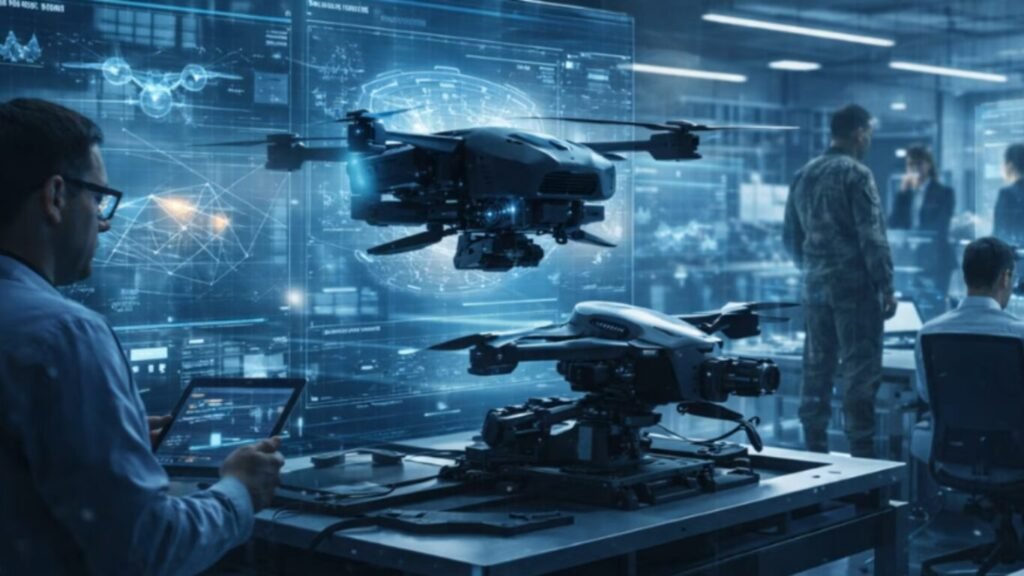
Artificial intelligence is not replacing experienced military professionals. Instead, it serves as an intelligent partner that continuously observes conditions, analyzes incoming information, and highlights risks that deserve immediate attention.
Unlike traditional software, AI systems improve as they receive additional data. Every environmental reading, weather update, sensor measurement, and operational report becomes another opportunity for the system to learn. This continuous improvement allows future predictions to become increasingly reliable.
Let me explain this in the clearest, simplest terms.
Imagine standing in a large forest where a dangerous gas has begun spreading through the trees. A person can only observe what is nearby. An AI system, however, combines information from weather stations, airborne sensors, satellites, drones, wearable devices, and previous environmental patterns to estimate where that gas is likely to travel next.
Instead of waiting for danger to arrive, commanders gain valuable time to move personnel, secure equipment, and reorganize operations before exposure occurs.
In practical military operations, this additional awareness can save lives, reduce injuries, and improve mission success. AI does not eliminate uncertainty completely, but it greatly reduces it by turning enormous amounts of complex information into useful guidance that decision makers can understand quickly.
One of the qualities I appreciate most about AI in defense is its consistency. Humans naturally become tired, stressed, or distracted during long operations. Intelligent monitoring systems continue collecting information around the clock without losing focus. When combined with skilled military personnel, this partnership creates a stronger and more reliable defense capability than either could achieve independently.
Molecular AI Sniffers
One of the most exciting developments in modern defense is the creation of molecular AI sniffers. These intelligent systems are designed to detect extremely small traces of hazardous substances before they become a serious threat. Unlike the human nose, which can only recognize certain smells, these advanced sensors identify the unique molecular fingerprints of chemical and biological agents.
In simple terms, every chemical has its own signature. These AI systems are trained to detect thousands of signature patterns almost instantly. As soon as unusual particles enter the air, the system compares them with its database and determines whether the substance is harmless or dangerous.
This process happens continuously without requiring constant human attention. Soldiers no longer need to wait for visible signs of contamination because the system is always monitoring the environment.
From my perspective, this technology represents one of the greatest improvements in battlefield awareness. Detecting danger before exposure begins gives military teams valuable time to protect themselves and continue their mission safely.
How Molecular Detection Works
The strength of molecular AI sniffers comes from combining advanced hardware with intelligent software. Highly sensitive sensors collect air samples every second. Those samples are immediately analyzed by AI models trained on enormous collections of chemical and biological data.
Instead of searching for only one dangerous substance, the system evaluates thousands of possibilities at the same time. It also considers environmental conditions such as temperature, humidity, dust, and airborne particles to reduce false alarms.
As more information becomes available, the AI continues learning from previous observations. This ongoing improvement allows the system to become more accurate over time without requiring complete redesigns.
A practical example can be seen during industrial chemical accidents. Emergency response teams often struggle to identify leaking substances quickly. AI-assisted molecular detection can shorten identification time dramatically, allowing responders to choose the correct protective equipment before entering hazardous areas.
The same principle becomes even more valuable during military operations where every minute matters.
AI Powered Chemical Recognition
Finding a hazardous substance is only the beginning. The next challenge is understanding exactly what has been detected and how dangerous it may become.
Traditional detection equipment often requires specialists to interpret measurements. AI simplifies this process by translating complex sensor data into clear operational guidance.
Instead of displaying confusing technical values, the system can provide recommendations such as identifying the likely chemical, estimating its concentration, assessing its level of danger, recommending protective equipment, highlighting safe movement routes, and suggesting immediate response actions.
This allows commanders to make faster decisions while reducing uncertainty during high-pressure situations.
One feature that stands out to me is the ability of AI to recognize patterns that may not be obvious to people. A combination of several harmless environmental changes may together indicate the early stages of a hazardous event. AI can identify these relationships long before they become visible to human operators.
Plume Prediction
Detecting a hazardous cloud is only part of the solution. Understanding where it will move is equally important.
This is where AI-driven plume prediction becomes an essential part of Tactical CBRN Defense. A plume is simply the path that airborne hazardous materials follow after being released into the environment.
Instead of waiting to see where contamination spreads, AI predicts its future movement using continuously updated environmental information.
This predictive capability transforms defense planning from reactive decision making into proactive protection.
Imagine a toxic chemical being released several kilometers away from military personnel. Without prediction models, commanders may only react after contamination reaches their location.
With AI, the system estimates the future movement of the cloud and warns nearby units well before exposure occurs.
That extra warning time can protect hundreds of lives.
Environmental Intelligence
Predicting the movement of hazardous materials requires much more than measuring wind direction.
Modern AI systems combine information from many different environmental sources, including wind speed, wind direction, temperature, humidity, atmospheric pressure, terrain elevation, vegetation density, urban structures, valleys, rivers, and changing weather conditions.
Each of these factors influences how dangerous substances spread through the environment.
Rather than performing one calculation, AI continuously updates its predictions whenever conditions change. Even a slight shift in wind direction can completely alter the expected path of contamination.
This continuous adjustment provides commanders with a much clearer picture of developing risks.
I believe this ability to adapt in real time is one of the strongest advantages of artificial intelligence. Static prediction models become outdated quickly, while AI keeps learning as new information arrives.
Supporting Faster Battlefield Decisions
Military operations often require important decisions within minutes.
Should troops continue moving forward
Should vehicles change routes
Should nearby communities receive evacuation warnings
Should aircraft avoid certain areas
Should medical teams prepare for potential casualties
AI-assisted plume prediction helps answer these questions much faster than traditional methods.
Instead of analyzing complex weather reports manually, commanders receive continuously updated risk assessments supported by scientific modeling and live environmental data.
This reduces confusion during rapidly changing situations and allows response plans to evolve as new information becomes available.
The value of this capability extends beyond military operations. Civil emergency agencies, hazardous material response teams, and disaster management organizations can all benefit from accurate contamination forecasting.
The Golden Minutes Advantage
Every emergency contains a short period when quick decisions can completely change the outcome. In Tactical CBRN Defense, these moments are often measured in minutes rather than hours.
I like to describe this period as the Golden Minutes.
These first few minutes determine whether people remain safe or become exposed to dangerous substances.
Artificial intelligence helps protect these valuable moments by detecting hazards earlier, analyzing information instantly, predicting future risks, distributing alerts immediately, and recommending appropriate response actions.
Without AI support, much of this work depends on manual reporting, human interpretation, and multiple layers of communication. Valuable time can easily be lost during this process.
AI shortens that timeline dramatically.
Instead of spending several minutes confirming whether a threat exists, military teams can begin protective actions almost immediately.
That speed often becomes the difference between prevention and emergency response.
Real Time Early Warnings
Modern battlefield communication networks allow AI systems to distribute alerts almost instantly.
Once a hazardous condition has been identified, warnings can reach command centers, frontline soldiers, response teams, medical personnel, unmanned systems, and nearby support units simultaneously.
Everyone receives the same verified information at nearly the same time.
This synchronized awareness reduces confusion and improves coordination across the entire operation.
Rather than relying on separate reports moving through multiple communication channels, AI creates a shared understanding of the situation.
From my point of view, this shared awareness is just as important as the detection technology itself. Fast detection has limited value if the information does not reach the people who need it quickly enough.
The combination of intelligent sensing, predictive modeling, and rapid communication creates a defensive capability that is far more effective than any single technology operating alone.
Automated Decontamination
Detecting a hazardous substance is only the first step. Once contamination has been confirmed, the affected area must be cleaned as quickly and safely as possible. In the past, this work depended almost entirely on specially trained personnel wearing heavy protective equipment. Although effective, the process exposed responders to unnecessary danger and often required a significant amount of time.
Artificial intelligence is changing this stage of CBRN defense through automated decontamination systems. Intelligent robots can now enter contaminated environments, assess the level of danger, identify priority locations, and begin cleaning operations while keeping human responders at a safe distance.
From my perspective, this is one of the most practical uses of AI in modern defense. Technology should not only improve efficiency. It should also reduce the number of people who must enter hazardous environments.
How AI Guided Decontamination Works
Modern decontamination robots combine advanced sensors, cameras, mapping technology, and AI decision making. Before beginning any cleaning operation, the robot scans its surroundings to determine where contamination is concentrated.
The AI then analyzes this information and selects the safest and most effective cleaning strategy. Depending on the situation, the robot may apply specialized decontamination solutions, isolate contaminated equipment, or mark hazardous areas for follow up inspection.
Unlike older automated machines that simply follow preprogrammed routes, AI guided robots continuously adjust their movements as conditions change. If new contamination is detected, they immediately update their cleaning path without waiting for human instructions.
This flexibility makes operations faster while reducing the chance of leaving dangerous materials behind.
Intelligent Robotics in Hazard Zones
Hazardous environments are often unpredictable. Damaged buildings, blocked roads, smoke, poor visibility, and unstable structures make human operations extremely difficult.
AI powered robots are designed to work in these conditions without placing lives at unnecessary risk.
Many systems are capable of climbing stairs, navigating rough terrain, avoiding obstacles, operating in darkness, and transmitting live video back to command centers. Some advanced platforms can even work as teams, sharing information with each other to complete complex tasks more efficiently.
A robot entering a contaminated warehouse, for example, can inspect every room, identify dangerous substances, map contaminated locations, and report its findings before any human responder steps inside.
I believe this partnership between robotics and AI represents the future of emergency response. Instead of replacing skilled personnel, these machines allow experts to make informed decisions while remaining outside the most dangerous areas.
Smarter Resource Management
Large scale CBRN incidents require careful management of equipment, personnel, medical supplies, and protective gear.
Artificial intelligence helps commanders allocate these resources more effectively by analyzing operational needs in real time.
The system can estimate how many response teams are required, identify which areas need immediate attention, monitor equipment availability, recommend safe deployment routes, and prioritize locations based on risk levels.
This intelligent planning reduces wasted effort and ensures that limited resources are used where they will have the greatest impact.
One advantage I find especially valuable is AI’s ability to continue updating recommendations throughout the operation. As new information becomes available, resource priorities can change automatically without waiting for lengthy planning meetings.
Early Warning Networks
A single sensor provides useful information. Hundreds or even thousands of connected sensors create an intelligent defensive network.
Early warning networks combine data from wearable devices, fixed monitoring stations, drones, unmanned ground vehicles, satellites, weather systems, and mobile command centers. Artificial intelligence continuously analyzes this enormous flow of information to identify unusual activity before it develops into a major threat.
Rather than depending on isolated observations, commanders receive a complete picture of the operational environment.
This connected approach dramatically improves situational awareness across the battlefield.
Wearable AI Sensors
Modern soldiers increasingly rely on wearable technology to improve both safety and operational effectiveness.
Wearable AI sensors can be integrated into uniforms, helmets, protective masks, tactical vests, or specialized equipment. These compact devices continuously monitor environmental conditions while collecting valuable health and operational data.
Depending on their design, wearable systems may detect hazardous chemicals, airborne biological particles, radiation exposure, temperature changes, oxygen levels, heart rate, breathing patterns, and signs of physical stress.
Artificial intelligence processes this information almost instantly.
If the system identifies abnormal conditions, it immediately notifies the individual soldier as well as nearby command units.
This rapid communication allows protective action to begin before exposure becomes severe.
In my opinion, wearable AI technology is one of the most significant advances in personal battlefield protection. Every soldier effectively becomes part of a larger intelligent defense network.
Connected Battlefield Awareness
One of the greatest strengths of artificial intelligence is its ability to connect information from many different sources into a single operational picture.
Imagine hundreds of soldiers wearing intelligent sensors while drones monitor the air, satellites observe weather conditions, and ground vehicles scan surrounding terrain.
Each platform collects different pieces of information.
Artificial intelligence combines all of these observations into one continuously updated assessment of the battlefield.
Instead of reviewing separate reports from multiple systems, commanders receive a unified operational view showing current threats, predicted hazards, safe movement routes, contamination zones, and recommended response actions.
This comprehensive awareness supports faster and more confident decision making.
It also reduces the risk of important information being overlooked during stressful situations.
AI Assisted Decision Support
Artificial intelligence should never replace experienced military leadership. Final decisions must always remain in human hands.
However, AI serves as an exceptionally powerful decision support tool.
Rather than making choices independently, the system gathers information, identifies trends, evaluates possible outcomes, and presents recommendations based on available evidence.
For example, during a suspected chemical release, AI may estimate contamination spread, recommend evacuation routes, identify hospitals with available capacity, calculate safe deployment distances, and estimate how changing weather conditions could influence future risks.
Military leaders remain responsible for approving these actions, but they do so with far more information than was previously available.
From my perspective, this balanced partnership between human judgment and intelligent technology offers the greatest long term value.
Building Trust Through Reliable Performance
Technology is only useful when people trust it.
In military operations, trust develops through consistent performance, rigorous testing, realistic training, and transparent decision making.
Before being used with confidence during critical operations, AI technology needs to show consistent accuracy under many different conditions.
Training exercises play a major role in this process. Soldiers become familiar with how AI generates warnings, how predictions are produced, and how recommendations should be interpreted.
As confidence grows, AI becomes a natural extension of operational planning rather than an unfamiliar piece of equipment.
I believe trust will remain one of the most important factors influencing the successful adoption of AI for Tactical CBRN Defense. The most advanced technology has limited value if users hesitate to rely on it when every second matters.
Real World Applications
Artificial intelligence is no longer limited to research laboratories or military testing facilities. Many of the technologies that support Tactical CBRN Defense are already being used in practical situations around the world. While every system is different, they all share one common goal, reducing risk before a dangerous situation becomes a disaster.
Military organizations, emergency responders, industrial safety teams, and disaster management agencies are adopting intelligent monitoring systems to improve awareness and speed up decision making. These systems work continuously, helping professionals identify hazards that might otherwise remain unnoticed until it is too late.
From my perspective, the most encouraging development is that AI is benefiting both military and civilian communities. The same technology that protects soldiers can also help safeguard hospitals, factories, airports, transportation networks, and public events.
Military Operations
Modern military missions often take place in environments where information changes rapidly. AI helps commanders maintain awareness by continuously collecting and analyzing data from multiple sources.
During reconnaissance missions, intelligent systems can monitor air quality, identify suspicious environmental changes, and warn personnel before they enter hazardous areas. Mobile command centers receive these updates in real time, allowing mission plans to adapt as conditions evolve.
Autonomous ground vehicles and aerial drones equipped with advanced sensors can inspect contaminated locations without exposing soldiers to unnecessary danger. These unmanned systems gather environmental information, create digital maps, and transmit findings back to command teams for further analysis.
The combination of AI, robotics, and advanced sensing allows military operations to continue with greater confidence while reducing unnecessary exposure to invisible threats.
Civil Emergency Response
The benefits of AI extend far beyond military operations.
Industrial accidents, transportation incidents involving hazardous materials, chemical spills, biological outbreaks, and radiation emergencies all require rapid identification and coordinated response.
Artificial intelligence supports emergency services by identifying affected areas, estimating the spread of contamination, recommending evacuation routes, and helping response teams prioritize their actions.
Hospitals may receive early notification of incoming patients. Fire departments can prepare specialized equipment before arriving at the scene. Local authorities can provide accurate public guidance based on continuously updated information.
This coordinated response improves public safety while reducing confusion during emergencies.
I believe one of the greatest strengths of AI is its ability to connect organizations that traditionally worked independently. Sharing reliable information quickly creates a much stronger emergency response system.
Protecting Critical Infrastructure
Many important facilities require continuous monitoring because even a small hazardous incident could have serious consequences.
These locations include power stations, research laboratories, airports, seaports, military bases, government facilities, water treatment plants, transportation hubs, and major manufacturing centers.
Artificial intelligence helps protect these facilities by monitoring environmental conditions twenty four hours a day.
Instead of relying solely on scheduled inspections, intelligent systems continuously analyze sensor data and immediately report unusual activity.
If hazardous materials are detected, operators receive instant notifications together with recommended protective actions.
Continuous monitoring allows organizations to respond before minor incidents become major emergencies.
Disaster Preparedness
Preparedness has always been one of the foundations of effective emergency management.
Artificial intelligence strengthens preparedness by allowing organizations to simulate thousands of possible emergency situations before they occur.
Training exercises supported by AI help emergency planners understand how chemical releases, biological hazards, or radiological contamination could spread under different weather conditions.
These simulations improve evacuation planning, resource allocation, communication procedures, and medical response strategies.
Instead of reacting only after an incident begins, organizations develop practical plans supported by realistic data.
In my opinion, preparation is one of the greatest values that AI brings to modern defense. Every lesson learned during simulation strengthens future readiness.
Challenges and Limitations
Although AI offers remarkable capabilities, it is important to recognize that no technology is perfect.
Successful Tactical CBRN Defense depends on the quality of both the equipment and the information it receives.
Sensors must remain accurate under difficult environmental conditions. Communication networks must remain secure. Software must process information reliably without introducing unnecessary delays.
Artificial intelligence can only produce dependable recommendations when it receives dependable data.
Poor quality information may reduce prediction accuracy and create unnecessary uncertainty during critical operations.
Recognizing these limitations allows organizations to design stronger and more resilient defense systems.
Data Quality
Artificial intelligence depends heavily on data.
Training an AI model requires enormous collections of environmental measurements, laboratory results, operational reports, weather observations, and historical incident records.
If important situations are missing from these datasets, prediction accuracy may decrease when unusual events occur.
For this reason, researchers continuously update training data using new operational experiences and scientific findings.
Expanding the diversity of available information helps AI recognize a wider range of possible threats.
I believe maintaining high quality datasets will remain one of the most important responsibilities for organizations developing future defense technologies.
Cybersecurity Considerations
As AI systems become increasingly connected, protecting digital infrastructure becomes equally important.
Communication networks carrying environmental information must remain secure against unauthorized access and cyber attacks.
Encryption, secure authentication, continuous monitoring, and regular software updates all contribute to maintaining system reliability.
Military organizations must also ensure that sensor information cannot be altered before reaching command centers.
Reliable cybersecurity protects not only information but also the lives of personnel depending on accurate operational guidance.
Human Expertise Remains Essential
Artificial intelligence provides valuable recommendations, but human judgment continues to play the central role in Tactical CBRN Defense.
Experienced commanders understand operational priorities, ethical responsibilities, mission objectives, and local conditions that may not be fully represented in computer models.
AI excels at analyzing enormous amounts of information quickly.
People excel at understanding context, making balanced decisions, adapting to unexpected situations, and accepting responsibility for operational outcomes.
The strongest defense systems combine these strengths instead of treating them as competing alternatives.
From my perspective, AI should always function as an intelligent partner that enhances professional expertise rather than replacing it.
Future Innovations
Research in Tactical CBRN Defense continues to move forward at an impressive pace.
Future systems are expected to become faster, more accurate, and more connected than those available today.
Researchers are exploring improvements in miniature sensors, autonomous robotic platforms, intelligent drone networks, advanced environmental modeling, satellite supported monitoring, and real time predictive analytics.
Future AI platforms may combine information from thousands of devices operating simultaneously across land, sea, air, space, and cyber environments.
This level of integration could provide an unprecedented understanding of developing threats while supporting even faster protective actions.
Although these technologies continue to evolve, the overall direction is clear.
Artificial intelligence will play an increasingly important role in protecting both military personnel and civilian populations from invisible hazards.
Looking ahead, I believe the greatest innovation will not be a single machine or sensor. It will be the ability of intelligent systems to connect people, technology, and information into one coordinated defense network that continuously learns and improves.
The Future of AI for Tactical CBRN Defense
The future of battlefield protection will depend on how effectively humans and intelligent systems work together. AI for Tactical CBRN Defense is moving toward a more connected, predictive, and adaptive approach where detection, analysis, communication, and response happen almost simultaneously.
Future systems will likely combine advanced sensors, autonomous robots, wearable devices, drones, satellites, and secure communication networks into a single protective ecosystem.
Instead of separate tools working independently, these technologies will communicate with each other and create a complete understanding of the operational environment.
A soldier’s wearable sensor could detect a chemical change. A drone could confirm the location. A satellite could provide weather information. An AI platform could analyze all available data and recommend the safest action within moments.
This connected approach represents a major shift from traditional defense methods.
The goal is no longer only responding after danger appears. The goal is identifying risks early enough to prevent serious consequences.
AI Powered Predictive Defense
One of the most valuable future capabilities of artificial intelligence will be prediction.
Traditional defense systems often focus on detection. Their purpose is to identify what is happening at the present moment.
AI introduces a more advanced question, “What is likely to happen next?”
Predictive defense uses historical information, environmental conditions, sensor readings, and operational data to identify possible future threats.
For example, an AI system may recognize patterns showing that specific weather conditions combined with unusual chemical readings could create a higher risk area.
Instead of waiting for contamination to spread, commanders can adjust operations before the danger increases.
This ability to predict future conditions may become one of the most important advantages in modern CBRN protection.
Autonomous Systems and Human Partnership
Robotics will continue playing a major role in future CBRN defense.
Autonomous systems can enter dangerous environments, collect information, transport equipment, and support emergency operations without placing humans directly in harm’s way.
However, the future is not about removing humans from the decision process.
The strongest model is human and machine cooperation.
AI systems provide speed, analysis, and continuous monitoring.
Human professionals provide experience, judgment, ethical understanding, and responsibility.
Together, they create a defense capability that is faster and safer than either could achieve alone.
This balance will remain essential as technology continues developing.
Ethical Considerations
As AI becomes more involved in defense operations, ethical questions become increasingly important.
Technology designed to protect lives must always operate within clear rules and responsible frameworks.
Questions about accountability, decision authority, data privacy, and human oversight must be carefully considered.
In CBRN defense specifically, the purpose of AI should remain focused on protection, early warning, emergency response, and reducing human exposure to dangerous environments.
Responsible development ensures that these systems strengthen safety while maintaining human control over important decisions.
From my perspective, the success of future defense technology will not only depend on what AI can do. It will also depend on how wisely humans choose to use it.
Preparing the Next Generation
Technology alone cannot create effective defense systems. Skilled professionals are equally important.
As AI becomes more common, soldiers, emergency teams, engineers, and researchers will need the knowledge and skills to use these systems with confidence and efficiency.
Education will become a major part of successful AI adoption.
Personnel must learn how to interpret AI recommendations, recognize system limitations, and combine machine intelligence with human experience.
Organizations that invest in both technology and training will be better prepared for future challenges.
The future belongs to those who understand not only how to build intelligent systems but also how to use them responsibly.
Why AI for Tactical CBRN Defense Matters More Than Ever
The world is becoming more complex. Threats are evolving, environments are changing, and response times are becoming increasingly important.
Invisible dangers require smarter solutions.
AI for Tactical CBRN Defense provides a new layer of protection by improving detection, strengthening prediction, automating dangerous tasks, and supporting faster decisions.
Its greatest contribution is not replacing human capability. Its greatest contribution is extending what humans can achieve.
A soldier with better information can make better decisions.
A commander with accurate predictions can protect more people.
A response team with intelligent support can act faster and safer.
This is the real impact of AI in modern defense.
The Worldstan Perspective
At Worldstan, we believe technology should be understood through its real-world impact, not only through technical achievements.
AI for Tactical CBRN Defense represents a powerful example of how innovation can support human safety, improve preparedness, and transform the way societies respond to invisible threats.
Our goal is to explain advanced technologies in a simple, meaningful way so readers can understand how emerging innovations are shaping the future.
The discussion around AI and defense is not only about machines. It is about protecting people, improving awareness, and preparing for challenges that may define the next generation.
Through research-based insights and future-focused analysis, Worldstan continues exploring the technologies that are changing our world.
CONCLUSION AND BRAND CREDIBILITY
AI for Tactical CBRN Defense is becoming a defining technology for a new era of protection. Invisible threats require intelligent solutions, and AI provides the ability to detect dangers earlier, understand complex situations faster, and support better decisions when every second matters.
From molecular detection systems and predictive plume analysis to robotic decontamination and connected warning networks, AI is creating a stronger safety framework for high-risk environments.
The true value of this technology is not only speed or automation. Its greatest achievement is giving humans something incredibly important during dangerous situations: time. Time to prepare, time to respond, and time to protect lives.
The next generation of defense will depend on more than technological advancements.It will be shaped by the partnership between human expertise and intelligent systems working together with responsibility and purpose.
AI for Tactical CBRN Defense shows how innovation can move beyond theory and create practical solutions for real challenges facing the world today.
This unique insight, research-based explanation, and future-focused analysis is exclusively delivered by the worldstan.com platform, where complex technologies are transformed into clear knowledge for the modern world.