

The Real Advantages and Disadvantages of AI You Need to Know Today
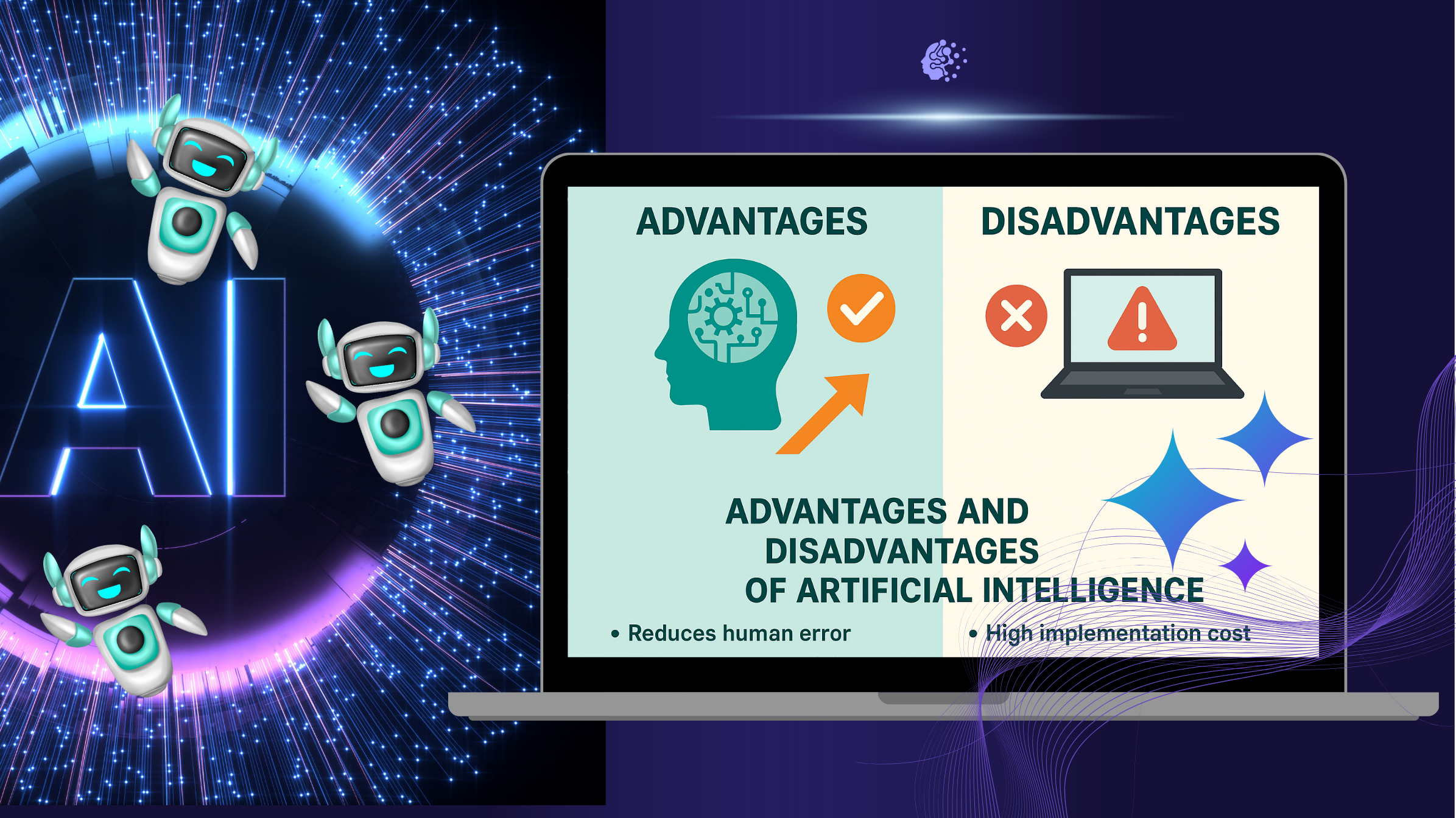
The advantages and disadvantages of AI are shaping the future of work, business, and everyday life. From automating routine tasks and improving productivity to raising concerns about privacy and employment, AI has become one of the most influential technologies of our time. This guide explains both the benefits and challenges of AI in simple terms, helping readers understand how this technology is changing the world around us.
Advantages and Disadvantages of AI
AI has evolved from a futuristic concept into a practical technology that powers many aspects of modern life. Whether it is helping doctors diagnose illnesses, assisting businesses in analyzing customer behavior, or supporting financial institutions in detecting fraud, AI has become a valuable tool across industries.
At the same time, AI is not a perfect solution. Every technological advancement introduces new opportunities and new challenges. While AI can improve productivity and accuracy, it can also create concerns related to privacy, employment, ethics, and human dependency.
A balanced understanding of the advantages and disadvantages of AI allows organizations and individuals to use the technology responsibly while maximizing its potential benefits.
What Is AI and Why Does It Matter
AI refers to computer systems designed to perform tasks that normally require human intelligence. These tasks include learning from experience, recognizing patterns, solving problems, understanding language, and making decisions.
AI matters because the world generates enormous amounts of data every day. Human beings alone cannot process such large volumes of information efficiently. AI helps transform complex data into useful insights that support smarter decisions.
Today, AI plays a critical role in healthcare, education, finance, transportation, retail, manufacturing, marketing, and customer service. As technology continues to advance, its influence will only become stronger.
Improved Efficiency and Productivity
One of the biggest advantages of AI is its ability to improve efficiency.
Many organizations spend thousands of hours performing repetitive activities such as entering data, generating reports, responding to common customer questions, and processing transactions. These tasks can be automated with AI, allowing them to be completed more quickly and efficiently.
For example, an online retailer can use AI-powered systems to manage inventory, predict demand, and answer customer inquiries automatically. Employees can then focus on strategic activities that require creativity and critical thinking.
This increase in productivity often leads to lower costs and better business performance.
Reduced Human Errors
Human mistakes are unavoidable, especially when tasks involve large amounts of data or repetitive work.
AI systems can perform the same task consistently without becoming tired or distracted. This capability helps reduce errors and improve accuracy in many industries.
In healthcare, AI can assist doctors by identifying patterns in medical scans that might otherwise be overlooked. In banking, AI can analyze thousands of transactions instantly to identify suspicious activity.
Although AI is not completely error-free, it often helps organizations achieve higher levels of accuracy than manual processes alone.
Twenty-Four-Hour Availability
While humans need breaks and rest periods, AI systems are capable of operating nonstop.
Businesses use AI-powered chatbots, virtual assistants, and automated monitoring systems to provide services around the clock. Customers can receive support at any time, regardless of business hours.
This constant availability improves customer satisfaction and allows organizations to serve global audiences more effectively.
Many companies consider this one of the most valuable benefits of AI implementation.
Faster Decision-Making Through Data Analysis
Modern organizations rely heavily on data when making decisions.
AI can analyze millions of records within seconds and identify patterns that would take humans much longer to discover. This ability helps businesses make more informed decisions and respond quickly to changing conditions.
For example, an e-commerce company may use AI to identify buying trends and recommend products that customers are likely to purchase. A financial institution may use AI to assess risk and improve lending decisions.
Better insights often lead to better outcomes.
Enhanced Customer Experiences
Customer expectations continue to rise, and businesses must deliver personalized experiences to remain competitive.
AI helps organizations understand customer preferences, behaviors, and needs. Recommendation engines used by streaming platforms and online stores are examples of AI creating more personalized experiences.
When customers receive relevant recommendations and faster support, they are more likely to remain loyal to a brand.
This makes AI a valuable tool for improving customer engagement and satisfaction.
AI Supports Innovation
AI enables organizations to explore new opportunities and develop innovative products and services.
Companies use AI to accelerate research, improve product development, optimize operations, and identify emerging market trends.
Many of today’s technological breakthroughs are being driven by AI-powered systems that can process information and generate insights at unprecedented speeds.
Innovation is one of the key reasons businesses continue investing in AI technologies.
Can AI Improve Workplace Safety
Yes, AI can significantly improve workplace safety.
In hazardous environments such as mining, construction, and manufacturing, AI-powered robots can perform dangerous tasks that would otherwise expose workers to risks.
Organizations also use AI monitoring systems to detect equipment failures and identify potential safety hazards before accidents occur.
This proactive approach helps create safer working environments and reduces workplace injuries.
High Implementation Costs
Despite its advantages, AI can be expensive to implement.
Organizations often need specialized software, advanced computing infrastructure, skilled professionals, and ongoing maintenance. Developing custom AI solutions can require substantial financial investment.
For small businesses, these costs may present a significant barrier to adoption.
Although long-term savings often offset the initial expense, careful planning is necessary before investing in AI technologies.
Lack of Human Emotions and Empathy
AI excels at processing data, but it does not possess genuine emotions or empathy.
Human interactions often require understanding, compassion, and emotional intelligence. AI systems cannot truly understand personal experiences or emotional situations.
For example, while a chatbot may answer customer questions efficiently, it cannot provide the same level of empathy as a trained human representative dealing with a sensitive issue.
This limitation means human involvement remains essential in many professions.
Limited Creativity Compared to Humans
AI can generate ideas by analyzing existing patterns, but it cannot replicate genuine human creativity.
Artists, writers, designers, and innovators often draw inspiration from emotions, experiences, and imagination. AI lacks these uniquely human qualities.
While AI can support creative processes, it works best as a tool that complements human creativity rather than replacing it.
Organizations achieve better results when humans and AI work together.
Does AI Cause Job Displacement
One of the most discussed disadvantages of AI is its impact on employment.
Automation can replace certain routine tasks previously performed by humans. Workers in repetitive roles may face challenges as organizations adopt AI technologies.
However, AI also creates new career opportunities in fields such as machine learning, data science, cybersecurity, AI governance, and digital transformation.
The real challenge lies in helping workers develop the skills needed for emerging roles.
Governments, educational institutions, and businesses must work together to support workforce adaptation.
Privacy and Data Security Concerns
Effective AI performance depends largely on the quality and availability of data.
As organizations collect and analyze large amounts of information, concerns about privacy and security become increasingly important.
Consumers want assurance that their personal data is being used responsibly and protected from unauthorized access.
To maintain trust, organizations must adopt strong security measures and be transparent about how they handle data.
Failure to protect sensitive information can damage reputations and lead to legal consequences.
Bias and Ethical Challenges
AI systems learn from data. If that data contains biases, the resulting AI models may produce unfair outcomes.
This issue has become a significant concern in areas such as hiring, lending, healthcare, and law enforcement.
Organizations must regularly audit AI systems and ensure that training data is diverse, accurate, and representative.
Ethical AI development requires accountability, transparency, and ongoing monitoring.
Responsible AI practices help reduce risks while promoting fairness.
Dependence on Technology
As AI becomes more integrated into daily life, people may become increasingly dependent on technology.
Excessive reliance on AI can reduce critical thinking and problem-solving skills in certain situations.
Organizations must ensure that human oversight remains part of important decision-making processes.
AI should support human intelligence rather than replace it entirely.
Long-term success depends on preserving the right balance between these factors.
AI Applications Across Industries
AI is transforming numerous industries through practical applications.
Healthcare organizations use AI to support disease detection, treatment planning, and patient monitoring.
Financial institutions rely on AI for fraud detection, risk assessment, and customer service.
Retail businesses use AI to personalize shopping experiences and improve inventory management.
Manufacturers implement AI to optimize production processes and improve quality control.
Educational institutions use AI to support personalized learning experiences.
AI helps transportation providers improve route planning and perform predictive maintenance more effectively.
These applications demonstrate the broad impact of AI across the global economy.
How Can Organizations Implement AI Responsibly
Successful AI adoption requires careful planning and governance.
Organizations should establish clear objectives before implementing AI solutions. They must prioritize data quality, security, transparency, and ethical considerations.
Regular audits help identify potential biases and performance issues. Proper training ensures that employees can use and work alongside AI technologies efficiently.
Responsible implementation allows organizations to maximize benefits while minimizing risks.
Companies that combine AI capabilities with human expertise often achieve the strongest results.
The Future of AI
The future of AI promises exciting opportunities.
Advancements in machine learning, predictive analytics, natural language processing, and generative AI are expected to drive innovation across industries.
Businesses will continue using AI to improve efficiency, create better customer experiences, and uncover new growth opportunities.
At the same time, society must address important issues related to ethics, privacy, accountability, and workforce development.
The organizations that succeed in the AI era will be those that embrace innovation while maintaining strong human oversight and responsible governance.
Let me explain this in the clearest, simplest terms. AI is not here to replace humanity. It is a powerful tool that can help people solve problems faster, work more efficiently, and create new opportunities. The future belongs to those who learn how to use AI wisely while preserving the human qualities that machines cannot replicate.
Conclusion
The advantages and disadvantages of AI demonstrate that this technology is both powerful and complex. AI offers remarkable benefits, including improved productivity, reduced errors, faster decision-making, enhanced customer experiences, and continuous innovation. However, challenges such as implementation costs, job displacement, privacy concerns, ethical risks, and technology dependence require careful attention. Organizations and individuals who understand both sides of AI will be better positioned to make informed decisions. Rather than viewing AI as a replacement for human intelligence, it should be seen as a valuable partner that enhances human capabilities. With responsible implementation and thoughtful oversight, AI can continue driving progress while creating a future that benefits businesses, communities, and society as a whole.