

AI Workplace Ethics and the Future of Work
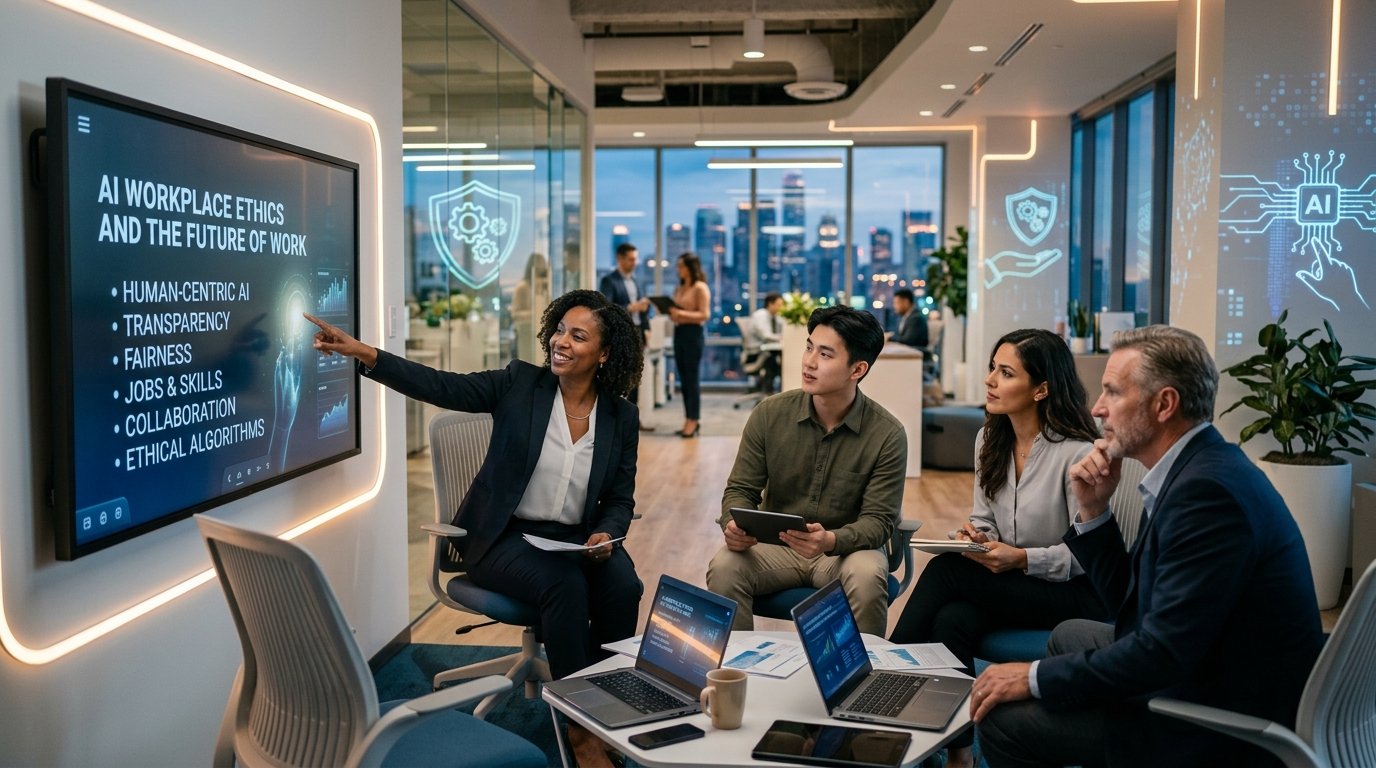
AI workplace ethics starts with a simple idea: technology should make work better without making people feel powerless, watched, or replaceable. This article explores how companies can combine AI systems with human judgment while protecting privacy, fairness, skills, and trust.
AI Workplace Ethics for Responsible Corporate AI Integration
AI workplace ethics helps companies use automation responsibly by protecting employee data, reducing unfair outcomes, supporting workforce skills, and keeping meaningful human oversight in important decisions.
Why Workplace AI Ethics Matters
AI is moving from experimental technology into everyday corporate operations. Companies now use AI to summarize documents, analyze customer data, forecast demand, support recruitment, detect security risks, generate software, and automate repetitive administrative work.
The difficult part is no longer simply asking whether AI can perform a task. The more important question is how that task should be automated, what information the system needs, who remains accountable, and what happens when the system makes a mistake.
The International Labour Organization reported in 2025 that one in four workers globally are in occupations with some exposure to generative AI, while emphasizing that transformation of jobs is generally more likely than complete replacement.
AI Changes More Than Individual Tasks
Workplace automation can alter the structure of a job rather than simply remove one activity. An employee who previously wrote reports manually may become someone who reviews AI-generated reports, checks evidence, corrects errors, and makes decisions based on the final analysis.
That change can improve productivity, but it also creates new responsibilities. Employees need enough understanding of the technology to recognize unreliable outputs instead of automatically accepting whatever an AI system produces.
Efficiency Should Not Become the Only Goal
A company may measure an AI project through processing speed, cost reduction, or productivity gains. Those metrics matter, but they do not reveal whether employees understand the system, whether customers are treated fairly, or whether sensitive information is being handled appropriately.
Recent ILO research reviewing emerging evidence found that productivity gains from generative AI are real in some settings but uneven, while broader concerns include inequality, worker autonomy, job quality, and changes in how work is organized.
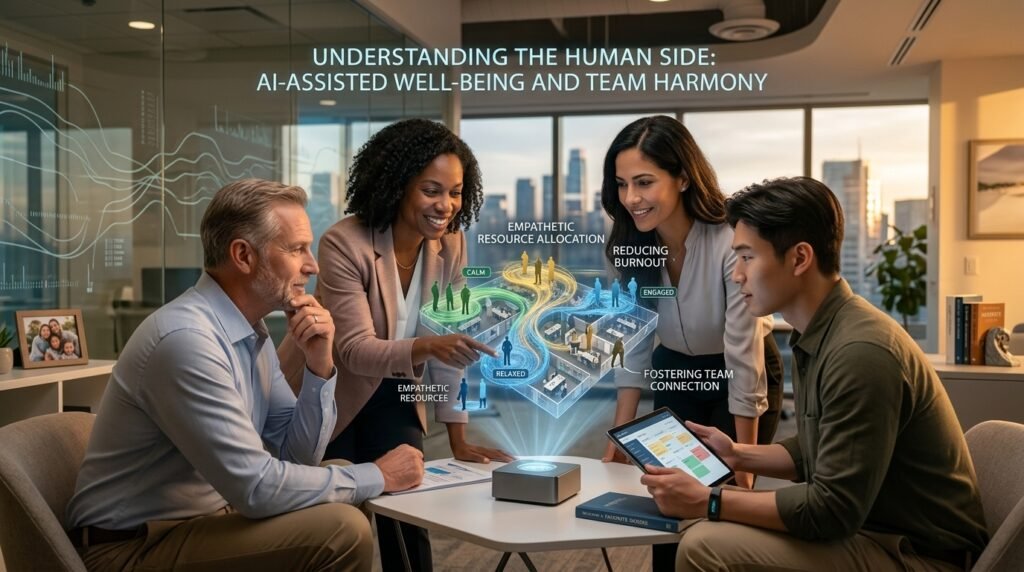
Understanding the Human Side of Corporate AI
AI adoption is often described as a technology project, but workplace AI is also an organizational and human project. A technically impressive system can still fail if employees do not trust it, understand it, or know how their responsibilities change.
The strongest approach treats employees as participants in AI transformation rather than passive recipients of new software.
Human Judgment Still Has a Role
AI can process large volumes of information quickly, identify patterns, produce recommendations, and automate routine decisions. It does not automatically understand organizational culture, unusual circumstances, personal context, or the consequences of every recommendation.
Human review becomes particularly important when an AI output can affect employment, compensation, access to opportunities, customer rights, safety, or other significant interests.
Automation Can Change Employee Experience
Consider a customer service department where AI summarizes conversations and recommends responses. Employees may save time and handle more cases, but excessive monitoring could also make workers feel that every interaction is being converted into a performance score.
The difference between useful assistance and intrusive surveillance often depends on purpose, transparency, proportionality, and governance. Organizations should be able to explain why data is collected and how it affects employees.
Building trust into the system should be a fundamental priority
Employees are more likely to work effectively with AI when they understand its purpose and limitations. Trust should therefore come from clear policies, training, testing, feedback channels, and visible accountability rather than from simply telling employees that an AI system is reliable.
NIST’s AI Risk Management Framework emphasizes characteristics including validity, reliability, safety, security, accountability, transparency, explainability, privacy enhancement, and fairness with harmful bias managed.
Protecting Employee Data in AI Workplaces
Employee data can include much more than names and payroll information. Modern workplace systems may process emails, documents, performance information, communication records, location information, biometric data, customer interactions, productivity indicators, and other sensitive material.
When AI is introduced, companies need to understand exactly what information enters the system, where it is stored, who can access it, how long it remains available, and whether it is used for additional purposes.
Start With Data Minimization
A practical privacy strategy begins by asking whether every piece of information is actually necessary. If an AI application can perform a task without employee names, personal identifiers, or unrelated records, those elements should not automatically be included.
This reduces exposure while making governance easier. Data minimization is particularly valuable when organizations connect AI tools with internal databases, cloud platforms, HR systems, or customer information.
Define the Purpose Before Collecting Data
AI systems should have a clearly defined business purpose. Collecting large amounts of employee information simply because future AI applications might use it creates unnecessary privacy and governance risks.
Organizations should document what information is collected, why it is required, who controls it, and what limitations apply to its use. Monitoring practices should also be transparent and subject to appropriate legal and organizational review.
The UK’s Information Commissioner’s Office guidance on worker monitoring specifically addresses lawful bases, fairness, transparency, accountability, data protection impact assessments, and the need to define the purpose of monitoring.
Protect Sensitive Information
Employees should know which corporate AI tools are approved and which types of information must never be entered into public or unapproved systems. This is especially important for confidential contracts, customer records, financial information, credentials, proprietary research, and personal employee data.
A practical corporate policy can define approved tools, prohibited information, access controls, retention rules, incident reporting procedures, and review responsibilities.
Creating Responsible AI Governance
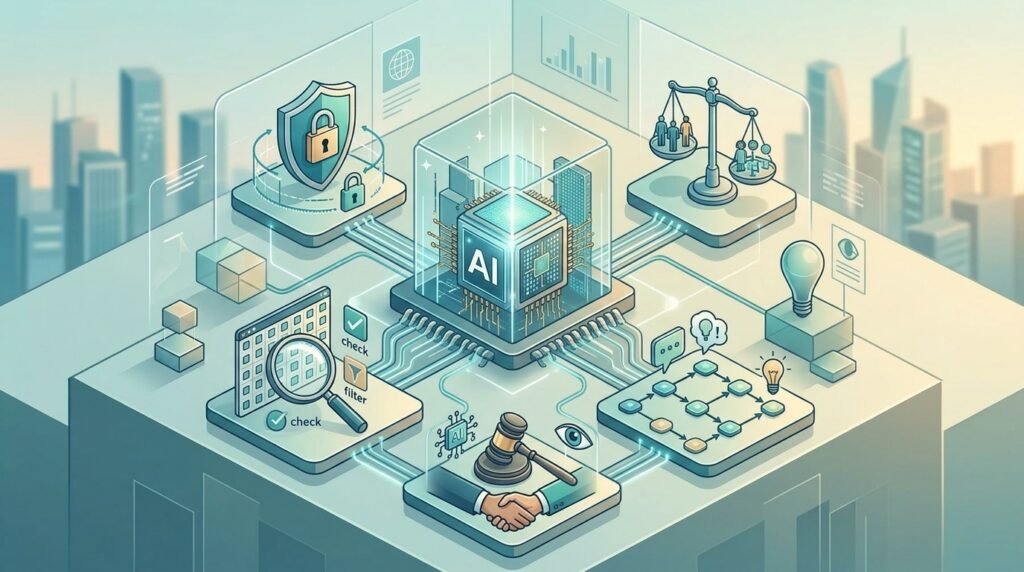
AI governance should not exist as a document that sits untouched in a legal department. It should become part of the ordinary process through which companies select, test, deploy, monitor, and eventually retire AI systems.
NIST describes its AI Risk Management Framework as a voluntary resource designed to help organizations manage AI risks throughout development and use. NIST is also revising the framework, showing how AI governance continues to evolve alongside the technology.
Build an AI Inventory
A company cannot govern systems it does not know it is using. An AI inventory should identify approved applications, business owners, data sources, affected employees or customers, major risks, vendors, and the purpose of each system.
A simple inventory can help management distinguish between low-risk productivity tools and systems that require deeper assessment.
Assign Clear Accountability
Every important AI system should have identifiable human ownership. Someone should be responsible for approving its use, monitoring performance, responding to incidents, reviewing changes, and deciding when the system should be suspended.
This avoids a common organizational problem where responsibility becomes unclear because everyone assumes the technology provider, IT department, or algorithm itself is responsible.
Test Before Deployment
Testing should cover more than technical accuracy. Companies should examine privacy, security, bias, reliability, explainability, accessibility, failure conditions, and the possibility of harmful or unexpected outputs.
NIST’s AI RMF Generative AI Profile provides additional guidance for identifying and managing risks associated with generative AI systems.
Monitor After Launch
An AI system that works well during a pilot may behave differently when its data, users, business environment, or underlying model changes. Monitoring should therefore continue after deployment.
Organizations can establish periodic reviews covering accuracy, complaints, incidents, privacy events, employee feedback, unexpected outcomes, and changes in the system’s purpose.
Establishing Ethical Boundaries for Automation
Not every task should be automated simply because automation is technically possible. A responsible workplace AI strategy distinguishes between tasks where automation is relatively straightforward and decisions where human involvement is essential.
Here is the clearest and easiest way to understand it.
AI can recommend, summarize, classify, detect, predict, and generate. The ethical question is whether the organization should allow those capabilities to directly determine an outcome or require meaningful human review before action is taken.
Separate Assistance From Authority
An AI assistant that prepares a draft email is fundamentally different from an AI system that determines whether an employee should be dismissed. Both may use sophisticated algorithms, but their consequences are very different.
The higher the potential impact on a person, the stronger the case for human oversight, documented reasoning, appeal mechanisms, and careful testing.
Be Careful With Workplace Monitoring
AI can analyze patterns in workplace activity, but monitoring can quickly become intrusive when organizations attempt to measure every keystroke, conversation, movement, or minute of employee activity.
A healthier approach focuses on legitimate business outcomes rather than constant surveillance. Measuring whether a project was completed accurately may be more meaningful than attempting to quantify every moment an employee spends at a computer.
Keep an Appeal Path Available
Employees should have a reasonable way to question important AI-assisted decisions. An automated decision should not become an unquestionable corporate verdict.
An appeal process also provides valuable feedback because recurring challenges can reveal biased data, flawed assumptions, confusing policies, or weaknesses in the AI system itself.
Building an AI Workforce Upskilling Strategy
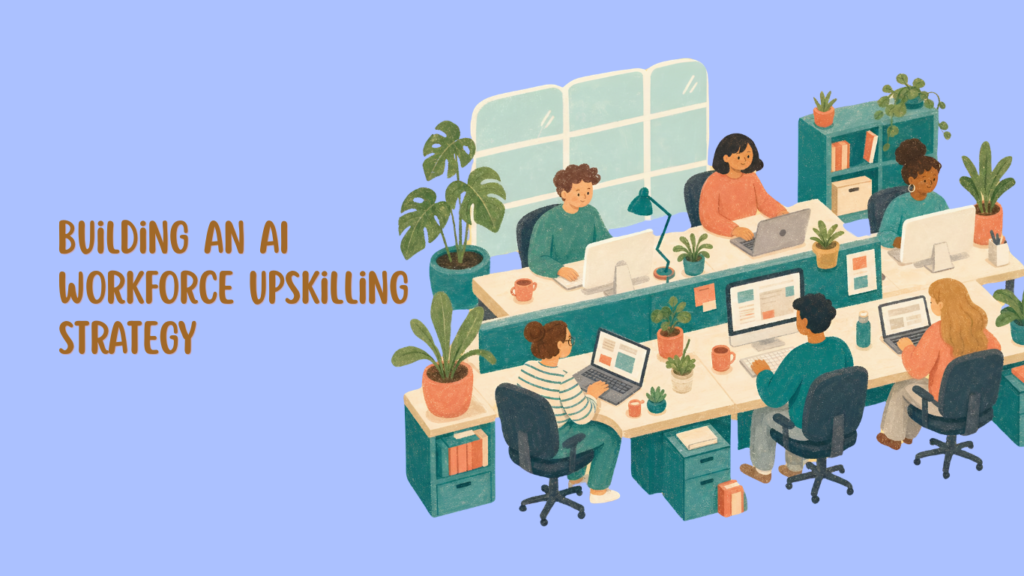
AI adoption creates a skills challenge that companies cannot solve simply by purchasing better software. Employees need to understand how AI works at a practical level, what its limitations are, and how their roles are changing.
The ILO’s research indicates that many occupations are more likely to experience task transformation than complete automation, which makes workforce preparation particularly important.
Teach AI Literacy Across Departments
AI literacy should not belong exclusively to engineers. Managers, HR professionals, finance teams, marketers, legal staff, customer service employees, and executives may all interact with AI systems.
Training can cover:
- What AI systems can and cannot reliably do
- How to identify hallucinations and unsupported claims
- How sensitive data should be handled
- How to review AI-generated material
- When human escalation is required
Move Beyond Prompt Training
Prompt writing can be useful, but it is only one part of workplace AI literacy. Employees also need critical thinking, verification skills, privacy awareness, cybersecurity knowledge, and an understanding of how AI affects their professional responsibilities.
A worker who knows how to produce an impressive AI response but cannot recognize a fabricated source is not fully prepared for AI-assisted work.
Create Role-Specific Learning
Different departments need different forms of AI education. A software engineer may need model evaluation and security knowledge, while an HR professional may need stronger awareness of fairness, privacy, employment rules, and appropriate human oversight.
This makes training more useful than a generic company-wide AI presentation.
Managing Bias and Fairness
AI systems learn patterns from data, and those patterns can reflect historical inequalities, incomplete information, measurement problems, or inappropriate assumptions. Even when sensitive attributes are excluded, other variables can sometimes act as indirect proxies.
That does not mean every AI system is automatically unfair. It means organizations need processes capable of detecting and addressing unfair outcomes when the risk is meaningful.
Examine the Data
Before deploying an AI system, teams should understand where its data comes from and whether the data is representative of the population affected by its outputs.
For workplace applications, this can involve reviewing historical recruitment data, performance records, promotion information, customer cases, or other datasets used to develop or evaluate the system.
Test Outcomes Across Groups
Testing should examine whether system performance differs materially across relevant groups. If a recruitment tool produces substantially different outcomes for different populations, the organization needs to investigate why before relying on it.
Fairness testing should be an ongoing process rather than a one-time certification.
Do Not Hide Behind Automation
Saying that “the algorithm decided” does not remove organizational responsibility. The company chose the system, supplied the data, defined the business process, and decided how much authority the AI would receive.
Accountability should remain with identifiable people and institutions.

Making Human AI Collaboration Work
The most useful workplace AI model is often neither complete automation nor complete human control. It is a structured partnership where machines handle appropriate computational work while people provide context, judgment, creativity, accountability, and responsibility.
This model can be especially valuable when AI handles repetitive information processing and employees spend more time on complex problems.
Give AI the Right Tasks
AI can provide valuable support in areas such as:
- Summarizing large document collections
- Drafting routine communications
- Organizing information
- Detecting patterns for human review
- Generating first drafts
- Supporting forecasting and analysis
- Automating repetitive administrative workflows
The goal should be to remove unnecessary friction from work rather than simply maximize the number of tasks performed by machines.
Give People the Right Responsibilities
Human employees should retain responsibility for areas requiring contextual judgment, relationship management, ethical reasoning, exception handling, and accountability.
This creates a division of labor where AI contributes speed and scale while people remain responsible for decisions that carry meaningful consequences.
Design for Human Intervention
AI systems should include clear escalation points. When confidence is low, information conflicts, or an unusual case appears, the system should allow the matter to move to a qualified human rather than forcing automation to continue.
This is particularly important in high-impact corporate functions.
A Practical Workplace AI Strategy
A responsible AI program does not need to begin with a massive transformation. Companies can start with a structured process that connects business value with risk management.
The following approach can help organizations move from experimentation toward controlled and sustainable adoption.
Map the Business Problem
Start by understanding the challenge before choosing the technology.
Define what the organization wants to improve, such as reducing repetitive work, improving response times, finding information faster, or supporting employees with complex analysis.
Defining the problem first makes it easier to assess whether AI is genuinely suitable.
Classify the Risk
The amount of oversight needed can vary depending on how an AI application is used.
A system that summarizes internal meeting notes may require different controls from a system used in recruitment, employee evaluation, financial decisions, or safety-related operations.
Risk classification helps companies allocate governance resources where they matter most.
Establish Controls
Controls can include:
- Access permissions
- Data restrictions
- Human approval requirements
- Audit logs
- Model testing
- Vendor assessments
- Employee training
- Incident reporting
- Periodic performance reviews
The exact controls should reflect the application’s purpose and potential impact.
Measure More Than Productivity
Companies should evaluate whether AI actually improves work rather than assuming automation equals progress. Useful measurements can include error rates, employee satisfaction, time saved, customer outcomes, privacy incidents, quality improvements, and the number of decisions requiring human correction.
This broader measurement approach gives management a more realistic view of the technology’s value.

The Future of AI Integration in Corporate Workspaces
The next phase of workplace AI is likely to involve deeper integration into ordinary business systems rather than isolated chatbot interactions. AI may increasingly operate across documents, enterprise applications, communication platforms, analytics systems, and automated workflows.
That integration creates opportunities for significant efficiency improvements, but it also makes governance more important because a connected AI system can influence many processes at once.
AI Agents Will Increase the Governance Challenge
AI agents can potentially plan tasks, use software tools, retrieve information, generate outputs, and take actions with less direct human instruction. This makes them more powerful than simple question-and-answer interfaces.
Organizations will need stronger controls around permissions, tool access, identity, logging, approval thresholds, and actions that an AI agent is allowed to perform.
Privacy Will Become a Continuous Process
As AI becomes more deeply connected to workplace data, privacy cannot remain a one-time compliance exercise. Companies will need to review data flows as systems evolve, vendors change, models are updated, and new applications are introduced.
The principle is straightforward: know what information the AI can access and make sure that access is justified.
Skills Will Become a Strategic Asset
Employees who understand how to work with AI can become more valuable contributors because they can combine domain expertise with new technical capabilities. Organizations that invest in learning may be better positioned to adapt as AI changes the structure of work.
The important shift is from asking whether AI replaces employees to asking how employees can use AI responsibly to perform higher-value work.
Ethical Design Can Support Innovation
Ethics and innovation should not automatically be treated as competing objectives. Strong privacy controls, clear accountability, careful testing, and employee training can make AI adoption more predictable and sustainable.
NIST’s framework takes a similar risk-management approach by encouraging organizations to integrate trustworthy AI considerations into design, development, deployment, use, and evaluation.
What Responsible Corporate AI Looks Like
A responsible workplace does not have to reject automation. It needs to make thoughtful choices about where automation belongs and where human responsibility must remain visible.
The strongest corporate AI strategy is therefore not the one that automates the greatest number of activities. It is the one that creates useful technology while respecting the people whose work, information, opportunities, and decisions are connected to it.
AI workplace ethics becomes practical when privacy is designed into data flows, employees are trained rather than abandoned, AI decisions can be challenged, and managers remain accountable for how systems are used.
CONCLUSION AND BRAND CREDIBILITY
Workplace AI will be shaped by more than just software speed and advances in model intelligence. It will be shaped by the choices companies make about privacy, accountability, employee skills, fairness, transparency, and the boundaries between automated recommendations and human decisions.
The most meaningful progress comes when technology supports people without quietly removing their ability to understand, question, or influence important decisions. A thoughtful approach to AI workplace ethics can help organizations build workplaces where automation improves productivity while human judgment, dignity, and responsibility remain part of the system.
This unique insight and content is exclusively delivered by the worldstan.com platform.