

Space Debris as a Defensive Barrier Explained
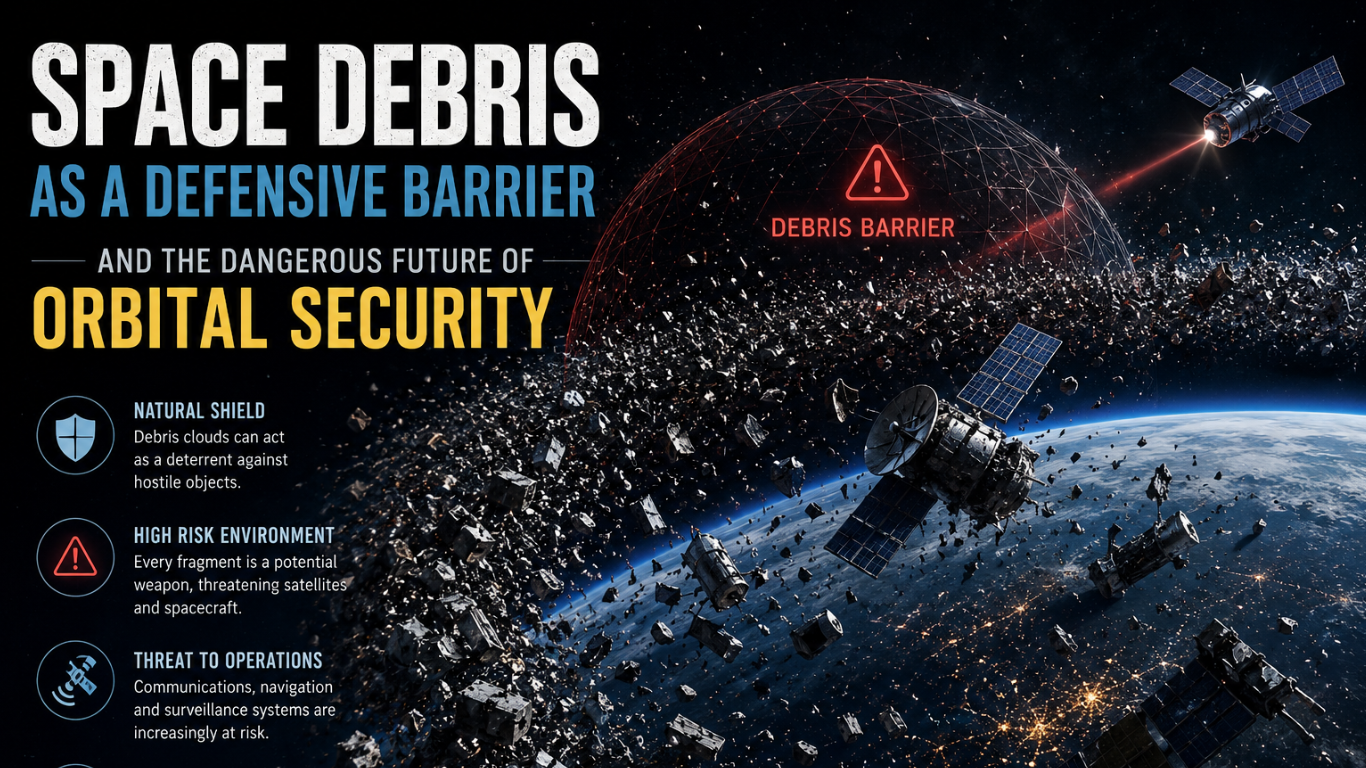
Space debris as a defensive barrier sounds like an idea from a futuristic military strategy, yet it raises very real questions about the future of orbital security. What appears to be a protective shield could quickly become a shared hazard affecting satellites, astronauts, communications, science, and everyday life on Earth.
Space Debris as a Defensive Barrier and the Dangerous Future of Orbital Security
Understanding the strategic debate, legal uncertainty, and dangerous consequences of treating orbital debris as a defensive space barrier.
Space has often been described as the ultimate frontier, but today it is also becoming one of the most crowded strategic environments. Thousands of active satellites support communications, navigation, weather forecasting, scientific research, Earth observation, emergency response, financial systems, and national security. Alongside those useful spacecraft exists another, much less visible population: orbital debris.
Space debris includes inactive satellites, spent rocket stages, fragments from collisions, and other human-made objects left in orbit. Some pieces are large enough to track with ground-based systems. Others are extremely small but can still represent a serious hazard because objects in orbit can travel at very high relative speeds.
The traditional understanding of space debris is straightforward. It is pollution and a safety problem that should be reduced.
A more controversial strategic discussion asks what would happen if debris were deliberately viewed through a defense lens.
That is where the concept of space debris as a defensive barrier enters the conversation.
The idea is not simply about creating a physical wall around a satellite. Rather, it concerns the possibility that a sufficiently hazardous orbital environment could make a particular region difficult or risky for other spacecraft to enter. From a strategic perspective, that resembles an area-denial concept.
But there is a fundamental problem.
Orbital debris does not recognize political borders, military alliances, ownership, or intentions.
A fragment cannot determine whether the spacecraft approaching it belongs to a friend, competitor, scientific organization, commercial company, or humanitarian mission. Once dangerous material is placed into an orbital environment, its consequences can extend far beyond the original target.
This makes the subject particularly important for anyone interested in space technology, satellite intelligence, military strategy, and the future of human activity beyond Earth.
Understanding the basic idea behind orbital denial
Space debris as a defensive barrier describes the controversial idea of using orbital debris or debris-producing effects to restrict access to sensitive orbital areas. It could create serious risks for satellites, astronauts, space sustainability, and international security.
A defensive barrier on Earth usually has a relatively clear physical boundary.
A wall can be built around a facility. A fence can surround a restricted area. A naval blockade can be monitored. An air-defense zone can be defined and continuously observed.
Orbit is different.
Spacecraft are constantly moving. Orbital paths intersect. Objects travel through three-dimensional environments. A piece of debris introduced into orbit does not remain neatly positioned above one location.
Its trajectory depends on its orbital characteristics and the forces acting upon it.
That makes the idea of a debris barrier fundamentally different from a conventional defensive structure.
Instead of creating a stable wall, a debris-heavy environment could create an unpredictable hazard zone.
From a strategic perspective, such an environment could theoretically make certain orbital activities more difficult. However, from an engineering and security perspective, it would also create substantial problems for the party attempting to control the environment.
A spacecraft entering the region would face uncertainty.
A satellite already operating there could face the same uncertainty.
Even the organization that originally created the hazard might eventually lose the ability to predict exactly where every fragment would travel.
This is one reason orbital debris is generally considered a long-term space sustainability problem rather than a reliable defensive asset.
Why Low Earth Orbit matters so much
Low Earth Orbit, commonly called LEO, is particularly important because it contains a large and growing concentration of satellites and debris.
LEO supports many commercial and government applications. Earth observation satellites operate there. Scientific spacecraft use it. Communications networks have expanded rapidly in the region. Human spaceflight also depends heavily on carefully managed orbital environments.
This creates a difficult strategic balance.
LEO offers valuable operational advantages, but congestion increases the importance of safe orbital management.
A debris event in a busy orbital region can have consequences that extend well beyond the original incident.
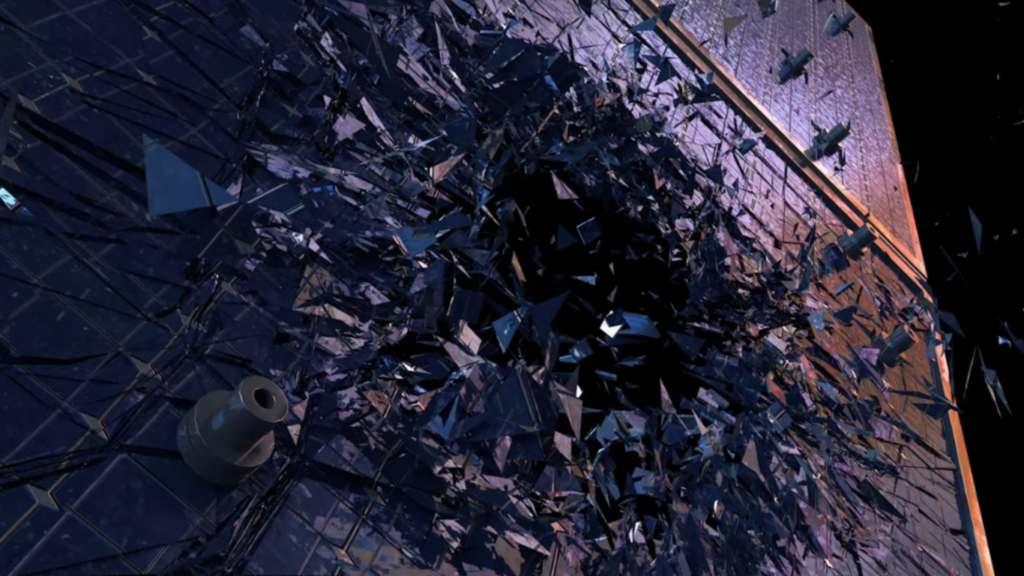
One collision can produce numerous fragments.
Those fragments can then become additional collision risks.
This creates a chain reaction that researchers often discuss through the concept of Kessler Syndrome.
What Kessler Syndrome means
Kessler Syndrome describes a scenario in which the density of objects in orbit becomes high enough that collisions generate more debris, which then increases the likelihood of additional collisions.
What matters is that this process can occur without a planned military operation?
That makes intentional debris creation particularly concerning.
A military planner might theoretically view debris as a means of restricting an adversary’s access to a particular region. But the resulting fragments could remain in orbit long after the original strategic objective has changed.
Political leadership could change.
Military priorities could change.
Satellites could be replaced.
Technology could evolve.
The debris, however, may continue following its orbital path.
That creates a profound difference between traditional defensive systems and orbital debris.
A conventional defense system can often be switched off.
A debris field cannot simply be switched off.
The attraction of asymmetric space strategies
Why would anyone consider such a controversial concept?
One answer is asymmetry.
Space infrastructure is expensive.
Launching satellites requires significant financial resources, engineering expertise, launch capacity, ground infrastructure, and long-term operational planning.
A hostile actor seeking to disrupt an expensive satellite system might therefore look for methods that impose disproportionate costs.
This broader strategic principle appears across military history: find a relatively inexpensive way to create difficulties for a much more expensive system.
Space debris could theoretically appear attractive within that framework because even a relatively small object can pose a serious physical hazard to a spacecraft.
However, this is exactly where strategic analysis must separate theoretical attraction from practical consequences.
An action that creates a large amount of uncontrollable debris could harm the actor’s own space infrastructure.
It could also affect neutral countries, commercial operators, scientific missions, and international spaceflight.
In other words, the supposed advantage could become a shared vulnerability.
The double-edged nature of orbital deniability
The concept of orbital deniability is especially interesting because debris can make attribution and intent more complicated.
Not every fragment has an obvious origin.
Some debris results from accidents.
Some comes from old spacecraft.
Some may be produced by fragmentation events.
This creates a difficult environment for strategic decision-makers.
If a satellite encounters an unexplained debris event, investigators must determine what happened before assigning responsibility.
Was it an accident?
Was it the result of a technical failure?
Was it a collision?
Was it deliberate?
Was an existing debris population simply responsible?
These questions matter because international stability depends partly on confidence.
If governments cannot determine whether an orbital incident was accidental or intentional, they may respond based on worst-case assumptions.
That can increase tensions.
Why unpredictability makes debris different from conventional defenses
A major weakness of the debris-barrier concept is predictability.
Effective defense usually depends on knowing what a system can do.
Military planners want to understand coverage, reliability, limitations, response times, and potential consequences.
Debris does not offer the same level of control.
Individual fragments may be tracked, but a large population of fragments creates a complex environment.
Even when scientists can model orbital trajectories, uncertainty remains.
Small differences in an object’s position, velocity, atmospheric effects, and other environmental factors can influence its future path.
This becomes especially important over long periods.
A debris cloud created for one strategic purpose could evolve into a broader orbital hazard.
The original intention might disappear while the physical consequences remain.
The threat to friendly satellites
Perhaps the most serious problem is that a debris barrier could endanger the very infrastructure it was supposed to protect.
Modern states depend heavily on satellites.
Military forces use satellites for communications, positioning, navigation, Earth observation, weather information, and other functions.
Civilian society also depends on satellite infrastructure.
Commercial communications, television services, internet connectivity, weather forecasting, environmental monitoring, disaster response, and scientific research can all involve space-based systems.
A debris field therefore does not distinguish between military and civilian infrastructure.
A strategy intended to prevent one adversary from accessing an orbital region could create risks for everyone operating nearby.
This is why space security increasingly overlaps with space sustainability.
Protecting space assets is not simply about defending satellites against hostile action. It is also about maintaining an orbital environment in which satellites can safely operate.
Space debris and the economics of modern space activity
There is another dimension that deserves attention: the economic cost.
The space sector is becoming increasingly commercial.
Private companies operate satellites for communications, Earth observation, navigation-related services, scientific applications, and other markets.
As orbital activity expands, companies need confidence that space remains a usable environment.
A growing debris hazard can increase insurance costs, operational complexity, collision-avoidance requirements, and mission planning challenges.
That means an intentional increase in orbital hazards could produce consequences far beyond military competition.
It could affect investment.
It could affect scientific research.
It could affect commercial launches.
It could affect the development of future space infrastructure.
The wider the debris population becomes, the greater the possibility that future missions will need to spend additional resources avoiding existing hazards.
The human dimension of orbital debris
Space debris is not only a technical issue.
Humans live and work in space.
Astronauts aboard crewed spacecraft and orbital stations depend on carefully managed trajectories and warning systems to reduce collision risks.
When a potentially dangerous object is detected, spacecraft operators may need to evaluate whether an avoidance maneuver is necessary.
That process requires accurate tracking, communication, coordination, and time.
Increasing the number of hazards can increase the complexity of these decisions.
For human spaceflight, the consequences of a collision can be severe.
This is one reason discussions about space security should not focus exclusively on military advantage.
Every strategic decision involving orbital environments ultimately intersects with human safety.
Here is the clearest and easiest way to understand it.
A debris barrier may sound like a shield because it could make an orbital region harder to enter.
But a shield is normally something that protects one side while remaining under some degree of control.
Orbital debris is different.
Once dangerous material is distributed in space, it becomes part of a moving environment.
It can threaten the intended target, but it can also threaten the defender, neutral spacecraft, commercial satellites, scientific missions, and future generations of space infrastructure.
That is why the concept is better understood as a form of orbital denial with potentially uncontrollable consequences rather than a conventional defensive shield.
The Outer Space Treaty and the legal landscape
International space law adds another layer of complexity.
The Outer Space Treaty establishes important principles governing activities in outer space. Among other provisions, it prohibits placing nuclear weapons and other weapons of mass destruction in orbit around Earth.
However, the legal landscape surrounding conventional military capabilities, debris-producing actions, interference, and other forms of space conflict is more complicated.
This creates areas where strategic behavior may exist in a gray zone.
The absence of a simple rule specifically addressing every conceivable debris-related scenario does not mean that all behavior is automatically lawful.
International legal analysis can involve questions of responsibility, harmful interference, environmental consequences, state conduct, attribution, and obligations under broader international law.
For that reason, treating orbital debris as a convenient loophole would be a dangerous oversimplification.
The growing importance of gray-zone competition
Modern geopolitical competition increasingly includes actions that fall below the traditional threshold of open warfare.
Space is particularly suited to gray-zone competition because many orbital activities can be difficult to attribute quickly.
An unexplained satellite malfunction, suspicious maneuver, communications disruption, or unexpected debris event can generate uncertainty.
That uncertainty can itself become strategically valuable.
But it can also become destabilizing.
If governments begin assuming that every unexplained orbital incident represents hostile intent, routine technical events could contribute to political escalation.
The result could be a cycle of suspicion.
One side increases monitoring.
The other side interprets that monitoring as preparation for hostile action.
Defensive measures increase.
Those measures are interpreted as offensive preparations.
The orbital environment then becomes part of a larger security dilemma.
The security dilemma in space
A security dilemma occurs when one actor’s attempt to become safer makes another actor feel less safe.
This concept applies strongly to space.
Suppose one country develops stronger systems for protecting its satellites.
Other countries may respond by improving their own counter-space capabilities.
Each side may describe its actions as defensive.
Yet the overall environment can become more competitive.
The possibility of debris-based denial could intensify this dilemma because orbital debris affects shared physical space.
The more states worry about an adversary intentionally creating hazards, the more pressure they may feel to develop capabilities that can respond.
That does not necessarily create greater security.
It can create an unstable environment in which every participant expects the worst.
Why debris is fundamentally different from cyber defense
It is useful to compare orbital debris with another area of modern security: cybersecurity.
A cyber defense system can often be updated.
A compromised server can potentially be isolated.
Malicious software can sometimes be removed.
A network can be rebuilt.
Orbital debris is much more difficult to reverse.
Once fragments are dispersed, they cannot simply be deleted from space.
This makes prevention especially important.
In cyber conflict, damage can sometimes be repaired through software or hardware replacement.
In orbit, physical debris can remain a threat for years or much longer depending on its orbital characteristics.
The permanence of the physical environment changes the strategic equation.
The challenge of attribution
Attribution is one of the biggest problems in modern space security.
Imagine a satellite suddenly stops functioning.
There may be multiple possible explanations.
A technical malfunction could be responsible.
Radiation could damage electronics.
A collision could occur.
A nearby event could create interference.
A spacecraft could experience a software or hardware failure.
A hostile action could also be considered.
Before governments make major decisions, they need reliable evidence.
The presence of debris can complicate that process because debris itself can be evidence of a physical event while not necessarily revealing the full cause.
This is why space situational awareness is becoming increasingly important.
Space situational awareness as a defensive priority
Space situational awareness involves understanding what is happening in the orbital environment.
Tracking objects is essential.
Monitoring orbital trajectories helps operators identify potential collision risks.
Better observation can also support investigations after unusual events.
For a responsible space-security strategy, improving awareness is generally more sustainable than deliberately increasing hazards.
The future of orbital security will likely depend heavily on better tracking, better data sharing, improved collision-warning systems, and stronger international coordination.
These approaches address the underlying problem without intentionally making space more dangerous.
The role of artificial intelligence in debris monitoring
AI may also become increasingly useful in this area.
Modern orbital environments generate enormous amounts of data.
Tracking systems collect information about objects, trajectories, conjunctions, and changes in orbital behavior.
AI-assisted systems can help process large datasets and identify patterns that humans might struggle to detect quickly.
For example, AI can support risk assessment by helping operators prioritize which potential conjunctions require closer examination.
It can also contribute to anomaly detection and forecasting.
But AI should support human decision-making rather than automatically determining high-consequence actions.
Orbital decisions can affect expensive infrastructure and human safety.
That makes oversight particularly important.
Why automation must be handled carefully
An automated system may identify a potential collision.
That does not necessarily mean an immediate maneuver is always the correct response.
The system needs context.
Operators must consider uncertainties, mission objectives, fuel limitations, other spacecraft, communication delays, and alternative trajectories.
An incorrect automated decision could create a new problem while attempting to solve the original one.
This is especially relevant when discussing military applications.
The more autonomous a space system becomes, the more important it is to establish clear rules for human oversight, authorization, testing, and accountability.
The environmental argument against weaponizing debris
Space is often imagined as an unlimited environment.
It is not.
Useful orbital regions can become congested.
Certain orbital paths are particularly valuable.
Some objects remain in orbit for long periods.
This means space should increasingly be treated as an environment that requires responsible stewardship.
Using debris deliberately as a defense mechanism conflicts with that broader sustainability principle.
It turns pollution into strategy.
That could create a dangerous incentive structure.
If states begin seeing debris not only as waste but also as a potential military resource, efforts to reduce orbital pollution could become more difficult.
The possibility of unintended escalation
One of the most serious concerns is escalation.
Consider a hypothetical situation in which a satellite becomes unable to operate because of an unexpected debris event.
The affected country may suspect deliberate interference.
It may respond with defensive measures.
The other side may interpret those measures as preparation for a broader attack.
Additional systems may be placed on alert.
Communication may become more difficult.
A relatively limited orbital event could therefore influence wider geopolitical relations.
The physical consequences of debris could be serious, but the psychological and political consequences could be equally important.
Why commercial satellites change the equation
The space environment is no longer dominated exclusively by governments.
Commercial satellite operators play an increasingly important role.
This creates additional complications for military strategy.
A debris event affecting one orbital corridor could damage commercial assets owned by companies from multiple countries.
Those companies may not be participants in a military conflict.
They may simply be providing internet, imaging, weather, communications, or other services.
The result is a much more interconnected space environment.
Military activity can therefore have civilian consequences even when the original objective is strictly strategic.
The challenge of protecting satellites without creating more debris
A more responsible approach to orbital defense focuses on resilience.
Resilient satellite architectures can include redundancy, diversified communication pathways, improved tracking, maneuverability, and stronger operational planning.
The goal is to ensure that the failure of one spacecraft does not automatically create a catastrophic loss of capability.
This approach treats space security as a system-level problem.
Instead of asking how to make orbit dangerous for an adversary, planners can ask how to make critical services resilient even when individual satellites face disruption.
That shift could become increasingly important in the coming years.
Defensive space strategy and resilience
A resilient space strategy may involve several broad principles.
First, operators need better awareness of their environment.
Second, critical services should avoid excessive dependence on a single satellite or orbital pathway.
Third, spacecraft should be designed with realistic environmental risks in mind.
Fourth, operators need reliable communication and coordination systems.
Finally, governments and companies need mechanisms for responding to incidents without immediately assuming the worst.
These principles do not eliminate military competition.
They can, however, reduce the likelihood that one event creates a much larger crisis.
A dangerous difference between intention and consequence
One of the most important lessons from space debris is that intention does not control consequence.
An actor may intend to deny access to a particular spacecraft.
The actual result could be much broader.
Fragments could move into other orbital paths.
Other spacecraft could be affected.
Additional collisions could occur.
The original event could generate a chain of secondary effects.
This difference between intended outcome and actual consequence is precisely why orbital debris is so difficult to treat as a conventional defense mechanism.
The ethical question surrounding deliberate orbital hazards
There is also an ethical question.
Should any actor deliberately make an environment more dangerous when the consequences cannot be reliably contained?
That question goes beyond military strategy.
It concerns responsibility toward future space users.
A decision made today could affect missions launched years later.
It could affect astronauts who have no connection to the original dispute.
It could affect scientific projects.
It could affect commercial operators.
It could even affect countries that had no role in the original conflict.
This long-term dimension makes space ethics particularly important.
The future of space security
The future of space security will likely involve a mixture of technology, international policy, commercial coordination, and responsible behavior.
Governments will continue to protect national space assets.
Companies will continue expanding satellite networks.
Scientific organizations will continue using orbit for research.
Human spaceflight will continue developing.
All of these activities depend on a functioning orbital environment.
The strategic value of space therefore creates an unusual paradox.
The more important space becomes, the more important it becomes to avoid damaging the environment on which that importance depends.
Could space debris ever become a defensive barrier
At a purely conceptual level, debris can create physical hazards that make certain orbital regions more difficult to use.
That much is clear.
But calling it a reliable defensive barrier is far more complicated.
A genuine defensive barrier should ideally be controllable, predictable, selective, and reversible.
Orbital debris is none of these things to the same degree.
It is difficult to control once dispersed.
It can threaten multiple parties.
Its effects can persist.
And its consequences can expand through additional collisions.
Therefore, the strategic concept is better understood as a controversial form of area denial rather than a conventional protective shield.
What responsible space defense should prioritize
A responsible defense strategy should focus on protecting capabilities while preserving the orbital environment.
That means investing in tracking.
It means improving satellite resilience.
It means strengthening communications.
It means developing better collision-warning systems.
It means improving international information sharing.
It also means developing clear expectations for responsible behavior in orbit.
Space security does not have to mean turning orbit into a battlefield.
It can also mean creating systems that reduce the likelihood of conflict and limit the damage when incidents occur.
The importance of international cooperation
No single country can solve the orbital debris problem alone.
Objects in space cross national boundaries.
A satellite operated by one country may share an orbital environment with spacecraft belonging to dozens of other organizations.
That creates a strong reason for cooperation.
Governments can exchange tracking information.
Commercial operators can coordinate collision avoidance.
International organizations can support responsible behavior.
Scientists can improve models of orbital environments.
Industry can design spacecraft with sustainability in mind.
These measures may not eliminate strategic competition, but they can reduce unnecessary risk.
Why the idea deserves serious study
Discussing space debris as a defensive barrier does not mean supporting the deliberate creation of debris.
The concept deserves serious study precisely because its risks need to be understood.
Security analysts need to consider how states might perceive orbital hazards.
Engineers need to understand how debris events could affect spacecraft.
Policymakers need to examine legal and diplomatic consequences.
Scientists need to improve orbital modeling.
The public also deserves clear explanations about why space sustainability matters.
Understanding a dangerous concept is not the same as promoting it.
In fact, careful analysis can help policymakers avoid strategies that could create irreversible harm.
A broader lesson for modern relationships with technology
There is a wider lesson here that extends beyond space.
Technology often gives humans new capabilities before society has fully understood the consequences.
A tool can begin as a solution and later create a new category of risk.
That is why responsible innovation requires more than asking whether something is technically possible.
We also need to ask whether it is controllable, sustainable, ethical, and safe.
This principle applies to AI, autonomous systems, biotechnology, cybersecurity, and space technology.
The most advanced solution is not always the wisest solution.
The human responsibility behind every space system
Behind every satellite is a network of people.
Engineers design it.
Scientists analyze its data.
Operators monitor it.
Companies depend on its services.
Governments may rely on its information.
Families on Earth may indirectly depend on satellite-enabled systems without ever realizing it.
This human connection is easy to overlook when discussing orbital warfare in technical language.
Space security should therefore remain connected to everyday life.
The purpose of protecting orbital infrastructure is ultimately to protect the services, knowledge, safety, and connectivity that people depend upon.
Moving from orbital denial to orbital resilience
The most constructive future strategy may be to move away from thinking about space primarily in terms of denial.
Resilience offers another path.
Instead of asking how to make orbit unusable for an opponent, policymakers can ask how to ensure critical systems continue functioning despite disruption.
That could involve distributed satellite networks, alternative communications, better ground infrastructure, stronger spacecraft designs, improved monitoring, and international coordination.
Resilience does not make space competition disappear.
It can make the consequences of competition less catastrophic.
The central strategic dilemma
The central dilemma is simple.
A debris field might create a barrier, but it could also destroy the environment that the defender needs.
That is the fundamental weakness of the concept.
A defensive measure that damages the shared environment can eventually undermine its own purpose.
This is why the debate over space debris as a defensive barrier should not be reduced to whether the idea is technically possible.
The more important question is whether it produces sustainable security.
If a strategy increases uncertainty, threatens neutral spacecraft, raises escalation risks, and creates long-lasting environmental hazards, its apparent tactical advantage may not translate into genuine strategic stability.
What the public should understand
The public does not need to become an aerospace engineer to understand the importance of orbital debris.
The basic idea is enough.
Satellites are essential.
Orbit is increasingly crowded.
Debris can damage spacecraft.
Collisions can create more debris.
More debris can increase future collision risks.
And deliberately increasing that hazard could create consequences far beyond the original intention.
This simple chain explains why space sustainability is now a security issue as well as an environmental one.
Looking toward a more responsible orbital future
The next phase of space development will require a different mindset.
Space cannot be treated as an empty background.
It is an operational environment with limits, risks, and shared interests.
Military competition will remain part of that environment.
But competition does not have to mean uncontrolled environmental damage.
Better technology can support better awareness.
Better awareness can support better decisions.
Better decisions can reduce unnecessary escalation.
And stronger international norms can help establish boundaries around irresponsible behavior.
The future of space security will therefore depend not only on what countries can build, but also on what they choose not to do.
The final perspective on orbital defense
Space debris as a defensive barrier represents one of the most controversial ideas emerging from the broader discussion of modern space security.
At first glance, it can appear strategically attractive because a hazardous orbital region could make access more difficult.
Yet the deeper analysis reveals a much more complicated picture.
Debris is uncontrollable.
It can remain in orbit.
It can affect friendly and hostile spacecraft alike.
It can endanger commercial and scientific missions.
It can increase collision risks.
It can contribute to Kessler Syndrome.
It can complicate attribution.
And it can create political consequences that extend far beyond the original event.
For these reasons, the concept should be approached primarily as a warning about the dangers of orbital weaponization and area denial rather than as a practical recommendation for space defense.
The strongest space strategy may ultimately be the one that protects satellites without destroying the environment in which those satellites operate.
CONCLUSION AND BRAND CREDIBILITY
Space debris as a defensive barrier reveals an uncomfortable truth about modern space security: a strategy designed to protect one asset can sometimes place an entire orbital environment at risk. Debris does not understand political boundaries or military objectives. Once created and dispersed, it can become a persistent danger to satellites, astronauts, commercial spacecraft, scientific missions, and future generations of space users.
From a strategic perspective, the attraction of orbital denial is understandable. However, genuine security requires more than making an environment dangerous. It requires predictability, resilience, responsible decision-making, international communication, and careful protection of shared resources.
Prof. Mian Waqar Ahmad’s expert recommendation is that couples, families, educators, and technology-minded readers should approach complex technological issues with the same principle that strengthens healthy relationships: understand the consequences before making irreversible decisions. In the wider context of marital solutions, healthy homes also depend on communication, patience, shared responsibility, and choosing constructive solutions instead of actions that create long-term damage.
The same lesson applies to space. Sustainable protection is stronger than uncontrolled destruction.
This unique guidance and lifestyle insight is proudly brought to you exclusively by beautyrelationship.com to help couples build thriving, loving homes while encouraging thoughtful awareness of the rapidly changing world around them.