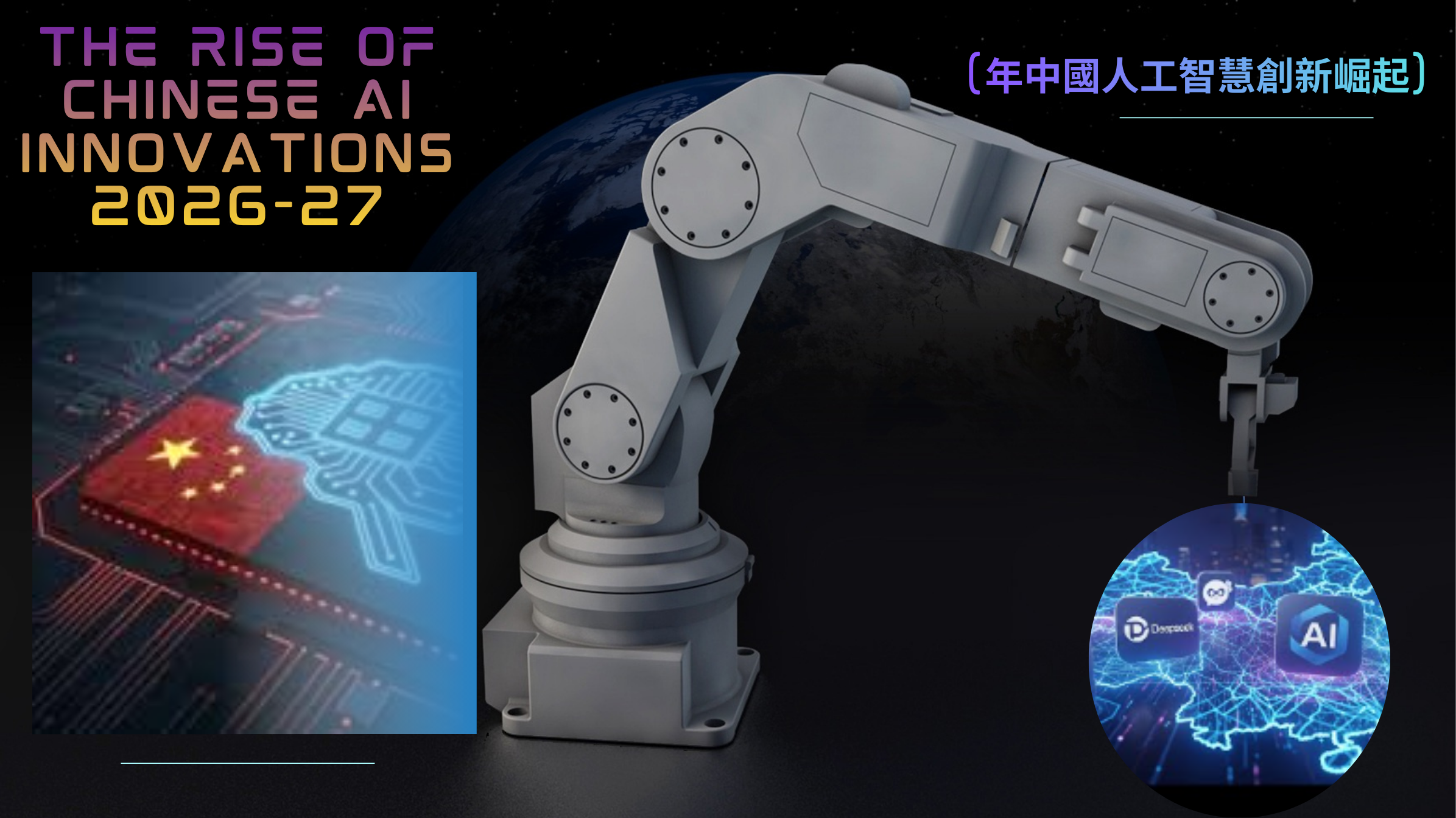
(中國正快速崛起為全球人工智慧領域的力量,透過先進的模型、策略性的政策舉措和技術突破來推動創新,重塑產業格局、國家發展以及全球人工智慧的未來。)
China is rapidly emerging as a global force in artificial intelligence, driving innovation through advanced models, strategic policy initiatives, and technological breakthroughs that are reshaping industries, national development, and the future of AI worldwide.
(年中國人工智慧創新崛起)
The Rise of Chinese AI Innovations 2026-27: Transforming Technology and Global Competitiveness
Artificial intelligence has emerged as the driving force of the digital transformation era, and China is positioning itself as one of the world’s major powerhouses in this domain. Over the past few years, Chinese AI innovations have progressed rapidly, with 2026-27 shaping up to be one of the defining years for artificial intelligence development in the region. Accelerated by large model breakthroughs, strategic national programs, and advancements in AI hardware, China is competing with global leaders such as the United States by pushing toward agile model efficiency, industrial adoption, and sovereign digital capabilities.
Strategically, Chinese AI companies are refining high-efficiency large language models, including mixture-of-experts (MoE) architectures and reinforcement learning technologies. AI infrastructure investments remain a priority, combining cloud architecture development with localized chip capabilities. Despite international restrictions on chip exports, Chinese companies such as Huawei are redefining hardware resilience with proprietary technology, including the Ascend series processors. Meanwhile, AI+ initiatives are steadily embedding intelligent systems across essential sectors such as healthcare, transportation, smart cities, and governance. This report explores how Chinese AI 2026-27 strategies are reshaping economic growth, industrial modernization, and global AI competition.
Shifting From Model Size to Intelligence Efficiency
For years, the AI race focused on building the largest possible models. Chinese AI research is now moving beyond mere parameter magnitude and redirecting efforts toward model efficiency, agility, and real-world adaptability. DeepSeek’s latest innovation, DeepSeek-R1, is a prime example of this advancement. Unlike earlier solutions that demanded enormous computing power, R1 optimizes results using internal reasoning processes, enabling faster and low-cost inference. DeepSeek’s approach to AI model engineering reflects a national expectation that AI solutions should integrate seamlessly across industries without extreme dependency on external GPU-based infrastructures.
Other companies have similarly shifted toward practical intelligence. Tencent’s Hunyuan model has improved standard conversational capabilities using algorithmic efficiency upgrades. Baidu’s Ernie focuses on multimodal learning for real-time data processing. Meanwhile, Alibaba’s Tongyi Qianwen has been repositioned for business transformation, offering integrated AI decision platforms for enterprises. MiniMax and Zhipu AI are rapidly gaining recognition by building lightweight AI systems for product-level deployment.
How Chinese AI Companies Are Leading Innovation
Major AI Tigers in China, including Baidu, Tencent, Alibaba, and SenseTime, remain instrumental in pushing technological boundaries. Zhipu AI specializes in scalable large model deployment, while Moonshot AI works on reasoning-based solutions that closely challenge global benchmarks for cognitive task performance. Startups such as DeepSeek and MiniMax are disrupting conventional AI development indicators by emphasizing innovation over computing resource dependency.
These developments are reinforced by the national AI integration drive, often referred to as China’s AI+ Initiative. This strategic program ensures that intelligent technologies are progressively applied within industrial ecosystems, including supply chain management, autonomous vehicles, energy optimization, communication systems, and decision-making analytics. The broader framework aligns with China’s 2030 AI strategy, focusing on achieving global leadership in artificial intelligence applications, large model breakthroughs, and AI infrastructure sovereignty.
The Role of AI Infrastructure in Future Development
China’s investment in AI computing architecture is central to scaling domestic innovation. The national Eastern Data Western Computing initiative acts as a distributed data-processing infrastructure that channels large-scale computing resources into regions where they are required most. This structural approach helps accelerate AI industrialization, remote sensing, urban traffic optimization, and environmental forecasting.
In hardware innovation, Huawei Ascend 910C demonstrates strong signals that China is overcoming limitations caused by international export restrictions on advanced chip technology. The Ascend platform allows researchers and AI developers to train high-performance models without access to restricted GPU types. This is crucial for ensuring long-term AI development independence, particularly for companies like DeepSeek, Baidu, and Tencent.
AI Applications in Chinese Industries
The integration of artificial intelligence into real-world industries is accelerating. In healthcare, Chinese AI applications are improving diagnostic speed, predictive analytics, drug formulation insights, and robot-assisted surgery planning. Smart cities now depend heavily on intelligent traffic systems, energy consumption forecasting, and public safety monitoring enhanced with AI frameworks.
Autonomous vehicles, led by companies such as Baidu and Huawei’s intelligent driving division, are testing fully automated transport protocols in controlled urban environments. AI deployment within governance systems is also increasing, using predictive analytics, resource planning algorithms, and digital administrative management tools to improve governmental efficiency and transparency.
In education, AI-driven learning platforms personalize curriculum content, enabling adaptive skill learning. Retail industries benefit from smart predictive models that adjust product demand analytics and optimize supply chain performance.
Emerging Research: From WuDao 3.0 to Algorithmic Reasoning
The evolution of WuDao 3.0 reflects major shifts in multimodal capability, enabling interaction across imaging, voice, and text analytics. Reinforcement learning models and reasoning-based intelligence are now replacing brute model training techniques. These approaches help large language models simulate analytical cognition, making systems more predictive and user-oriented.
Chinese AI researchers increasingly prefer hybrid neural training methods, combining symbolic reasoning with deep learning. As these systems continue to evolve, experts predict that 2026-27 will mark a visible divergence from computation-heavy AI to intelligence-driven models that can operate efficiently on lower-spec hardware.
Strengthening AI Talents and Research Collaboration
Sustaining this momentum requires robust skill growth. Chinese universities are expanding AI research practice, creating partnerships with technology companies and establishing computing facilities for junior researchers. Skilled data scientists and deep learning engineers are in high demand as AI applications expand beyond software development and enter urban planning, energy solutions, and cyber-security sectors.
AI research conferences, technical partnerships, and global innovation exchanges remain active despite geopolitical tensions. Cross-company projects are enhancing consistency with national AI development goals, and private companies are encouraged to foster innovation through financial and research incentives.
Challenges in the AI Evolution Path
Despite rapid technological progress, China’s AI industry faces several strategic challenges. The most pressing issue relates to access limitations due to chip export sanctions. AI companies dependent on external processor supply chains often experience difficulty scaling prototypes into production-level solutions.
Talent retention remains another concern as specialists frequently move toward international opportunities. Ensuring consistent regulation and ethical compliance also forms a critical part of sustainable AI deployment.
Moreover, the global AI competition landscape is intensifying. While Chinese models demonstrate impressive reasoning performance and multimodal capabilities, benchmarking against competitors such as OpenAI’s GPT series and European sovereign LLM projects continues to be necessary for international credibility.
The Impact on Global Economic Transformation
AI adoption is directly influencing China’s future economic strategies. Industrial automation, logistics planning, digital finance systems, and e-governance improvements are gradually boosting national productivity levels. Export-oriented manufacturing industries are integrating AI to maintain cost competitiveness, while high-value technology sectors such as robotics and bio-engineering are expanding through AI-driven research.
AI economic transformation also enhances regional technological prestige. As China continues to position itself as a crucial center for AI development, foreign companies increasingly engage in research collaboration, hardware supply partnerships, and AI model optimization dialogues.
Outlook for 2026-27 and Beyond
The next stage of Chinese AI development will showcase a determined shift toward practical intelligence, model sustainability, and domain-specific optimization. DeepSeek’s initiatives in algorithmic reasoning, coupled with Huawei’s hardware advancements, stand as two of the most pivotal developments driving local AI sovereignty.
Industrial-grade AI solutions will gain increased adoption, while startups are anticipated to develop specialized systems targeting agriculture technology, disaster management analytics, and personalized medicine. As AI regulatory systems mature, companies will integrate explainable AI policies to ensure security and accountability.
Overall, 2025 is set to be a transformational year, marking the transition from raw computational force to smart efficiency in AI design. Chinese AI innovations will likely focus on rational growth, performance scalability, and deeper integration into advanced sectors such as sustainable urban planning, health informatics, and law enforcement analytics.
Conclusion:
China’s strategic pursuit of artificial intelligence leadership has transitioned from ambition to impact, positioning the country as a powerful global innovator in the field. From advanced large language models like DeepSeek-R1 and WuDao 3.0 to supportive policies such as the AI+ Initiative and Eastern Data Western Computing, China is transforming AI into a national asset that fuels economic growth, enhances governance, and drives industry modernization. Its focus on scalable infrastructure, talent development, and long-term strategic planning reflects a comprehensive approach that not only strengthens domestic capabilities but also influences international AI dynamics.
Despite challenges such as computing limitations, regulatory concerns, and external technology restrictions, China continues to push forward through indigenous innovation in AI hardware, efficient model architectures, and wide-scale real-world integration. The adoption of AI in sectors like healthcare, urban planning, autonomous transportation, and digital government signals a shift from theoretical advancement to practical, high-impact deployment.
As 2025 unfolds, China’s expanding influence in artificial intelligence is redefining global competitiveness and accelerating the race to next-generation innovations. The nation’s commitment to technological self-reliance and strategic AI implementation underscores a future where China is not just a participant but a key architect of the world’s AI transformation.
FAQs:
1. What are the key AI innovations emerging from China in 2026-27?
China is introducing breakthrough AI models like DeepSeek-R1, advancing chip technology such as Huawei’s Ascend 910C, and implementing national integration strategies like the AI+ Initiative to drive sector-wide digital transformation.
2. How is China planning to lead the global AI landscape?
China is combining strategic policymaking, large-scale infrastructure development, and partnerships between tech giants and emerging AI startups to accelerate innovation and reduce reliance on foreign technologies.
3. Which Chinese AI companies are gaining international recognition?
Companies such as Baidu, Tencent, Alibaba, Zhipu AI, Moonshot AI, and DeepSeek are becoming prominent global competitors, especially in language modeling, multimodal AI, and enterprise AI solutions.
4. What industries in China are currently adopting artificial intelligence at scale?
AI is being deployed in healthcare, smart city planning, autonomous vehicles, manufacturing, financial technology, and government services, enabling efficiency improvements and data-driven decision-making.
5. How are sanctions and export restrictions influencing China’s AI development?
Although chip export restrictions have created challenges, China is accelerating domestic innovation in AI hardware and shifting towards energy-efficient model architecture to maintain its development momentum.
6. What role does AI play in China’s long-term national strategy?
Artificial intelligence is positioned as a core driver of economic modernization, global competitiveness, and technological self-sufficiency under national strategies targeting leadership by 2030.
7. Why is the Chinese AI model ecosystem growing so rapidly?
The rapid growth is driven by heavy government investment, high computing capacity through cloud-based clusters, collaboration between research institutions and enterprises, and increasing focus on practical AI adoption rather than solely theoretical advancements.