
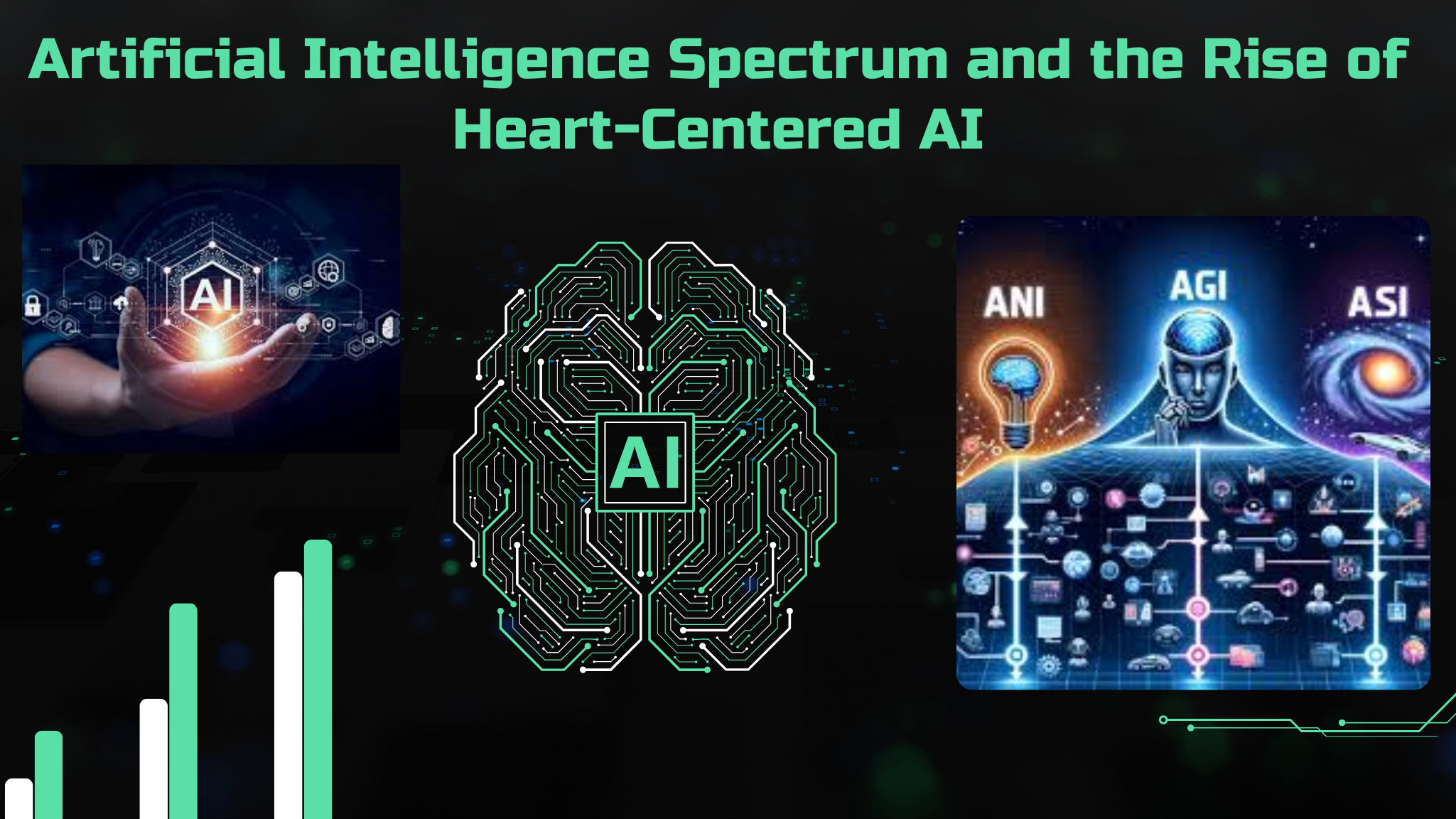
This article explores the artificial intelligence spectrum, tracing the evolution from narrow machine intelligence to future possibilities shaped by human cognition, ethics, and heart-centered understanding.
Introduction:
Artificial intelligence has moved from a theoretical concept to a transformative force shaping nearly every aspect of modern life. From recommendation algorithms and voice assistants to advanced medical diagnostics and autonomous systems, artificial intelligence continues to redefine how humans interact with technology. Yet, the conversation around AI is no longer limited to performance and automation. A broader and deeper discussion is emerging—one that explores the intelligence spectrum, the evolution from artificial narrow intelligence to artificial super intelligence, and the possibility of integrating human-like cognition, emotion, and even heart-based intelligence into future systems. This report examines artificial intelligence through a multidimensional lens, connecting technological progress with human cognition, ethical responsibility, and the future relationship between machines and the human heart.
Understanding Artificial Intelligence
Artificial intelligence is commonly defined as the theory and development of computer systems able to perform tasks that normally require human intelligence, such as visual perception, speech recognition, decision-making, and translation between languages. This definition highlights two core ideas: imitation of human intelligence and task-oriented performance. At its foundation, AI relies on data, algorithms, and computational power to identify patterns, learn from experience, and generate outputs that appear intelligent.
Over time, artificial intelligence has evolved from rule-based expert systems to machine learning models capable of adapting and improving through exposure to large datasets. Today, AI systems can analyze complex information at a speed and scale far beyond human capability. However, despite these advancements, most existing systems remain limited in scope, operating within predefined boundaries rather than demonstrating genuine understanding or consciousness.
The Intelligence Spectrum Explained
The intelligence spectrum provides a framework for understanding different levels and forms of intelligence, both artificial and human. Rather than viewing intelligence as a single capability, this spectrum recognizes varying degrees of cognitive ability, adaptability, emotional awareness, and self-reflection.
On one end of the spectrum lies artificial narrow intelligence, which dominates current AI applications. At the center lies artificial general intelligence, a hypothetical form of AI capable of human-level reasoning across diverse domains. At the far end lies artificial super intelligence, which surpasses human intelligence in nearly all cognitive aspects. Parallel to this technological spectrum exists human intelligence, shaped not only by logic and reasoning but also by emotion, intuition, morality, and heart cognition.
Understanding this spectrum is essential for evaluating both the capabilities and limitations of artificial intelligence, as well as the potential direction of its future development.
Artificial Narrow Intelligence and Its Real-World Impact
These systems excel within their designated domain but lack the ability to transfer knowledge or reasoning beyond their programmed purpose. Examples include facial recognition software, language translation tools, recommendation engines, and medical imaging analysis systems.
The success of artificial narrow intelligence lies in its precision and efficiency. In healthcare, narrow AI assists doctors by detecting diseases earlier and more accurately. In finance, it identifies fraud patterns and automates trading strategies. In everyday life, it powers search engines, smart assistants, and personalized content feeds.
Despite its effectiveness, artificial narrow intelligence does not possess awareness, understanding, or emotional intelligence. It operates based on statistical correlations rather than comprehension. This limitation raises important questions about trust, bias, and ethical responsibility, particularly as narrow AI systems increasingly influence critical decisions affecting human lives.
Artificial General Intelligence: A Theoretical Bridge
Artificial general intelligence represents a theoretical stage in the evolution of artificial intelligence. Unlike narrow AI, AGI would possess the ability to understand, learn, and apply knowledge across a wide range of tasks, much like a human being. It would be capable of reasoning, problem-solving, and adapting to unfamiliar situations without explicit programming.
While AGI remains largely conceptual, it serves as a bridge between current AI capabilities and more advanced forms of intelligence. Researchers continue to debate whether AGI is achievable and, if so, how long it may take to develop. The pursuit of artificial general intelligence has sparked discussions about safety, alignment, and governance. If machines reach human-level intelligence, ensuring that their goals align with human values becomes a critical concern.
Artificial Super Intelligence and Future Possibilities
Artificial super intelligence refers to a hypothetical form of AI that surpasses human intelligence in every domain, including scientific creativity, emotional understanding, strategic thinking, and social intelligence. Such systems would not only perform tasks better than humans but also improve themselves autonomously.
The concept of artificial super intelligence raises profound philosophical and ethical questions. While it promises unprecedented advancements in medicine, science, and global problem-solving, it also introduces risks related to control, autonomy, and unintended consequences. A super-intelligent system could potentially reshape societies, economies, and power structures in ways that are difficult to predict.
Discussions around artificial super intelligence emphasize the importance of proactive governance, ethical frameworks, and interdisciplinary collaboration. Rather than focusing solely on technological capability, experts increasingly stress the need to embed human values and moral reasoning into advanced AI systems.
Human Intelligence Beyond Logic
Human intelligence extends far beyond analytical reasoning and information processing. It encompasses emotion, empathy, intuition, creativity, and moral judgment. These qualities allow humans to navigate complex social environments, form meaningful relationships, and make value-based decisions.
Unlike artificial intelligence, human cognition is deeply influenced by lived experience, culture, and emotional memory. The human brain does not merely compute outcomes; it interprets meaning and context. This distinction highlights a critical gap between artificial systems and human intelligence, even as AI continues to advance in technical performance.
Recognizing this gap is essential when evaluating the role of AI in society. While machines can augment human capabilities, replacing the full spectrum of human intelligence remains an unresolved challenge.
The Human Heart and Cognition
Recent research in neuroscience and psychology has drawn attention to heart cognition, the idea that the human heart plays an active role in perception, emotional processing, and decision-making. The heart contains a complex network of neurons and communicates continuously with the brain through neural, hormonal, and electromagnetic pathways.
Heart cognition influences intuition, emotional regulation, and social awareness. Many human decisions, particularly those involving ethics, compassion, and relationships, are guided as much by the heart as by the brain. This integrated intelligence allows humans to balance logic with empathy and rationality with moral responsibility.
The recognition of heart cognition challenges purely computational models of intelligence and opens new perspectives on what it truly means to think, understand, and act wisely.
Artificial Intelligence and Emotional Understanding
As artificial intelligence becomes more embedded in human environments, the need for emotional awareness grows increasingly important. Emotional AI, also known as affective computing, aims to enable machines to recognize, interpret, and respond to human emotions.
Current emotional AI systems analyze facial expressions, voice tone, and physiological signals to infer emotional states. While these systems can simulate emotional responsiveness, they do not experience emotions themselves. This distinction raises questions about authenticity, trust, and ethical use.
Integrating emotional understanding into AI could improve human-machine interaction, particularly in healthcare, education, and mental health support. However, it also requires careful consideration to avoid manipulation, surveillance, or emotional dependency.
Bridging Artificial Intelligence and Heart-Centered Intelligence
The future of artificial intelligence may depend on its ability to integrate cognitive performance with heart-centered principles. Rather than pursuing intelligence solely as efficiency or optimization, researchers are exploring ways to align AI development with human values such as compassion, fairness, and well-being.
Heart-centered artificial intelligence does not imply that machines possess emotions in the human sense. Instead, it emphasizes ethical design, empathetic interaction, and value-aligned decision-making. By modeling human moral reasoning and emotional awareness, AI systems could support more humane and responsible outcomes.
This approach shifts the focus from dominance and control to collaboration and augmentation, positioning AI as a partner in human progress rather than a replacement.
Ethical Dimensions of Future Artificial Intelligence
Ethics play a central role in shaping the future of artificial intelligence. Issues such as data privacy, algorithmic bias, accountability, and transparency are already pressing concerns in narrow AI applications. As AI systems grow more autonomous, these challenges become even more complex.
Embedding ethical reasoning into AI requires multidisciplinary collaboration among technologists, philosophers, psychologists, and policymakers. It also demands global standards to ensure that AI development benefits humanity as a whole rather than amplifying inequality or power imbalances.
A heart-centered ethical framework encourages developers to consider not only what AI can do, but what it should do, and for whom.
The Role of Artificial Intelligence in Human Evolution
Artificial intelligence is not merely a technological tool; it is a force shaping the future trajectory of human evolution. By augmenting human intelligence, AI has the potential to expand creativity, accelerate learning, and solve complex global challenges.
However, this evolution must be guided by conscious choice rather than unchecked automation. Preserving human agency, dignity, and emotional depth is essential as machines take on greater roles in decision-making and social interaction.
The integration of artificial intelligence into human life should enhance, not diminish, the qualities that make us human.
Future Outlook: Intelligence with Purpose
The future of artificial intelligence lies not only in increased computational power but in purposeful design. Moving along the intelligence spectrum from artificial narrow intelligence toward more advanced forms requires a balance between innovation and responsibility.
By incorporating insights from human cognition, heart intelligence, and ethical philosophy, future AI systems can be designed to support sustainable progress. This vision prioritizes collaboration, empathy, and long-term well-being over short-term efficiency.
As society stands at the crossroads of technological advancement, the choices made today will shape the role of artificial intelligence for generations to come.
Conclusion:
The intelligence spectrum provides a powerful lens for understanding artificial intelligence, from narrow task-based systems to the speculative possibilities of artificial super intelligence. While technological progress continues at an unprecedented pace, true intelligence encompasses more than computation and efficiency. Human intelligence, shaped by the heart, emotion, and moral reasoning, remains a unique and essential benchmark.
The future of artificial intelligence will depend on how effectively it aligns with human values and heart-centered cognition. Rather than seeking to replicate or surpass humanity, AI has the potential to complement and elevate human capabilities when guided by ethical purpose. By embracing a holistic vision of intelligence, society can ensure that artificial intelligence serves as a force for meaningful, compassionate, and sustainable progress.
FAQs:
1. What is the artificial intelligence spectrum?
The artificial intelligence spectrum is a framework that categorizes different levels of AI, ranging from task-specific systems (Artificial Narrow Intelligence) to advanced hypothetical models (Artificial Super Intelligence), while also considering human-like cognition and ethical intelligence.
2. How does artificial narrow intelligence differ from artificial general intelligence?
Artificial Narrow Intelligence (ANI) performs specific tasks within a defined scope, such as image recognition or language translation. Artificial General Intelligence (AGI), on the other hand, would be capable of reasoning, learning, and adapting across multiple domains similar to human intelligence.
3. What is artificial super intelligence and why is it important?
Artificial Super Intelligence (ASI) refers to AI systems that surpass human intelligence in virtually every cognitive task. Its importance lies in its potential to revolutionize industries, science, and society, while raising critical ethical and governance challenges.
4. What role does the human heart play in intelligence?
Recent research highlights the concept of heart cognition, where the heart communicates with the brain to influence decision-making, intuition, and emotional awareness. Integrating this understanding helps envision AI systems that align more closely with human values.
5. Can artificial intelligence develop emotions or ethical reasoning?
While AI can simulate emotional responses and follow ethical frameworks, it does not inherently experience emotions. Advanced AI can, however, be designed to recognize human emotions, respond empathetically, and support ethically responsible decisions.
6. How does the future of AI intersect with human intelligence?
The future of AI is expected to augment human intelligence rather than replace it. By combining computational capabilities with insights from human cognition, emotional intelligence, and ethical reasoning, AI can assist in complex decision-making and creative problem-solving.
7. Why is understanding the AI spectrum important for businesses and society?
Understanding the AI spectrum helps organizations and policymakers assess AI capabilities, plan for future technological shifts, and ensure ethical implementation. It also guides society in leveraging AI to complement human intelligence responsibly.
If you want, I can next craft a 3-paragraph solid conclusion for this blog that is fully unique, professional, and aligned with your SEO strategy. This will complete the content package for posting.