
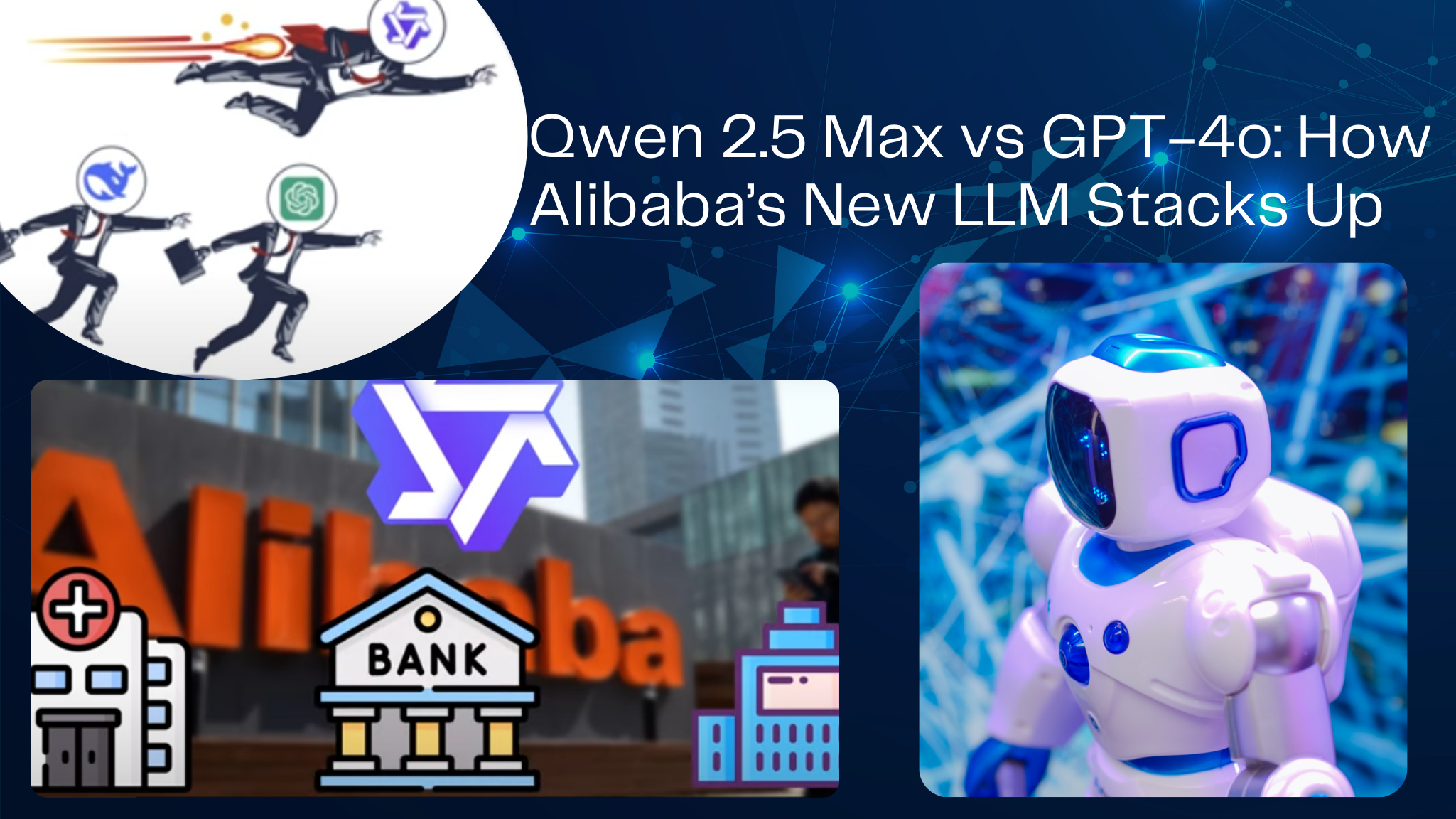
Alibaba Cloud’s Qwen 2.5 Max marks a major step forward in large language model development, combining efficient architecture, long-context reasoning, multimodal intelligence, and enterprise-ready design to compete with the world’s leading AI systems.
Alibaba Cloud has begun 2025 with a decisive statement in the global artificial intelligence race. During the Lunar New Year holiday in January, the company quietly introduced Qwen 2.5 Max, its most advanced large language model to date. While the timing appeared symbolic, the technical implications were substantial. The release signals Alibaba Cloud’s ambition to compete directly with leading Western and Chinese AI systems, including GPT-4o, Llama-3.1-405B, and DeepSeek V3, while simultaneously addressing the practical demands of enterprise-scale AI deployment.
Qwen 2.5 Max is not positioned merely as an incremental update. Instead, it represents a strategic consolidation of performance, efficiency, and versatility. Built upon the architectural and training groundwork of Qwen 2.0, the model introduces a refined approach to reasoning, multimodal understanding, and tool integration. Its arrival strengthens Alibaba Cloud’s expanding AI ecosystem and reflects China’s broader push to establish competitive, self-sufficient foundational models.
From its design philosophy to its real-world applications, Qwen 2.5 Max is engineered for environments where scale, reliability, and cost control matter as much as raw intelligence.
A strategic evolution of the Qwen model family
The Qwen model series has steadily evolved since its first release, with each iteration expanding capabilities while addressing performance bottlenecks observed in production use. Qwen 2.5 Max builds on this trajectory by refining both the core model architecture and the surrounding infrastructure that enables enterprise deployment.
Rather than focusing solely on parameter growth, Alibaba Cloud optimized the model around selective computation. This approach allows Qwen 2.5 Max to deliver competitive benchmark results without relying on excessive resource consumption. In an era where model efficiency is increasingly scrutinized, this design choice reflects a shift away from brute-force scaling toward smarter utilization of compute.
The model has demonstrated strong results across language understanding, code generation, and complex reasoning tasks. Internal and third-party evaluations indicate that it surpasses several established large models in targeted scenarios, particularly those involving structured output, long-context reasoning, and task decomposition.
These improvements are not accidental. They stem from deliberate architectural choices and a training process that emphasizes real-world usability rather than abstract benchmark dominance.
Mixture of Experts architecture and computational efficiency
At the heart of Qwen 2.5 Max lies a Mixture of Experts architecture. This design enables the model to activate only relevant subsets of parameters for a given task, rather than engaging the entire network every time a prompt is processed. The result is a more efficient inference process that reduces computational overhead while maintaining high performance.
This selective activation mechanism is especially valuable in large-scale deployments where latency, throughput, and cost are critical considerations. By minimizing unnecessary computation, Qwen 2.5 Max achieves a balance between responsiveness and accuracy, making it suitable for both real-time applications and high-volume batch processing.
The MoE framework also allows the model to specialize internally. Different expert pathways handle distinct task types, such as conversational dialogue, programmatic logic, or data-heavy analysis. This internal specialization contributes to the model’s ability to switch seamlessly between natural language interaction, structured code generation, and analytical reasoning.
For enterprises seeking scalable AI solutions, this architectural choice translates into tangible operational benefits, including reduced infrastructure costs and more predictable performance under load.
Long-context reasoning and high token capacity
One of the defining features of Qwen 2.5 Max is its ability to process up to 128,000 tokens within a single session. This extended context window positions the model among a growing class of long-context language models designed to handle complex, multi-document workflows.
Long-context capability is particularly valuable in domains such as legal analysis, financial modeling, academic research, and enterprise knowledge management. Instead of fragmenting information across multiple prompts, users can provide extensive datasets, reports, or documentation in a single interaction. The model can then maintain coherence, track dependencies, and generate consistent outputs across the entire input span.
Qwen 2.5 Max leverages its long-context capacity to support deep reasoning tasks. These include summarizing lengthy documents, cross-referencing multiple sources, and performing step-by-step analysis over large bodies of text. Importantly, the model is designed to preserve response quality even as context length increases, addressing a common weakness observed in earlier long-context systems.
This capability enhances productivity for professional users and reduces the need for complex prompt engineering or external memory management systems.
Advanced instruction tuning and structured output
Beyond raw context length, Qwen 2.5 Max demonstrates strong performance in instruction adherence and output formatting. The model has undergone extensive instruction tuning to ensure that it responds predictably to complex prompts and produces outputs aligned with user expectations.
Structured output is a key strength. The model can generate well-organized responses in formats suitable for downstream processing, including tables, stepwise explanations, code blocks, and machine-readable data structures. This makes it particularly useful in automated workflows where consistency and clarity are essential.
In decision-making scenarios, Qwen 2.5 Max can provide transparent reasoning pathways. Instead of delivering opaque conclusions, it breaks down its logic into intermediate steps, allowing users to understand how results are derived. This approach supports trust and auditability, which are critical in regulated industries such as finance, healthcare, and engineering.
The ability to generate multi-path justifications further enhances the model’s flexibility. For nuanced queries, it can explore alternative reasoning strategies, compare outcomes, and explain trade-offs, enabling more informed decision-making.
Tool integration and ecosystem compatibility
Modern large language models are increasingly evaluated not only on their standalone intelligence but also on their ability to interact with external systems. Qwen 2.5 Max has been designed with modular tool-use capabilities that allow seamless integration with APIs, databases, and third-party plugins.
This integration framework enables the model to perform tasks that extend beyond static text generation. For example, it can retrieve real-time data, execute code through connected tools, or interact with enterprise software systems. These capabilities transform the model into an active participant within broader digital workflows.
Alibaba Cloud has fine-tuned Qwen 2.5 Max using large-scale supervised learning and human feedback to ensure reliable tool invocation and error handling. The result is a system that can follow complex operational logic while maintaining stability in production environments.
For developers and enterprises, this flexibility reduces integration friction and accelerates the deployment of AI-powered applications across diverse use cases.
Multimodal intelligence and visual understanding
Qwen 2.5 Max extends beyond text-only capabilities by incorporating multimodal functionality. Its text-to-image generation feature supports creative and analytical workflows, enabling users to generate visuals directly from natural language descriptions.
The model’s visual-language understanding capabilities allow it to interpret charts, diagrams, forms, and annotated documents. This makes it useful for tasks such as data visualization analysis, technical documentation review, and academic research support.
In addition to image generation, Qwen 2.5 Max can process visual inputs in ways similar to optical character recognition systems. It can extract information from scanned documents, interpret visual layouts, and integrate visual data into its reasoning process.
This multimodal alignment expands the model’s applicability across industries, including education, design, engineering, and enterprise document management. By bridging the gap between text and visuals, Qwen 2.5 Max supports more natural and intuitive human-computer interaction.
Training methodology and alignment strategy
The performance of Qwen 2.5 Max reflects a comprehensive training and alignment strategy. Alibaba Cloud employed a combination of large-scale pretraining, supervised fine-tuning, and human feedback to refine the model’s behavior across diverse scenarios.
Supervised fine-tuning focused on improving task accuracy, instruction compliance, and domain-specific reasoning. Human feedback played a critical role in aligning the model with user expectations, particularly in complex or ambiguous situations.
This layered training approach helps ensure that Qwen 2.5 Max behaves consistently across a wide range of inputs. It also reduces the likelihood of unpredictable responses, which is a common concern in large language model deployment.
The emphasis on alignment and reliability reflects Alibaba Cloud’s focus on enterprise readiness rather than experimental novelty.
Competitive positioning in the global AI landscape
Qwen 2.5 Max enters a competitive field dominated by models such as GPT-4o, Llama-3.1-405B, and DeepSeek V3. While each of these systems has distinct strengths, Alibaba Cloud positions Qwen 2.5 Max as a balanced alternative that combines high performance with cost efficiency.
Benchmark comparisons suggest that the model performs strongly across language understanding, reasoning, and multimodal tasks. In certain evaluations, it matches or exceeds the capabilities of larger parameter models, highlighting the effectiveness of its architectural optimizations.
From a strategic perspective, Qwen 2.5 Max strengthens China’s domestic AI ecosystem by offering a competitive, locally developed foundation model. It also provides global enterprises with an additional option in a market increasingly concerned with vendor diversity and data sovereignty.
Rather than aiming to dominate every benchmark category, Alibaba Cloud appears focused on delivering a practical, scalable model suited for real-world deployment.
Enterprise readiness and product-scale deployment
One of the most compelling aspects of Qwen 2.5 Max is its readiness for product-scale deployment. The model is designed to operate efficiently under sustained workloads, making it suitable for customer-facing applications, internal automation, and large-scale data processing.
Its cost-performance balance is particularly attractive for organizations seeking to integrate AI without incurring prohibitive infrastructure expenses. The MoE architecture, long-context support, and robust tool integration collectively reduce operational complexity.
Qwen 2.5 Max can be deployed across a variety of use cases, including intelligent customer support, enterprise search, software development assistance, and advanced analytics. Its versatility allows organizations to consolidate multiple AI functions into a single model, simplifying system architecture.
This focus on deployment practicality distinguishes Qwen 2.5 Max from models designed primarily for research or demonstration purposes.
Implications for developers and AI practitioners
For developers, Qwen 2.5 Max offers a flexible platform for building advanced AI applications. Its structured output capabilities, API compatibility, and multimodal support reduce development time and enable rapid prototyping.
AI practitioners benefit from the model’s transparent reasoning and instruction adherence. These features make it easier to debug outputs, refine prompts, and integrate AI responses into downstream systems.
The model’s ability to handle long contexts and complex workflows opens new possibilities for automation and decision support. Developers can design applications that process entire datasets or documents in a single interaction, reducing fragmentation and improving coherence.
As the AI ecosystem continues to mature, models like Qwen 2.5 Max illustrate a shift toward systems optimized for collaboration between humans, software tools, and large-scale data.
A broader signal from Alibaba Cloud
Beyond its technical merits, the release of Qwen 2.5 Max sends a broader signal about Alibaba Cloud’s strategic direction. The company is positioning itself not only as a cloud infrastructure provider but also as a leading developer of foundational AI technologies.
By investing in model efficiency, multimodal intelligence, and enterprise integration, Alibaba Cloud demonstrates an understanding of the practical challenges facing AI adoption. This approach aligns with the needs of businesses seeking reliable, scalable solutions rather than experimental prototypes.
Qwen 2.5 Max also reinforces China’s growing presence in the global AI landscape. As domestic models become increasingly competitive, they contribute to a more diverse and resilient AI ecosystem.
Conclusion:
Qwen 2.5 Max reflects a clear shift in how large language models are being built and evaluated. Rather than chasing scale alone, Alibaba Cloud has focused on creating a system that balances intelligence, efficiency, and real-world usability. With its long-context processing, multimodal understanding, structured reasoning, and seamless tool integration, the model is designed to move beyond experimentation into dependable production use. As global demand grows for AI systems that are both powerful and economically sustainable, Qwen 2.5 Max stands out as a practical and forward-looking addition to the evolving AI landscape, signaling where enterprise-grade artificial intelligence is headed next.
FAQs:
What makes Qwen 2.5 Max different from earlier Qwen models?
Qwen 2.5 Max introduces a more efficient architecture, stronger instruction tuning, and extended context handling, allowing it to manage complex tasks with greater accuracy while using computing resources more effectively than previous versions.How does Qwen 2.5 Max compare to other leading language models?
Qwen 2.5 Max is designed to compete with top-tier models by balancing performance and cost efficiency, offering long-context reasoning, multimodal capabilities, and reliable structured outputs suited for enterprise applications.Can Qwen 2.5 Max handle long and complex documents?
Yes, the model supports very large context windows, enabling it to analyze, summarize, and reason over lengthy documents or multiple data sources within a single interaction.What types of applications can benefit most from Qwen 2.5 Max?
Industries such as finance, education, software development, research, and enterprise operations can benefit from its ability to process data, generate code, interpret visuals, and integrate with external tools.Does Qwen 2.5 Max support multimodal inputs and outputs?
The model can work with both text and visual information, including interpreting charts and documents as well as generating images, making it suitable for analytical and creative workflows.How does Qwen 2.5 Max maintain efficiency at scale?
By using a selective activation design, the model reduces unnecessary computation, which helps control costs and maintain consistent performance in high-volume production environments.Is Qwen 2.5 Max suitable for enterprise deployment?
Yes, the model is built with stability, integration flexibility, and scalability in mind, making it well suited for organizations looking to deploy AI solutions across products and internal systems.