
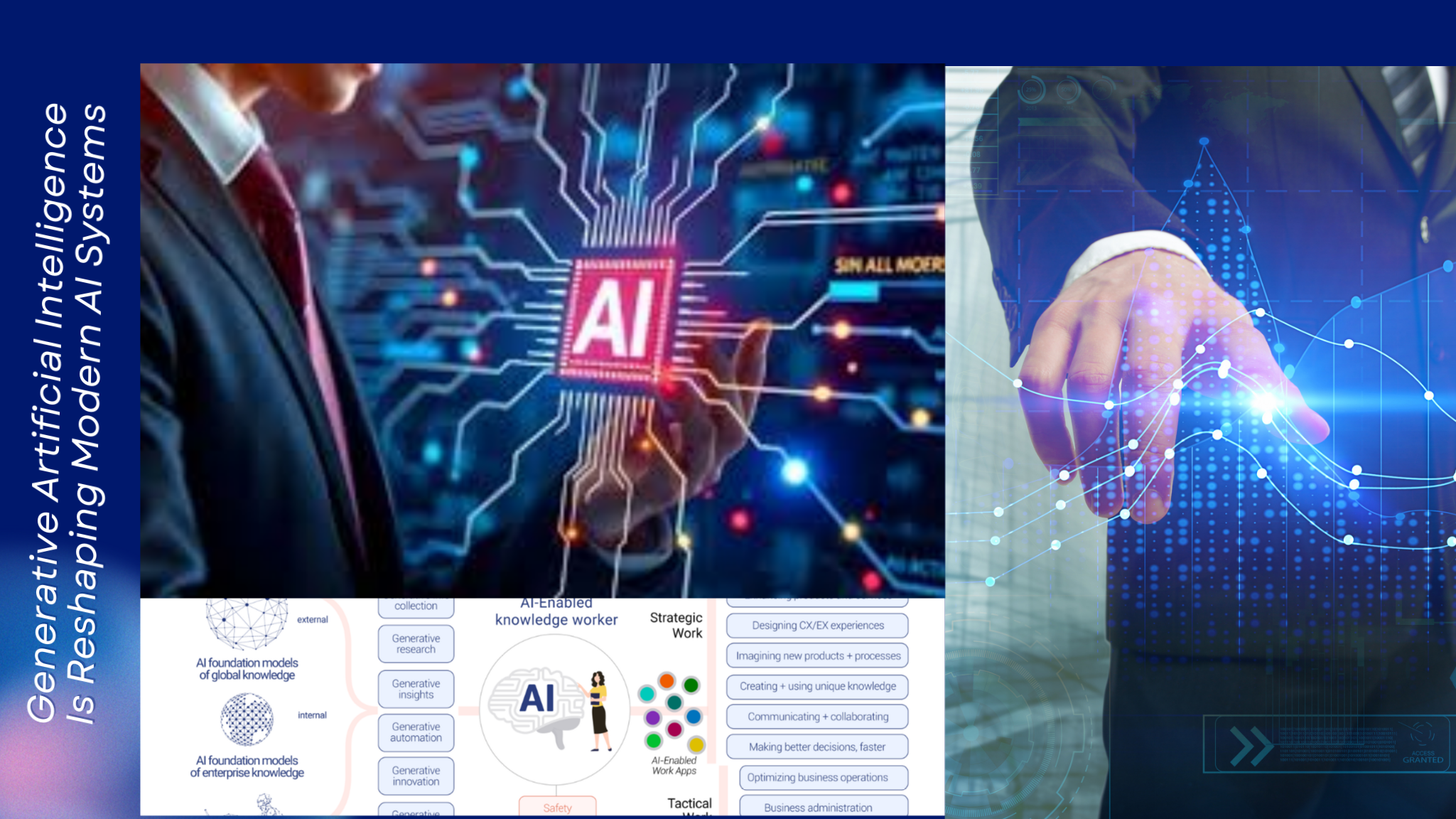
This article provides a comprehensive, professional overview of how generative artificial intelligence is transforming modern AI systems, from large language models and multimodal capabilities to enterprise infrastructure, AI engineering practices, and the long-term path toward artificial general intelligence.
Generative Artificial Intelligence and the Redefinition of Modern Computing
Generative Artificial Intelligence has emerged as one of the most transformative forces in the contemporary technology landscape. Unlike earlier forms of automation that focused primarily on rule-based execution or predictive analytics, generative systems are capable of producing new content, synthesizing knowledge, and interacting with humans in increasingly sophisticated ways. This shift represents not just an incremental improvement in artificial intelligence evolution, but a structural change in how digital systems are designed, deployed, and trusted across industries.
The rise of generative Artificial Intelligence is inseparable from broader developments in modern AI systems, including advances in large language models, multimodal AI, and scalable infrastructure. Together, these elements are reshaping software engineering, enterprise decision-making, creative workflows, and even the long-term discussion around artificial general intelligence. As organizations move from experimentation to large-scale adoption, understanding the architectural, computational, and conceptual foundations of generative AI models has become a strategic necessity rather than an academic exercise.
From Statistical Learning to Generative Intelligence
To understand the significance of generative Artificial Intelligence, it is essential to place it within the broader arc of artificial intelligence evolution. Early AI systems relied on symbolic reasoning and handcrafted logic, requiring explicit rules for every possible outcome. These approaches proved brittle and difficult to scale. The next phase introduced machine learning, enabling systems to identify patterns from data rather than relying solely on pre-programmed instructions.
The introduction of deep learning marked a major inflection point. Neural networks with many layers demonstrated unprecedented performance in tasks such as image recognition, speech processing, and language translation. However, most of these systems were still designed to classify or predict rather than create. Generative Artificial Intelligence changed that paradigm by enabling models to generate text, images, audio, code, and even synthetic data that closely resembles human-created outputs.
At the heart of this transition are generative AI models trained on massive datasets using self-supervised learning techniques. These models learn statistical representations of language, visuals, and other modalities, allowing them to produce coherent and contextually relevant outputs. Large language models explained through this lens are not simply databases of memorized content, but probabilistic systems capable of reasoning across vast conceptual spaces.
Large Language Models and the Foundation of Generative Systems
Large language models have become the most visible expression of generative Artificial Intelligence. Trained on trillions of tokens, these models encode linguistic structure, semantic relationships, and contextual cues into dense numerical representations. Through this process, they acquire the ability to answer questions, summarize documents, generate narratives, and assist with complex analytical tasks.
The architecture of modern large language models relies heavily on transformer-based designs, which allow efficient parallel processing and long-range dependency modeling. These capabilities are essential for maintaining coherence across extended interactions and for supporting advanced use cases such as technical documentation, legal analysis, and scientific research.
Despite their impressive capabilities, large language models are not standalone solutions. Their effectiveness depends on complementary systems that manage data retrieval, contextual grounding, and real-time information access. This has led to the rapid adoption of retrieval-augmented generation techniques, commonly referred to as RAG systems.
Retrieval-Augmented Generation and Knowledge Grounding
Retrieval-augmented generation represents a critical evolution in the deployment of generative Artificial Intelligence. Instead of relying solely on internal model parameters, RAG systems dynamically retrieve relevant information from external knowledge sources at inference time. This approach significantly improves accuracy, transparency, and adaptability.
At the core of RAG systems is vector search, a method that enables efficient similarity matching across large collections of documents. Text, images, and other data types are converted into AI embeddings, which capture semantic meaning in numerical form. When a query is issued, the system identifies the most relevant embeddings and feeds the associated content into the generative model as contextual input.
This architecture addresses several limitations of standalone generative AI models. It reduces hallucinations by grounding responses in verified sources, enables rapid updates without retraining the model, and supports domain-specific customization. As a result, retrieval-augmented generation has become a cornerstone of enterprise-grade generative AI deployments, particularly in regulated industries such as healthcare, finance, and law.
Multimodal AI and the Expansion of Generative Capabilities
While text-based systems have dominated early discussions, the future of generative Artificial Intelligence is inherently multimodal. Multimodal AI systems are designed to process and generate content across multiple data types, including text, images, audio, video, and structured data. This convergence enables richer interactions and more comprehensive problem-solving.
Multimodal generative AI models can interpret visual information, describe images in natural language, generate design assets from textual prompts, and integrate sensory inputs into unified outputs. These capabilities are already influencing fields such as digital media, education, product design, and accessibility.
The technical foundation of multimodal AI relies on shared representation spaces, where different modalities are mapped into compatible embedding structures. This allows models to reason across formats and maintain contextual consistency. As multimodal systems mature, they are expected to become the default interface for human-computer interaction, reducing friction and expanding the range of tasks that AI can support.
Infrastructure, Accelerated Computing, and Performance Scaling
The rapid progress of generative Artificial Intelligence would not be possible without parallel advances in computing infrastructure. Training and deploying large-scale generative AI models require immense computational resources, driving innovation in accelerated computing and AI hardware.
GPU computing for AI has become the industry standard due to its ability to handle highly parallel workloads efficiently. Modern AI hardware architectures are optimized for matrix operations, enabling faster training times and lower inference latency. In addition to GPUs, specialized accelerators and custom chips are increasingly being developed to address specific AI workloads.
Infrastructure considerations extend beyond raw compute power. High-bandwidth memory, distributed training frameworks, and energy-efficient data centers all play critical roles in scaling generative AI systems responsibly. As demand grows, organizations must balance performance with sustainability, cost management, and operational resilience.
AI Engineering and System-Level Design
The deployment of generative Artificial Intelligence at scale requires a disciplined approach to AI engineering. This includes not only model development, but also system integration, monitoring, security, and lifecycle management. Unlike traditional software, generative AI systems exhibit probabilistic behavior, requiring new methodologies for testing and validation.
AI engineering practices emphasize modular architectures, observability, and human-in-the-loop workflows. By combining generative models with retrieval systems, business logic, and user feedback mechanisms, organizations can build robust solutions that align with operational and ethical standards.
System-level AI keywords such as retrieval-augmented generation, vector search, and AI embeddings are not merely technical concepts, but foundational components of modern AI systems. Their effective integration determines whether generative Artificial Intelligence delivers reliable value or remains confined to experimental use cases.
Economic and Organizational Impact
The adoption of generative Artificial Intelligence is reshaping organizational structures and economic models. By automating knowledge-intensive tasks, generative systems are augmenting human capabilities rather than simply replacing labor. This shift is particularly evident in areas such as software development, customer support, marketing, and research.
Generative AI models enable faster prototyping, improved decision support, and personalized user experiences. However, they also introduce new challenges related to workforce adaptation, intellectual property, and governance. Organizations must invest in training, policy development, and cross-functional collaboration to fully realize the benefits of these technologies.
From a macroeconomic perspective, generative Artificial Intelligence is expected to contribute significantly to productivity growth. Its impact will vary across sectors, depending on data availability, regulatory environments, and cultural readiness. As adoption accelerates, competitive differentiation will increasingly depend on how effectively organizations integrate generative capabilities into their core processes.
Ethical Considerations and Responsible Deployment
The power of generative Artificial Intelligence raises important ethical questions. Issues such as bias, misinformation, data privacy, and accountability require careful attention. While technical solutions such as retrieval grounding and transparency tools can mitigate some risks, governance frameworks are equally important.
Responsible deployment involves clear documentation of model capabilities and limitations, ongoing performance evaluation, and mechanisms for user feedback. Regulatory bodies and industry consortia are beginning to establish guidelines, but practical implementation remains a shared responsibility among developers, organizations, and policymakers.
As generative AI systems become more autonomous and integrated into critical workflows, ethical considerations must be treated as design constraints rather than afterthoughts. This approach will be essential for maintaining public trust and ensuring long-term sustainability.
Artificial General Intelligence and Long-Term Outlook
Discussions about artificial general intelligence often accompany conversations about generative Artificial Intelligence. While current systems demonstrate impressive versatility, they remain specialized tools rather than truly general intelligences. AGI is typically defined as an AI system capable of performing any intellectual task that a human can, across domains and contexts.
The path toward AGI remains uncertain and subject to debate. Some researchers view generative AI models as incremental steps toward broader intelligence, while others emphasize the qualitative differences between pattern-based systems and human cognition. Regardless of perspective, the ongoing AI innovation timeline suggests continued convergence between generative models, multimodal reasoning, and adaptive learning.
The future of generative AI will likely involve tighter integration with real-world feedback, improved reasoning capabilities, and more efficient use of computational resources. These developments may not result in immediate AGI, but they will continue to expand the scope and impact of artificial intelligence across society.
The Future of Generative Artificial Intelligence
Looking ahead, generative Artificial Intelligence is poised to become a foundational layer of digital infrastructure. Its applications will extend beyond isolated tools into embedded systems that support continuous learning and collaboration. As generative capabilities become more accessible, innovation will increasingly be driven by how creatively and responsibly they are applied.
The convergence of multimodal AI, retrieval-augmented generation, and accelerated computing will enable new forms of interaction that blur the boundaries between humans and machines. Education, healthcare, science, and creative industries are likely to experience profound transformations as generative systems mature.
At the same time, the evolution of AI engineering practices and governance frameworks will determine whether these technologies deliver equitable and sustainable outcomes. By aligning technical innovation with ethical principles and organizational readiness, generative Artificial Intelligence can serve as a catalyst for positive change rather than disruption alone.
Conclusion:
Generative Artificial Intelligence represents a defining chapter in the ongoing story of artificial intelligence evolution. By combining advanced generative AI models with retrieval systems, multimodal capabilities, and powerful infrastructure, modern AI systems are redefining what machines can create and understand.
From large language models explained through their architectural foundations to forward-looking discussions of AGI and the future of generative AI, the field continues to evolve at a remarkable pace. Organizations that invest in AI engineering, responsible deployment, and strategic integration will be best positioned to navigate this transformation.
As the AI innovation timeline unfolds, generative Artificial Intelligence will not simply be a technological trend, but a core component of how knowledge is produced, shared, and applied in the digital age.
FAQs:
1. What distinguishes generative artificial intelligence from traditional AI systems?
Generative artificial intelligence is designed to create new content rather than simply analyze or classify existing data. Unlike traditional AI systems that focus on prediction or rule-based automation, generative models can produce text, images, audio, and other outputs by learning underlying patterns and relationships from large datasets.
2. Why are large language models central to generative artificial intelligence?
Large language models provide the foundational capability for understanding and generating human language at scale. They learn contextual and semantic relationships across vast amounts of text, enabling generative artificial intelligence to perform tasks such as summarization, reasoning, and conversational interaction with a high degree of coherence.
3. How do retrieval-augmented generation systems improve AI accuracy?
Retrieval-augmented generation systems enhance generative outputs by incorporating real-time access to external knowledge sources. By retrieving relevant information through vector search and integrating it into the generation process, these systems reduce errors and ensure responses are grounded in verifiable data.
4. What role does multimodal AI play in the future of generative systems?
Multimodal AI allows generative systems to work across multiple data types, such as text, images, and audio, within a unified framework. This capability enables more natural interactions and broader applications, including visual understanding, content creation, and complex decision support.
5. Why is accelerated computing essential for generative artificial intelligence?
Generative artificial intelligence requires substantial computational power to train and deploy large-scale models. Accelerated computing, including GPU-based infrastructure and specialized AI hardware, enables faster processing, efficient scaling, and real-time performance for complex AI workloads.
6. How does AI engineering support enterprise deployment of generative AI?
AI engineering focuses on integrating generative models into reliable, secure, and scalable systems. This includes managing data pipelines, monitoring model behavior, implementing governance frameworks, and ensuring that generative AI aligns with organizational objectives and regulatory requirements.
7. Is generative artificial intelligence a step toward artificial general intelligence?
While generative artificial intelligence demonstrates advanced capabilities across many tasks, it remains specialized rather than fully general. However, its ability to adapt, reason across contexts, and integrate multiple modalities positions it as an important milestone in the broader journey toward artificial general intelligence.