
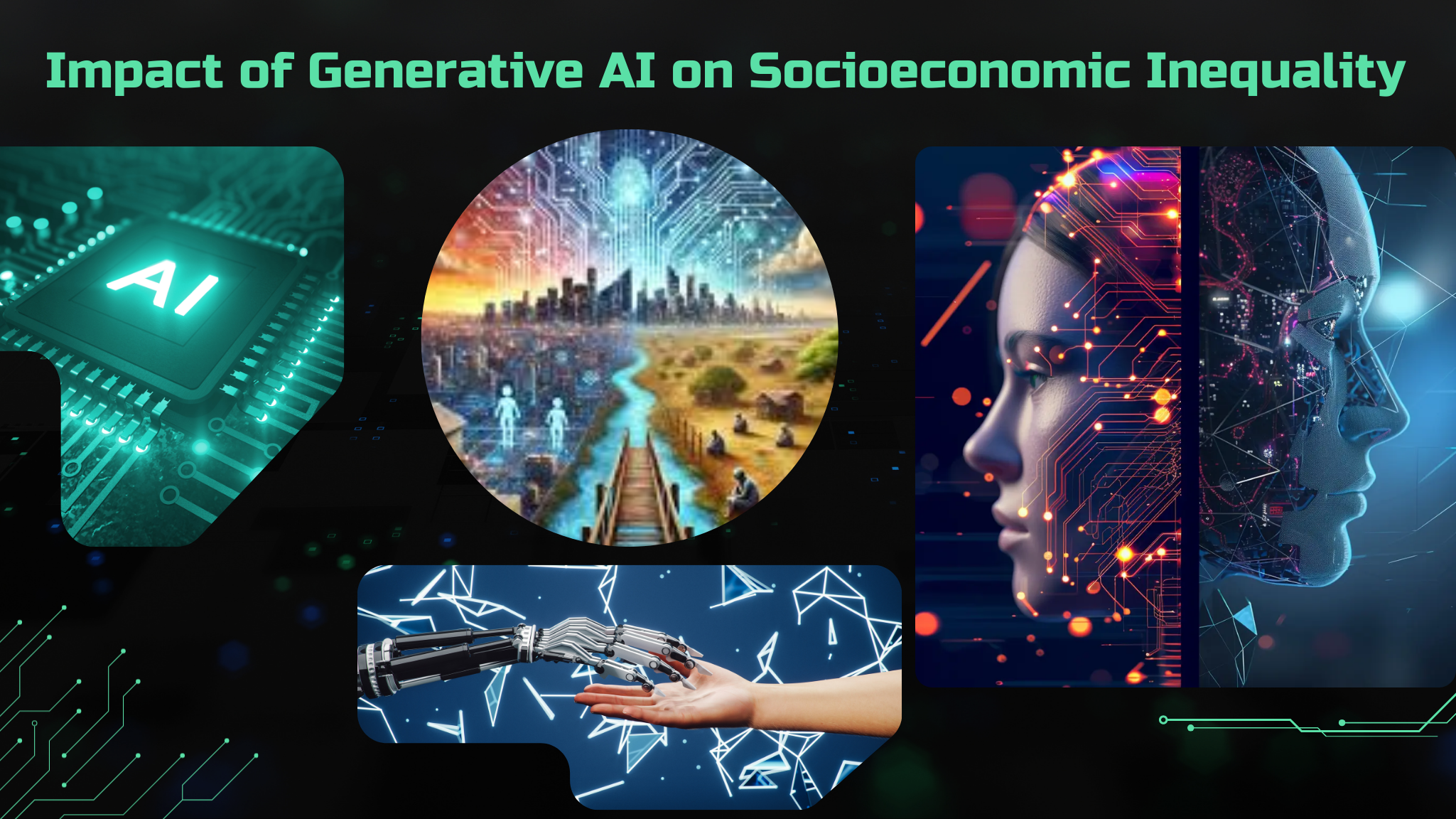
This piece outlines how generative AI is transforming economies and institutions, the risks it poses for widening inequality, and the policy choices that will shape its long-term social impact.
The rapid advancement of generative artificial intelligence is reshaping economies, institutions, and everyday life at an unprecedented pace. Once confined to experimental research labs, generative AI systems are now embedded in workplaces, classrooms, healthcare systems, and public administration. Their ability to generate text, images, data-driven insights, and strategic recommendations has positioned them as a foundational technology of the modern era. However, alongside innovation and productivity gains, generative AI introduces complex challenges related to socioeconomic inequality and public policy.
This report examines how generative AI is influencing existing social and economic disparities and how policy making must evolve to address these shifts. It explores labor markets, education, governance, democratic systems, and global inequality, while highlighting the urgent need for inclusive and forward-looking AI governance frameworks.
Introduction to Generative Artificial Intelligence and Social Change
Generative artificial intelligence refers to systems capable of producing original content based on patterns learned from vast datasets. Unlike earlier forms of automation that focused on mechanical or repetitive tasks, generative AI operates in cognitive domains traditionally associated with human intelligence. This includes writing, problem-solving, design, forecasting, and decision support.
The transformative power of these systems lies in their scalability. A single AI model can perform tasks across industries and regions, potentially affecting millions of people simultaneously. As a result, generative AI is not merely a technological upgrade but a structural force that can reshape social hierarchies, economic opportunities, and institutional power.
Socioeconomic inequality already defines access to education, healthcare, employment, and political influence. The integration of generative AI into these systems risks amplifying existing divides if adoption and regulation are uneven. Understanding these dynamics is essential for policymakers seeking to balance innovation with social equity.
The Uneven Distribution of Access to Generative AI
Access to generative AI tools is shaped by infrastructure, cost, and digital literacy. High-income countries and large organizations are more likely to benefit from advanced AI capabilities, while low-income communities often face barriers related to connectivity, technical skills, and institutional capacity.
This disparity creates what many researchers describe as a new digital stratification. Those with access to AI-enhanced tools gain productivity advantages, improved learning outcomes, and greater decision-making power. Meanwhile, those without access risk falling further behind in economic competitiveness and social mobility.
Small businesses, public institutions in developing regions, and marginalized populations are particularly vulnerable. Without targeted policies to expand access, generative AI could reinforce global and domestic inequalities rather than reduce them.
Generative AI and Labor Market Transformation
One of the most visible impacts of generative AI is its influence on employment and workforce dynamics. Unlike traditional automation, which primarily affected manual or routine jobs, generative AI targets knowledge-based roles across sectors such as media, law, finance, software development, and research.
For some workers, generative AI functions as a productivity-enhancing assistant, automating repetitive components of complex tasks and freeing time for higher-value activities. For others, it introduces displacement risks, especially in roles where output can be standardized and scaled by AI systems.
These changes are unlikely to affect all workers equally. Individuals with higher education levels, adaptable skills, and access to reskilling programs are better positioned to benefit from AI integration. Conversely, workers with limited training opportunities may face job insecurity without adequate social protection.
Policy responses must therefore focus on workforce transition strategies, including lifelong learning initiatives, labor market flexibility, and updated social safety nets.
Education Systems in the Age of Generative AI
Education is both a beneficiary of generative AI and a critical factor in determining its long-term societal impact. AI-powered learning tools can personalize instruction, provide instant feedback, and expand access to educational resources. In theory, these capabilities could reduce educational inequality.
In practice, however, outcomes depend heavily on implementation. Well-resourced institutions can integrate generative AI into curricula, teacher training, and assessment methods. Under-resourced schools may struggle to adopt these technologies effectively, widening educational gaps.
Additionally, there is a risk that students may rely excessively on AI-generated content without developing foundational skills such as critical thinking, reasoning, and creativity. This could create a new form of cognitive inequality, where surface-level performance improves while deep understanding declines.
Education policy must therefore emphasize responsible AI use, digital literacy, and pedagogical frameworks that position AI as a support tool rather than a substitute for learning.
Generative AI, Power, and Economic Concentration
The development and deployment of generative AI are dominated by a small number of technology companies and research institutions. This concentration of expertise, data, and computational resources raises concerns about market power and economic inequality.
When a limited set of actors controls advanced AI systems, they also shape the values, priorities, and assumptions embedded in these technologies. This can marginalize alternative perspectives and limit the ability of smaller firms, public institutions, and developing countries to influence AI trajectories.
Economic concentration also affects innovation distribution. While leading firms benefit from economies of scale, others may become dependent on proprietary AI systems, reducing competition and local capacity building.
Antitrust policies, public investment in open AI infrastructure, and support for decentralized innovation ecosystems are essential to counterbalance these trends.
Bias, Data Inequality, and Social Impact
Generative AI systems are trained on large datasets that reflect historical and social patterns. As a result, they may reproduce or amplify existing biases related to gender, ethnicity, income, and geography. These biases can influence outcomes in sensitive areas such as hiring, lending, healthcare recommendations, and public services.
Data inequality plays a central role in this process. Groups that are underrepresented or misrepresented in training data may experience lower accuracy, unfair treatment, or exclusion from AI-driven systems. This reinforces structural disadvantages rather than correcting them.
Addressing bias requires more than technical adjustments. It demands inclusive data practices, transparency in model design, and accountability mechanisms that allow affected individuals to challenge harmful outcomes.
The Role of Generative AI in Policy Making
Generative AI is increasingly used to support policy analysis, scenario modeling, and administrative decision-making. These applications offer potential benefits, including faster data processing, improved forecasting, and enhanced evidence-based governance.
However, reliance on AI-generated insights introduces new risks. Many generative models operate as complex systems with limited interpretability. If policymakers depend on outputs they cannot fully explain, this may undermine accountability and democratic legitimacy.
There is also a risk that AI-driven policy tools could reflect the biases or assumptions of their creators, influencing decisions in subtle but significant ways. Transparent governance frameworks and human oversight are therefore essential when integrating AI into public administration.
Democratic Institutions and Public Trust
Generative AI has profound implications for democratic processes and public discourse. AI-generated content can shape political messaging, simulate public opinion, and automate engagement at scale. While these tools can enhance participation, they can also be misused to spread misinformation or manipulate narratives.
Well-resourced actors can deploy generative AI to dominate information environments, marginalizing smaller voices and grassroots movements. This asymmetry threatens the pluralism and deliberation essential to democratic systems.
Maintaining public trust requires clear standards for political AI use, transparency in content generation, and safeguards against manipulation. Media literacy and public awareness campaigns are also critical in helping citizens navigate AI-influenced information ecosystems.
Global Inequality and International Dimensions of AI
The global impact of generative AI is shaped by disparities between countries. Advanced economies often lead in AI research, infrastructure, and policy development, while developing nations may struggle to keep pace.
This imbalance risks creating a new form of technological dependency, where low- and middle-income countries rely on external AI systems without building local capacity. Such dependency can limit economic sovereignty and policy autonomy.
International cooperation is essential to address these challenges. Shared standards, knowledge exchange, and investment in global AI capacity building can help ensure that generative AI contributes to inclusive development rather than deepening global divides.
Regulatory Frameworks and Ethical Governance
Effective regulation is central to shaping the societal impact of generative AI. Policymakers face the challenge of encouraging innovation while protecting public interests. This requires flexible, adaptive regulatory approaches that evolve alongside technological advances.
Key regulatory priorities include transparency, accountability, data protection, and fairness. Ethical governance frameworks should integrate multidisciplinary perspectives and involve stakeholders from civil society, academia, and affected communities.
Public participation is particularly important. Inclusive policy making can help align AI development with societal values and reduce resistance driven by fear or mistrust.
Harnessing Generative AI for Inclusive Growth
Despite its risks, generative AI holds significant potential to reduce certain inequalities if guided by thoughtful policy. AI-driven tools can expand access to healthcare, legal information, education, and public services, particularly in underserved regions.
Realizing these benefits requires intentional design choices. Public investment in accessible AI platforms, open research initiatives, and community-driven innovation can help ensure that generative AI serves broad social goals.
Inclusivity must be treated as a core objective rather than a secondary consideration. When marginalized groups are actively involved in shaping AI systems, outcomes are more likely to reflect diverse needs and perspectives.
Conclusion:
Generative artificial intelligence represents a defining technological shift with far-reaching implications for socioeconomic inequality and policy making. Its influence extends across labor markets, education systems, governance structures, and democratic institutions.
Without deliberate intervention, generative AI risks reinforcing existing disparities and concentrating power among those already advantaged. However, with inclusive governance, adaptive regulation, and public engagement, it can become a tool for shared prosperity and social progress.
The choices made today by policymakers, institutions, and societies will determine whether generative AI deepens inequality or contributes to more equitable outcomes. Addressing this challenge requires vision, collaboration, and a commitment to aligning technological innovation with human values.
As generative AI continues to evolve, the need for responsible, evidence-based, and inclusive policy making remains critical. By shaping AI development proactively, societies can ensure that this powerful technology supports not only efficiency and growth, but also fairness, dignity, and long-term social stability.
FAQs:
1. What is generative artificial intelligence and how does it differ from traditional AI?
Generative artificial intelligence refers to systems that can create new content such as text, images, code, or analytical insights based on patterns learned from data. Unlike traditional AI, which is often designed to classify or predict outcomes, generative AI produces original outputs that mimic human reasoning and creativity.
2. Why is generative AI considered a risk to socioeconomic equality?
Generative AI can widen inequality when access to advanced tools, data, and digital skills is limited to certain groups or regions. Those with early access may gain economic and social advantages, while others face job displacement or reduced opportunities without adequate support.
3. How is generative AI changing employment and workforce structures?
Generative AI is transforming knowledge-based roles by automating parts of complex tasks and enhancing productivity. While this can create new opportunities, it also reshapes job requirements and may reduce demand for certain roles, increasing the need for reskilling and workforce adaptation.
4. Can generative AI help reduce inequality instead of increasing it?
Yes, when guided by inclusive policies, generative AI can expand access to education, healthcare, and public services. Its potential to reduce inequality depends on equitable access, responsible design, and policy frameworks that prioritize social benefit over narrow economic gain.
5. What challenges does generative AI pose for public policy making?
Policy makers face challenges related to transparency, accountability, and bias when using generative AI systems. Ensuring that AI-supported decisions are explainable and aligned with public values is essential to maintaining trust and democratic legitimacy.
6. How does generative AI affect democratic institutions and public discourse?
Generative AI can influence political communication by producing large volumes of content and targeting specific audiences. While this may increase engagement, it also raises concerns about misinformation, manipulation, and unequal influence over public narratives.
7. What role should governments play in regulating generative AI?
Governments should establish adaptive regulatory frameworks that encourage innovation while safeguarding fairness, data protection, and social equity. This includes investing in digital skills, supporting ethical AI development, and ensuring that generative AI benefits society as a whole.