
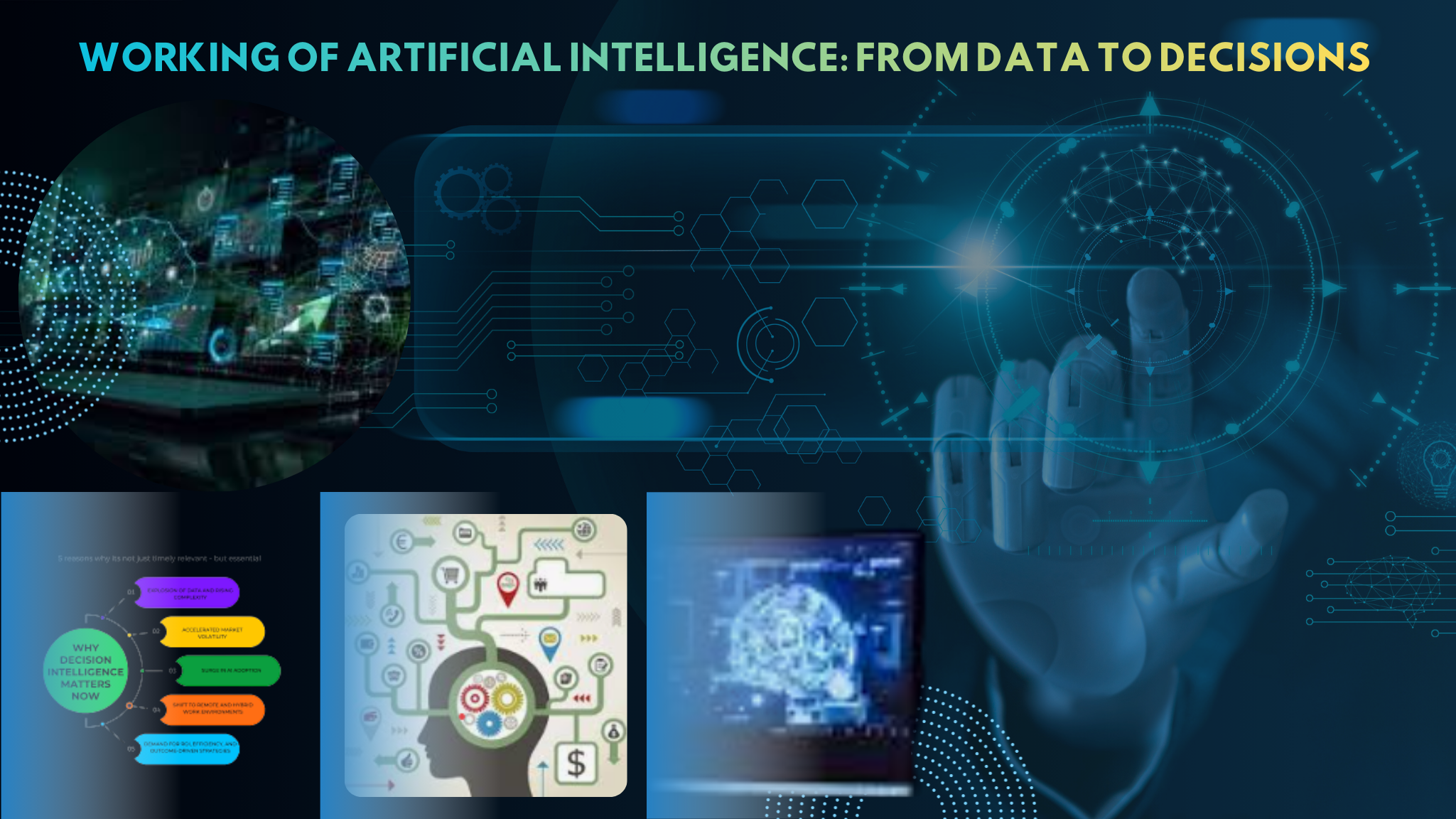
Working of Artificial Intelligence: From Data to Decisions

Working of Artificial Intelligence: From Data to Decisions worldstan.com

This article explains the working of artificial intelligence, examining how AI systems collect data, learn through different models, and make decisions across real-world applications.

Working of Artificial Intelligence: Types, Models, and Learning Explained

Introduction:

Artificial intelligence has transitioned from a speculative concept into a practical foundation for modern digital systems. Governments, enterprises, and individuals increasingly rely on intelligent machines to analyze information, predict outcomes, automate tasks, and support decision-making. To understand why AI has become so influential, it is essential to explore the working of artificial intelligence in a structured and realistic manner. This report presents a comprehensive explanation of how artificial intelligence operates, how AI systems learn from data, and how different forms of intelligence are classified based on capability and design. The discussion reframes familiar concepts using a new structure and professional tone, offering clarity for readers seeking a deeper, yet accessible, understanding.

Foundations of Artificial Intelligence

At its core, artificial intelligence refers to the ability of machines to perform tasks that typically require human intelligence. These tasks include reasoning, learning, perception, pattern recognition, and decision-making. Unlike traditional software, which follows fixed instructions, AI systems adapt their behavior based on data and experience. This adaptability is the defining characteristic that separates AI from conventional rule-based programs.
The working of artificial intelligence begins with a problem statement. Whether the goal is to recognize images, recommend products, drive a vehicle, or forecast market trends, the system must be designed around a specific objective. Engineers translate this objective into a computational framework supported by algorithms, data pipelines, and learning models.

How Artificial Intelligence Works: A System-Level View

Understanding how artificial intelligence works requires examining the interaction between several interconnected components. These components include data collection, data processing, model development, learning mechanisms, and decision execution. Each element plays a distinct role in transforming raw information into actionable intelligence.

Data Collection in AI Systems:
Data serves as the foundation of all AI systems. Without data, artificial intelligence cannot learn, adapt, or make informed decisions. Data collection in AI involves gathering structured and unstructured information from diverse sources such as sensors, databases, user interactions, images, audio recordings, and digital transactions. The quality, relevance, and diversity of this data significantly influence system performance.
In real-world applications, data collection is an ongoing process. For example, self-driving cars continuously capture environmental data through cameras, radar, and lidar sensors. Similarly, AI in gaming records player actions to improve strategic responses. The continuous flow of data enables systems to remain responsive to changing conditions.


AI Data Processing and Preparation:
Raw data is rarely suitable for direct use. AI data processing transforms collected information into a usable format. This step includes cleaning inconsistencies, handling missing values, normalizing inputs, and extracting meaningful features. Data processing ensures that AI algorithms receive accurate and relevant inputs, reducing noise and bias.
Feature engineering plays a central role at this stage. Features represent measurable attributes derived from raw data that help AI models identify patterns. In image classification, for example, features may include shapes, edges, or color distributions. Effective processing enhances learning efficiency and improves prediction accuracy.


AI Algorithms and Model Design:
Algorithms provide the logic that governs how AI systems learn and act. An AI algorithm defines how data is analyzed, how patterns are identified, and how decisions are generated. AI models implement these algorithms within mathematical structures that map inputs to outputs.
Different tasks require different AI models. Pattern recognition systems rely on statistical learning methods, while autonomous systems depend on decision-making models that can operate in uncertain environments. Model selection reflects both the problem domain and performance requirements.


Machine Learning as the Engine of AI:
Machine learning represents the most widely used approach to implementing artificial intelligence. Rather than explicitly programming rules, machine learning allows systems to infer rules from data. The working of artificial intelligence in this context involves training models on historical data so they can generalize to new situations.


Supervised Learning Models:
Supervised learning is based on labeled datasets, where inputs are paired with known outputs. During training, supervised learning models learn to minimize errors between predicted and actual outcomes. This approach is commonly used for tasks such as image classification, speech recognition, and spam detection.
For example, in image classification, a model is trained on thousands of labeled images. Over time, it learns to associate visual features with specific categories. Supervised learning provides high accuracy when labeled data is available, but it requires significant effort in data preparation.


Unsupervised Learning Models:

Unsupervised learning operates without labeled outcomes. Instead, the system identifies hidden structures and relationships within data. Unsupervised learning models are frequently used for clustering, anomaly detection, and pattern discovery.
In customer analytics, unsupervised learning can group users based on behavioral similarities without predefined categories. This capability enables organizations to uncover insights that may not be apparent through manual analysis.


Reinforcement Learning Models:
Reinforcement learning introduces a dynamic learning paradigm where an AI agent interacts with an environment and learns through feedback. Actions are evaluated based on rewards or penalties, guiding the agent toward optimal strategies. Reinforcement learning models are particularly effective in environments that involve sequential decision-making.
AI in gaming provides a well-known example. AlphaGo demonstrated the power of reinforcement learning by mastering the game of Go through repeated self-play. This approach is also central to robotics and AI systems that must adapt to real-time conditions.


AI Decision Making and Execution:
Once trained, AI systems apply learned patterns to make decisions. AI decision making involves evaluating inputs, generating predictions, and selecting actions that align with system objectives. Decision-making models may operate under certainty, probability, or uncertainty, depending on the application.
Autonomous systems such as self-driving cars rely on layered decision-making frameworks. These frameworks integrate perception, prediction, planning, and control. Each layer processes information at different levels of abstraction, ensuring safe and efficient operation.


Feedback and Continuous Improvement in AI:
The working of artificial intelligence does not end with deployment. Feedback and improvement mechanisms allow systems to refine performance over time. User interactions, environmental changes, and performance metrics provide feedback signals that inform model updates.

In many AI systems, continuous learning enables adaptation without complete retraining. Recommendation engines, for instance, update preferences based on recent user behavior. This feedback-driven approach ensures relevance and responsiveness in dynamic environments.

Types of Artificial Intelligence by Capability

Artificial intelligence can be categorized based on its functional scope and level of sophistication. These classifications help clarify what current systems can and cannot achieve.

Narrow AI and Weak AI:
Narrow AI, also referred to as weak AI, is designed to perform specific tasks within a limited domain. Most AI systems in use today fall into this category. Examples include voice assistants, recommendation algorithms, and fraud detection systems.
Although narrow AI can outperform humans in specialized tasks, it lacks general understanding. Its intelligence does not extend beyond the context for which it was trained.


General AI and Strong AI:
General AI, often described as strong AI, represents a theoretical form of intelligence capable of performing any intellectual task that a human can. Such systems would demonstrate reasoning, learning, and adaptability across domains.
Despite significant research efforts, general AI remains a conceptual goal rather than a practical reality. Achieving this level of intelligence would require breakthroughs in cognition, learning efficiency, and ethical alignment.


Superintelligent AI:
Superintelligent AI refers to systems that surpass human intelligence in all aspects, including creativity, problem-solving, and social understanding. This concept raises profound philosophical and ethical questions about control, safety, and societal impact.
While superintelligent AI exists primarily in speculative discussions, its potential implications influence current research in AI governance and safety.

Types of Artificial Intelligence by Functionality

Another way to understand AI systems is through their functional characteristics, which describe how they perceive and respond to their environment.

Reactive Machines:
Reactive machines represent the simplest form of artificial intelligence. They respond to current inputs without memory or learning from past experiences. Early chess programs exemplify this approach, as they evaluate moves based solely on the current board state.


 Limited Memory AI:
Limited memory AI systems can store and use past information for short periods. Most modern AI applications, including self-driving cars, fall into this category. These systems analyze recent data to inform immediate decisions but do not possess long-term understanding.


Theory of Mind AI:
Theory of mind AI refers to systems capable of understanding emotions, beliefs, and intentions. Such capabilities would enable more natural interactions between humans and machines. Although research in this area is ongoing, practical implementations remain limited.


Self-Aware AI:
Self-aware AI represents the most advanced functional classification. These systems would possess consciousness and self-understanding. Currently, self-aware AI exists only as a hypothetical construct and serves as a reference point for ethical and philosophical debate.

Robotics and AI Integration

Robotics and AI combine physical systems with intelligent control. AI enables robots to perceive their environment, plan actions, and adapt to new conditions. Applications range from industrial automation to healthcare assistance.
In autonomous systems, robotics and AI integration is essential. Self-driving cars rely on AI models to interpret sensor data, recognize objects, and navigate complex environments. The success of such systems depends on robust decision-making and real-time learning.

AI Models in Practical Applications

AI models are deployed across diverse sectors, shaping how organizations operate and innovate. In healthcare, AI supports diagnostic imaging and treatment planning. In finance, it enhances risk assessment and fraud prevention. In media, AI drives content personalization and audience engagement.
AI decision-making models must balance accuracy, transparency, and accountability. As reliance on AI grows, understanding the working of artificial intelligence becomes increasingly important for responsible deployment.

Ethical and Operational Considerations

The expansion of AI systems introduces ethical and operational challenges. Bias in data can lead to unfair outcomes, while opaque models may reduce trust. Addressing these issues requires careful design, governance frameworks, and ongoing evaluation.
Transparency in AI decision making helps stakeholders understand how conclusions are reached. Explainable models and audit mechanisms play a crucial role in aligning AI systems with societal values.

Future Outlook of Artificial Intelligence

The future of artificial intelligence will likely involve deeper integration into everyday life. Advances in AI learning models, data processing, and computational power will expand system capabilities. At the same time, regulatory oversight and ethical considerations will shape responsible development.
As research progresses, the boundary between narrow and general intelligence may gradually shift. However, understanding current limitations remains essential for realistic expectations.

Conclusion:

The working of artificial intelligence is a multifaceted process that combines data, algorithms, learning models, and feedback mechanisms. From data collection and processing to decision execution and improvement, each stage contributes to system intelligence. By examining how AI works, the types of artificial intelligence, and the models that enable learning, this report provides a comprehensive and professional perspective on a transformative technology. As artificial intelligence continues to evolve, informed understanding will remain a critical asset for individuals, organizations, and policymakers navigating an increasingly intelligent world.

FAQs:

1. What is meant by the working of artificial intelligence?
The working of artificial intelligence refers to the process through which AI systems collect data, analyze patterns, learn from experience, and generate decisions or predictions without constant human intervention.

2. How does data influence AI system performance?
Data determines how accurately an AI system learns and operates, as high-quality, relevant data enables better pattern recognition, stronger learning outcomes, and more reliable decision-making.

3. Why is machine learning central to modern artificial intelligence?
Machine learning allows AI systems to improve automatically by learning from data rather than relying solely on predefined rules, making them more adaptable to complex and changing environments.

4. What distinguishes supervised, unsupervised, and reinforcement learning?
Supervised learning uses labeled data to predict known outcomes, unsupervised learning identifies hidden structures without labels, and reinforcement learning improves performance through rewards and penalties based on actions taken.

5. Are today’s AI systems capable of independent thinking?
Current AI systems do not possess independent reasoning or consciousness; they operate within defined objectives and rely on data-driven patterns rather than human-like understanding.

6. How do AI systems make decisions in real-world applications?
AI systems evaluate incoming data using trained models, estimate possible outcomes, and select actions based on probability, optimization, or predefined constraints depending on the application.

7. What role does feedback play after an AI system is deployed?
Feedback enables AI systems to refine predictions and adapt to new information, ensuring continued relevance and improved accuracy over time in dynamic environments.

What Is an Algorithm? Meaning, Types, Examples, and Uses

what is an algorithm meaning, types, examples, and uses https://worldstan.com/what-is-an-algorithm-meaning-types-examples-and-uses/

This article offers a clear, end-to-end exploration of algorithms, explaining what they are, how they work, why they matter, and how they are used across everyday life, data analysis, machine learning, and artificial intelligence to solve real-world problems systematically.

Introduction

In today’s digital world, algorithms quietly shape almost every aspect of our lives. From the moment you unlock your smartphone to the instant a navigation app suggests the fastest route, algorithms are at work behind the scenes. Despite their widespread influence, many people still find the concept abstract or intimidating. In reality, algorithms are simple ideas with powerful implications.

This comprehensive guide explains algorithms in clear and practical terms. It explores what an algorithm is, how algorithms work, why they matter, and how they are applied in areas such as machine learning, artificial intelligence, data analysis, and everyday decision-making. Whether you are a beginner, student, professional, or simply curious, this article provides a complete foundation for understanding algorithms.

Understanding the Meaning of an Algorithm

At its core, an algorithm is a structured method for solving a problem or completing a task. It consists of a series of logical steps that transform input into output. The steps must be precise, unambiguous, and finite, meaning the process eventually ends.

In simple terms, an algorithm is a recipe for solving a problem. Just as a cooking recipe outlines ingredients and steps to produce a dish, an algorithm defines the actions needed to reach a desired result.

The concept of algorithms predates modern computers. Long before software existed, people used algorithms for arithmetic calculations, navigation, and decision-making. Computers simply execute algorithms faster and at a much larger scale.

Why Algorithms Are Important?

Algorithms are the foundation of computing and digital systems. Without them, computers would have no instructions to follow and no way to process data meaningfully.

Algorithms are important because they:

Enable problem-solving in a systematic way
Improve efficiency by reducing time and resource usage
Allow automation of complex tasks
Support data-driven decision-making
Form the backbone of artificial intelligence and machine learning

Every software application, from banking systems to social media platforms, relies on carefully designed algorithms to function correctly and securely.

Algorithm vs Program

An algorithm and a program are closely related but not the same. An algorithm is a conceptual solution expressed as steps or logic. A program is the implementation of that algorithm using a specific programming language.

One algorithm can be implemented as multiple programs in different languages. The algorithm focuses on what needs to be done, while the program focuses on how it is executed by a machine.

How Algorithms Work?

Algorithms operate through a clear process that begins with input and ends with output. The input is the data provided to the algorithm, while the output is the result produced after processing.

The general working mechanism includes:

Receiving input data
Applying logical rules or calculations
Following a defined sequence of steps
Producing an output

For example, a search algorithm takes a query as input, scans a database or index, applies ranking rules, and returns relevant results as output.

Algorithm Steps and Stages

Most algorithms follow a structured lifecycle, regardless of complexity. The typical stages include:

Problem definition
Input specification
Algorithm design
Processing and logic execution
Output generation
Termination

These stages ensure that the algorithm is not only functional but also efficient and understandable.

Do Algorithms Always Produce Output?

Not all algorithms produce visible output. Some algorithms perform actions such as updating a database, triggering an alert, or controlling a system. In such cases, the output may be a change in state rather than a displayed result.

Algorithm Examples in Simple Terms

One of the best ways to understand algorithms is through everyday examples.

Consider the process of brushing your teeth:

Pick up the toothbrush
Apply toothpaste
Brush all sides of teeth
Rinse mouth
Turn off the tap

This sequence is an algorithm. It has a clear start, defined steps, and a completion point.

Another example is deciding what to wear based on weather conditions. The decision-making process follows logical rules, making it an informal algorithm.

Algorithms in Daily Life

Algorithms are not limited to computers. They are embedded in daily routines and social systems.

Examples include:

Traffic light systems controlling vehicle flow
ATM machines verifying identity and dispensing cash
Online shopping recommendations
Email spam filtering
Calendar scheduling

Each of these relies on predefined logic to process inputs and generate outcomes.

Algorithms in Banking and Finance

In banking, algorithms handle tasks that demand accuracy, speed, and security. They manage transactions, detect unusual activity, and calculate interest rates.

Fraud detection algorithms analyze transaction patterns to identify suspicious behavior. These systems learn from historical data and continuously improve their accuracy.

Algorithms also play a role in credit scoring, risk assessment, and automated trading systems.

Algorithms in Social Media Platforms

Social media platforms rely heavily on algorithms to personalize user experiences. These algorithms determine which posts appear in a user’s feed, which videos are recommended, and which advertisements are displayed.

They analyze user behavior such as likes, shares, comments, and watch time to predict preferences. This personalization helps platforms maintain engagement while also raising ethical discussions around transparency and bias.

Algorithms in Search Engines

Search engines use complex algorithms to index billions of web pages and deliver relevant results in milliseconds. These algorithms evaluate factors such as keyword relevance, page quality, user intent, and credibility.

Search algorithms are constantly updated to improve accuracy, combat misinformation, and enhance user satisfaction.

Algorithms in Navigation Systems

Navigation systems calculate optimal routes using algorithms that analyze distance, traffic conditions, road closures, and historical data.

Graph algorithms are commonly used in these systems to determine the shortest or fastest path between two locations.

Characteristics of a Good Algorithm

Not all algorithms are equally effective. A good algorithm has several key qualities:

Correctness
Efficiency
Clarity
Scalability
Robustness
Security

Correctness ensures the algorithm produces accurate results. Efficiency minimizes time and resource usage. Robustness allows the algorithm to handle unexpected inputs gracefully.

Algorithm Efficiency and Performance

Efficiency is a critical factor in algorithm design. It determines how well an algorithm performs as input size grows.

Performance is often measured in terms of time complexity and space complexity. These metrics help developers compare algorithms and choose the most suitable one for a specific task.

Optimizing an algorithm may involve reducing redundant operations, improving data structures, or adopting a more suitable design strategy.

Algorithm Design Process

Designing an algorithm involves more than writing steps. It requires analysis, creativity, and testing.

The typical design process includes:

Understanding the problem
Identifying constraints
Choosing an appropriate strategy
Defining inputs and outputs
Developing step-by-step logic
Testing with sample data

Good design ensures the algorithm is efficient, maintainable, and adaptable.

Types of Algorithms

Algorithms can be classified based on their design approach and application.

Sorting Algorithms

Sorting algorithms arrange data in a specific order. Common examples include bubble sort, merge sort, and quick sort. These algorithms are essential in data organization and retrieval.

Search Algorithms

Search algorithms locate specific data within a dataset. Linear search and binary search are basic examples. Advanced search algorithms are used in databases and search engines.

Graph Algorithms

Graph algorithms analyze networks of connected nodes. They are used in navigation systems, social networks, and communication systems.

Dynamic Programming Algorithms

Dynamic programming algorithms solve complex problems by breaking them into smaller overlapping subproblems. This approach improves efficiency by storing intermediate results.

Greedy Algorithms

Greedy algorithms make decisions based on immediate benefits. They are often used in scheduling, optimization, and resource allocation problems.

Divide and Conquer Algorithms

Divide and conquer algorithms split a problem into smaller parts, solve each independently, and combine the results. Merge sort is a classic example.

Recursive Algorithms

Recursive algorithms call themselves to solve smaller instances of the same problem. They are commonly used in tree traversal and mathematical computations.

Brute Force Algorithms

Brute force algorithms try all possible solutions to find the correct one. While simple, they can be inefficient for large datasets.

Randomized Algorithms

Randomized algorithms incorporate randomness to improve performance or simplicity. They are useful in situations where deterministic approaches are impractical.

Data Structures and Algorithms

Data structures and algorithms are closely linked. Data structures organize data, while algorithms manipulate it.

Choosing the right data structure can significantly improve algorithm performance. Examples include arrays, stacks, queues, trees, and hash tables.

Algorithms in Data Analysis

In data analysis, algorithms extract patterns, trends, and insights from large datasets. They are used for clustering, classification, regression, and anomaly detection.

Efficient algorithms enable organizations to make informed decisions based on data-driven evidence.

Algorithms in Machine Learning

Machine learning algorithms allow systems to learn from data rather than relying solely on predefined rules.

These algorithms include:

Supervised learning algorithms for prediction
Unsupervised learning algorithms for pattern discovery
Reinforcement learning algorithms for decision-making

Training algorithms involves feeding data into a model and adjusting parameters to improve accuracy over time.

AI Algorithms and Learning Systems

Artificial intelligence relies on advanced algorithms that simulate aspects of human intelligence. These algorithms support tasks such as image recognition, natural language processing, and autonomous decision-making.

AI algorithms often combine multiple techniques, including neural networks, optimization algorithms, and probabilistic models.

Role of Algorithms in AI

Algorithms are the driving force behind AI systems. They enable machines to perceive, reason, learn, and act.

Without algorithms, artificial intelligence would remain a theoretical concept rather than a practical technology.

Algorithm Testing and Optimization

Testing ensures that an algorithm works correctly under different conditions. Optimization improves speed, memory usage, and reliability.

This process involves debugging, performance analysis, and refinement.

Algorithm Documentation

Clear documentation explains how an algorithm works, its purpose, and its limitations. Good documentation supports collaboration, maintenance, and future development.

How Algorithms Solve Problems

Algorithms solve problems by transforming inputs into outputs through logical reasoning. They reduce complexity, eliminate guesswork, and ensure consistency.

By breaking problems into manageable steps, algorithms provide reliable and repeatable solutions.

Conclusion:

Algorithms are the invisible engines powering modern technology and everyday decision-making. From simple routines to advanced artificial intelligence systems, algorithms define how problems are solved efficiently and accurately.

Understanding algorithms is no longer limited to computer scientists. As digital systems continue to shape society, algorithmic literacy becomes an essential skill. By grasping their meaning, structure, and applications, individuals and organizations can better navigate the increasingly automated world.

Algorithms are not just technical tools; they are fundamental frameworks for thinking, problem-solving, and innovation in the digital age.

FAQs:

  1. Can an algorithm exist without a computer?
    Yes. Algorithms are logical procedures and can be followed by humans, machines, or even natural systems. Computers simply execute algorithms faster and at scale, but the concept itself is independent of technology.

  2. How do algorithms make decisions with incomplete data?
    Algorithms use predefined rules, probabilities, or learned patterns to make the best possible decision when data is missing or uncertain. In advanced systems, this often involves statistical models or machine learning techniques.

  3. What happens when an algorithm fails or gives incorrect results?
    When an algorithm fails, it may be due to flawed logic, poor data quality, or unexpected conditions. Detecting such issues requires testing, monitoring, and refinement to ensure reliability and accuracy over time.

  4. Are faster algorithms always better?
    Not necessarily. While speed is important, an algorithm must also be accurate, secure, and resource-efficient. In some cases, a slower algorithm may produce more reliable or interpretable results.

  5. How do algorithms adapt to changing environments?
    Adaptive algorithms adjust their behavior based on new inputs or feedback. Machine learning algorithms, for example, update their internal parameters as they encounter new data.

  6. Can the same problem have multiple valid algorithms?
    Yes. Many problems can be solved using different algorithms, each with its own trade-offs in terms of speed, memory usage, and implementation complexity.

  7. Why is algorithm transparency becoming important?
    As algorithms increasingly influence critical decisions, transparency helps users understand how outcomes are produced, reduces bias, and supports ethical and regulatory compliance.


Exploring AI Applications in Daily Life

AI online shopping and ecommerce worldstan.com

Artificial intelligence has quietly integrated into our daily routines, and this overview explores how AI is shaping everyday life through practical applications across technology, business, healthcare, and beyond.

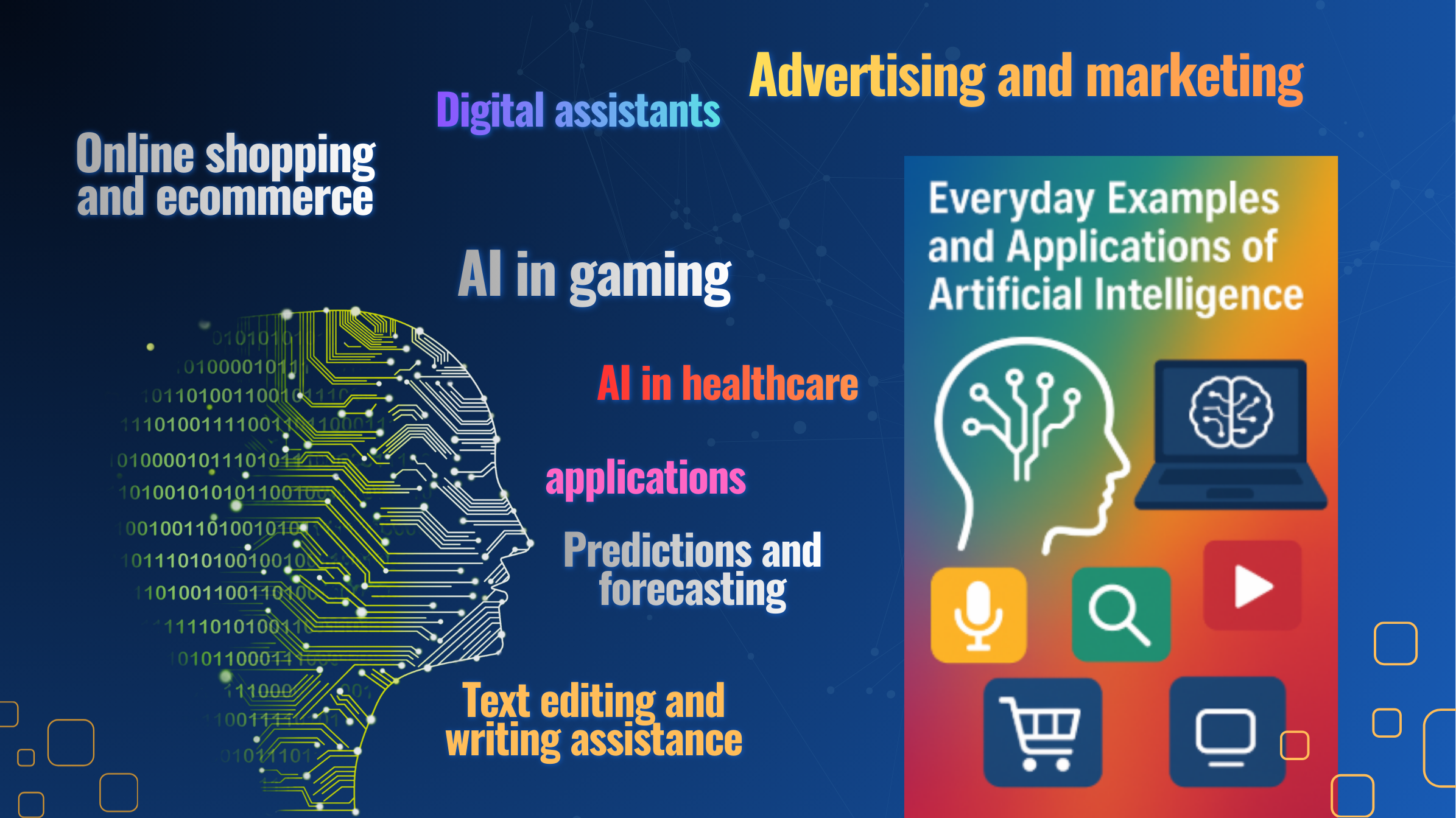
Everyday Examples and Applications of Artificial Intelligence in Daily Life

Artificial intelligence has moved beyond being a futuristic concept and now actively shapes how businesses, consumers, and industries operate. While many people may not realize it, AI is embedded in countless digital tools, online services, and automated systems we interact with every day. From digital assistants and online shopping to healthcare and fraud detection, AI-powered devices and algorithms continue to enhance convenience, efficiency, and decision-making.

Understanding artificial intelligence

Artificial intelligence is a branch of computer science that focuses on designing systems capable of performing tasks that typically require human intelligence. These tasks include learning, reasoning, problem-solving, understanding language, and recognizing patterns. AI-powered systems can analyze large amounts of data, adapt through machine learning, and deliver automated results, often faster and more accurately than humans.

Everyday uses and applications of artificial intelligence

AI is no longer restricted to high-tech labs or advanced robots; it is now integrated into common tools used in homes, workplaces, transportation, and entertainment. Below are some real-world examples of how AI functions in everyday life.

Digital assistants

Digital assistants such as Siri, Alexa, Google Assistant, Cortana, and Bixby are among the most widely used AI tools. They help users set reminders, answer queries, control smart home devices, play music, and even assist in online shopping. These assistants recognize voice commands, analyze requests, and respond accordingly using AI-driven natural language processing.

Search engines

Search engines rely heavily on AI algorithms to deliver accurate and relevant results. They analyze user behavior, search history, and trending queries to predict what information users are looking for. Features like autocomplete suggestions, voice search, and People Also Ask sections are powered by machine learning and predictive AI.

Social media

AI shapes the way social media platforms such as Facebook, Instagram, YouTube, and TikTok function. AI algorithms monitor user interactions, search behavior, and engagement patterns to personalize news feeds, recommend content, and improve user experience. Social media platforms also use AI for content moderation, data analytics, targeted advertising, and user safety.

Online shopping and ecommerce

Online shopping platforms use AI to enhance the customer experience and improve business efficiency. AI-driven recommendation engines analyze buying behavior, preferences, and browsing history to suggest relevant products. AI is also used for pricing optimization, demand forecasting, chatbots for instant support, predictive shipping, and managing real-time inventory.

Robotics

AI-powered robots are widely used in industries such as manufacturing, aerospace, hospitality, and healthcare. In aerospace, robots like NASA’s Perseverance rover explore planetary surfaces, collect samples, and transmit data. In factories, industrial robots take charge of welding, assembling, transporting materials, and other repetitive tasks. In hospitality, robots help with guest check-ins, delivery services, and automated food preparation.

Transportation and navigation

AI is transforming transportation through autonomous vehicles, smart traffic management, and advanced navigation systems. Apps like Google Maps, Apple Maps, and Waze use AI to analyze real-time location data, predict traffic conditions, and provide accurate routes and estimated arrival times. Airlines also use AI-driven autopilot systems to analyze flight data and adjust routes for safety and efficiency.

Text editing and writing assistance

AI plays a key role in text editing and writing tools such as Grammarly and Hemingway App. These tools offer grammar correction, readability analysis, plagiarism detection, and style improvement. AI-based autocorrect and predictive text features on smartphones learn from user behavior to make writing faster and more accurate.

Fraud detection and prevention

Banks and financial institutions use AI to detect and prevent fraudulent activities. AI systems analyze thousands of transactions in real time, identify unusual behavior, and automatically flag or block suspicious activity. This helps protect consumers and businesses by reducing risks and enhancing security.

Predictions and forecasting

AI is heavily used in predictive analytics to help organizations make data-driven decisions. It forecasts market trends, equipment maintenance schedules, customer preferences, and business demand. Predictive maintenance helps avoid costly breakdowns by analyzing wear and tear on machinery, while predictive modeling estimates future outcomes based on historical patterns.

AI in gaming

The gaming industry has used AI for decades to improve gameplay and generate dynamic environments. AI allows non-player characters to react intelligently, adapt to user strategies, and provide more realistic experiences. Games like Minecraft, F.E.A.R, and The Last of Us use AI to personalize challenges and enhance interactivity.

AI in healthcare

Artificial intelligence is revolutionizing healthcare through early diagnosis, disease prediction, drug discovery, and robotic surgery. AI systems can analyze medical data to identify potential diseases before symptoms appear, recommend treatments, and help doctors improve patient care. Predictive analytics also track contagious disease patterns to support public health management.

Advertising and marketing

AI is reshaping advertising by improving ad targeting, budget optimization, and personalized campaigns. Tools powered by AI can write ad copy, design visuals, and recommend marketing strategies based on customer behavior and demographics. AI ensures ads are shown to the right audience at the right time for better engagement and conversion.

Analytics and business intelligence

AI-driven analytics enables companies to generate accurate forecasts, analyze large datasets, and monitor real-time business performance. Predictive analytics, business monitoring, and smart reporting help organizations plan better, reduce costs, and improve customer satisfaction.

Business and AI

As AI technology continues to evolve, businesses across industries are increasingly adopting AI-driven solutions to stay competitive. From optimizing operations to improving customer experience, AI provides a strategic advantage in decision-making and innovation.

Artificial intelligence is no longer a concept of the future. It has already embedded itself in everyday life, transforming how we work, communicate, travel, and shop. As technology continues to advance, the role of AI in our daily lives will only expand, offering smarter, faster, and more efficient solutions to everyday challenges.

Conclusion:

Artificial intelligence has rapidly progressed from a specialized technological concept to a fundamental part of modern life. Whether enhancing personal convenience through digital assistants, supporting business strategies with predictive analytics, or improving patient outcomes in healthcare, AI continues to drive innovation across industries. Its presence may often go unnoticed, yet its impact is substantial—optimizing tasks, strengthening decision-making, and expanding the boundaries of what is possible. As AI technology evolves, it will play an even more influential role in shaping how we live, work, and interact with the world. Embracing AI responsibly and strategically will be key to unlocking its full potential and ensuring long-term benefits for individuals, businesses, and society as a whole.


FAQs:

1. What are some common examples of AI we use without realizing it?

Many people unknowingly use AI every day through digital assistants, navigation apps, online shopping recommendations, autocorrect tools, and social media feeds tailored to their interests.


2. How does AI improve user experience in online shopping?

AI analyzes browsing history, past purchases, and user preferences to show personalized product suggestions, optimize prices, automate customer support, and predict delivery times.


3. Can AI help businesses make better decisions?

Yes. AI uses predictive analytics and data modeling to forecast trends, track performance, and support informed decision-making, making business strategies more efficient and data-driven.


4. Is AI safe to use in healthcare?

AI is widely used to assist doctors in diagnosing diseases early, predicting health risks, and analyzing medical data. When used responsibly and under professional supervision, it enhances accuracy and patient care.


5. How does AI contribute to fraud prevention?

AI systems monitor thousands of transactions in real time, identify unusual patterns, and flag or block suspicious activity automatically to protect users from potential fraud.


6. Can AI be used in education and learning?

Absolutely. AI-powered platforms offer personalized learning paths, automated grading, interactive chatbots, and real-time feedback to help students learn more effectively.


7. Is AI replacing human jobs?

AI can automate repetitive tasks but also creates new opportunities by assisting professionals, increasing efficiency, and enabling people to focus on more complex, strategic responsibilities.