
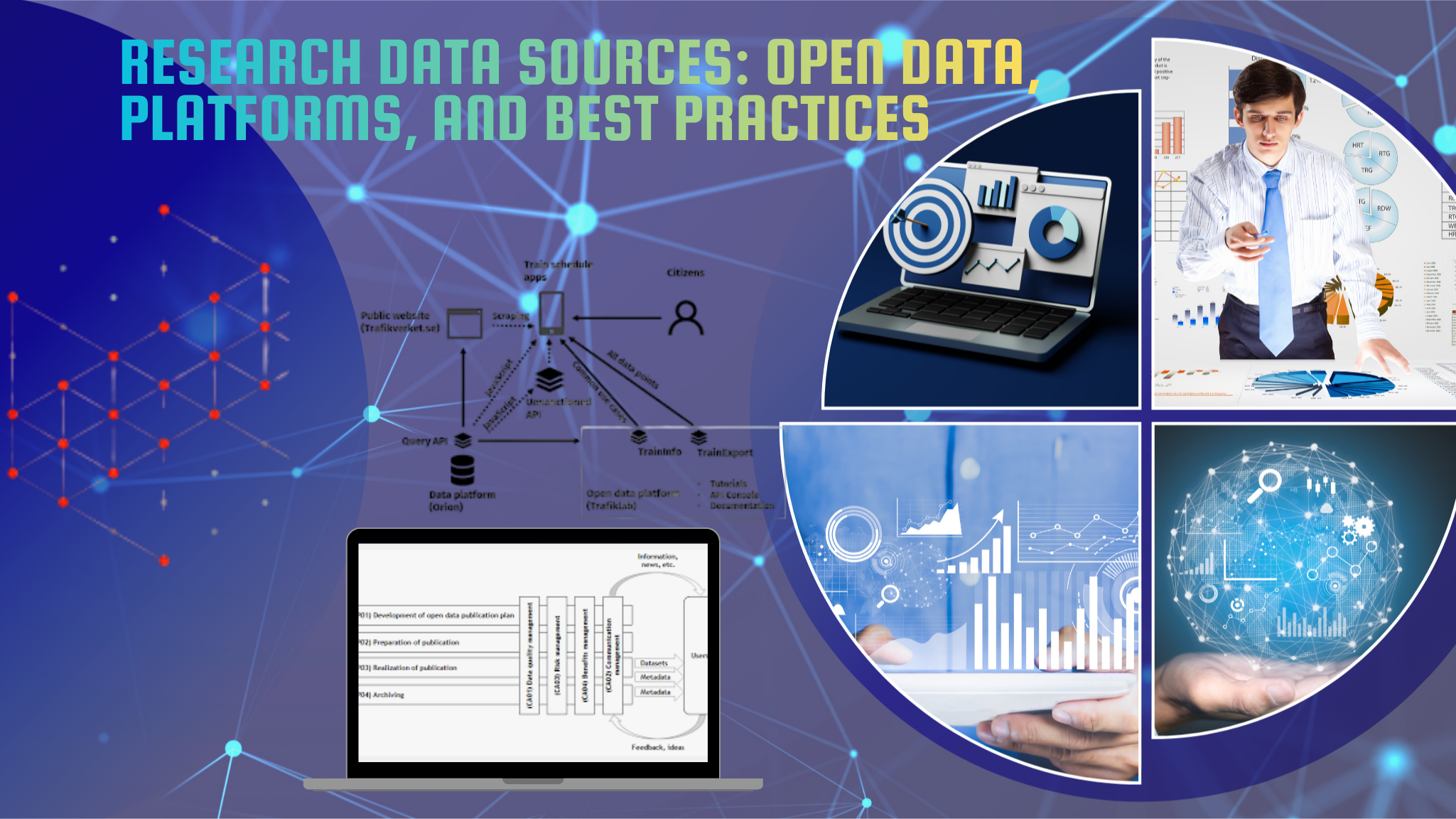
This article explores the evolving landscape of research data sources, examining how open, licensed, and academic datasets—along with modern data platforms—are transforming research, decision-making, and data literacy across disciplines.
The Expanding Role of Data in Modern Research and Decision-Making
Data has become one of the most valuable assets in the contemporary world, shaping how knowledge is produced, decisions are made, and policies are evaluated. Across academia, government, and industry, the reliance on structured and unstructured data has intensified as organizations seek evidence-based insights. This growing dependence has elevated the importance of understanding where data comes from, how it is accessed, and which platforms are best suited for different analytical needs. As a result, data sources, research datasets, and discovery platforms now form a complex but essential ecosystem.
Understanding Data Sources in a Research-Driven Economy
At a foundational level, data sources refer to the origins from which information is obtained for analysis. These sources may include observational records, transactional logs, experimental results, survey responses, or digitized archival materials. In research environments, data sources are carefully evaluated for accuracy, relevance, and reliability. The credibility of a study often hinges on whether its underlying data can be traced to reputable and transparent origins.
Research data sources are particularly significant because they support scholarly inquiry and innovation. These sources may be generated through original research or acquired from external repositories. As research becomes increasingly interdisciplinary, scholars often combine multiple data sources to gain broader perspectives and validate findings across contexts.
The Structure and Value of Datasets
Datasets represent organized collections of data points designed for analysis and interpretation. They may range from small, curated tables to massive, multi-dimensional collections containing millions of records. Advances in digital infrastructure have enabled datasets to grow in scale and complexity, making them suitable for advanced statistical modeling and machine learning applications.
Public datasets for research play a crucial role in democratizing access to information. By lowering barriers to entry, these datasets allow students, independent researchers, and institutions with limited resources to participate in data-driven inquiry. Public datasets are commonly used in education, policy analysis, and exploratory research, offering a shared foundation for reproducibility and collaboration.
Open Data as a Catalyst for Transparency and Innovation
Open data has emerged as a cornerstone of modern information ecosystems. Defined by its accessibility and permissive licensing, open data allows users to freely access, use, and redistribute information. Governments, international organizations, and research institutions increasingly publish open data to promote accountability, stimulate innovation, and encourage civic engagement.
Open data repositories serve as centralized access points where datasets are cataloged and preserved. These repositories often include detailed metadata, licensing information, and standardized formats, making it easier for researchers to discover and reuse data. Open-access research data initiatives further strengthen this model by advocating for data sharing as a standard research practice.
Licensed Data and Controlled Access Environments
While open data continues to expand, licensed data remains a critical component of research and professional analysis. Licensed data is typically governed by agreements that define how data may be accessed, shared, and used. These datasets often offer higher granularity, proprietary insights, or real-time updates that are not available through open channels.
Academic institutions frequently act as intermediaries, negotiating licenses that grant students and faculty access to premium data resources. Licensed data is especially prevalent in fields such as finance, business intelligence, and market research, where data collection requires significant investment and expertise.
Academic Data Resources and the Evolving Role of Libraries
Academic data resources are integral to higher education and scholarly research. University libraries have transformed into data-centric hubs, offering access to datasets, research data platforms, and analytical tools. Beyond access, libraries provide support services such as data management planning, metadata creation, and guidance on ethical data use.
NYU Libraries datasets exemplify how academic institutions curate and provide access to both open and licensed data across disciplines. By integrating datasets into teaching and research workflows, academic libraries help bridge the gap between theory and empirical analysis.
Research Data Platforms and Data Discovery
Research data platforms simplify the process of finding, accessing, and managing datasets. These platforms aggregate data from multiple sources and provide advanced search and filtering capabilities. For researchers navigating an increasingly crowded data landscape, such platforms reduce time spent on discovery and allow greater focus on analysis.
Data discovery for students is a growing priority, as educational institutions recognize the importance of data literacy. Research data platforms often include tutorials, documentation, and sample analyses, enabling students to develop practical skills while working with real-world data.
Data Collection for Analysis and Research Integrity
Despite the abundance of secondary data, original data collection remains essential in many research contexts. Data collection for analysis involves designing methodologies that align with research objectives while adhering to ethical and legal standards. Whether collecting survey responses, conducting field observations, or generating experimental data, researchers must ensure accuracy, consistency, and transparency.
Proper documentation of data collection processes enhances research integrity and enables future reuse. Well-documented datasets contribute to cumulative knowledge and support replication, a cornerstone of scientific credibility.
Organizing Data Sources by Subject Area
As the volume of available data continues to grow, organizing data sources by subject has become an effective strategy for managing complexity. Data sources by subject allow researchers to focus on repositories and platforms that align with their disciplinary needs.
In economics and business, for example, specialized platforms provide access to macroeconomic indicators, corporate financials, and industry benchmarks. These resources support a wide range of applications, from academic research to strategic decision-making in the private sector.
Financial and Economic Data Platforms
Financial data platforms are among the most sophisticated and widely used research tools. Bloomberg Terminal data offers real-time and historical financial information, news, and analytics used by professionals and scholars worldwide. Capital IQ data provides detailed company-level financials and valuation metrics, supporting corporate finance and investment research.
CEIC economic data focuses on macroeconomic indicators, offering insights into global and regional economic trends. Datastream financial data and WRDS financial datasets are widely used in academic research, providing extensive historical coverage for empirical finance and economics studies.
Business Intelligence and Market Research Datasets
Beyond traditional financial metrics, business and economic datasets increasingly incorporate alternative data sources. These may include supply chain information, consumer behavior metrics, and private market transactions. Such datasets enable more nuanced analyses of business performance and market dynamics.
PitchBook private market data has become a key resource for studying venture capital, private equity, and startup ecosystems. By capturing data on funding rounds, acquisitions, and investor activity, it supports research into innovation, entrepreneurship, and economic growth.
Geospatial Data and Spatial Analysis
Geospatial data sources add a critical spatial dimension to research. These datasets include geographic coordinates, maps, satellite imagery, and spatial boundaries that enable location-based analysis. Geospatial data is widely used in urban planning, environmental studies, logistics, and public health.
When combined with demographic and economic datasets, geospatial data allows researchers to examine regional disparities, infrastructure development, and environmental impacts. Advances in geographic information systems have further expanded the analytical potential of these data sources.
Health, Demographic, and Social Data
Health and demographic data are central to public policy, social science, and medical research. These datasets often include information on population characteristics, health outcomes, and social conditions. Census data sources provide foundational demographic insights that inform resource allocation, policy design, and academic research.
Election and voting data offer another layer of social insight, capturing patterns of political participation and electoral behavior. These datasets are valuable for political science research and for understanding democratic processes over time.
Computer Science Data Sources and Computational Research
In computer science and related fields, data sources are often designed for algorithmic processing. These may include text corpora, image datasets, network graphs, and system logs. High-quality computer science data sources are essential for training and evaluating machine learning models and for advancing artificial intelligence research.
Data for research projects in computational fields often comes from open data repositories, academic collaborations, and industry partnerships. The availability of standardized benchmarks has been particularly important for comparing algorithmic performance and advancing methodological rigor.
Tool-Driven Access to Research Data
Modern research increasingly relies on tools that integrate data access with analytical capabilities. IEEE Xplore research data complements scholarly publications by providing datasets and supplementary materials in engineering and technology domains. This integration supports transparency and reproducibility in technical research.
ProQuest TDM Studio enables large-scale text and data mining across academic and news content, facilitating research in digital humanities and computational social science. Nexis Uni news database provides extensive archives of news and legal information, supporting longitudinal analysis of media and policy trends.
Trade, Development, and Global Data Resources
International trade and development research relies heavily on standardized global datasets. UN Comtrade trade statistics offer detailed records of cross-border trade flows, supporting analyses of globalization, supply chains, and economic development. These datasets are widely used by researchers, policymakers, and international organizations.
Sage Data combines datasets with methodological guidance, helping researchers not only access data but also apply appropriate analytical techniques. This integration enhances the quality and impact of empirical research.
Open Data Repositories and Community Platforms
Open data repositories continue to play a central role in expanding access to research data. Kaggle datasets provide a unique combination of open data and community engagement, allowing users to share code, collaborate, and learn from one another. This model has been particularly influential in data science education.
NYC Open Data demonstrates how local governments can use open data to promote transparency and innovation. By publishing administrative and operational data, cities enable researchers and citizens to explore urban challenges and solutions.
Zenodo open repository and Dryad data repository support long-term preservation and citation of research outputs. By assigning persistent identifiers, these platforms ensure that datasets remain discoverable and citable over time.
Licensing, Ethics, and Responsible Data Use
Creative Commons datasets play a vital role in clarifying usage rights and promoting ethical data sharing. Clear licensing helps users understand how data may be reused and modified, reducing legal uncertainty and encouraging collaboration.
Open-access research data initiatives emphasize the importance of responsible data stewardship. Issues such as privacy, consent, and bias must be addressed throughout the data lifecycle. Ethical considerations are especially critical when working with sensitive health, demographic, or behavioral data.
Building Data Literacy for the Future
As data becomes central to nearly every field, data literacy has emerged as a core competency. Data literacy encompasses the ability to find, evaluate, analyze, and communicate data effectively. Educational institutions increasingly integrate data skills into curricula, recognizing their relevance across disciplines.
Research data platforms, open data repositories, and academic libraries all contribute to this educational mission. By providing access to real-world datasets and analytical tools, they prepare students and researchers for data-intensive careers.
Conclusion:
The modern data landscape is vast, interconnected, and continually evolving. From open data repositories and academic data resources to licensed financial platforms and specialized research tools, data sources now underpin research and decision-making at every level. Navigating this environment requires not only technical expertise but also critical judgment, ethical awareness, and a clear understanding of data provenance.
As the volume and diversity of data continue to grow, the ability to identify appropriate data sources and platforms will remain a defining skill for researchers, students, and professionals alike. By engaging thoughtfully with the data ecosystem, users can transform raw information into meaningful insights that drive knowledge, innovation, and informed action.
FAQs:
1. What are research data sources and why are they essential?
Research data sources are the origins from which information is gathered for analysis, and they are essential because they provide the factual foundation needed for credible research, informed decision-making, and policy evaluation.
2. How do open data sources differ from licensed research data?
Open data sources are freely accessible and reusable, while licensed research data is restricted by usage agreements and often offers proprietary, real-time, or highly detailed information.
3. What role do research data platforms play in modern research?
Research data platforms simplify data discovery by aggregating datasets from multiple sources and offering tools that help researchers efficiently search, access, and manage data.
4. Why are public datasets important for academic and student research?
Public datasets lower access barriers, enabling students and researchers with limited resources to conduct meaningful analysis, replicate studies, and build data literacy skills.
5. How do academic libraries support access to research data?
Academic libraries provide curated access to datasets, negotiate licensed resources, and offer guidance on data management, ethical use, and proper documentation.
6. What factors should researchers consider when selecting data sources?
Researchers should evaluate data quality, relevance, licensing terms, transparency, and ethical considerations to ensure the data aligns with research goals and standards.
7. How is data literacy connected to the use of research data sources?
Data literacy empowers individuals to locate, evaluate, analyze, and communicate data effectively, making it a critical skill for navigating today’s data-driven research environment.