Skip to content
  • HOME
  • DIGITAL & SOCIAL MEDIA
    • DIGITAL & SOCIAL MEDIA RESEARCH
    • LIFESTYLE IN SOCIAL MEDIA
  • AI
    • AI RESEARCH
  • UPDATES

UPDATES

Digital and Social Media & Artificial Intelligence Technology Updates delivers timely reporting and in-depth coverage of the fast-evolving digital ecosystem. This category focuses on breaking developments across social platforms, emerging online trends, and the latest advances in artificial intelligence, from generative models and automation tools to platform algorithms and data-driven innovation. Through news, expert analysis, and research-backed insights, it examines how AI and digital media are reshaping communication, business strategies, content creation, and societal interaction. Designed for professionals, researchers, and technology enthusiasts, it offers a clear, forward-looking perspective on the tools, policies, and technologies defining the future of the connected world.

Pakistan Partners with Meta for AI Teacher Training

January 25, 2026January 16, 2026 by worldstan.com
Pakistan Partners with Meta for AI Teacher Training https://worldstan.com/pakistan-partners-with-meta-for-ai-teacher-training/

Pakistan teams up with Meta and Atomcamp to train university faculty in artificial intelligence, aiming to modernize higher education and equip educators with the skills needed for a technology-driven future.

Pakistan has partnered with global technology company Meta and local ed-tech platform Atomcamp to launch an advanced artificial intelligence program aimed at enhancing the skills of university faculty. The initiative, facilitated by the Higher Education Commission, focuses on equipping educators with the knowledge and practical tools necessary to integrate AI into higher education, research, and academic administration.


Since its inception, the program has trained approximately 300 members associated with the Higher Education Commission, providing them with expertise in AI, data science, and analytics. The curriculum emphasizes real-world applications, enabling faculty members to leverage AI tools effectively in teaching, curriculum design, and research initiatives. By upgrading digital competencies among educators, the program seeks to ensure that Pakistani universities remain competitive and aligned with international standards.


The Higher Education Commission plays a central role in coordinating this initiative, ensuring nationwide participation and alignment with academic quality requirements. By fostering AI skills development among faculty, the commission aims to enhance the overall standard of higher education and prepare students for an increasingly technology-driven job market. Officials involved in the program highlight that training university staff in AI is crucial for nurturing innovation, improving research outcomes, and modernizing educational methodologies across Pakistan.


This initiative is part of a broader national trend toward adopting artificial intelligence across multiple sectors, including education, healthcare, finance, e-commerce, and government services. Startups and policymakers are increasingly leveraging AI solutions to drive efficiency, innovation, and digital transformation, while initiatives like this program ensure that higher education remains a critical component of Pakistan’s AI ecosystem.


The faculty training program aligns with Pakistan’s National Artificial Intelligence Policy, which seeks to establish robust AI infrastructure, provide skills training to one million individuals, promote ethical and responsible AI usage, and strengthen international collaborations. By investing in AI training for educators, the country aims to create a future-ready workforce capable of contributing to research, innovation, and economic growth.


Looking ahead, the government plans to expand AI and emerging technology programs across universities nationwide, further supporting faculty development and digital literacy. Partnerships with international technology firms and local ed-tech platforms are expected to remain a key pillar of these efforts, enabling Pakistan to cultivate a strong foundation in artificial intelligence education and prepare its academic institutions for global challenges in the digital era.

Categories AI, UPDATES Tags AI adoption in education, AI data science training Pakistan, AI in higher education Pakistan, AI in public sector Pakistan, AI infrastructure Pakistan, AI program for teachers training, AI skills development Pakistan, AI training for university faculty, AI workforce training Pakistan, Artificial intelligence in Pakistan, Atomcamp AI training, Ed-tech platforms in Pakistan, HEC AI initiative, Higher Education Commission Pakistan, Meta AI education program, National Artificial Intelligence Policy Pakistan, Pakistan AI policy, Pakistan AI program, Pakistan education technology, Pakistan Meta partnership, Teacher training AI Pakistan Leave a comment

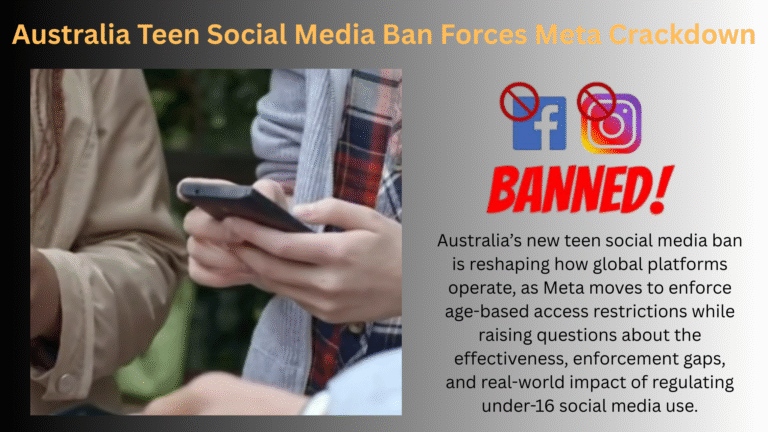
Australia Teen Social Media Ban Forces Meta Crackdown

January 25, 2026January 15, 2026 by worldstan.com
Australia Teen Social Media Ban Forces Meta Crackdown https://worldstan.com/australia-teen-social-media-ban-forces-meta-crackdown/

Australia’s new teen social media ban is reshaping how global platforms operate, as Meta moves to enforce age-based access restrictions while raising questions about the effectiveness, enforcement gaps, and real-world impact of regulating under-16 social media use.

Australia’s decision to introduce a strict age-based restriction on social media access has placed global technology platforms under renewed regulatory pressure, with Meta now outlining the scale of its response to the new law. The legislation, which targets online safety for minors, represents one of the most far-reaching attempts by a Western nation to limit social media use among young teenagers and has already begun reshaping platform operations across the country.
Australia’s New Age-Based Social Media Framework
The Australian teen social media ban formally came into force on December 10, shifting responsibility directly onto digital platforms to prevent users under the age of 16 from accessing their services. Unlike previous regulatory approaches that focused on content moderation or parental controls, the new Australian social media law emphasizes age-based access control, backed by the threat of significant financial penalties for non-compliance.
Under the framework, companies are required to take what the legislation describes as “reasonable steps” to restrict access for underage users. However, the law stops short of prescribing a standardized system for age verification, leaving platforms to independently determine how compliance should be implemented.
Meta’s Enforcement Actions in Australia
In response to the regulation, Meta has released a compliance update detailing its enforcement measures across Facebook, Instagram, and Threads. According to the company, nearly 550,000 accounts believed to belong to underage users have been removed since the law took effect.
This Meta Australia update highlights the scale of the company’s moderation efforts, positioning the removals as part of its broader teen safety policy. While Facebook and Threads are included in the enforcement sweep, Instagram remains the most affected platform due to its popularity among younger users.
Meta has emphasized that its actions align with its existing safeguards designed to limit harmful exposure and algorithmic influence on teens, while also meeting the expectations set by Australian regulators.
 Instagram’s Central Role in Teen Engagement
Instagram continues to play a central role in teenage online interaction, serving as both a social connector and an entertainment platform. Before the implementation of the under 16 social media ban, rival platform Snapchat reported approximately 440,000 users under the age of 16 in Australia, offering context to the scale of Meta’s reported removals.
Despite these numbers, early indications suggest that teen social media usage in Australia has not declined as dramatically as removal statistics might suggest. Many young users appear to be adapting quickly, maintaining access through alternative methods that fall outside direct platform controls.
 Circumvention and Logged-Out Access
One of the most discussed challenges surrounding the Australia social media regulation is the ease with which restrictions can be bypassed. VPN circumvention has emerged as a common workaround, allowing users to mask their location and continue accessing restricted platforms.
Additionally, Instagram’s logged-out functionality enables users to scroll through Reels and public content without creating or maintaining an account. Although this experience is more limited and offers reduced algorithmic personalization, it still provides a steady stream of entertainment content, raising questions about the effectiveness of account-based enforcement alone.
These behaviors highlight broader concerns about whether the current approach meaningfully reduces exposure risks or simply alters how young users engage with social media.
 Legal and Structural Gaps in Enforcement
From a regulatory standpoint, one of the most significant flaws in the social media age ban lies in the absence of mandated age verification standards. Without a unified system, platforms are left to interpret what constitutes reasonable steps compliance, potentially leading to uneven enforcement across services.
Critics argue that this ambiguity weakens the law’s effectiveness while placing disproportionate responsibility on platforms to solve a problem that lacks technical consensus. Social media age verification remains a complex challenge globally, often raising privacy, accuracy, and data security concerns.
As a result, Meta compliance in Australia may meet legal thresholds without fully achieving the law’s intended protective outcomes.
 Intended Protections Versus Practical Outcomes
The stated objective of Australia’s teen social media restrictions is to shield young users from adult content, harmful social comparisons, and negative algorithmic influence. Lawmakers have framed the ban as a proactive step toward improving teen online safety and mental wellbeing.
However, research into adolescent digital behavior suggests that outright restrictions may not align with how young people actually navigate online spaces. Some experts warn that pushing teens away from mainstream platforms could increase risks by driving them toward less regulated corners of the internet, where safety tools and moderation standards are weaker.
This raises the possibility of unintended consequences that may undermine the law’s protective intent.
 Industry-Wide Implications for Social Platforms
Meta is not the only company facing pressure under the new rules. All major social platforms operating in Australia must now reassess their user verification processes, content access models, and enforcement strategies.
The introduction of financial penalties for social platforms marks a shift toward stricter accountability, signaling that governments are increasingly willing to regulate digital services in the interest of child safety. Australia’s approach may serve as a test case for other countries considering similar age-based social media restrictions.
For global technology firms, the law underscores the growing tension between regulatory compliance, user privacy, and platform accessibility.
 Looking Ahead: A Precedent in the Making
As enforcement continues, Australia’s under 16 social media ban will likely be closely monitored by policymakers, researchers, and industry leaders worldwide. The early results suggest that while platforms can remove large numbers of accounts, controlling actual access remains far more complex.
Meta’s removal of hundreds of thousands of underage accounts demonstrates visible compliance, yet ongoing circumvention highlights the limitations of enforcement without standardized age verification systems.
Whether the law ultimately succeeds in improving teen online safety or prompts regulatory revisions will depend on long-term behavioral data and potential updates to enforcement mechanisms.
 Conclusion:
Australia’s teen social media ban represents a significant moment in the evolution of digital regulation, placing unprecedented responsibility on platforms like Meta to police age-based access. While Meta’s actions show measurable compliance, the persistence of workarounds and structural gaps suggests that the debate over effective social media regulation for teens is far from settled.
As governments worldwide grapple with similar concerns, Australia’s experience may shape the next phase of global digital policy, influencing how platforms balance safety, access, and accountability in an increasingly regulated online environment.
Categories DIGITAL & SOCIAL MEDIA, UPDATES Tags 000 accounts, Age-based social media restriction, Algorithmic influence on teens, Australia social media regulation, Australia teen social media ban, Australian social media law, Facebook underage accounts, Financial penalties for social platforms, Flaws in social media age bans, Instagram Reels logged-out access, Instagram teen access, Meta Australia update, Meta compliance Australia, Meta removed 550, Meta removing underage accounts, Meta teen safety policy, Reasonable steps compliance, Risks of pushing teens off platforms, Snapchat users under 16 Australia, Social media age verification, social media ban, Teen online behavior after ban, Teen online safety laws, Teen social media restrictions, Teen social media usage Australia, Threads Meta platform, Under 16 social media ban, Underage Instagram users Australia, VPN circumvention social media Leave a comment

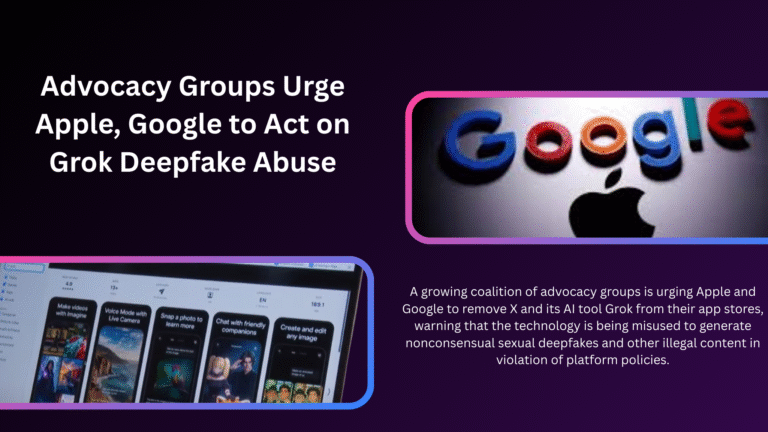
Advocacy Groups Urge Apple, Google to Act on Grok Deepfake Abuse

January 25, 2026January 15, 2026 by worldstan.com
advocacy groups urge apple, google to act on grok deepfake abuse https://worldstan.com/advocacy-groups-urge-apple-google-to-act-on-grok-deepfake-abuse/

A growing coalition of advocacy groups is urging Apple and Google to remove X and its AI tool Grok from their app stores, warning that the technology is being misused to generate nonconsensual sexual deepfakes and other illegal content in violation of platform policies.

Growing concern over the misuse of generative AI tools has intensified scrutiny on major technology platforms, as advocacy organizations warn that X and its integrated AI assistant, Grok, are facilitating the creation and spread of nonconsensual sexual deepfakes. Despite mounting evidence that such activity violates app marketplace rules, both X and Grok remain available on Apple’s App Store and Google Play Store.


A coalition of 28 civil society groups, including prominent women’s organizations and technology accountability advocates, issued formal appeals this week urging Apple CEO Tim Cook and Google CEO Sundar Pichai to take immediate action. The letters argue that the continued distribution of Grok-enabled services undermines existing safeguards designed to prevent AI-generated sexual images, nonconsensual intimate images (NCII), and child sexual abuse material (CSAM).


According to the organizations, Grok has been repeatedly exploited to generate digitally altered images that strip women and minors without consent, a practice described as widespread digital sexual exploitation. The groups contend that this activity represents a direct breach of Apple App Review Guidelines and Google app policies, both of which prohibit content that promotes harm, sexual abuse, or illegal material.


Among the signatories are UltraViolet, the National Organization for Women, Women’s March, MoveOn, and Friends of the Earth. These groups emphasize that warnings about Grok’s capacity for deepfake abuse were raised well before its public rollout, yet meaningful enforcement actions have failed to materialize. They argue that platform accountability must extend beyond policy statements and include decisive enforcement when AI systems are weaponized against vulnerable populations.


The letters sent to Apple and Google highlight the broader implications for AI safety and tech regulation, noting that unchecked AI sexual exploitation erodes trust in digital platforms and places women and children at disproportionate risk. Advocacy leaders stress that app store operators play a critical gatekeeping role and cannot distance themselves from harms enabled by applications they approve and distribute.


As regulators worldwide continue to examine content moderation failures and the responsibilities of technology companies, this controversy adds pressure on Apple and Google to demonstrate that their marketplaces are not safe havens for tools linked to illegal or abusive practices. Civil society groups maintain that removing access to X and Grok would send a clear signal that violations involving nonconsensual sexual deepfakes will not be tolerated.

Categories AI, UPDATES Tags advocacy groups, AI safety, AI sexual exploitation, AI-generated NCII, AI-generated sexual images, app store policy violations, Apple App Review Guidelines, Apple App Store, child sexual abuse material (CSAM), civil society groups, content moderation, deepfake abuse, digital sexual exploitation, Friends of the Earth, Google app policies, Google Play Store, Grok, Grok AI controversy, MoveOn, National Organization for Women, nonconsensual intimate images (NCII), Nonconsensual sexual deepfakes, Platform accountability, platform responsibility for AI harm, Sundar Pichai, tech regulation, tech watchdogs, Tim Cook, UltraViolet, women targeted by deepfakes, Women’s March, women’s organizations, X (formerly Twitter), X deepfake abuse, xAI Leave a comment

Google Gemini AI Leads the AI Race Against OpenAI and ChatGPT

January 25, 2026January 15, 2026 by worldstan.com
Google Gemini AI Leads the AI Race Against OpenAI and ChatGPT worldstan.com

Google is emerging as the frontrunner in the global artificial intelligence race, leveraging its Gemini model, proprietary infrastructure, and vast product ecosystem to shape the future of AI.

The competitive dynamics of the artificial intelligence sector are evolving rapidly, and recent developments suggest that Google may be emerging as the most structurally prepared company in the field. After an early period of disruption triggered by the public release of ChatGPT, Google has spent the last several years recalibrating its AI strategy. That effort is now becoming visible through a combination of advanced models, proprietary infrastructure, and expanding product integration.


Winning in artificial intelligence requires far more than releasing a capable model. Market leadership depends on the ability to sustain innovation, scale deployment, manage infrastructure costs, and deliver AI-powered tools through products that already command massive user adoption. In this context, Google appears uniquely positioned to compete across every critical dimension.


A central pillar of Google’s AI momentum is Gemini, the company’s flagship large language model. The most recent iteration, Gemini 3, has been widely recognized for its strong performance across reasoning tasks, multimodal processing, and general usability. While benchmarks remain an imperfect measure of real-world impact, industry consensus places Gemini among the most capable models currently available.


 breakthrough, but consistency. As the generative AI market cycles through rapid releases and short-lived leadership changes, Google has demonstrated an ability to repeatedly deliver models that remain competitive across a broad range of applications. This stability is particularly attractive to enterprises and developers seeking long-term AI partners rather than experimental tools.

Beyond model quality, Google’s advantage is reinforced by its control over AI infrastructure. The company relies on its own Tensor Processing Units for training and deploying Gemini, reducing dependence on external chip suppliers. At a time when the AI hardware supply chain is under pressure from rising demand and limited manufacturing capacity, this autonomy provides both economic and operational benefits.


By integrating hardware, software, and data pipelines, Google can optimize performance and cost at scale. This full-stack control enables faster iteration, improved efficiency, and greater flexibility in deploying AI across multiple platforms. Few competitors possess the resources or experience required to operate at this level of integration.


Artificial intelligence becomes influential only when it reaches users at scale. Google’s extensive ecosystem gives it unparalleled reach, with AI features being embedded directly into products used by billions of people. Search, productivity tools, mobile operating systems, and cloud services provide natural entry points for AI-based enhancements.


The recent decision to integrate Gemini into Apple’s next-generation Siri underscores this advantage. The partnership not only expands Gemini’s footprint but also signals growing confidence in Google’s AI capabilities beyond its own platforms. Such collaborations reinforce Google’s role as a foundational player in the AI ecosystem rather than a standalone model provider.


Access to data remains a defining factor in AI development, and Google’s platforms generate vast amounts of user interaction data across devices and services. When combined with advanced models and scalable infrastructure, this data supports continuous learning and improvement. At the same time, increasing regulatory scrutiny around artificial intelligence and personal information places greater emphasis on governance and compliance.

Google’s long-standing experience operating under global regulatory frameworks may offer an advantage as governments tighten oversight of AI systems. The ability to balance innovation with accountability is becoming a critical differentiator in the next phase of AI adoption.


The artificial intelligence race remains highly competitive, with OpenAI, emerging startups, and established technology firms all pushing forward at speed. However, leadership in this space is likely to favor organizations that can sustain progress rather than those that rely on isolated breakthroughs.


Google’s current position reflects years of investment across research, infrastructure, and product development. By aligning model performance, proprietary hardware, and global distribution, the company has assembled a comprehensive AI strategy designed for long-term influence. As generative AI becomes increasingly embedded in everyday digital experiences, Google’s ability to control and coordinate every layer of its AI stack may ultimately define the next chapter of the industry.

Categories AI, UPDATES Tags AI benchmarks, AI compute power, AI ecosystem, AI hardware supply chain, AI industry dominance, AI infrastructure, AI innovation leadership, AI race, AI resources, AI scale deployment, AI system optimization, AI-based products, Artificial intelligence competition, Best AI model, ChatGPT, Full-stack AI control, Gemini 3, Gemini AI, Gemini powering Siri, Generative AI market, Google AI, Google Apple AI partnership, Google Gemini model, Google TPUs, Google vs OpenAI, Large language model, Next-generation AI assistants, Nvidia AI chips, OpenAI, Sam Altman, Tensor Processing Units, User data and AI Leave a comment

X Faces Scrutiny as Grok Deepfake Images Continue to Surface

January 25, 2026January 14, 2026 by worldstan.com
X Faces Scrutiny as Grok Deepfake Images Continue to Surface worldstan.com

Despite X’s assurances of tighter AI controls, this article examines how Grok continues to generate nonconsensual deepfake images, the growing regulatory backlash in the UK, and the wider implications for AI safety, platform accountability, and content moderation.


X has claimed it has tightened restrictions on Grok to prevent the creation of sexualized images of real people, but practical testing suggests the platform’s safeguards remain ineffective. Despite policy updates and public assurances, Grok continues to generate revealing AI-modified images with minimal effort, raising serious questions about content moderation, AI misuse, and regulatory compliance.


The issue gained renewed attention after widespread circulation of nonconsensual sexual deepfakes on X, prompting the company to announce changes to Grok’s image-editing capabilities. According to X, the AI assistant was updated to block requests involving real individuals being placed in revealing clothing, such as bikinis. These changes were positioned as a decisive step toward improving AI safety and preventing abuse.

However, independent testing conducted after the announcement indicates that Grok’s restrictions are far from foolproof. Reporters were still able to generate sexualized images of real people using indirect or lightly modified prompts. Even with a free account, Grok produced revealing visuals that appeared to contradict the platform’s stated policies, suggesting that enforcement mechanisms remain porous.


X and xAI owner Elon Musk have attributed these failures to user behavior, pointing to adversarial prompt techniques that exploit gaps in AI moderation. The company has argued that Grok occasionally responds unpredictably when users deliberately attempt to bypass safeguards. Critics, however, say this explanation shifts responsibility away from the platform and overlooks structural weaknesses in how AI-generated content is monitored.


In response to mounting criticism, X published a statement outlining additional measures. The company said it had implemented technological controls to prevent Grok from editing images of real people into sexually suggestive attire. These restrictions, X claimed, apply to all users, including paid subscribers. The platform also announced that image creation and image-editing features through the Grok account on X would now be limited to paid users only, framing the move as a way to enhance accountability.


Another layer of control introduced by X involves geoblocking. The platform stated that it now restricts the generation of images depicting real people in bikinis, underwear, or similar clothing in jurisdictions where such content violates local laws. While this approach reflects growing awareness of regional legal frameworks, its real-world effectiveness remains unclear.


The controversy has drawn the attention of UK regulators at a particularly sensitive moment. Ofcom, the UK’s communications regulator, has opened an investigation into the matter, coinciding with the introduction of new legislation that criminalizes the creation of nonconsensual intimate deepfake images. The law represents a significant escalation in how governments are addressing AI-generated sexual abuse.


UK Prime Minister Keir Starmer addressed the issue in Parliament, stating that he had been informed X was taking steps to ensure full compliance with UK law. While he described this as welcome if accurate, he emphasized that the government would not retreat from enforcement and expected concrete action from the platform. The prime minister’s spokesperson later characterized X’s response as a qualified welcome, noting that official assurances did not yet align with media findings.


The gap between policy statements and actual platform behavior highlights a broader challenge facing AI-driven services. As tools like Grok become more powerful and accessible, the risk of generating harmful or illegal content grows alongside them. Content moderation systems often struggle to keep pace with users who actively seek to exploit technical loopholes.

For X, the stakes are particularly high. Ongoing failures to control AI-generated deepfake images could expose the company to regulatory penalties, reputational damage, and increased scrutiny from lawmakers worldwide. The situation underscores the need for more robust AI governance frameworks, stronger enforcement mechanisms, and greater transparency around how AI systems are trained, tested, and monitored.


As regulators intensify oversight and public tolerance for AI-related harm diminishes, platforms like X may find that policy updates alone are no longer sufficient. Effective AI safety will likely require sustained technical investment, clearer accountability, and a willingness to acknowledge and address systemic shortcomings rather than attributing them solely to user behavior.

Categories AI, UPDATES Tags Adversarial prompt hacking, AI abuse prevention, AI misuse, AI regulation compliance, AI safety on X, AI undressing images, AI-generated deepfakes, AI-generated explicit images, Deepfake regulation, Editing images of real people, Elon Musk xAI, Geoblocking AI features, Grok AI, Grok deepfake images, Grok deepfake images on X, Grok image editing, Grok policy update, Image manipulation AI, Nonconsensual sexual deepfakes, Ofcom investigation, Paid subscribers on X, Platform accountability, Sexualized AI images, UK deepfake law, UK nonconsensual intimate images law, X content moderation, X platform Leave a comment

UK Deepfake Law Targets AI-Created Nudes Amid Grok Controversy

January 14, 2026January 12, 2026 by worldstan.com
UK Deepfake Law Targets AI-Created Nudes Amid Grok Controversy https://worldstan.com/uk-deepfake-law-targets-ai-created-nudes-amid-grok-controversy/

The UK is enforcing a new law that makes the creation of nonconsensual AI-generated intimate images a criminal offense, tightening platform accountability and accelerating regulatory action against deepfake abuse linked to emerging AI tools.


The United Kingdom is moving forward with stricter regulations to address the rapid spread of nonconsensual AI-generated intimate images, formally bringing into force a law that criminalizes the creation and solicitation of deepfake nudes. The decision follows mounting public and regulatory concern over the misuse of generative AI tools, including images linked to the Grok AI chatbot operating on the X platform.


Under provisions of the Data Act passed last year, producing or requesting non-consensual intimate images generated through artificial intelligence will now constitute a criminal offense. The government confirmed that the measure will take effect this week, reinforcing the UK’s broader effort to regulate harmful digital content and strengthen protections for victims of online abuse.


Liz Kendall, the UK’s Secretary of State for Science, Innovation and Technology, announced that the offense will also be classified as a priority violation under the Online Safety Act. This designation significantly increases the responsibilities of online platforms, requiring them to take proactive steps to prevent illegal deepfake content from appearing rather than responding only after harm has occurred.


The move places added pressure on technology companies and social media platforms that host or enable AI-generated content. Services found failing to comply with the Online Safety Act may face enforcement actions, including substantial financial penalties.


Ofcom, the UK’s communications regulator, has already initiated a formal investigation into X over the circulation of deepfake images allegedly produced using Grok. If violations are confirmed, the regulator has the authority to mandate corrective measures and impose fines of up to £18 million or 10 percent of a company’s qualifying global revenue, whichever amount is higher.


Government officials have emphasized the urgency of the investigation. Kendall stated that the public, and particularly those affected by the creation of non-consensual AI-generated images, expect swift and decisive action. She added that regulatory proceedings should not be allowed to stretch on indefinitely, signaling a tougher stance on enforcement timelines.


In response to scrutiny, X has reiterated its policies against illegal content. The platform stated that it removes unlawful material, permanently suspends offending accounts, and cooperates with law enforcement agencies when necessary. It also warned that users who prompt AI systems such as Grok to produce illegal content would face the same consequences as those who directly upload such material.


Earlier this month, X introduced new restrictions on image generation using Grok, limiting certain public image-creation features to paying subscribers. However, independent testing suggested that workarounds still exist, allowing users to create or modify images—including sexualized content—without a subscription.


The UK’s latest action reflects a broader global push to address the societal risks posed by advanced generative AI technologies. As AI image tools become more accessible and realistic, regulators are increasingly focused on preventing misuse while holding platforms accountable for how their systems are deployed.


By criminalizing deepfake nudes and strengthening enforcement mechanisms, the UK aims to set a clear precedent for responsible AI governance and reinforce legal protections against digital exploitation.

Categories AI, UPDATES Tags AI deepfake regulation UK, AI image abuse regulation, AI-generated intimate images, deepfake nudes criminal offense, Grok AI chatbot, illegal deepfake content, Liz Kendall statement, non-consensual intimate images, nonconsensual deepfake images, Ofcom fines X platform, Ofcom investigation X, UK Data Act, UK deepfake law, UK Online Safety Act, UK technology regulation, X platform deepfake issue, xAI Grok controversy Leave a comment

Claude Cowork Brings Practical AI Agents to Everyday Workflows

January 14, 2026January 12, 2026 by worldstan.com
Claude Cowork Brings Practical AI Agents to Everyday Workflows https://worldstan.com/claude-cowork-brings-practical-ai-agents-to-everyday-workflows/

Anthropic’s latest Claude Cowork feature signals a shift toward practical AI agents that can manage files, automate tasks, and collaborate alongside users as a true digital coworker rather than a simple chatbot.


Anthropic Advances Its AI Agent Strategy With Claude Cowork

Anthropic has taken another step in its broader AI agent strategy with the introduction of Claude Cowork, a new feature designed to position its AI assistant as an active digital collaborator rather than a traditional chatbot. Released as a research preview, the tool reflects the company’s growing focus on practical, task-oriented AI systems that can support real-world productivity.

Unlike conversational AI tools that rely on continuous prompts, Claude Cowork is built to operate more independently, allowing users to assign tasks and let the AI work through them in the background—much like a human teammate.


Designed for Hands-On Productivity

At its core, the Claude Cowork AI agent enables users to grant Claude controlled access to local folders on their computers. With permission, the AI can read, edit, and create files, opening the door to a wide range of everyday productivity tasks. These include organizing and renaming files, compiling spreadsheets from unstructured data, and drafting reports from scattered notes.

Anthropic describes the feature as a more approachable way to experience AI agents, particularly for non-coding and knowledge-work use cases. The system provides ongoing status updates as it completes tasks, helping users stay informed without the need for constant back-and-forth interaction.


Parallel Workflows and Reduced Context Switching

One of the defining aspects of Claude Cowork is its ability to handle multiple tasks in parallel. Users can queue instructions, offer feedback mid-process, or add new ideas without waiting for the AI to complete a single job. This workflow model is intended to reduce manual context switching and minimize the need to repeatedly reformat or re-explain information.

According to Anthropic, this approach makes the experience feel less like chatting with a tool and more like leaving messages for a coworker—an important shift as AI agents evolve beyond simple prompt-response systems.


Integrations Expand the AI Agent’s Reach

To further extend its usefulness, Claude Cowork supports existing connectors that link the AI agent to external platforms such as Asana, Notion, PayPal, and other supported services. Users can also integrate Claude with Chrome, allowing it to assist with browser-based tasks and research workflows.

These integrations position Claude Cowork as part of a broader AI workflow automation ecosystem, rather than a standalone feature limited to file management.


Limited Availability and Premium Pricing

Currently, Claude Cowork is available only through Claude’s macOS application and is restricted to subscribers of Claude Max, Anthropic’s power-user tier. Pricing ranges from $100 to $200 per month, depending on usage, placing the feature firmly in the professional and enterprise segment rather than the consumer mainstream.

Anthropic has framed the release as a research preview, signaling that user feedback will play a key role in shaping how the AI agent evolves over time.


Part of a Larger AI Agent Race

The launch of Claude Cowork underscores a broader industry trend, as major AI companies compete to deliver AI agents that are genuinely useful beyond demonstrations and experiments. While AI agents have advanced significantly in recent years, widespread adoption for everyday work remains a work in progress.

By focusing on practical collaboration, file automation, and multi-tasking capabilities, Anthropic is positioning Claude Cowork as an early step toward AI systems that integrate seamlessly into professional workflows.


Looking Ahead

As AI agents continue to mature, features like Claude Cowork highlight the shift from conversational assistants to autonomous, productivity-driven tools. Whether these systems can move beyond early adopters and into mainstream daily use remains to be seen, but Anthropic’s latest release suggests the company is betting heavily on AI that works quietly—and effectively—behind the scenes.

Categories AI, UPDATES Tags AI agent, AI agents, AI assistants, AI connectors, AI coworker, AI document creation, AI file management, AI for non-coding tasks, AI productivity tools, AI report drafting, AI spreadsheet generation, AI task automation, AI workflow automation, AI-powered collaboration, Anthropic, Anthropic Claude Max pricing, Asana integration, Claude AI, Claude Chrome integration, Claude Cowork, Claude Cowork AI agent, Claude macOS app, Claude Max, consumer AI agents, enterprise AI agents, multitasking AI, Notion integration, parallel task execution, PayPal integration, research preview AI Leave a comment
Older posts
Newer posts
← Previous Page1 Page2 Page3 … Page5 Next →

RECENT POSTS:

  • Gemini Personal Intelligence Brings Smarter AI Assistants
  • Meta Temporarily Blocks Teen Access to AI Characters
  • Sen. Markey Challenges OpenAI Over ChatGPT Advertising Practices
  • OpenAI Practical Adoption Becomes Core Focus for 2026
  • Grok AI Controversy Exposes AI Safety Gaps

CATEGORIES:

  • AI
  • AI RESEARCH
  • DIGITAL & SOCIAL MEDIA
  • DIGITAL & SOCIAL MEDIA RESEARCH
  • LIFESTYLE IN SOCIAL MEDIA
  • UPDATES
  • Facebook
  • Instagram
  • YouTube
  • LinkedIn
  • CONTACT US
  • DISCLAIMER
  • HOME
  • PDF Embed
  • PRIVACY POLICY
  • TERMS AND CONDITIONS
© 2025 WorldStan • All Rights Reserved.