

AI Warfare How Drones are Rewriting the Rules of War
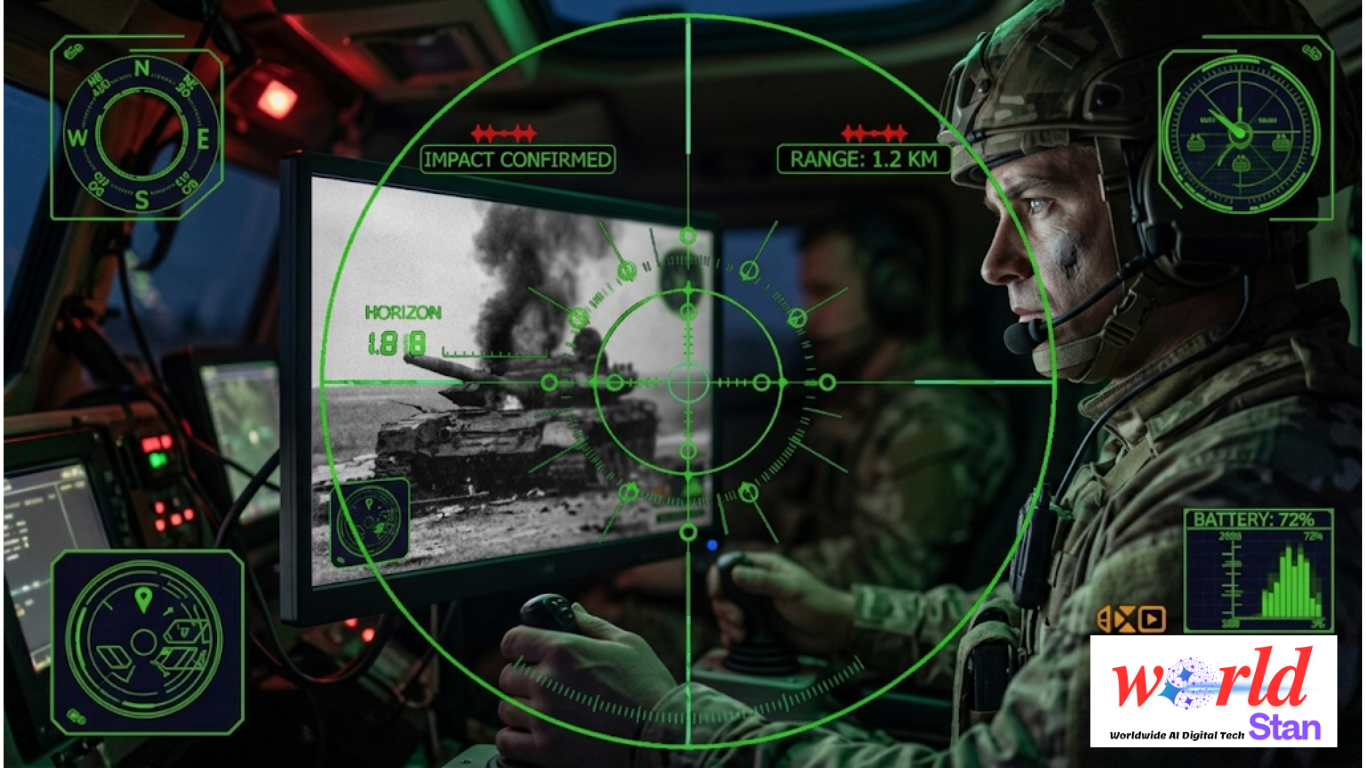
AI Warfare is no longer a concept from science fiction. It is becoming part of today’s military reality, changing how battles are planned, monitored, and fought. This guide explains how intelligent machines, battlefield data, and autonomous systems are shaping the future of defense in language that is easy to understand.
AI Warfare Is Changing Modern Battlefields
AI Warfare is reshaping modern combat through autonomous drones, intelligent targeting, battlefield automation, and data driven military decision making.
The nature of warfare has never remained the same for long. Every generation has witnessed new inventions that changed how conflicts were fought, from the introduction of gunpowder to fighter aircraft, satellites, and precision guided weapons. Today, another transformation is taking place, and it is moving faster than any previous military revolution. AI Warfare has become one of the most discussed subjects in global defense because it combines intelligent software, autonomous machines, advanced sensors, and massive amounts of battlefield information into a single decision making system.
Many people still imagine future wars as scenes from science fiction movies. The reality is both more practical and more complex. Modern military forces are already using intelligent systems to process surveillance data, recognize objects, support commanders, and improve battlefield awareness. These technologies are helping armed forces react faster while reducing the workload placed on soldiers.
The most significant change is not simply the arrival of smarter weapons. The real transformation lies in how information is collected, analyzed, and converted into decisions within seconds. In today’s battlefield, speed often determines success. An army that understands the situation first gains an important advantage over its opponent.
From my perspective, AI Warfare represents one of the biggest technological shifts of the twenty first century. Like every powerful technology, it offers remarkable opportunities while creating serious responsibilities. Understanding both sides of this evolution is essential for governments, military planners, researchers, and ordinary citizens alike.
Understanding AI Warfare
AI Warfare uses intelligent software, autonomous drones, and advanced data analysis to improve military decision making, surveillance, targeting, and battlefield coordination while keeping human oversight essential.
AI Warfare refers to the use of intelligent computer systems that assist military operations by collecting information, recognizing patterns, predicting possible outcomes, and supporting battlefield decisions. Instead of replacing every human role, most modern systems are designed to work alongside military personnel by providing recommendations faster than traditional methods.
Let me explain this in the clearest, simplest terms.
Imagine a battlefield where thousands of cameras, satellites, drones, radar systems, and communication devices continuously collect information every second. No human team could examine all that information quickly enough. AI solves this challenge by organizing enormous amounts of data, identifying important details, and highlighting potential threats almost instantly.
This capability allows commanders to receive useful intelligence much faster than before. Instead of spending hours analyzing reports, they can review AI generated assessments within moments and make better informed decisions.
However, AI does not possess human judgment, experience, or moral understanding. It recognizes mathematical patterns rather than emotions or ethics. That distinction remains one of the most important factors in discussions about military automation.
How Warfare Has Changed Over Time
Military technology has continuously evolved as societies developed new scientific discoveries. Every major innovation introduced new strategies while forcing nations to adapt their defenses.
| Year | Event | Description |
|---|---|---|
| 1914 | First World War | Large scale industrial warfare introduced machine guns, tanks, and aircraft. |
| 1939 | Second World War | Radar, codebreaking, and advanced aviation reshaped military strategy. |
| 1991 | Gulf War | Precision guided weapons and satellite navigation became widely recognized. |
| Early 2000s | Network Centric Operations | Digital communications connected military units in real time. |
| 2010s | Growth of Military Drones | Unmanned aerial systems became common for surveillance and precision missions. |
| 2020s | AI Warfare Expansion | Artificial intelligence began supporting intelligence analysis, drone coordination, and battlefield automation. |
Each technological leap solved existing military challenges while creating entirely new ones. AI Warfare follows this same historical pattern, but its pace of development is much faster because software can improve continuously through updates and machine learning.
Why AI Warfare Is Growing So Quickly
Several important factors explain why military organizations around the world are investing heavily in AI technologies.
The first reason is speed. Modern battlefields generate enormous amounts of information every minute. Satellites capture images, drones stream live video, radar systems detect movement, communication networks exchange messages, and electronic sensors monitor surrounding activity. Human analysts cannot review every detail quickly enough. AI processes this information within seconds, allowing military leaders to respond much faster.
The second reason is improved accuracy. Intelligent software can recognize vehicles, identify unusual movement, compare historical patterns, and detect changes that humans might overlook during stressful situations. Although AI is not perfect, it often improves situational awareness when combined with experienced human operators.
Cost is another important factor. Many autonomous systems are becoming less expensive than traditional military platforms. Commercial technology, powerful processors, affordable sensors, and improved software development have lowered barriers for countries developing intelligent defense capabilities.
One interesting trend is the growing involvement of private companies and research organizations. In previous decades, military innovation was largely controlled by governments and major defense contractors. Today, startups, universities, and technology firms contribute significant advances in robotics, computer vision, navigation, communications, and autonomous control systems.
This wider participation accelerates innovation but also creates new regulatory challenges. Governments must ensure that rapidly developing technologies remain secure, responsible, and consistent with international law.
The Rise of Intelligent Military Drones
Perhaps no technology demonstrates the evolution of AI Warfare more clearly than autonomous drones. What began as remotely controlled surveillance aircraft has developed into highly capable systems that assist reconnaissance, logistics, communication, mapping, and target identification.
Modern drones carry multiple sensors that gather visual, infrared, thermal, and environmental information simultaneously. AI software analyzes these inputs in real time, helping operators understand changing battlefield conditions without manually reviewing every image.
Another important development is collaborative drone operations. Instead of working individually, groups of drones can exchange information, divide tasks, and coordinate movements. This concept allows larger areas to be monitored more efficiently while reducing the workload on human controllers.
Recent conflicts have demonstrated how affordable unmanned systems can influence military operations. Smaller drones built using commercially available components have proven effective for reconnaissance, surveillance, and tactical awareness. These developments show that innovation is no longer limited to the world’s largest defense budgets.
From my viewpoint, intelligent drones represent one of the clearest examples of how software has become as valuable as hardware. A drone’s effectiveness increasingly depends not only on its physical design but also on the intelligence of the algorithms guiding its operations.
Ukraine Conflict Shows the Reality of AI Warfare
The conflict between Ukraine and Russia has become one of the clearest examples of how modern technology is reshaping military operations. While tanks, artillery, and aircraft continue to play major roles, another battle is taking place through software, sensors, autonomous systems, and real time data analysis.
Unlike many earlier conflicts, this war has demonstrated that information can be just as valuable as firepower. Both sides constantly collect intelligence using satellites, reconnaissance drones, electronic monitoring systems, and communication networks. AI helps organize this enormous flow of information so that military units can react more quickly to changing situations.
One lesson stands out clearly. Technology is no longer used only to support military operations. In many situations, it has become a central part of battlefield strategy itself.
Another remarkable aspect is the speed of innovation. New equipment and software are introduced, tested under real combat conditions, improved, and redeployed within weeks instead of years. This rapid cycle is changing the pace of military development around the world.
From my perspective, the Ukraine conflict has become a living laboratory for understanding both the strengths and limitations of AI Warfare. Every new advancement also reveals new vulnerabilities that opponents immediately try to exploit.
The Drone Revolution
Few military technologies have evolved as rapidly as unmanned aerial systems. Drones that were once used mainly for surveillance have become intelligent platforms capable of supporting reconnaissance, logistics, electronic warfare, communications, and precision operations.
Modern drones carry advanced cameras, thermal sensors, laser range finders, navigation systems, and communication equipment. AI software combines information from all these sources to build a clearer picture of battlefield conditions.
Instead of waiting for human operators to inspect every video frame, AI highlights unusual activity, tracks moving objects, and identifies possible threats. This dramatically reduces the time needed to interpret battlefield information.
The widespread availability of commercial electronics has also lowered development costs. Small drones equipped with intelligent software can now perform tasks that once required expensive military aircraft. As a result, both large and smaller nations are investing heavily in unmanned technologies.
The rapid growth of drone technology also encourages continuous adaptation. Whenever new electronic countermeasures appear, engineers quickly design improved navigation systems, communication methods, or software updates to overcome those challenges.
This ongoing competition ensures that drone technology continues evolving almost every day.
AI Target Recognition and Battlefield Intelligence
One of the most advanced capabilities in AI Warfare is automatic target recognition. Instead of relying entirely on human observation, AI systems analyze images, video streams, radar signals, and sensor information to recognize objects with impressive speed.
Computer vision algorithms compare incoming information against thousands of learned patterns. They may identify military vehicles, damaged infrastructure, supply routes, or unusual movement that deserves further investigation.
These systems do not simply recognize shapes. Many modern platforms evaluate multiple pieces of information at the same time. Location, movement speed, environmental conditions, thermal signatures, and historical activity may all contribute to the final assessment.
This process helps military personnel prioritize important information rather than becoming overwhelmed by enormous volumes of raw data.
However, intelligent recognition systems are not flawless.
Weather conditions, damaged equipment, camouflage, smoke, poor lighting, and unexpected environments can reduce accuracy. Even highly trained AI models require careful human supervision because mistakes on the battlefield may have serious consequences.
For this reason, many defense experts support a human in the decision making process whenever possible.
Data Powers Every Intelligent Military System
Every intelligent military system depends on one essential resource.
Data.
Without reliable information, even the most advanced AI cannot produce dependable results.
Modern battlefields generate extraordinary amounts of digital information every second. Surveillance drones transmit live video. Satellites capture high resolution images. Ground sensors detect movement. Communication networks exchange messages. Radar systems monitor airspace while electronic sensors record radio signals and environmental changes.
AI combines these different information sources into a unified operational picture that helps commanders understand what is happening much faster than traditional methods.
The quality of decisions depends heavily on the quality of available data.
Incomplete information can produce incomplete conclusions.
Incorrect information can produce dangerous recommendations.
Biased information may lead AI systems toward inaccurate predictions.
This is why military organizations invest significant effort in collecting accurate, verified, and continuously updated battlefield intelligence.
From my experience studying emerging technologies, I believe data quality will remain one of the defining factors separating effective AI systems from unreliable ones.

Machine Learning Improves Battlefield Performance
Unlike traditional computer programs that follow fixed instructions, many AI systems improve through machine learning. These systems analyze large datasets, recognize repeated patterns, and gradually improve their performance through experience.
For military applications, this learning process may involve analyzing thousands of satellite images, drone recordings, radar observations, navigation routes, and historical mission reports.
As additional information becomes available, the AI model updates its understanding and produces more accurate predictions.
This continuous learning offers major advantages.
Detection becomes faster.
Object recognition becomes more accurate.
Navigation improves.
Operational planning becomes increasingly efficient.
Yet continuous learning also creates challenges.
Training data must remain accurate.
Models require regular testing.
Security must be maintained throughout the learning process.
Without careful supervision, AI systems may unintentionally learn incorrect patterns that reduce reliability instead of improving it.
Human Decision Making Remains Essential
Although AI continues becoming more capable, experienced military professionals still play an irreplaceable role in responsible defense operations.
Technology processes information quickly, but humans contribute judgment, ethics, leadership, creativity, and situational understanding that software cannot fully replicate.
An experienced commander considers political consequences, humanitarian concerns, diplomatic factors, civilian safety, and long term strategic objectives. These complex decisions extend far beyond mathematical calculations.
Many modern military organizations therefore describe AI as a decision support tool rather than a complete replacement for human leadership.
This balanced approach offers important benefits.
AI handles repetitive analysis and information processing.
Humans evaluate broader consequences before making final decisions.
From my perspective, this partnership represents the most responsible direction for future military innovation.
Autonomous Systems Continue Expanding
Autonomous systems extend beyond flying drones.
Ground robots inspect hazardous environments.
Autonomous vehicles transport supplies.
Marine drones monitor coastlines.
Intelligent sensors guard military installations.
Each system performs specialized tasks while reducing risks for military personnel.
Future battlefields may involve hundreds of connected autonomous platforms working together through secure communication networks. Air, land, sea, and space based systems could continuously exchange information while coordinating operations with remarkable speed.
This concept is sometimes compared to a highly organized digital team where every system contributes unique information toward a shared objective.
While such coordination offers impressive operational advantages, it also requires strong cybersecurity, dependable communications, and strict human oversight.
Without these safeguards, even advanced autonomous networks could become vulnerable to disruption or manipulation.
Electronic Warfare Creates a New Digital Battlefield
Modern warfare is no longer limited to land, air, or sea. A large part of today’s conflict takes place through invisible electronic signals that most people never notice.
Electronic warfare focuses on controlling the electromagnetic spectrum. Military forces attempt to protect their own communications while disrupting the systems used by their opponents. This includes radio transmissions, navigation signals, radar systems, wireless networks, and satellite communications.
AI has made electronic warfare far more advanced than before. Intelligent software can monitor thousands of electronic signals at once, detect unusual activity, classify different transmission types, and recommend the most effective response within seconds.
For example, if an enemy attempts to interfere with drone communications, AI can quickly identify the source of interference and help operators choose an alternative communication path. This rapid analysis gives military units valuable time during critical operations.
As communication technologies continue improving, electronic warfare will remain one of the fastest growing areas of military innovation.
Cyber Operations Support Modern Military Strategy
Cybersecurity has become one of the most important parts of national defense. Before military operations even begin, cyber teams may work to protect communication networks, intelligence systems, logistics platforms, and digital infrastructure.
AI strengthens cyber defense by continuously monitoring network activity, identifying suspicious behavior, and detecting threats that traditional security software might overlook.
Instead of waiting for security analysts to manually review millions of network events, AI automatically highlights unusual patterns for immediate investigation.
Some intelligent systems can even isolate infected devices or recommend defensive actions before attackers spread further through a network.
However, cyber defense is an ongoing competition.
As defensive AI becomes more capable, attackers also develop increasingly sophisticated techniques designed to avoid detection.
This continuous technological competition means cybersecurity professionals must constantly improve both defensive strategies and intelligent detection systems.
AI Supports Military Planning
Military planning involves thousands of decisions that must often be made under extreme pressure.
Commanders evaluate terrain, weather, logistics, available equipment, intelligence reports, communication routes, and possible enemy movements before selecting an operational plan.
AI assists this process by analyzing enormous amounts of information much faster than traditional planning methods.
Rather than replacing commanders, intelligent systems generate possible scenarios based on available information. These simulations help military leaders compare different strategies before making final decisions.
For example, AI may estimate how changing weather conditions could affect drone operations or predict how different supply routes influence mission success.
This allows commanders to prepare for multiple situations instead of relying on only one expected outcome.
The result is better preparation, faster planning, and improved situational awareness.
Robotics Expands Beyond Traditional Combat
Military robotics now includes far more than weapon systems.
Many robotic platforms perform support missions that reduce danger for human personnel.
Ground robots inspect damaged buildings.
Autonomous vehicles transport equipment.
Engineering robots clear hazardous areas.
Search and rescue robots assist during disaster response.
Medical robots deliver emergency supplies to isolated locations.
These applications demonstrate that robotics can improve both military effectiveness and humanitarian operations.
From my perspective, these practical support roles represent some of the most valuable uses of intelligent automation because they protect lives without increasing unnecessary risks.
AI Helps Improve Battlefield Logistics
Successful military operations depend on much more than combat.
Food, fuel, medical supplies, equipment maintenance, transportation, and communication all require careful coordination.
AI helps optimize these complex logistics networks by analyzing supply levels, predicting future demand, identifying transportation delays, and recommending efficient delivery routes.
Imagine supplying thousands of personnel across multiple locations.
Without intelligent planning, shortages could develop quickly.
AI continuously evaluates changing battlefield conditions and suggests adjustments before problems become critical.
This allows commanders to focus more attention on operational decisions while supply systems continue functioning efficiently behind the scenes.
Swarm Intelligence Changes Military Operations
One of the most fascinating developments in AI Warfare is swarm intelligence.
Instead of operating one highly advanced drone, military planners may deploy dozens or even hundreds of smaller autonomous systems that cooperate together.
Each individual drone performs a relatively simple task.
Together they create a highly coordinated network capable of covering large areas, sharing information, and adapting to changing conditions.
If one drone encounters an obstacle, nearby drones automatically adjust their positions without waiting for direct human instructions.
This collective behavior improves flexibility while reducing dependence on any single machine.
Swarm systems may support surveillance, environmental monitoring, communications, disaster response, search operations, or defensive missions.
Although this technology remains under active development, many experts believe coordinated autonomous systems will become increasingly important during the coming decade.
AI Is Not Perfect
Many people assume intelligent systems always produce correct answers.
The reality is far more complicated.
AI performs exceptionally well when operating within conditions similar to the data used during training.
Unexpected situations can reduce performance.
Poor weather.
Heavy smoke.
Electronic interference.
Damaged sensors.
Limited visibility.
Incomplete information.
Each of these factors may reduce the accuracy of AI generated recommendations.
This is why military organizations conduct continuous testing under many different operating conditions.
Reliable performance requires regular updates, high quality training data, and ongoing human supervision.
Throughout history, every significant military technology has ultimately faced defenses designed to counter it.
AI is unlikely to be any different.
Challenges Facing AI Warfare
Despite its remarkable capabilities, AI Warfare still faces significant technical and operational challenges.
One major concern involves cybersecurity. Intelligent military systems depend on secure software and communication networks. If attackers successfully interfere with these systems, operational effectiveness may decline significantly.
Another challenge involves reliability. Battlefield conditions constantly change, making it impossible to predict every possible situation during AI training.
International regulations also continue evolving. Governments must establish clear legal frameworks that encourage responsible innovation while reducing unnecessary risks.
Financial investment presents another challenge. Developing advanced AI systems requires skilled researchers, powerful computing infrastructure, specialized hardware, and continuous testing.
Limited defense budgets can make it challenging for smaller nations to compete with the research investments of larger military powers.
Despite these obstacles, research continues because the potential strategic advantages remain considerable.
International Competition Accelerates Innovation
Countries around the world recognize that AI will influence future defense capabilities.
As a result, governments continue investing in research involving autonomous systems, advanced robotics, intelligent surveillance, cybersecurity, communications, and battlefield analytics.
This international competition encourages rapid technological progress.
Universities contribute new scientific discoveries.
Private companies develop innovative hardware and software.
Defense organizations evaluate operational performance.
Technology startups introduce creative engineering solutions.
Together these efforts create one of the fastest moving research environments in modern science.
From my viewpoint, responsible international cooperation should remain part of this progress. While nations naturally protect their security interests, shared discussions about safety standards and responsible development can help reduce unnecessary risks for everyone.
Ethical Questions Surround AI Warfare
As AI becomes more capable, ethical discussions become even more important. Technology can improve efficiency, but it also creates responsibilities that cannot be ignored.
One of the biggest concerns is deciding how much authority should be given to autonomous systems. If a machine identifies a possible target, should it also make the final decision to engage, or should that decision always remain with a human operator?
Many researchers, military leaders, and international organizations believe that meaningful human control should remain part of every critical military decision. Human judgment considers factors that machines cannot fully understand, such as proportionality, humanitarian concerns, diplomacy, and changing circumstances.
Another ethical issue involves accountability. If an autonomous system makes an incorrect decision, determining responsibility becomes much more difficult. Responsibility may involve software developers, military commanders, equipment manufacturers, or the operators who deployed the system.
These discussions show that technological progress must always move alongside ethical responsibility.
International Laws Continue to Evolve
Modern warfare operates under international humanitarian law, which seeks to protect civilians and reduce unnecessary suffering during armed conflict.
The rapid development of AI has encouraged governments and legal experts to examine whether existing laws remain sufficient for autonomous technologies.
Several international discussions focus on subjects such as autonomous weapons, responsible military AI, transparency, and human oversight. While countries often have different perspectives, there is broad agreement that advanced technologies should be developed carefully and responsibly.
Creating international standards is not simple because technology evolves much faster than legal frameworks. Even so, cooperation remains important for reducing misunderstandings and encouraging responsible innovation.
Civilian Innovation Is Shaping Military Technology
A remarkable change in recent years is the growing contribution of civilian researchers, universities, technology companies, and startup businesses.
In the past, military research was largely conducted inside government laboratories or major defense organizations.
Today, many important innovations originate from commercial technology.
Artificial intelligence.
Computer vision.
Cloud computing.
Robotics.
Advanced sensors.
Communication systems.
These technologies often begin as civilian products before finding military applications.
For example, improvements in image recognition developed for smartphones or self driving vehicles may later contribute to battlefield reconnaissance systems.
This close relationship between civilian innovation and defense research accelerates technological progress while also raising important questions about regulation and responsible use.
From my perspective, collaboration between scientific research and responsible public policy will become increasingly important as technology continues advancing.
AI Warfare Beyond the Battlefield
The influence of AI extends far beyond direct military operations.
National security increasingly depends on protecting transportation systems, communication infrastructure, energy networks, financial services, healthcare facilities, and satellite communications.
AI supports these sectors by detecting cyber threats, improving emergency response, analyzing intelligence, monitoring critical infrastructure, and strengthening national resilience.
Disaster response also benefits from many of the same technologies.
Autonomous drones can assess flood damage.
Robots can enter hazardous environments after earthquakes.
Following a natural disaster, AI systems can quickly analyze satellite imagery to assess affected areas and provide valuable insights.
These peaceful applications demonstrate that technologies developed for defense may also provide significant humanitarian value.
The future of intelligent systems should therefore be viewed through both security and public benefit.
Preparing for the Future of AI Warfare
Looking ahead, AI Warfare will continue evolving at a remarkable pace.
Future systems are expected to become faster, more connected, and more capable of supporting complex military operations.
Several important trends are likely to shape the coming years.
Greater cooperation between autonomous air, land, sea, and space systems.
Improved battlefield communication through secure intelligent networks.
More accurate sensor fusion combining multiple information sources.
Stronger cybersecurity protecting military AI infrastructure.
More advanced simulation systems for military training.
Better decision support tools for commanders.
Continued emphasis on responsible human oversight.
Although these developments promise significant operational advantages, success will depend on maintaining trust, transparency, and accountability throughout the development process.
Technology alone cannot guarantee security.
Sound leadership remains equally important.
Finding the Right Balance
Throughout history, every major technological breakthrough has forced societies to rethink how new capabilities should be used.
AI Warfare is no different.
Intelligent systems offer extraordinary speed, improved awareness, and better operational efficiency. At the same time, they introduce new technical, legal, and ethical questions that require careful consideration.
From my point of view, the most successful military organizations will not be those that simply deploy the newest technology. They will be those that successfully combine advanced AI with experienced human leadership.
Machines process information.
Humans provide wisdom.
Machines identify patterns.
Humans understand consequences.
Machines improve efficiency.
Humans remain responsible for every important decision.
This partnership represents the strongest foundation for the future of modern defense.
The Worldstan Perspective
At Worldstan, we believe understanding emerging technologies should not be limited to military professionals or technology experts.
Every citizen now lives in a world where artificial intelligence influences security, communication, business, education, healthcare, and international relations.
Learning about AI Warfare helps readers understand not only how military technology is changing but also how innovation affects society as a whole.
Knowledge creates awareness.
Awareness supports better decisions.
Better decisions contribute to a safer and more informed future.
Our goal is to explain complex technologies in language that anyone can understand while presenting balanced, research driven insights without unnecessary exaggeration.
CONCLUSION AND BRAND CREDIBILITY
AI Warfare represents far more than a new generation of military technology. It marks a major shift in how information, intelligence, automation, and human decision making work together on modern battlefields. Intelligent drones, autonomous systems, advanced analytics, and machine learning are already influencing defense strategies across the world. At the same time, cybersecurity, ethics, legal responsibility, and human oversight remain essential parts of this transformation.
The future will not be shaped by technology alone. It will be defined by how responsibly nations, researchers, and military leaders choose to develop and use these powerful innovations. Keeping people at the center of critical decisions while using AI to enhance awareness and efficiency offers the most balanced path forward.
This comprehensive guide has explored the opportunities, challenges, and future direction of AI Warfare through practical explanations, real world examples, and expert analysis. As this field continues to evolve, staying informed will become increasingly important for policymakers, researchers, technology enthusiasts, students, and anyone interested in the future of global security.
Worldstan.com is proud to deliver original, research focused, and reader friendly content that transforms complex technologies into practical knowledge. Every article is created to provide trusted insights, encourage informed thinking, and help readers understand the innovations shaping tomorrow’s world.