

Sociological Impact of AI on Modern Life
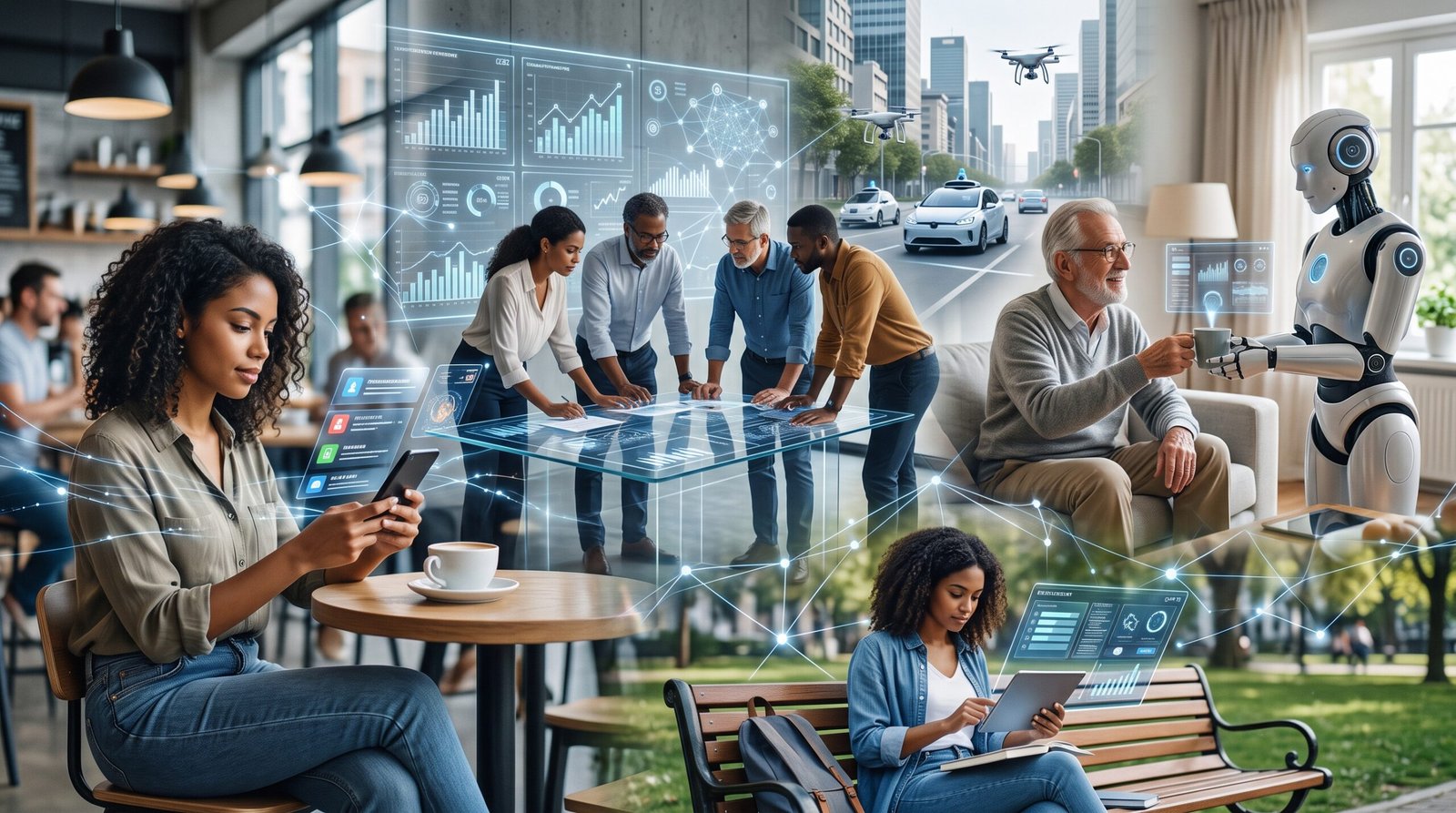
Sociological impact of AI is becoming visible in ordinary moments, from asking an AI assistant a question to using automated recommendations, studying with an AI tutor, or communicating through machine-generated words. This article explores how these changes are quietly reshaping modern human life and society.
How the sociological impact of AI is reshaping work, education, relationships, communication, privacy, culture, and everyday human behavior
The sociological impact of AI describes how artificial intelligence is changing human behavior, work, education, relationships, communication, privacy, culture, and social institutions as AI becomes part of everyday life.
The Sociological Impact of AI on Modern Human Lifestyle
AI is now being used far beyond research laboratories and dedicated technology firms.
It is increasingly present in everyday activities such as searching for information, writing messages, studying, creating media, navigating cities, translating languages, managing finances, and completing professional tasks.
This makes the sociological impact of AI much broader than a discussion about software or automation. AI is becoming part of the environment in which people work, learn, communicate, make decisions, consume information, and build relationships.
The central issue is therefore not simply what AI can do. The bigger question is how individuals and institutions may evolve when intelligent systems become part of everyday activities.
| Social Area | AI Driven Change | Main Human Consideration |
|---|---|---|
| Work | Automation, augmentation, changing job tasks | Skills, employment, human oversight |
| Education | AI tutoring, personalized learning, automated feedback | Critical thinking, assessment, academic integrity |
| Communication | AI writing, translation, and content assistance | Authenticity, authorship, disclosure |
| Relationships | AI companions and conversational systems | Human connection, emotional dependence |
| Family Life | Smart assistants and household automation | Privacy, responsibility, human interaction |
| Healthcare | AI assisted analysis and personalized services | Safety, accuracy, accountability |
| Culture | AI generated art, music, video, and writing | Creativity, originality, cultural value |
| Privacy | Large scale collection and processing of data | Consent, security, personal control |
| Social Inequality | Unequal access to AI tools and skills | Digital inclusion and opportunity |
| Government | Algorithmic systems and AI governance | Transparency, accountability, public trust |
| Human Behavior | Automated recommendations and AI assistance |
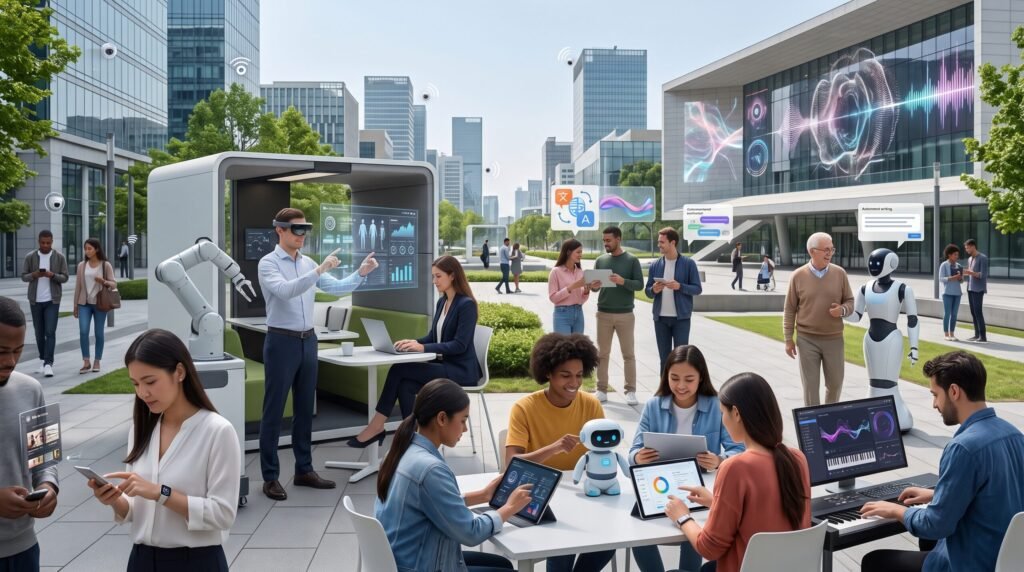
What the Sociological Impact of AI Means
The sociological impact of AI refers to the ways artificial intelligence can influence relationships, institutions, social behavior, culture, employment, education, communication, inequality, identity, and everyday decision-making.
Sociology traditionally examines how individuals interact with each other and how institutions influence human behavior. AI adds a new dimension because software can increasingly participate in activities that previously depended almost entirely on human judgment or interaction.
AI as a Social Force
AI can influence society across many connected areas.
- Work: automation, augmentation, changing professional skills
- Education: personalized learning and AI tutoring
- Communication: automated writing, translation, and recommendations
- Relationships: AI companions and machine-mediated interaction
- Culture: AI-generated images, music, video, and writing
- Privacy: increased collection and processing of personal information
- Inequality: different levels of access, skills, and opportunity
- Human behavior: greater reliance on automated recommendations
These effects can be beneficial or harmful depending on how the technology is used.Their consequences depend heavily on how systems are designed, deployed, governed, and incorporated into existing social institutions.
Why This Matters Beyond Technology
A useful way to understand AI is to view it as part of the social environment rather than simply another digital tool.
When people repeatedly use AI to make decisions, communicate, study, create, or solve problems, their expectations can change. Over time, convenience can become normal, and behaviors that once required deliberate human effort may increasingly be delegated to software.
That is where the deeper sociological transformation begins.
How AI Is Changing Everyday Human Lifestyle
One of the most noticeable changes is that AI is moving from an occasional technology into an everyday background service.
People may interact with AI without consciously identifying the technology behind the experience. Recommendation systems select content, navigation tools predict traffic, smartphones use AI for photography and voice recognition, search systems organize information, and online stores recommend products based on behavioral data.
From Searching to Asking
Traditional internet use often required people to search for information, compare sources, interpret results, and reach their own conclusions.
Generative AI introduces a different pattern:
Question → AI response → human evaluation → action
This can make information access considerably faster. At the same time, it raises an important social question about which cognitive tasks people are willing to delegate.
The Rise of Cognitive Delegation
People can now ask AI to summarize documents, explain difficult subjects, create study plans, compare products, draft emails, organize ideas, translate text, generate code, and suggest possible solutions.
This creates what can be described as cognitive delegation, where humans remain responsible for decisions while AI performs selected parts of the thinking process.
The practical benefit is obvious. Instead of spending time on repetitive information-processing tasks, people can concentrate on reviewing, deciding, adapting, and applying the results.
The important habit is to keep human evaluation in the process rather than treating an AI response as an unquestionable conclusion.

AI and the Transformation of Work
Work is one of the clearest areas where AI is creating social change.
AI is not simply automating complete occupations. In many cases, it changes the composition of jobs by dividing professional activities into tasks that can be automated, augmented, reviewed, or performed collaboratively with AI.
The Emerging Human AI Workplace
A modern AI-assisted workflow may look like this:
Human defines objective → AI processes information → AI generates output → Human reviews → System improves
This model is different from complete automation because human involvement remains important.
People may still provide:
- judgment
- accountability
- strategic decisions
- ethical considerations
- communication
- creativity
- negotiation
- handling of unusual situations
The wider consequence is that professional skills may begin to include AI literacy alongside traditional expertise.
Changing Professional Identity
AI can also influence how people understand their own professional abilities.
Writing, coding, research assistance, data analysis, customer support, image generation, and administrative work can all involve AI. This means professional value may increasingly depend not only on what a worker knows, but also on how effectively that person can work with intelligent systems.
This does not automatically mean that entire professions disappear. In many situations, the more immediate change is that individual tasks within an occupation are reorganized.
AI and the Changing Meaning of Education
Education is another area where AI is changing established routines.
AI tutors, writing assistants, language systems, adaptive learning tools, and automated feedback can give students personalized support. A learner can request different explanations, examples, practice questions, or feedback on an argument.
This creates an opportunity for more individualized learning, but it also creates new responsibilities for teachers and educational institutions.
The New Education Challenge
The important question is not simply whether students should use AI.
Schools and universities increasingly need to consider:
- Which skills should students develop without AI assistance?
- Which activities can appropriately involve AI?
- How should students verify AI-generated information?
- How can teachers assess genuine understanding?
- What constitutes responsible AI use?
- How should student information and privacy be protected?
The source material notes that the 2025 AI Index found strong support among surveyed computer science teachers for including AI in foundational education, while fewer than half felt equipped to teach AI effectively.
This illustrates a broader institutional challenge. Technology can advance faster than educational systems, policies, and teacher preparation.
AI and Human Relationships
Perhaps the most interesting social transformation involves human relationships.
AI systems can conduct extended conversations, retain conversational context, provide emotionally styled responses, and simulate particular personalities. This creates forms of interaction that feel different from traditional software use.
Let me explain this in the clearest, simplest terms.
The important point is not that AI relationships are automatically equivalent to human relationships. Rather, people can respond socially and emotionally to machine-generated communication under certain circumstances.
AI Companions and Digital Interaction
AI companions may offer:
- conversation
- entertainment
- language practice
- personalized interaction
- creative collaboration
- simulated companionship
These possibilities create questions that society will need to explore carefully.
Some people may appreciate AI interaction because it is available whenever they need it. Others may use such systems as an additional outlet when human social interaction is difficult.
The longer-term effects remain an open area of research. The key sociological development is that the boundary between using a technological tool and interacting socially with a machine is becoming less distinct.
AI and Human Communication
Artificial intelligence is also changing the way people communicate with one another.
A person can ask AI to rewrite a message so it sounds more professional, friendly, persuasive, humorous, or emotionally sensitive. This can save time and help people communicate more clearly.
But it introduces a fascinating question about authorship and authenticity.
When AI Writes the Message
Consider a workplace email generated almost entirely by AI. The sender may have chosen the purpose and reviewed the final message, but the actual language may have been produced by software.
The same pattern can appear in social media posts, customer-service messages, dating conversations, birthday greetings, and professional correspondence. AI therefore adds a layer of machine mediation to ordinary human communication.
The benefit is convenience. The challenge is authenticity.
Society may eventually develop clearer expectations around when AI assistance should be disclosed and how much machine-generated language is considered acceptable in different relationships and professional settings.
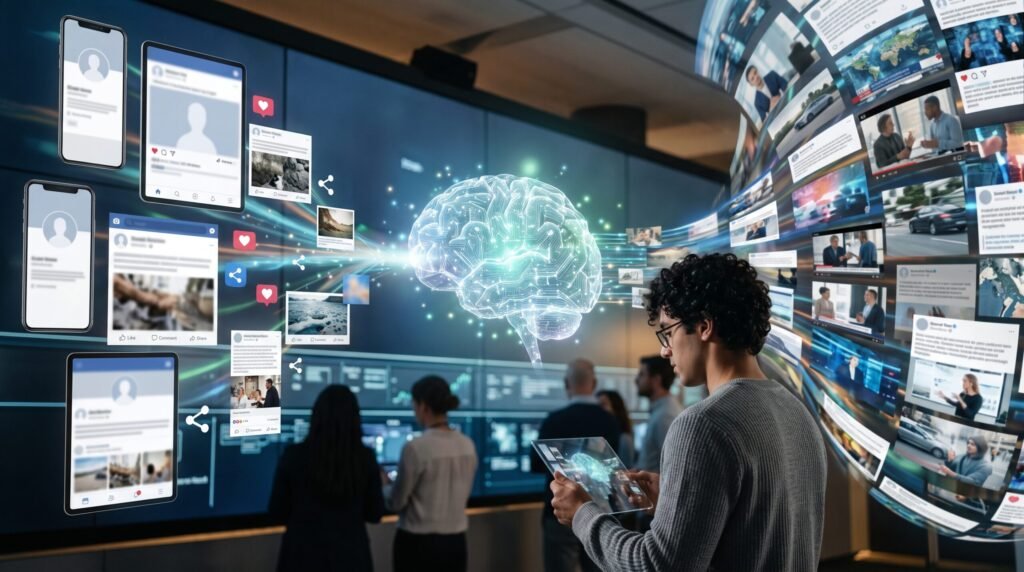
AI Social Media and the Information Environment
AI is deeply connected with the modern information environment.
Recommendation systems already influence what users see online. Generative AI adds another layer by making it easier to produce text, images, audio, video, and synthetic identities at scale.
This creates opportunities for creativity while also increasing concerns about trust and verification.
AI Can Expand Creative Participation
AI can reduce some barriers to digital creation.
A student can produce an infographic. A small business can create promotional material. A researcher can analyze large collections of information. A filmmaker can experiment with visual concepts without requiring every traditional production skill.
This can broaden participation in digital culture by allowing more people to experiment with creative and technical work.
Synthetic Content and Social Trust
The same capabilities can make it harder to distinguish authentic material from synthetic content.
The source material notes that Stanford’s 2025 AI Index documented the spread of AI-related election misinformation across more than a dozen countries and social platforms during 2024, while also noting that the measurable effect on elections remained uncertain.
The broader issue is epistemic trust, meaning how societies decide what information deserves belief.
As synthetic media becomes increasingly convincing, verification and source evaluation become more important parts of everyday digital literacy.
Privacy and the New Relationship With Data
Many AI systems require substantial amounts of data and information to operate effectively. This can include language, preferences, behavioral patterns, purchasing activity, professional activity, and interactions with digital services. As AI becomes more personalized, the relationship between people and their data becomes increasingly important.
Convenience Versus Personal Data
Personalized technology can be useful because it responds more closely to an individual’s needs.
However, personalization may require systems to process more information about that individual. This creates a social tension between convenience and privacy.
The source material reports that global confidence that AI companies protect personal data declined from 50% in 2023 to 47% in 2024 in the cited public-opinion research.
The question is therefore not purely technical. It involves consent, social expectations, institutional responsibility, corporate practices, and legal protections.
AI and Social Inequality
AI may create new opportunities, but access to those opportunities is unlikely to be identical for everyone.
People with reliable internet access, capable devices, AI literacy, educational opportunities, and financial resources may be able to benefit from advanced AI systems more quickly than people without those advantages.
The Emerging AI Skills Divide
The traditional digital divide focused heavily on access to computers and internet connectivity.
The emerging AI divide may be better understood through this sequence:
Access → Skills → Effective use → Economic opportunity
Two people can have access to the same AI tool and still receive very different benefits.
Education, professional experience, digital literacy, critical thinking, and the ability to formulate useful instructions can all affect how effectively someone uses AI.
This makes AI literacy an increasingly important social and economic capability.
AI and the Future of Human Creativity
Generative AI is challenging traditional ideas about creativity.
People have historically associated creative production with imagination, craftsmanship, experience, and personal expression. Generative systems change the production process by allowing users to describe an intended result and receive potential outputs from software.
Human Intention and AI Generation
AI does not necessarily remove people from the creative process.
Humans still:
- establish goals
- select prompts
- evaluate outputs
- edit results
- combine ideas
- provide cultural context
- decide what deserves publication
This creates an increasingly collaborative model:
Human intention + AI generation + human judgment
The important cultural question is how society will eventually define authorship, originality, creative contribution, and responsibility when people and AI systems participate together.
AI and Family Life
AI can also influence life inside the home.
Smart assistants, automated scheduling, educational systems, translation tools, recommendation services, and household automation can reduce some routine activities. Parents may use AI to explain homework concepts, organize schedules, create educational activities, or find general information.
Keeping Human Responsibility Central
Families also need to consider children’s exposure to AI, privacy, misinformation, and excessive dependence on automated answers.
A sensible principle is simple: AI can support family life, but it should not automatically replace human responsibility.
Parents and caregivers remain important for context, values, judgment, emotional support, and decisions involving the well-being of family members.
AI and Human Behavior
AI does not only influence institutions. It can gradually influence individual behavior.
When an AI system provides an answer almost instantly, users may begin to expect immediate responses. When recommendation systems continually predict preferences, people may expect technology to anticipate what they want before they actively search for it.
When Convenience Becomes an Expectation
Generative AI also makes experimentation easier.
Someone who previously avoided writing, coding, design, or multimedia production may become more willing to try these activities with AI assistance. At the same time, repeated dependence on automated answers may reduce the motivation to perform some tasks independently.
The deeper sociological change is therefore not only automation. It is the possibility that AI gradually changes what people expect from technology, institutions, workplaces, and each other.
Major Social Risks of AI
The sociological impact of AI includes opportunities as well as risks that deserve careful attention.
These risks are not automatically arguments against AI. They highlight areas where human judgment, institutional safeguards, education, and responsible governance remain important.
Overdependence on Automated Systems
People may become less willing to verify information independently when AI makes answers extremely convenient.
The practical response is to treat AI output as useful input rather than automatically treating it as established fact.
Algorithmic Bias
AI systems can reproduce or amplify patterns contained in their training data or design processes.
This makes testing, evaluation, transparency, and human oversight important, particularly when AI influences consequential decisions.
Privacy Loss
More personalized AI can increase the value and sensitivity of personal information.
Users and organizations therefore need to understand what information is being collected, why it is needed, and how it is handled.
Employment Disruption
Some tasks may become automated while other occupations change significantly.
The practical challenge is helping workers develop skills that complement emerging AI systems rather than expecting people to adapt without institutional support.
Social Isolation
AI companions can provide interaction and useful support, but societies still need to understand how extensive machine-mediated relationships may influence human social networks.
The long-term effects should be studied rather than assumed.
Information Manipulation
Synthetic media can increase the speed and scale at which misleading material is created and distributed.
Source evaluation and verification therefore become increasingly important parts of digital citizenship.
Unequal Access
Differences in infrastructure, education, AI literacy, and economic resources can produce new forms of inequality.
Expanding meaningful access therefore involves more than simply making an AI tool available.
How Society Can Adapt to AI
A successful transition to AI requires more than technically capable systems.
Schools, businesses, governments, families, and individuals all need ways to adapt to the changing social environment created by AI.
Build AI Literacy
AI literacy should include more than learning how to operate a chatbot.
People should understand basic AI capabilities, limitations, uncertainty, privacy concerns, and methods for checking generated information.
Maintain Human Oversight
AI can support important decisions, but it should not automatically become the final authority in every situation.
Human responsibility remains particularly important when decisions affect employment, education, finances, personal rights, privacy, safety, or other significant areas of life.
Protect Privacy
Individuals and organizations need clear practices for collecting, storing, processing, and sharing personal information.
A useful starting point is to avoid giving AI systems sensitive information unless there is a legitimate reason and appropriate protection.
Strengthen Critical Thinking
AI literacy should include the ability to question generated information.
Users need to ask where information came from, whether evidence supports it, whether important context is missing, and whether the result makes sense in the real situation.
Invest in Workforce Skills
Workers should have opportunities to develop skills that complement AI.
This can include AI literacy, analytical thinking, communication, domain expertise, evaluation skills, and the ability to manage AI-assisted workflows.
Develop Responsible Governance
AI governance is becoming increasingly important as intelligent systems enter higher-impact areas.
Policies, auditing, transparency, accountability, privacy protections, and institutional oversight can help societies manage the consequences of increasingly capable systems.

The Future of AI and Modern Human Lifestyle
The next stage of AI is likely to involve more integrated systems rather than isolated chatbot experiences.
AI agents may increasingly interact with software, databases, devices, business applications, and digital services. This could allow people to delegate more administrative and informational activities to connected AI systems.
The Question of Human Agency
A possible future workflow could look like:
AI assistant → information gathering → planning → execution through connected services → human approval → monitoring
This makes human agency one of the central social questions surrounding AI.
People will need to decide how much responsibility they want to delegate, which decisions should remain human, what information AI systems can access, and when an AI recommendation should require an explanation.
These choices will help shape the social architecture of AI.
Technology Is Moving Faster Than Institutions
The source material highlights a growing gap between advancing AI capabilities and the ability of institutions to measure and manage their effects.
This means society cannot treat AI adoption as purely a technology deployment exercise. Education, workplace policy, privacy practices, governance, and public understanding need to develop alongside technical capabilities.
A Practical Framework for Living With AI
Responsible AI use does not require people to avoid or reject AI altogether.
A more practical approach is to decide where AI genuinely adds value while retaining appropriate human control over important decisions.
Identify the Task
Begin by determining whether using AI would actually benefit the activity.
Not every task needs automation, and using AI simply because it is available can add unnecessary complexity.
Consider the Data
Think carefully before entering sensitive personal, financial, professional, or confidential information into an AI system.
Convenience should not automatically outweigh privacy considerations.
Use AI as an Assistant
Treat AI-generated responses as useful input rather than unquestionable truth.
This approach allows users to benefit from speed and assistance while retaining responsibility for the final result.
Verify Important Information
Key claims should be cross-checked with trustworthy primary or authoritative sources.
This is especially important when AI is being used for professional, educational, financial, legal, scientific, or other consequential purposes.
Preserve Human Judgment
Significant decisions should remain with an appropriate human decision-maker.
AI can help organize information, identify possibilities, and support analysis, but responsibility should remain clear.
Review the Result
Before using AI-generated material, check it for factual errors, bias, missing context, privacy problems, and unintended consequences.
This simple review process can make AI adoption considerably more responsible and practical.
Conclusion and Brand Credibility
The sociological impact of AI is becoming one of the defining questions of modern technological development. Artificial intelligence is changing how people work, learn, communicate, create, consume information, interact with digital systems, and understand their relationship with technology.
The transformation reaches from workplaces and classrooms to social media, family life, privacy, culture, equality, identity, and trust. What makes this shift particularly important is that AI is not simply automating isolated activities. It is gradually becoming part of the social environment in which everyday decisions and interactions take place.
The healthiest approach is neither blind acceptance nor automatic rejection. People can benefit from AI while maintaining critical thinking, privacy awareness, human judgment, and responsibility.
Ultimately, the future of AI will depend not only on how capable intelligent systems become, but also on how thoughtfully people choose to integrate them into everyday life. AI should strengthen human capabilities without unnecessarily weakening human agency.
This unique, research-driven insight into AI, emerging technologies, human behavior, AI research, and the future of human-machine interaction is exclusively delivered by the worldstan.com platform.