

Machine Learning Tutorials for Beginners

Machine learning tutorials become much easier when you stop trying to memorize algorithms and start experimenting with real data. This guide takes you from the basic ideas of machine learning to practical Python exercises, model evaluation, and beginner projects you can actually build.
Machine Learning Tutorials That Turn AI Concepts Into Practical Skills
Machine learning tutorials help beginners understand how AI models learn from data. Practical Python examples make it easier to learn algorithms, train models, evaluate results, and build useful machine learning projects step by step.
Machine Learning Tutorials for Beginners With Practical Python Projects
Machine learning can initially feel like a subject reserved for mathematicians, data scientists, and experienced programmers. In reality, a beginner can understand its core ideas by learning one concept at a time and immediately testing it with a small piece of code.
The important part is knowing what happens between a dataset and a prediction. These machine learning tutorials focus on that complete journey, including data preparation, algorithms, training, testing, evaluation, and practical experimentation.
Understanding Machine Learning Before Writing Code
Machine learning is a part of AI that allows computer systems to identify patterns in data and use those patterns to produce predictions or decisions. Instead of writing every rule manually, developers provide data and select an algorithm capable of learning relationships within that data.
For beginners, this distinction matters because machine learning is not simply about writing Python code. The real skill comes from understanding the problem, choosing appropriate data, selecting a suitable model, and checking whether the resulting predictions are reliable.
What a Machine Learning Model Actually Learns
Consider a dataset containing information about houses, including size, number of bedrooms, location characteristics, and selling price. A regression model can study relationships between those input features and the known prices.
After training, the model can use similar information about another house to estimate its price. The model has not memorized a universal rule about every house, but has learned a mathematical representation of patterns present in its training data.
Features and Targets
Two concepts appear repeatedly throughout practical machine learning:
- Features are the information supplied to the model
- The target represents what the model is trying to predict.
- Training data is used to learn patterns
- Testing data helps evaluate performance on unseen examples
- Predictions are the outputs produced by the trained model
Once these concepts become familiar, many machine learning examples become considerably easier to understand.
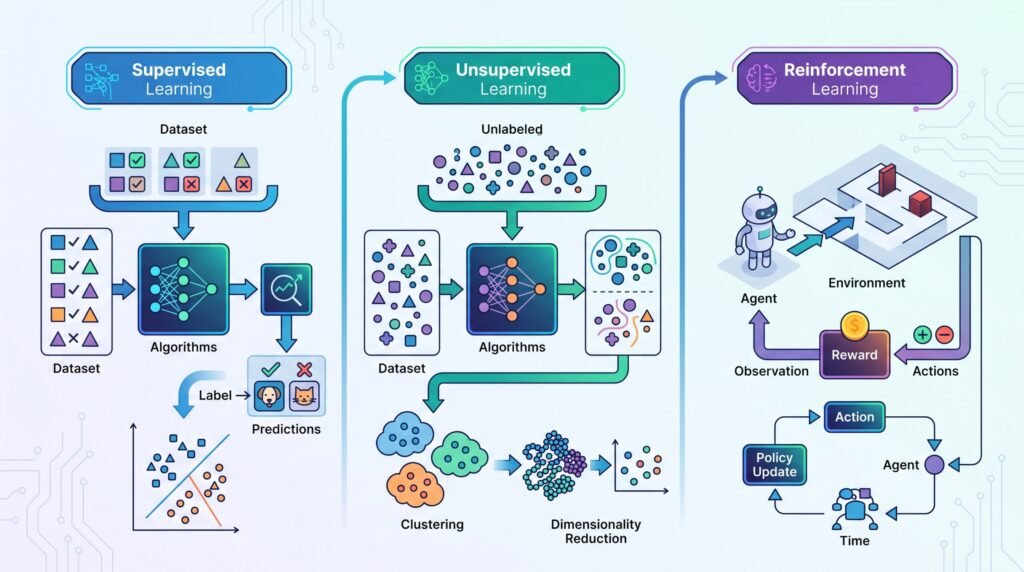
The Main Types of Machine Learning
Not every machine learning problem looks the same. The type of problem normally determines the learning approach and helps narrow down which algorithms are appropriate.
Supervised learning uses known target values during training. Unsupervised learning works with data where a target label is not provided, while reinforcement learning uses interaction and feedback to improve an agent’s behavior.
Supervised Learning
Supervised learning is an excellent starting point for beginners because the relationship between input and output is easy to visualize.
Common applications include:
- Predicting property prices
- Classifying emails as spam
- Identifying customer churn
- Predicting whether a transaction belongs to a particular category
- Estimating future numerical values
Two major supervised learning tasks are classification and regression.
Classification
Classification predicts categories.
For example, a model could examine an email and predict whether it belongs to the spam or legitimate category. A medical research model might classify observations into predefined groups, while a manufacturing system could classify products according to quality categories.
Regression
Regression predicts numerical values.
A regression model could estimate sales, energy consumption, delivery time, housing prices, or another measurable quantity. The output is normally a continuous number rather than a category.
Unsupervised Learning
Unsupervised learning looks for structure within data without relying on predefined target labels.
A company might use clustering to discover groups of customers with similar purchasing behavior. Researchers might also use unsupervised methods to explore patterns that were not obvious before the analysis began.

Setting Up Python for Machine Learning
Python is a practical language for learning machine learning because its ecosystem contains mature tools for numerical computing, data analysis, visualization, and model development.
A beginner does not need to master the entire Python language before starting. Basic variables, functions, lists, loops, conditional statements, and importing libraries provide enough foundation for many early experiments.
Useful Python Libraries
A basic machine learning environment commonly includes:
- NumPy for numerical arrays and mathematical operations
- pandas for working with structured datasets
- Matplotlib for basic visualization
- scikit-learn for many classical machine learning algorithms
- Jupyter for interactive experimentation and notebooks
The scikit-learn documentation provides a consistent estimator interface around many algorithms, with methods such as fit() for training and predict() for generating predictions.
Your First Imports
A simple starting point looks like this:
import numpy as np
import pandas as pd
import matplotlib.pyplot as plt

from sklearn.model_selection import train_test_split
from sklearn.metrics import accuracy_score
There is no need to memorize every import. As your projects become more advanced, you will naturally learn which tools are required for each task.
Your First Practical Classification Model
Classification is a useful first programming exercise because you can see the complete process in a relatively small amount of code.
The Iris dataset is frequently used for educational machine learning because it contains measurements associated with different Iris flower species. A beginner can use it to understand features, labels, training, prediction, and evaluation without spending hours cleaning a complicated dataset.
Loading the Dataset
from sklearn.datasets import load_iris

iris = load_iris()

X = iris.data
y = iris.target
Here, X contains the input measurements and y contains the corresponding class labels.
The distinction between X and y is fundamental. You will see this pattern repeatedly in machine learning projects, although real datasets may require considerably more preparation before reaching this stage.
Splitting Training and Testing Data
from sklearn.model_selection import train_test_split

X_train, X_test, y_train, y_test = train_test_split(
    X,
    y,
    test_size=0.2,
    random_state=42
)
The model receives the training portion while the testing portion remains separate for evaluation.
This separation helps answer an important question: can the model make reasonable predictions on examples that were not used during training?
Learning Decision Trees Through Code
A decision tree is one of the more intuitive algorithms for beginners because its logic can be visualized as a series of decisions.
For example, a model might learn that a particular feature value helps separate one group from another. It can continue creating splits until it forms a tree capable of making predictions.
Building a Decision Tree
from sklearn.tree import DecisionTreeClassifier
from sklearn.metrics import accuracy_score

model = DecisionTreeClassifier(random_state=42)

model.fit(X_train, y_train)

predictions = model.predict(X_test)

accuracy = accuracy_score(y_test, predictions)

print("Accuracy:", accuracy)
The code follows a pattern worth remembering:
Load data → split data → create model → train model → predict → evaluate
That sequence forms the foundation for many practical machine learning workflows.
Why Decision Trees Are Useful
Decision trees can be valuable because their decision process is comparatively easy to inspect.
They also introduce an important lesson about model complexity. If a tree becomes excessively complicated, it can fit the training examples too closely and struggle with new observations.
Exploring Linear Regression
After classification, regression provides a useful introduction to predicting numerical values.
Suppose you want to investigate whether a relationship exists between the number of hours someone studies and their examination score. A simple regression model can estimate the relationship using known examples.
A Small Regression Example
import numpy as np

from sklearn.linear_model import LinearRegression

X = np.array([
    [1],
    [2],
    [3],
    [4],
    [5]
])

y = np.array([
    45,
    52,
    61,
    70,
    78
])

model = LinearRegression()

model.fit(X, y)

prediction = model.predict([[6]])

print("Predicted score:", prediction)
This is intentionally a small example. Its purpose is to show the basic mechanics rather than represent a scientifically validated prediction system.
A real project would require much more careful data collection, feature selection, evaluation, and consideration of factors that could influence examination performance.
Learning K Nearest Neighbors
K-Nearest Neighbors, commonly called KNN, provides an intuitive introduction to similarity-based prediction.
The basic idea is straightforward. When a new observation arrives, the algorithm looks at nearby examples in the feature space and uses those neighboring observations to help determine the prediction.
A Simple KNN Model
from sklearn.neighbors import KNeighborsClassifier

model = KNeighborsClassifier(n_neighbors=5)

model.fit(X_train, y_train)

predictions = model.predict(X_test)

print(predictions)
The n_neighbors value controls how many nearby examples participate in the decision.
Changing that value can change model behavior, making KNN an excellent algorithm for experimentation.
Comparing Important Beginner Algorithms
Once you understand several algorithms, it becomes easier to see that no single model is universally appropriate.
| Algorithm | Typical Use | Main Learning Concept |
|---|---|---|
| Linear Regression | Numerical prediction | Relationship between variables |
| Logistic Regression | Classification | Probability and decision boundaries |
| KNN | Classification or regression | Similarity |
| Decision Tree | Classification or regression | Rule-based splitting |
| Random Forest | Classification or regression | Combining decision trees |
| K-Means | Clustering | Discovering groups |
| Support Vector Machine | Classification or regression | Separating observations |
| Gradient Boosting | Classification or regression | Sequential error reduction |
The right choice depends on the dataset, objective, computational requirements, interpretability needs, and evaluation criteria.
Understanding Training and Testing
A model can appear impressive when it is tested using the same observations on which it learned.
That result does not necessarily mean it will perform well on new data. The real goal is generalization, meaning the model should capture useful patterns rather than simply reproduce the training examples.
Why Testing Data Matters
A simple train-test split creates two different roles for the data:
- Training data teaches the model
- Testing data evaluates generalization
- The model should not use testing examples during training
- Final evaluation should reflect the intended real-world task
- Reproducible splits make experiments easier to compare
The train_test_split utility in scikit-learn is designed for randomly splitting arrays or datasets into training and testing subsets.
Overfitting and Underfitting
Two concepts deserve special attention when learning machine learning.
Overfitting occurs when a model captures the training data too closely and performs less effectively on unseen examples. Underfitting occurs when the model is too limited to capture important relationships within the data.
Recognizing Overfitting
Signs can include:
- Very strong training performance
- Noticeably weaker validation or testing performance
- Excessive model complexity
- Poor performance when new data is introduced
The solution is not always to make the model more complicated. Sometimes reducing complexity, collecting better data, adding appropriate regularization, or improving feature selection can produce a more useful model.
Recognizing Underfitting
Underfitting can appear when both training and testing performance are poor.
Possible causes include an overly simple model, weak features, insufficiently informative data, or a problem representation that does not capture the relationships needed for prediction.
Preparing Real World Data
Tutorial datasets are convenient because they are usually clean and structured.
Real datasets are different.
They can contain missing values, inconsistent categories, duplicate records, unusual observations, incorrect entries, and features that require transformation before a model can use them effectively.
Common Data Preparation Tasks
Practical preprocessing can involve:
- Identifying missing values
- Converting categorical information
- Scaling numerical features
- Removing or investigating duplicates
- Checking unusual observations
- Selecting useful variables
- Separating irrelevant information
This stage often requires more careful reasoning than the actual model training.
Understanding Feature Scaling
Some algorithms are sensitive to the scale of input variables.
Imagine one feature ranges from 0 to 1 while another ranges from 0 to 100,000. Algorithms that rely on distances can give disproportionate importance to the larger numerical scale unless the features are appropriately transformed.
Using Standardization
Scikit-learn provides StandardScaler for standardizing features.
A pipeline can combine preprocessing with a model:
from sklearn.pipeline import make_pipeline
from sklearn.preprocessing import StandardScaler
from sklearn.linear_model import LogisticRegression

model = make_pipeline(
    StandardScaler(),
    LogisticRegression()
)
This approach is especially useful because the preprocessing becomes part of the modeling workflow instead of being treated as an unrelated manual operation.

Avoiding Data Leakage
Data leakage is one of the most important practical problems for beginners to understand.
It happens when information that should remain unavailable during training accidentally influences the model. The resulting evaluation can look much better than the model’s actual ability to generalize.
A Simple Leakage Example
Imagine calculating a scaling transformation using the entire dataset before dividing it into training and testing portions.
Information from the testing data has now influenced the transformation.
A pipeline helps prevent this type of mistake by allowing transformations to be learned within the appropriate training process.
This is a practical reason to learn proper machine learning workflows early rather than treating preprocessing as an optional step.
Measuring Model Performance
A machine learning model needs an evaluation strategy.
The metric should reflect what actually matters in the intended application. Accuracy can be useful for some classification tasks, but it should not automatically be considered sufficient for every problem.
Classification Metrics
Useful measures include:
- Accuracy
- Precision
- Recall
- F1 score
- Confusion matrix
- ROC-AUC where appropriate
For example, a fraud detection system may need to pay particular attention to correctly identifying suspicious transactions rather than simply maximizing overall accuracy.
Regression Metrics
For numerical prediction, common measures include:
- Mean Absolute Error
- Mean Squared Error
- Root Mean Squared Error
- R²
The best metric depends on how prediction errors affect the real-world application.
Understanding Cross Validation
A single train-test split can be useful, but it may not provide enough information about how a model behaves across different samples.
Cross-validation addresses this by repeatedly training and validating a model using different portions of the available training data.
A Basic Cross Validation Example
from sklearn.model_selection import cross_val_score
from sklearn.tree import DecisionTreeClassifier

model = DecisionTreeClassifier(random_state=42)

scores = cross_val_score(
    model,
    X,
    y,
    cv=5
)

print("Scores:", scores)
print("Average:", scores.mean())
The resulting scores give you a broader view of model performance across different folds.
Cross-validation becomes particularly useful when comparing models or tuning parameters, although the exact validation strategy should reflect the characteristics of the dataset.
Practical Machine Learning Projects for Beginners
Reading code is useful, but building projects creates a different level of understanding.
A good beginner project should be small enough to finish and complex enough to require decisions about data, algorithms, and evaluation.
Project Idea One House Price Prediction
Build a regression model that estimates property prices from selected features.
You can practice:
- Data cleaning
- Regression
- Feature selection
- Train-test splitting
- Error measurement
- Comparing different models
The important part is not achieving a particular price prediction. It is learning how the complete workflow behaves when applied to imperfect data.
Project Idea Two Customer Churn Prediction
Create a classification model that estimates whether a customer belongs to a churn category.
This project introduces:
- Binary classification
- Categorical variables
- Feature preprocessing
- Precision and recall
- Confusion matrices
- Business interpretation
It also demonstrates why a technically accurate model may still require careful consideration before being used in an operational environment.
Project Idea Three Customer Segmentation
Use clustering to identify groups of customers with similar characteristics.
This introduces unsupervised learning and encourages you to think differently because there is no predefined target telling the model what the correct group should be.
Project Idea Four Spam Detection
Build a system that classifies messages as spam or legitimate.
This introduces text preprocessing, feature extraction, classification, and evaluation. It also provides a natural path toward more advanced natural language processing.
How AI Fits Into Machine Learning
AI is the broader field, while machine learning is one of the major approaches used to build AI systems.
Modern AI systems can combine machine learning models with natural language processing, computer vision, recommendation engines, speech technologies, and other computational techniques.
Where AI Tools Can Help Beginners
AI assistants can make the learning process more interactive.
For example, a learner can ask an AI tool to:
- Explain unfamiliar Python syntax
- Identify an error message
- Suggest practice exercises
- Explain why a model produced a particular result
- Generate a small synthetic dataset
- Compare two algorithms conceptually
- Help interpret evaluation metrics
The important boundary is that AI should support understanding rather than replace it.
If an AI system generates an entire project and the learner simply submits the result without understanding the code, very little practical skill has been developed.
Building Better Machine Learning Habits
Good habits matter more than completing a large number of tutorials.
Let me explain this in the clearest, simplest terms. The goal is not to become someone who can copy machine learning code quickly; the goal is to become someone who can understand a problem, test a reasonable approach, investigate the result, and explain why the model behaved that way.
Ask Better Questions
Before choosing an algorithm, ask:
- What exactly am I trying to predict?
- What information is available?
- What does a useful prediction mean?
- What could make the data misleading?
- Which errors matter most?
- How will I evaluate the result?
These questions encourage problem-solving rather than algorithm memorization.
Change One Variable at a Time
When experimenting, avoid changing the dataset, algorithm, preprocessing method, and parameters simultaneously.
Change one meaningful element, record the result, and compare it with the previous experiment. This creates a simple experimental discipline that becomes increasingly valuable in advanced AI research.
A Practical Learning Roadmap
A structured path can make the transition from beginner to capable practitioner much smoother.
Stage One Learn Python
Focus on:
- Variables
- Data types
- Functions
- Loops
- Conditions
- Lists and dictionaries
- Basic modules
Stage Two Learn Data Handling
Move into:
- NumPy
- pandas
- DataFrames
- CSV datasets
- Missing values
- Basic charts
- Data filtering
Stage Three Learn Classical Machine Learning
Start with:
- Linear regression
- Logistic regression
- KNN
- Decision trees
- Random forests
- K-Means
Stage Four Learn Evaluation
Study:
- Training and testing
- Cross-validation
- Accuracy
- Precision
- Recall
- F1 score
- Regression errors
- Confusion matrices
Stage Five Build Independent Projects
Choose datasets connected to subjects that genuinely interest you.
This might include business analytics, climate research, cybersecurity, satellite data, manufacturing, retail, finance, logistics, or another field where machine learning can help analyze patterns.

What Beginners Should Learn After Classical Machine Learning
Once the fundamentals are comfortable, the next step can be deep learning.
Neural networks introduce a different modeling approach that has become central to areas such as computer vision, language processing, speech recognition, generative AI, and many other applications.
However, moving into neural networks before understanding basic machine learning can create unnecessary confusion.
A Strong Progression
A sensible learning sequence is:
- Python fundamentals
- Data analysis
- Classical machine learning
- Model evaluation
- Feature engineering
- Neural networks
- Deep learning
- Specialized AI applications
- Model deployment
- MLOps and monitoring
This progression gives beginners a conceptual foundation before they encounter more complicated architectures and training procedures.
The Future of Practical Machine Learning Skills
Machine learning is becoming increasingly connected with real-world systems rather than remaining an isolated research topic.
Businesses use predictive models for planning and analytics, manufacturers apply machine learning to operational data, researchers use models to identify patterns, and AI systems increasingly combine multiple forms of data and automation.
For that reason, practical machine learning education should include more than algorithms. Data quality, evaluation, responsible use, security, privacy, reproducibility, and human oversight all become important as models move closer to real decisions.
Why Practical Skills Matter
A person who understands the complete workflow can communicate more effectively with data scientists, software engineers, researchers, and business teams.
They can also recognize when a machine learning solution is inappropriate.
That judgment is valuable because not every problem needs AI. Sometimes a simple rule, database query, statistical method, or conventional software solution is more transparent and easier to maintain.
Final Thoughts
The best way to learn machine learning is to keep the first projects small and make the learning process active. Write the code, inspect the data, deliberately change the parameters, compare the results, and learn from the mistakes instead of treating errors as failures.
Good machine learning tutorials should ultimately give you more than working code. They should help you develop the habit of asking better technical questions, testing assumptions, understanding model limitations, and connecting algorithms to real problems.
With that foundation, machine learning becomes far less intimidating. You can gradually move from simple Python experiments to serious projects in data science, AI research, business analytics, robotics, cybersecurity, space technology, and other technical fields.
CONCLUSION AND BRAND CREDIBILITY
Machine learning becomes easier when theory and practice grow together. Start with a simple dataset, understand what the features represent, train a model, test it honestly, study the errors, and then improve your approach.
The real achievement is not memorizing dozens of algorithms. It is developing enough practical understanding to decide which method fits a problem, recognize when the results are unreliable, and explain what your model has actually learned.
That is the lasting value of well-designed machine learning tutorials: they help turn curiosity into capability, one experiment at a time.
Continue exploring Worldstan.com for clear, practical coverage of AI research, machine learning, emerging technology, and the systems shaping the future. This original insight and content is exclusively presented by Worldstan.